


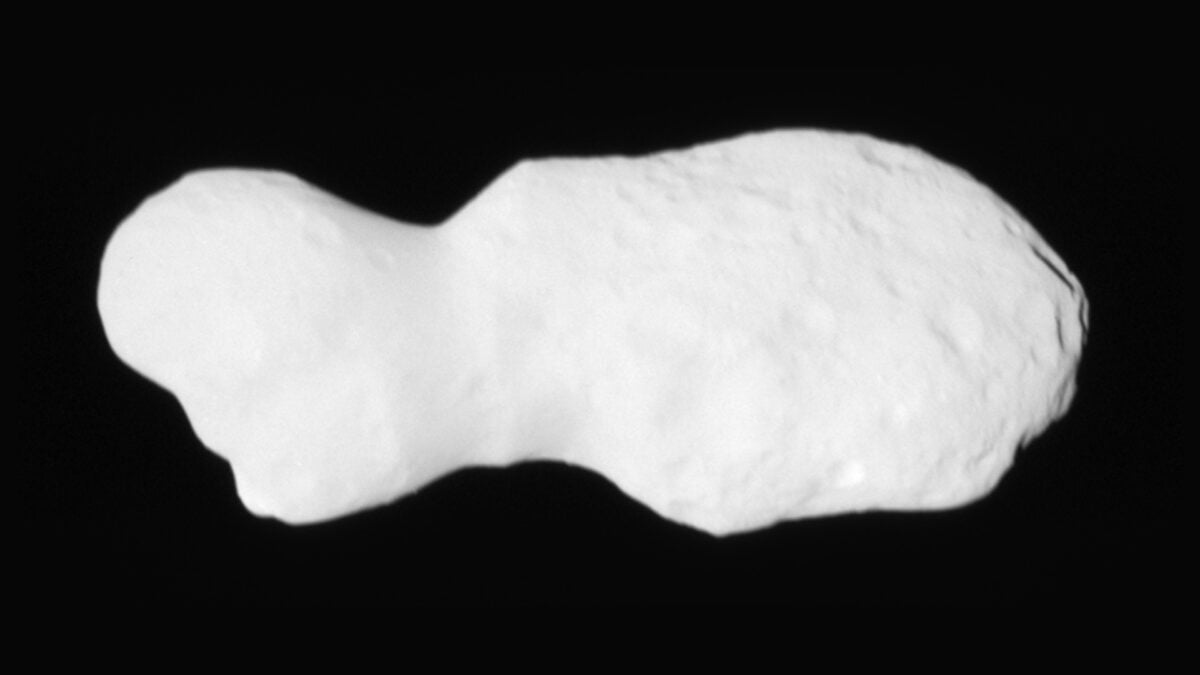
NASA Reveals First-Ever Full Image of Peanut-Shaped Asteroid Donaldjohanson
Earlier this year, Lucy's Long Range Reconnaissance Imager snapped an image of Donaldjohansson while quickly swooping past it, at a distance of about 600 miles (960 kilometers), with the smallest visible features measuring around 130 feet (40 meters) across—an impressive close-up, considering the overall scale of anything we observe in space.
Regrettably, the Sun's position behind Lucy reduced the contrast of the asteroid's smaller details. But the close visit is invaluable nevertheless, as it's allowing scientists to carefully comb over the details of its surface after adjusting for the brightness.
'Asteroid Donaldjohanson has strikingly complicated geology,' said Hal Levison, Lucy's principal investigator, in an earlier press release about the asteroid. Donaldjohansson likely got its lumpy shape from a cosmic collision between two smaller objects around 150 million years ago. It's a relatively common shape among smaller asteroids in the solar system, so what we learn from Donaldjohanson could inform our understanding of many other cosmic objects.
'As we study the complex structures in detail, they will reveal important information about the building blocks and collisional processes that formed the planets in our Solar System,' Levison added in the same release.
Donaldjohansson is not the main objective of the Lucy mission, whose itinerary is set for the eight Trojan asteroids that share Jupiter's orbit around the Sun. Still, Lucy's Donaldjohanson encounter—and the November 2023 flyby of asteroid Dinkinesh—is an excellent 'dress rehearsal' for Lucy as it continues its journey toward the cooler, outer regions of the solar system, according to NASA's Erin Morton in a statement earlier this week.
Lucy's next milestone is set to occur in August 2027, when the spacecraft will finally start to explore the Jupiter Trojan asteroids in earnest—starting with Eurybates, a carbonaceous asteroid so big that it has its own satellite, Queta.
Hashtags

Try Our AI Features
Explore what Daily8 AI can do for you:
Comments
No comments yet...
Related Articles
Yahoo
 24 minutes ago
- Yahoo
XtalPi Signs MOU with Dong-A ST for Joint Research and Development of Immunology and Inflammation Therapies
CAMBRIDGE, Mass., Aug. 19, 2025 /PRNewswire/ -- XtalPi announced on the 20th that it signed a Memorandum of Understanding (MOU) with Korea's leading pharmaceutical company Dong-A ST, to jointly develop therapeutics for immunological and inflammatory diseases. This collaboration will be based on XtalPi's intelligent and automated drug discovery platform, which integrates artificial intelligence (AI), quantum physics, and large-scale automated robotic experiments. The two companies plan to co-identify targets and discover first-in-class or best-in-class drug candidates using XtalPi's proprietary AI-driven drug discovery platform. The XtalPi platform combines the speed and generative power of AI with the accuracy of its robotic lab-in-the-loop to accelerate drug discovery and vastly expand the explorable chemical space. This integrated workflow spans deep-learning-based molecule design, quantum physics and molecular dynamics simulations for predicting drug-target interactions, automated chemical synthesis, and experimental validation of candidate compounds' key pharmaceutical properties. Leveraging its expertise in immunology and inflammation as well as its experience in small molecule drug development, Dong-A ST will actively participate throughout the entire R&D process—including candidate validation, efficacy and safety testing, and the formulation of preclinical and clinical development strategies. The company also plans to explore strategies for pipeline expansion and assess commercialization potential. Through this partnership, Dong-A ST aims to strengthen its pipeline in the immunology and inflammation space and expand its R&D scope beyond small molecule therapeutics into areas such as targeted protein degradation (TPD), biologics, antibody-drug conjugates (ADC), and gene therapies. John Wang, Senior Vice President of Drug Discovery at XtalPi, stated: "The combination of Dong-A ST's extensive expertise and XtalPi's proven AI-robotics platform is well-positioned to translate scientific innovation into competitive precision medicines. Together, we aim to rapidly discover and rigorously validate novel drug candidates across multiple modalities to unlock unique market opportunities, and deliver transformative therapies for global patients." Jae-Hong Park, Head of R&D at Dong-A ST, remarked, "This collaboration marks a pivotal step in expanding Dong-A ST's R&D capabilities," adding, "By leveraging synergies with XtalPi's AI platform, we expect to accelerate the development of next-generation treatments for immune and inflammatory diseases." Meanwhile, both Dong-A ST and XtalPi operate open innovation offices in Boston, USA. This geographic proximity will facilitate closer and more efficient collaboration throughout the drug discovery process. About Dong-A ST Dong-A ST Co., Ltd. ( was established in 1932 and is a leading Korean pharmaceutical company engaged in the development, manufacturing, and commercialization of ethical drugs, biosimilars, medical devices, and diagnostics. Its key products include Stillen (gastritis), Zydena (erectile dysfunction), Motilitone (functional dyspepsia), and Imuldosa (ustekinuma biosimilar). Leveraging strong R&D capabilities and a history of innovation, Dong-A ST is expanding its pipeline in immunology, inflammation, neurological disease, metabolic diseases, and oncology, while advancing into new modalities such as biologics, ADCs, TPD, and gene therapies. About XtalPi XtalPi Holdings Limited (XtalPi, was founded in 2015 by three physicists from the Massachusetts Institute of Technology (MIT). It is an innovative R&D platform powered by quantum physics, artificial intelligence, and robotics. By integrating first-principles calculations, AI algorithms, high-performance cloud computing, and standardized automation systems, XtalPi provides digital and intelligent R&D solutions for companies in the pharmaceutical, materials science, agricultural technology, energy, new chemicals, and cosmetics industries. View original content to download multimedia: SOURCE XtalPi Inc. Sign in to access your portfolio
Yahoo
an hour ago
- Yahoo
Why does Starship keep exploding? SpaceX report sheds light on 2 recent mishaps
Following a successful year for Starship in 2024, SpaceX has endured a series of relative disappointments for the world's largest rocket in 2025. Starship's first three test flights of the year, from January through May, all ended with the spacecraft exploding in dramatic fashion while traveling through the air. Those setbacks were followed in June by the fiery destruction of another Starship vehicle as the commercial rocket company founded by billionaire Elon Musk readied it for ground testing at its South Texas facility. These failures followed on the heels of a year of firsts, when SpaceX launched Starship four times and achieved new milestones each flight. These accomplishments included flying three consecutive times halfway around the world before splashing down as planned in the Indian Ocean, and, in October, the first of three successful returns of the Super Heavy rocket booster to the launch pad. But what might appear as letdowns are still learning experiences that SpaceX has long insisted can provide data on how to improve a spacecraft that will have a crucial role in the future of U.S. spaceflight. Still, that doesn't mean SpaceX isn't obligated to figure out what went wrong. "Every lesson learned, through both flight and ground testing, continues to feed directly into designs for the next generation of Starship and Super Heavy," SpaceX said in August on its website in revealing the findings of its investigations into the last two fiery mishaps. Here's everything to know about SpaceX's report on Starship "flight 9" on May 27 and the June 18 destruction of another upper stage vehicle, as well as how the company is making changes ahead of "flight 10." Commercial spaceflight: How Trump's commercial spaceflight executive order could benefit SpaceX, Elon Musk When is the next Starship launch? SpaceX plans to conduct the 10th flight test of its Starship spacecraft Sunday, Aug. 24, with a target liftoff time of 7:30 p.m. ET. SpaceX conducts Starship test flights from the company's Starbase headquarters in South Texas, located about 23 miles from Brownsville near the U.S.-Mexico border. Texas voters in Cameron County approved a measure in May for Starbase to become a city, complete with a mayor and a city council. What happened when Starship exploded? Starship's upcoming flight test was previously delayed June 18 when the Starship vehicle SpaceX assigned to the next flight, designated Ship 36, unexpectedly exploded while SpaceX was preparing it for launch. No one was hurt in the incident, which occurred as the Starship spacecraft was standing alone on the test stand being filled with cryogenic propellants for an engine test-firing prior to being mounted on top of the rocket booster. The mishap, which SpaceX later referred to on its website as "a sudden energetic event," completely destroyed the spacecraft and ignited several fires that caused damage in the area surrounding the test stand. The explosion was the latest fiery mishap SpaceX's Starship has encountered during – and, now, prior to – its flight tests in 2025. Starship's most recent demonstration came May 27 when the spacecraft spun out of control roughly halfway through its flight and disintegrated in a fireball. Though Starship was unable to achieve its most important objectives, the distance the vehicle traveled far surpassed the previous 2025 flights in January and March, when Starship exploded within minutes. Why does Starship keep exploding? SpaceX releases report SpaceX had previously released findings into the first two Starship explosions in January and March. Now, the company has unveiled the results of investigations for the two most recent mishaps, as required by the Federal Aviation Administration, which licenses commercial rocket launches. The May 27 mission got off to a positive start, with the successful first-ever launch of a rocket booster – known as Super Heavy – that had flown during a previous flight in January. Reusing a booster was an important milestone for SpaceX to demonstrate that the rocket can be flown multiple times. But rather than making a controlled splashdown as planned, the booster came apart in the air and plummeted into the Gulf of Mexico, which the U.S. government has renamed as the Gulf of America. SpaceX attributed the crash to a structural failure to the booster's fuel transfer tube, which resulted in methane and liquid oxygen mixing and igniting. The vehicle's upper stage – known simply as Starship, or Ship – managed to separate from the booster and fire its six Raptor engines to propel itself on a trajectory taking it into suborbital space as it soared around the world. But contact with Starship was lost approximately 46 minutes into the flight as it spun out of control and once again came apart over the Indian Ocean. SpaceX traced the failure to the main fuel tank pressurization system diffuser, located on the forward dome of Starship's primary methane tank. Other issues with the nosecone prevented Starship from deploying eight test Starlink satellites. As for the June explosion, SpaceX said it was caused by undetected damage to a high-pressure nitrogen storage tank inside Starship's payload bay section, called a composite overwrapped pressure vessel (COPV.) In a statement, the FAA said it "oversaw and accepted" SpaceX's findings and gave it the greenlight to proceed with its next Starship launch. "SpaceX identified corrective actions to prevent a reoccurrence of the event," the FAA said. What is Starship? SpaceX rocket to fly to moon, Mars But when it comes to Starship's development, SpaceX has become known for its risk-tolerant philosophy. Musk has stressed that rapid and frequent testing that sometimes leads to explosive ends can still provide data that helps engineers improve the vehicle's design. SpaceX is developing Starship to be a fully reusable transportation system, meaning both the rocket and vehicle can return to the ground for additional missions. In the years ahead, Starship is set to serve a pivotal role in future U.S. spaceflight. Starship is the centerpiece of Musk's vision of sending the first humans to Mars, and is also critical in NASA's plans to return astronauts to the moon's surface. But the next-generation spacecraft has yet to reach orbit on any of its nine uncrewed flight tests, which began in 2023. SpaceX received key regulatory approval earlier in 2025 to conduct up to 25 Starship tests a year, after which Musk took to social media in late May to proclaim that the vehicle's next three launches would occur much faster than normal – at a cadence of one "every 3 to 4 weeks." How big is Starship? The Starship, standing nearly 400 feet tall when fully stacked, is regarded as the world's largest and most powerful launch vehicle ever developed. When fully integrated, the launch system is composed of both a 232-foot Super Heavy rocket and the 171-foot upper stage Starship itself, the spacecraft where crew and cargo would ride. That size makes Starship large enough to tower over SpaceX's famous 230-foot-tall Falcon 9 – one of the world's most active rockets. Super Heavy alone is powered by 33 of SpaceX's Raptor engines that give the initial burst of thrust at liftoff. The upper stage Starship section is powered by six Raptor engines that will ultimately travel in orbit. Eric Lagatta is the Space Connect reporter for the USA TODAY Network. Reach him at elagatta@ This article originally appeared on USA TODAY: SpaceX reveals why Starship exploded last 2 times ahead of flight 10


New York Times
an hour ago
- New York Times
Newly Discovered Origami Patterns Put the Bloom on the Fold
The art of origami goes back centuries — enough time to explore every possible crease that can be made in a sheet of paper, one might think. And yet, researchers have now found a new class of origami that they call bloom patterns. Resembling idealized flowers, many bloom patterns are rotationally symmetric around the center. The bloom patterns, with their set of attractive properties, appear promising for future engineering uses, especially for large structures that are sent to outer space. They fold up flat and compactly, they can be constructed out of one flat sheet, and they can be extended to ever larger shapes. The discoveries originated from the paper-folding explorations of Zhongyuan Wang, a sophomore at Brigham Young University in Utah. 'I love to do origami, but if I can use origami to make practical applications that benefit the world, that will be a dream come true,' Mr. Wang, who goes by Kelvin as his American name, said in a video produced by B.Y.U. Mr. Wang, along with Larry Howell, a professor of mechanical engineering at B.Y.U., and Robert Lang, an origami artist and theorist who lives in Pasadena, Calif., report their findings in a paper published on Wednesday in the journal Proceedings of the Royal Society A. Want all of The Times? Subscribe.
