


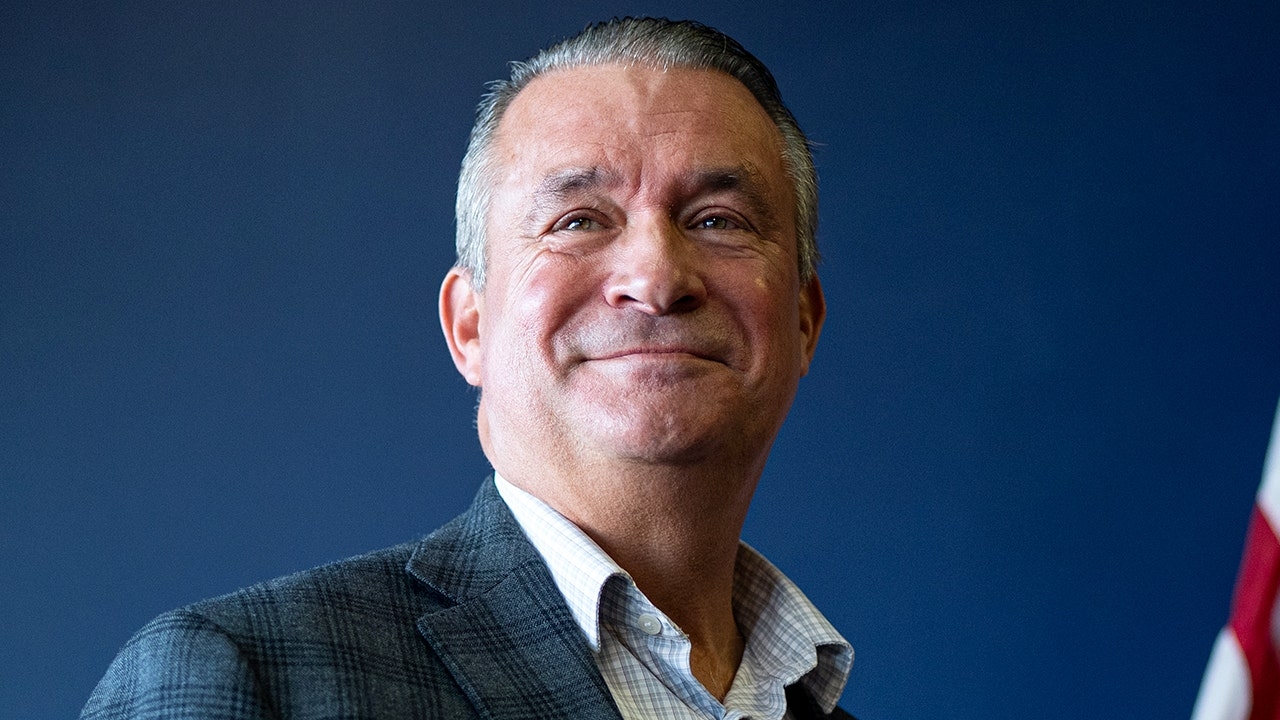
Pro-Ukraine GOP Rep. Bacon declares 'real Republicans know that Putin's Russia hates the West and freedom'
"We also know that Ukraine wants democracy, free markets and rule of law. We stand with right vs evil. Reagan, Churchill, Eisenhower… that is our legacy. I won't walk away from it," he added.
The U.S. has provided significant aid to the Eastern European nation over the last few years since Moscow invaded its neighbor, sparking the Russia-Ukraine war.
Bacon asserted on CSPAN's "Washington Journal" that it is in America's "national security interest for Ukraine to win," warning that a Russian victory would cause the U.S. to spend "a lot more money."
The congressman has expressed support for helping to arm Ukraine.
The U.S. has "no troops in Ukraine and no one is advocating for that. We want to arm Ukraine so they can defeat this Putin invasion," he said on X.
"What happens if Ukraine falls? Do you think it ends there? China is watching how we handle this too. I'm for helping Ukraine win," he noted in another post. "They are fighting for their freedom just like we have in our history. I'm for a just peace, not surrender nor slavery."
After someone on the platform asked Bacon approximately how much it would cost to oust Russia from Ukraine, the lawmaker replied, "Read Clausewitz. It's changing the will of the adversary. Hard to measure. But being weak strengthens the adversaries' will. It's more about good vs evil and being on [the] right side of history."
Hashtags

Try Our AI Features
Explore what Daily8 AI can do for you:
Comments
No comments yet...
Related Articles
Yahoo
 4 minutes ago
- Yahoo
The Fox host gushed over the cheeseburger-eating president's 'childlike spirit,' evident in his heaven talk.
Donald Trump should be commended for his 'childlike spirit' on display while negotiating to end Russia's war against Ukraine, Jesse Watters said Tuesday. The Fox News host claimed the president was somewhat serious earlier in the day when he said he was motivated to bring peace to improve his chances of getting into heaven—'and that's why we love him.' 'He has this childlike spirit, this Sunday school school of thought that if you just do good things, there's a chance,' Watters said on The Five. But there's more to Trump that makes him appealing, he went on.


Politico
6 minutes ago
- Politico
In: EV incentives. Out: Sales mandates.
Presented by With help from Camille von Kaenel and Noah Baustin EV COMPLICATIONS: California drivers don't want to lose their electric vehicle tax incentives, but even voters in one of the bluest states are wary about reviving plans to phase out gas cars. Voters are split down the middle on whether California should stick to its guns on its Trump-blocked plans to phase out sales of gas cars by 2035, according to an exclusive POLITICO-Citrin Center-Possibility Lab poll. Only 46 percent of the more than 1,400 registered voters surveyed said they support the policy, while 47 percent said no. Yes, there was an obvious partisan split: 60 percent of Democrats said they backed the phase-out, compared to 40 percent of independents and 31 percent of Republicans. But the results offer a note of caution for Gov. Gavin Newsom, who directed the California Air Resources Board to start writing new vehicle emissions rules after Republicans revoked the state's sales mandates for cars and heavy-duty trucks in June. 'None of us really like the idea of government intervening to take something away from us,' said Dan Sperling, a former CARB member and director of the University of California, Davis' Institute for Transportation Studies. 'That's even the most liberal of us.' Poll respondents are more bought into Newsom's plan to backfill the soon-to-be-defunct $7,500 federal EV tax credit. Nearly two-thirds — 64 percent — said they would support state-funded tax incentives once the federal subsidy ends Sept. 30, as part of the Trump administration's ongoing attacks on clean energy policy. That question again showed a partisan divide, with 80 percent of Democrats saying they back the approach, compared to 60 percent of independent voters and just 43 percent of Republicans. But the overall result bolsters Newsom's push to backfill incentives that the Biden administration used to coax drivers off fossil fuels, as he suggested using cap-and-trade revenues to fund last year and directed state agencies to consider in a June executive order. But Jack Citrin, a veteran political science professor at UC Berkeley and partner on the poll, said a closer look at the poll results shows that Democrats need to keep affordability in mind. He pointed to the fact that 28 percent of respondents said they'd only support new EV incentives if gas prices aren't impacted and another 20 percent said they should be reserved for low-income buyers, reflecting the fact that cost of living was the top concern of voters polled. And 64 percent of respondents said gasoline prices are putting a significant, extreme or moderate burden on their household budgets. 'That reflects a concern with the cost of all of this,' Citrin said. 'Yes, we're for environmental protection. Yes, we're for all of this, just as long as it doesn't cost a lot.' The poll comes the same day that state agencies released a joint report with recommendations for countering Trump's assault, calling on lawmakers to bolster tax incentives, improve charging infrastructure and regulate facilities that attract polluting trucks, but offering few specific timelines or dollar figures. California Air Resources Board Chair Liane Randolph framed the report — which Newsom asked for in his June order — as a first step in the state's defense against a hostile federal government. 'Clean air efforts are under siege, putting the health of every American at risk,' she said during a press briefing. 'California is continuing to fight back and will not give up on cleaner air and better public health.' Sperling called the report a surprisingly 'modest document' and said it lacks the specificity he hoped to see. 'The word I would use is disconcerting,' Sperling said when asked about where California stands in its fight against Trump. — AN Did someone forward you this newsletter? Sign up here! INVEST OR TRADE: The cap-and-trade legislative games are off to the races. Assemblymember Jacqui Irwin, who's leading the Assembly's cap-and-trade working group, began circulating on Tuesday her draft legislative language to extend the state's signature climate program through 2045. The proposal, obtained by POLITICO, would also make moderate changes to how the carbon market is run and make several multiyear appropriations of its revenues for wildfire, water, air and energy programs. It's the first detailed proposal to come out of the Legislature and follows Newsom's May proposal to reauthorize the program largely as-is. Lawmakers are now staring down a three-week sprint to resolve their differences and pass a bill on cap and trade, which is not only the regulatory backstop that ensures California meets its climate targets but also a multibillion-dollar revenue engine that's brought in lower-than-expected revenues amid uncertainty about its fate after its 2030 expiration. That uncertainty is set to continue. Ahead of the California Air Resources Board's next quarterly auction scheduled for Wednesday, prices on California's carbon market 'barely responded' to news of the Assembly's proposed amendments, according to Alicia Robinson, CEO of Elevate Climate, a carbon market analytics firm. 'While the Assembly's draft language indicates forward progress, market participants seem to need less talk and more walk before they double down on buying allowances,' she said. Broadly, the proposal — which Irwin is planning to insert into her AB 1207 in the coming weeks — seeks a middle ground between business groups advocating for more free emissions permits in the name of lowering costs and environmental groups advocating for fewer free permits in the name of furthering emissions reductions. It instructs CARB to conduct its own analysis of the risk of businesses — and emissions — leaving the state as a result of the program, and to distribute free allowances accordingly. It also proposes letting businesses offset some of their emissions through investments in carbon dioxide removal technology and natural and working lands and would keep surplus permits off the market to prop up weaker-than-expected auctions. Nick Miller, a spokesperson for Assembly Speaker Robert Rivas, said in an email that the proposal 'reflects the Assembly's core values: advancing climate ambition while prioritizing affordability for California working families and businesses.' The Senate working group led by Sen. Monique Limón, meanwhile, has been circulating a draft framework, also obtained by POLITICO, to reduce free allowances over time and add a new border adjustment tax to insulate in-state industries. Senate President Pro Tem Mike McGuire did not respond to a request for comment Tuesday. — CvK THE DELTA BETWEEN THEM: The war of words over a controversial proposed tunnel to route water south around the Sacramento-San Joaquin River Delta is heating up. Newsom on Tuesday touted the Delta Conveyance Project as the 'most promising action' to protect the state's water delivery system from more extreme storms and droughts, higher temperatures and sea level rise. The occasion: His administration's first-ever report on adapting the State Water Project to climate change released Tuesday. The other occasion: the trailer bill he's backing — with no legislative sponsor yet — to streamline the tunnel's construction. In a now-familiar dance, environmental groups and Delta region lawmakers who oppose the 45-mile-long tunnel's construction because of its impacts on the local ecosystem immediately panned the report, while water agencies that would get its water praised it. The report also lists other strategies to climate-proof the State Water Project, which delivers water to 27 million Californians. Among them: correcting subsidence that's eating away aqueduct capacity, developing 2 million acre-feet of storage south of the Delta, using advanced weather forecasts to manage releases from Oroville Dam and permitting a physical barrier in the Delta to prevent saltwater from creeping up during low water years. — CvK TALK IT OUT: Three Assembly policy committees are coming together tomorrow for an oversight hearing on transportation fuels that will put representatives from oil, labor and environmental justice groups at the table amid a push to overhaul drilling regulations and avert two refinery closures. The joint Natural Resources, Transportation and Utilities and Energy committee hearing should offer an inside look at negotiations on a draft bill from Newsom that would boost oil drilling in Kern County — a proposal that's won plaudits from oil companies and enraged groups that say California is backtracking on its climate goals. The speaker list includes Zach Leary, senior director at the Western States Petroleum Association; Cesar Aguirre, co-director of Central California Environmental Justice Network's air and climate justice team; Mike Smith, chair of the United Steelworkers' national oil bargaining program; and Jeremy Martin, Union of Concerned Scientists' director of fuel policy. The committees will also hear from Benicia Mayor Steve Young, whose city is facing the planned closure of a Valero refinery, and Notre Dame professor Emily Grubert, who's studied clean energy transitions around the country. CARB's Randolph, California Energy Commission Vice Chair Siva Gunda and California Department of Conservation Director Jennifer Lucchesi will also speak. — AN HOT STUFF: It's August, California is about to be hit with a prolonged heat wave, and energy leaders are braced to protect the state's grid. Sound familiar? In August 2020, similar conditions forced the California Independent System Operator to launch rolling electricity blackouts as the grid was overwhelmed with demand from air conditioners across the state. Two years later, Newsom was forced to send out a statewide emergency alert pleading with residents to turn off their appliances during a September temperature spike. As 2025's heat wave approaches, energy officials are confident (mostly) that the state is out of the woods (almost). 'We are cautiously optimistic about the summer,' the CEC's Gunda said at a Senate Energy, Utilities and Communications Committee hearing Tuesday. 'Even under the conditions that we've experienced in 2020 and 2022, we don't expect any shortfalls in the grid,' Gunda said. 'This is because of the storage capacity that has come online.' After the 2020 blackouts, Californians, from the state's utilities to residents putting the tech in their garages, went on a battery-building bonanza, adding over 12,000 megawatts of energy storage to the grid, bringing the CAISO portfolio to about 13,500 MW. The additional storage helps grid managers supply enough energy to meet demand during the early evening, the trickiest time of the day as solar production plummets at the same time that residents arriving home turn on their appliances. 'Still, a long lasting West-wide heat wave coincident [with] a big potential fire could still put us on the edge, and that's something we want to watch carefully,' Gunda said. — NB PEAK OF THE FIRE: California's No. 1 — in homes at fire risk. The state has nearly 1.3 million homes at moderate or higher wildfire risk, representing $800 billion in reconstruction costs, according to a new report released Tuesday by property data and analytics company Cotality. Second-place Colorado has 318,000 homes at similar risk, representing $142 billion. California also claims eight of the 15 metropolitan areas with the most homes at risk: Los Angeles, Riverside, San Diego, Sacramento, San Francisco, Oxnard, Redding and Chico. — CvK — Suisun City is considering annexing thousands of inland acres from the tech-billionaire backed company California Forever to stay afloat amid rising seas. — See where forecasters are scheduling extreme heat and red flag warnings in California starting Thursday. — The House Oversight Committee is investigating whether the California High-Speed Rail Authority knowingly misrepresented the project's numbers in order to obtain federal funding.

Wall Street Journal
6 minutes ago
- Wall Street Journal
Putin Calls Zelensky the West's Illegitimate Puppet. Can He Talk Peace With Him?
If Russian President Vladimir Putin agrees to meet his Ukrainian counterpart, Volodymyr Zelensky, as urged by President Trump, he will come face-to-face with a man he has spent 3½ years excoriating as an illegitimate leader and puppet. Negotiating directly with Zelensky would run sharply counter to the narrative Putin has carefully constructed and sold to Russians in an effort to justify his 2022 invasion of Ukraine: that the war is part of a broader conflict with the West in which Zelensky and his country are mere pawns.
