


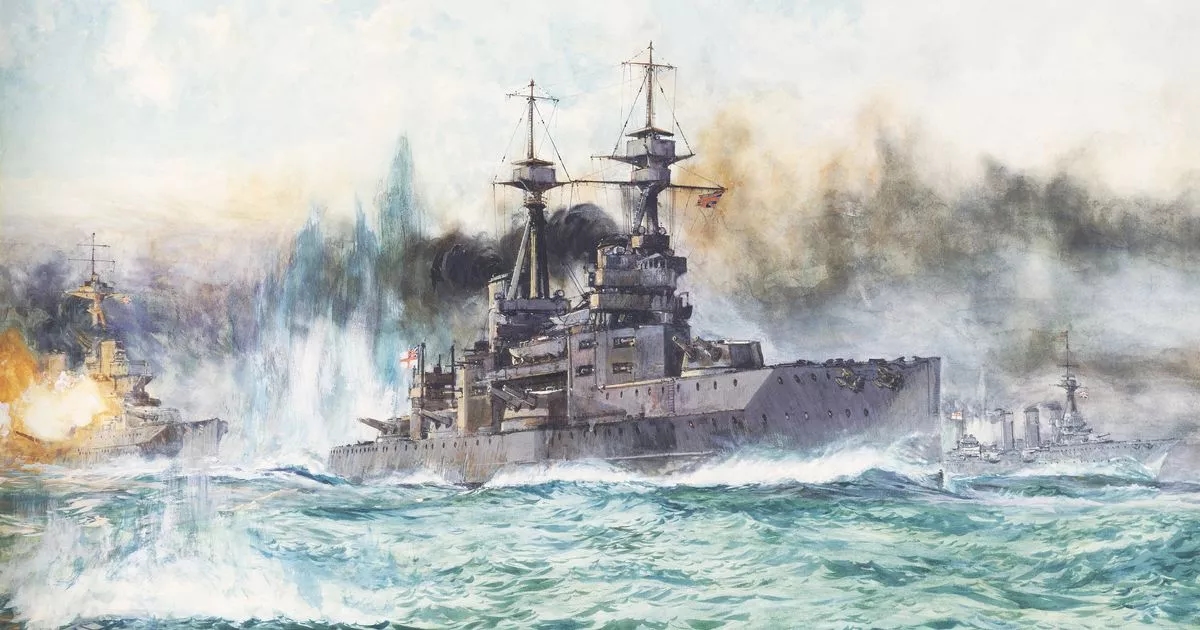
Artefacts from WWI ship that sank in Orkney claiming hundreds of lives reclaimed after a century
More than 100 years after one of the Royal Navy's worst disasters, divers have recovered artefacts from a sunken ship. HMS Vanguard lies on the seabed of Scapa Flow in Orkney, a solemn relic from the tragedy that claimed the lives of 845 lives in 1917.
The ship's bell, along with a metal badge from one of the ship's main guns and a tampion, a protective gun barrel plug, have been carefully brought to the surface after three years of planning.
All three items were located just outside the wreck's exclusion zone and will be loaned to the Scapa Flow Museum once conservation work is complete.
The discovery marks a significant step in preserving the memory of the men who perished in what is believed to be the greatest accidental loss of life in a single incident in Royal Navy history.
HMS Vanguard, a St Vincent-class dreadnought and veteran of the Battle of Jutland, was anchored alongside the Grand Fleet at Scapa Flow on July 9, 1917, when a catastrophic explosion in a magazine tore through the ship.
She sank in moments. Only three of the 848 men onboard survived, one of whom later died from his injuries. The cause of the explosion remains uncertain, though it's widely believed to have been an accidental detonation of cordite stored near the magazines.
The wreck now lies at a depth of 34 metres (110 feet) and is protected under the Protection of Military Remains Act 1986 as a Sovereign Immune Wreck.
Special permission was granted to recover the artefacts, which were discovered during a 2017 survey led by diver Emily Turton as part of centenary commemorations.
Turton's team spent more than 500 hours meticulously mapping the wreck site, which is spread across a large area on the seafloor.
Naval historian Nick Hewitt, now culture team leader at Orkney Islands Council, believes the recovered bell in particular will resonate deeply with the public.
'A hundred years-plus ago your relatives looked at it, heard it ringing,' said Wendy Sadler, whose great-grand uncle Henry Metcalf was among those who died in the sinking.
'To think of what happened to them that night, losing their lives, and it is not seen for another 110 years, it is a privilege and an honour,' she told the BBC. 'We can't stop doing things like this, them fading into history, we've got to keep their memory alive somehow.'
Join the Daily Record WhatsApp community!
Get the latest news sent straight to your messages by joining our WhatsApp community today.
You'll receive daily updates on breaking news as well as the top headlines across Scotland.
No one will be able to see who is signed up and no one can send messages except the Daily Record team.
All you have to do is click here if you're on mobile, select 'Join Community' and you're in!
If you're on a desktop, simply scan the QR code above with your phone and click 'Join Community'.
We also treat our community members to special offers, promotions, and adverts from us and our partners. If you don't like our community, you can check out any time you like.
To leave our community click on the name at the top of your screen and choose 'exit group'.
If you're curious, you can read our Privacy Notice.
Sadler is currently leading a project to collect photographs of as many of HMS Vanguard's crew members as possible.
Experts believe the tampion, possibly made from horsehair and leather, may have been preserved thanks to the silty conditions of the seabed. The ship's bell, now bent and warped by the explosion that sank her, was found some 200 metres from the original location of the vessel.
The recovery effort has been a collaborative project involving the Ministry of Defence, the National Museum of the Royal Navy (NMRN), Orkney Islands Council and the Scottish government.
After conservation, the artefacts will take pride of place at the Scapa Flow Museum, honouring the memory of those lost in one of the darkest chapters of British naval history.
Hashtags

Try Our AI Features
Explore what Daily8 AI can do for you:
Comments
No comments yet...
Related Articles


Press and Journal
 5 hours ago
- Press and Journal
Aberdeen man celebrates 100th birthday and credits family for long life
On the day of his 100th birthday, an Aberdeen man has said the key to a fruitful long life is having a 'great family' by his side. John Adamson, who is a resident at Renaissance Care's Cranford Care Home, celebrated his centenary with his family and friends at Aberdeenshire Cricket Club. Even though he feels 'too bloody old', John said that 'life's been good to me'. Born in Banff, he married Edith – who passed away in 2019 – at Triple Kirks in Aberdeen in 1952. The pair enjoyed a four-night stay at the Burnett Arms in Kemnay for their honeymoon. As a youngster, he was brought up in Fordyce and moved all over the Buchan and Mearns area, as his father was a farm labourer. He was one of seven children and attended school at Portsoy and Laurencekirk. 'We had a really happy family life,' he said, remembering how his father used to entertain them by playing music. After completing education, John became a builder's labourer at 13-years-old. Between the ages of 18 and 22 he served in the Royal Navy, which saw him deployed in the Second World War. He was always a hard worker. Or as John says: 'I didn't mind working, as long as I was paid for it.' He had a number of roles during a long and successful career. These included working at Aberdeen Fish Market with Allan and Dey, as well as at Aberdeen Market Coldstores. He was employed by Aberdeen City Council, where he was a playing field groundsman at Hazlehead, Kaimhill and Northfield. And he was then employed by Robert Gordon's College, serving as head groundsman at their Seafield playing fields for 23 years. His last job was as a solicitor's runner with Burnett and Reid, a role he only retired from at the age of 80. Despite that successful career, his proudest moment is the family he nurtured. He has four daughters, Jill, Lorraine, Kay and Maureen, as well as four grandchildren and seven great grandchildren. 'They couldn't have been better,' he proudly told The P&J. 'What a great family. Having lived for 100 years, John said his big regret is not learning to drive a car. He did sit his test twice, but failed both times – the second time for not giving a cyclist enough space. John did drive a tractor when growing up on farms in his younger years. Among John's hobbies was gardening – which he would do for family and friends – and greyhound and horse racing. And to this day, he still bets on the horse racing each day, something he has done since he was 16 or 17. 'I like to have a good look (at the odds),' he said. As well as this, he enjoys a small dram of malt and listening to bothy ballads. 'Good malt whisky and hard work' are what he says has been the key to his long life. And his advice to the world is simple. 'Be good and kind and enjoy a dram.' As well as his party, he will be receiving a letter from the King to celebrate his day. 'You'd be lucky if I read it,' he said. 'I've got no time for the Royals.'


The Courier
5 hours ago
- The Courier
REVEALED: Why distinctive 'zebra' ship has been sailing along Firth of Forth
The arrival of a distinctive 'zebra-striped' ship in the Firth of Forth turned heads in Fife on Monday. The vessel in question was the Dutch-flagged Sans Vitesse – an accommodation ship notable for its black and white striped paintwork. It sailed up the Firth of Forth towards the iconic three bridges shortly after 10am before being assisted by two tug boats along the final stretch into Rosyth dockyard. Royal Navy sailors are to be housed on the 100-room barge while repairs to the HMS Queen Elizabeth aircraft carrier continue. It's understood the temporary accommodation will become the home for many of the ship's company. The Royal Navy confirmed it will be the temporary living quarters for the 'duty watch' – fire crews and emergency personnel required to be stationed within two minutes of the carrier when it is sat in dry dock. However, it was the distinctive geometric-patterned camouflage that caught the public's attention. One onooker described the vessel as 'zebra-striped' and 'very odd'. She added: 'I've lived in Dalgety Bay for over 50 years and seen every type of ship imaginable. 'But it's certainly the first time I've seen anything zebra-striped. 'It was very odd indeed and I could not take my eyes off it.' The markings are referred to as 'dazzle camouflage,' primarily used by ships during the First World War. The ship is unlike other conventional forms of camouflage, which are designed to hide or obscure. The aim of Dazzle, with its distinct black and white stripes, is not to hide but to confuse. The complex geometric patterns make it difficult to estimate a target's range, speed and heading. However, the black and white paintwork on the Sans Vitress is thought to be simply cosmetic rather than functional.

The National
5 hours ago
- The National
What is the 'Zebra-striped' ship spotted in the Firth of Forth?
The ship, which stands out due to its zebra stripe pattern, is called the Sans Vitesse. The barge is used for accommodation and will house Navy personnel while the HMS Queen Elizabeth undergoes planned maintenance at Rosyth Dockyard. However, not all of the crew will be staying on the ship. The barge is used for accommodation and will house Navy personnel. (Image: Dennis Penny) Those on the Sans Vitesse will solely be the duty watch who need to be close to the ship; while the rest of the crew will be staying in HMS Caledonia. A Royal Navy spokesperson said: "When ships go into refit periods there are occasions when it becomes necessary to source alternative temporary accommodation for some of the ship's company. "The health and wellbeing of our people remain paramount, and we make sure that accommodation is suitable and meets our standards, which this accommodation has. "The Sans Vitesse will provide suitable accommodation for our personnel while HMS Queen Elizabeth undergoes planned maintenance in Rosyth." The Sans Vitesse with the Forth Road Bridge. (Image: Dennis Penny) Graeme Downie, the MP for Dunfermline and Dollar, added: "I have spoken to ministers over the past few days, and they have assured me the accommodation on Sans Vitesse is of the highest quality and suitable for personnel from HMS Queen Elizabeth while the ship is docked at Rosyth. 'However, I think we must also see work to upgrade and modernise HMS Caledonia to ensure the base is fit for purpose and has the facilities and services to accommodate personnel in the future and I will be pressing ministers and the Royal Navy further on this matter."
