



Israel's ceasefire with Hamas in doubt again
A ceasefire in Gaza was in doubt as the region marked 500 days of Israel's war with Hamas, while Israel and the United States sent conflicting signals over whether they want the truce to continue. Talks on the ceasefire's second phase are yet to start.
500 days of war in Gaza
Israelis held protests calling for the Gaza ceasefire to be extended so that more hostages abducted in the Oct. 7 attack can be freed.
An Israeli official said four bodies are expected to be returned to Israel on Thursday. The official gave no further details and spoke on condition of anonymity because details were being arranged. So far, no bodies have been handed over during the ceasefire's current phase. There was no immediate comment from Hamas.
Israeli officials have said they believe eight of the 33 people to be returned in the ceasefire's first phase are dead. Hamas is gradually releasing the 33 in exchange for nearly 2,000 Palestinian prisoners. Israeli forces have pulled back from most parts of Gaza and allowed a surge of humanitarian aid.
This first phase ends in less than two weeks. Negotiations on the more difficult second phase — which would release more hostages and see the withdrawal of Israeli forces from Gaza — should have started two weeks ago.
"All I care about, all I want, is for my friends to return. There were six of us living in unbearable conditions" Ohad Ben Ami, released a week and a half ago, told Israeli President Isaac Herzog. Families have described loved ones barefoot or in chains.
"It's just not within the realm of possibility that they're still there," said protester Eleanor Satlow in Jerusalem. Others rallied in Tel Aviv, where newly released hostage Iair Horn told them: "I'm telling you, the hostages don't have time, we don't have time." His brother Eitan is still in Gaza.
In the second phase, Hamas would release over 70 remaining hostages — around half believed to be dead — in exchange for more Palestinian prisoners and a lasting ceasefire.
Israeli Prime Minister Benjamin Netanyahu and U.S. President Donald Trump 's administration say they are committed to the eradication of Hamas and the return of all hostages. Those goals are widely seen as incompatible.
The militant group, though weakened, remains in control of Gaza. Hamas has said it is willing to relinquish power to other Palestinians but will not accept any occupying force.
Israel welcomes Trump's proposal
Trump calls for Gaza's population of over 2 million to be permanently relocated to other countries and for the United States to take ownership of the territory. Israel welcomes the plan, while Palestinians and Arab nations have rejected it. Rights groups say implementation would likely violate international law.
Egypt is working on a counter-plan to rebuild Gaza without removing Palestinians.
Hamas-led militants in their Oct. 7 attack killed some 1,200 people, mostly civilians, and abducted around 250. More than half of the hostages have been returned. Eight have been rescued in military operations.
Israel's air and ground war has killed over 48,000 Palestinians, more than half of them women and children, according to Gaza's Health Ministry, which does not say how many were combatants.
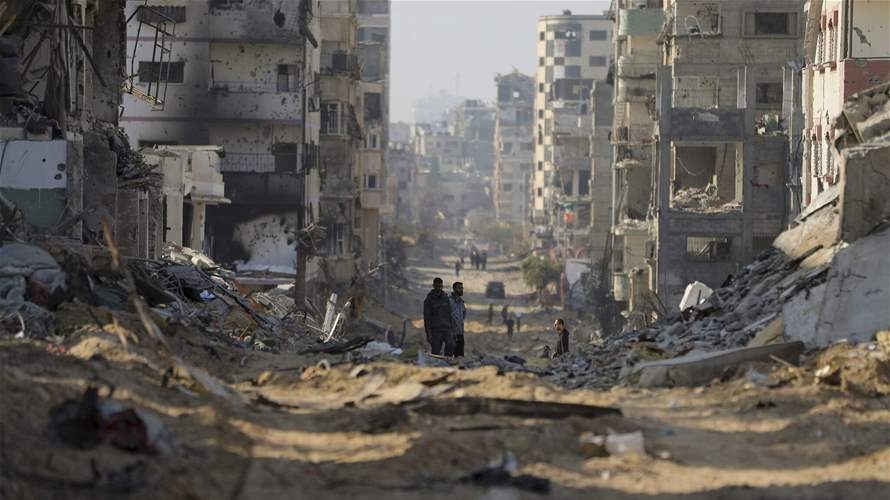
"Everything is destroyed, nothing is left in Gaza, Gaza is not fit for life," said one resident, Mohammed Barash, reflecting on 500 days of war.
Settlement expansion is set to accelerate
A watchdog opposed to Jewish settlements on Palestinian territory said Israel has issued a tender for the construction of nearly 1,000 additional settler homes in the occupied West Bank.
Peace Now said the 974 new housing units would allow the population of the Efrat settlement to expand by 40% and further block the development of the nearby Palestinian city of Bethlehem.
There was no immediate Israeli government comment.
Israel has built over 100 settlements across the West Bank, ranging from hilltop outposts to fully developed communities. Over 500,000 settlers live in the West Bank, home to about 3 million Palestinians.
The settlers have Israeli citizenship. Palestinians live under military rule, with the Western-backed Palestinian Authority administering population centers.
Israel captured the West Bank, along with the Gaza Strip and east Jerusalem, in the 1967 Mideast war. The Palestinians want them for their future state.
Hashtags

Try Our AI Features
Explore what Daily8 AI can do for you:
Comments
No comments yet...
Related Articles

LBCI
 3 hours ago
- LBCI
White House says US reviewing latest Gaza ceasefire proposal
White House spokesperson Karoline Leavitt said Tuesday that the United States is continuing discussions on a proposal for a 60-day ceasefire in Gaza between Israel and the Palestinian Islamist movement Hamas, which the group has accepted. At a White House press briefing, she added, 'I don't think it's a coincidence that Hamas accepted this proposal after the president of the United States issued a very strong statement on this conflict on Truth Social yesterday.' Reuters


Ya Libnan
5 hours ago
- Ya Libnan
Trump says Putin may not want to make a deal on Ukraine
By Andrea Shalal , Tom Balmforth and Anastasiia Malenko WASHINGTON- U.S. President Donald Trump said on Tuesday he hoped Russia's Vladimir Putin would move forward on ending the war in Ukraine but conceded that the Kremlin leader may not want to make a deal at all, adding this would create a 'rough situation' for Putin. In an interview with the Fox News 'Fox & Friends' program Trump said he believed Putin's course of action would become clear in the next couple of weeks. Trump again ruled out American troops on the ground in Ukraine and gave no specifics about the security guarantees he has previously said Washington could offer Kyiv under any post-war settlement. 'I don't think it's going to be a problem (reaching a peace deal), to be honest with you. I think Putin is tired of it. I think they're all tired of it, but you never know,' Trump said. 'We're going to find out about President Putin in the next couple of weeks … It's possible that he doesn't want to make a deal,' said Trump, who has previously threatened more sanctions on Russia and nations that buy its oil if Putin does not make peace. Ukraine and its European allies have been buoyed by Trump's promise of security guarantees to help end the war during an extraordinary summit on Monday but face many unanswered questions, including how willing Russia will be to play ball. Ukrainian President Volodymyr Zelenskiy hailed the talks at the White House as a 'major step forward' towards ending Europe's deadliest conflict in 80 years and setting up a trilateral meeting with Putin and Trump in the coming weeks. Zelenskiy was flanked by the leaders of allies including Germany, France and Britain at the summit. His warm rapport with Trump contrasted sharply with their disastrous Oval Office meeting in February. But the path to peace remains deeply uncertain and Zelenskiy may be forced to make painful compromises to end the war, which began with Russia's full-scale invasion in February 2022. Analysts say more than 1 million people have been killed or wounded in the conflict. RUSSIAN ATTACKS While the Washington talks allowed for a temporary sense of relief in Kyiv, there was no let-up in the fighting. Russia launched 270 drones and 10 missiles in an overnight attack on Ukraine, the Ukrainian air force said, the largest this month. The energy ministry said Russia had targeted energy facilities in the central Poltava region, home to Ukraine's only oil refinery, causing big fires. However, Russia also returned the bodies of 1,000 dead Ukrainian soldiers on Tuesday, Ukrainian officials said. Moscow received 19 bodies of its own soldiers in return, according to the state-run TASS news agency. 'The good news (from Monday's summit) is that there was no blow-up. Trump didn't demand Ukrainian capitulation nor cut off support. The mood music was positive and the trans-Atlantic alliance lives on,' John Foreman, a former British defense attache to Kyiv and Moscow, told Reuters. 'On the downside, there is a great deal of uncertainty about the nature of security guarantees and what exactly the U.S. has in mind.' Ukraine's allies held talks in the so-called 'Coalition of the Willing' format on Tuesday, discussing additional sanctions to crank up the pressure on Russia. The grouping has also agreed that planning teams will meet U.S. counterparts in the coming days to advance plans for security guarantees for Ukraine. NATO military leaders were expected to meet on Wednesday to discuss Ukraine, with U.S. General Dan Caine, the chairman of the Joint Chiefs of Staff, expected to attend the meeting virtually, officials told Reuters. 'We are now actively working at all levels on the specifics, on what the architecture of the guarantees will look like, with all members of the Coalition of the Willing, and very concretely with the United States,' Zelenskiy said on X. 'TIPTOEING AROUND TRUMP' Russia has made no explicit commitment to a meeting between Putin and Zelenskiy. Foreign Minister Sergei Lavrov said on Tuesday that Moscow did not reject any formats for discussing peace in Ukraine but any meeting of national leaders 'must be prepared with utmost thoroughness'. Putin has said Russia will not tolerate troops from the NATO alliance in Ukraine. He has also shown no sign of backing down from demands for territory , including land not under Russia's military control, following his summit with Trump last Friday in Alaska. Neil Melvin, director, International Security at the Royal United Services Institute think-tank, said Russia could drag out the war while trying to deflect U.S. pressure with a protracted peace negotiation. 'I think behind this there's a struggle going on between Ukraine and the Europeans on one side, and the Russians on the other, not to present themselves to Trump as the obstacle to his peace process,' Melvin said. 'They're all tiptoeing around Trump' to avoid any blame, he said, adding that on security guarantees, 'the problem is that what Trump has said is so vague it's very hard to take it seriously'. Reuters


L'Orient-Le Jour
7 hours ago
- L'Orient-Le Jour
Aoun urges extension of UN peacekeepers' mandate
President Joseph Aoun on Tuesday warned against ending the United Nations peacekeepers' mandate in the country's south, after the U.N. Security Council began debating extending their mission. The annual mandate renewal this year comes after Lebanese authorities, under heavy U.S. pressure, have committed to disarming Hezbollah by year's end, following a November cease-fire deal that sought to halt more than a year of hostilities between the Iran-backed group and Israel. Israel and the United States, which wields a veto on the Security Council, have reportedly opposed the renewal. "Any timetable for the mandate of UNIFIL that is different from the actual needs will negatively impact the situation in the South, which still suffers from Israeli occupation," Aoun told force commander Diodato Abagnara, according to a presidency statement. The U.N. Interim Force in Lebanon has been deployed since 1978 to separate Israel and Lebanon and counts some 10,000 personnel from around 50 countries. The Security Council on Monday began debating a resolution drafted by France to extend the force for a year with the ultimate aim of withdrawing it. Aoun said Beirut "has begun contacts with Security Council member states, and brotherly and friendly countries, to ensure the extension" of UNIFIL's mandate. He cited Lebanon's need for the force to help "maintain security and stability in the south" and to support the army following the government's decision to increase troop numbers there to 10,000 personnel. Under the cease-fire, Hezbollah was to withdraw from near the Israeli border, while the Lebanese Army was to bolster its deployment there. Abagnara said on X that UNIFIL's "close coordination" with the Lebanese Army was "key to help restore stability." Last week, UNIFIL said that with its support, the army had deployed to more than 120 positions in the country's south. Despite the cease-fire, Israel has continued to strike Lebanon, saying it will do so until Hezbollah is disarmed. Israeli forces also occupy five areas of the south that it deems strategic. The text of the draft resolution would extend UNIFIL's mandate until Aug. 31, 2026, but "indicates its intention to work on a withdrawal of UNIFIL." A vote of the 15-member Security Council is expected on Aug. 25, before the force's mandate expires at the end of the month.
