


Japanese Startup Gives Menstrual Products to Girls in Nairobi Slum, Boosting School Attendance and Future Prospects
In 2013, Sakata set off on a trip around the world after collapsing due to overwork at an advertising agency. While in Kenya, one sight left a deep impression on her. She saw a wall separating wealthy people playing golf with a caddy on beautiful lawns from Kibera children bathing in wastewater flowing from the golf course while their mother did laundry.
'It was like a wall between two worlds, and I wondered if there was anything I could do [to bridge the gap],' Sakata said.
She began visiting schools in Kibera to provide financial support to children. Later, she noticed that female students were absent several days a month. They could not afford menstrual products and therefore stayed at home. Some went to school using rags instead, which led to infections. Some were bullied by boys after their blood stained chairs in the classroom.
The girls had a hard time keeping up with the school curriculum and their grades dropped. 'Poor grades meant that they couldn't go on to higher education, couldn't get a good job, and remained in poverty,' Sakata said.
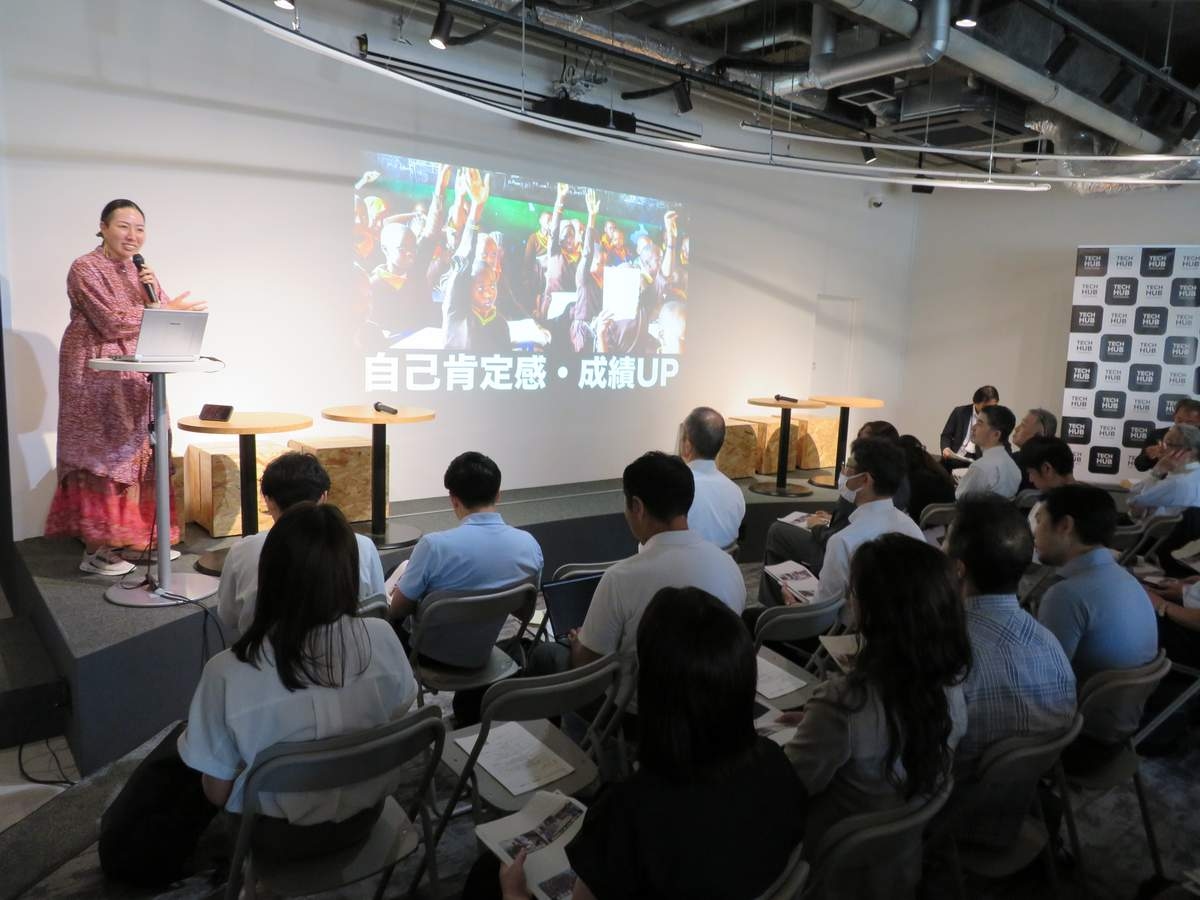
To address the issue, Sakata founded Cotatsu, which has distributed 1.3 million menstrual products to a total of 8,000 women, with partial support from a Japanese manufacturer of sanitary products. As a result, a survey found that the average number of days absent per year was reduced by 36. Also, the students' self-esteem increased and their grades improved.
'I believe that going to school to learn reading, writing and arithmetic, and being able to think for themselves and do things on their own, is the first step toward changing their lives, even if they are born and raised in a slum.'
The challenge is that the project requires a large amount of funding.
Sakata aimed at creating a business model in which local people could utilize their own talents, work for themselves, and use the profits to properly support those around them. What caught her attention was that Kenya has a culture of altering clothes and creating custom-made garments.Kenya imports large quantities of second-hand clothing from developed countries, some of which is sent for disposal. Sakata said that clothes are affordable and abundant in Kibera, so people there have a keen sense of fashion.
She recruited local tailors and designers and created a brand called 'SHIFT80.' They make upcycled clothing by combining various second-hand clothes, and sell them in Kenya and Japan. They also make clothes combining the second-hand clothes with kimono. With the brand, Sakata said, 'We want to shift the world by returning 80% of profits, excluding personnel and other expenses, to the local community.'They organize showcases for fashion influencers and pop-up events to retail their clothing products. They also hold competitions for young Kenyan fashion designers to provide opportunities and to find talented personnel.
Sakata has also offered scholarships to high school and college students. Sharon Ademba, an orphan, graduated from college on such a scholarship and now mentors children in similar circumstances. 'Her strength lies in her ability to empower children by talking about her own difficult past,' Sakata said.
Now Sakata aims to expand her activities beyond Kibera to other slums in the future.
Sakata said: 'In Japan, I thought I would die of overwork. It was so difficult for me. But in Kibera, I met many friends who were positive and sturdy, and interacting with them saved me. I want to convey the strength of the people in Kibera to Japanese people, and it would be nice if I could help them in return for their favor.'
Hashtags

Try Our AI Features
Explore what Daily8 AI can do for you:
Comments
No comments yet...
Related Articles

 23 minutes ago
SBI Holdings Seen Investing in Tohoku Bank
News from Japan Aug 20, 2025 08:44 (JST) Tokyo, Aug. 20 (Jiji Press)--Major Japanese online financial service group SBI Holdings Inc. is in talks on forming a capital and business tie-up with Tohoku Bank, which is mainly operating in Iwate Prefecture, part of the Tohoku northeastern Japan region, it has been learned. SBI Holdings is expected to acquire an equity stake of about 3 pct in the bank, which is listed on the Standard section of the Tokyo Stock Exchange, informed sources said. This would mark SBI Holdings' first investment in a regional bank since 2022, when it bought shares in Taiko Bank, based in the city of Nagaoka, Niigata Prefecture, central Japan. Tohoku Bank would be the 10th regional bank to receive investment from SBI Holdings, listed on the TSE's top-tier Prime section. SBI Holdings aims to accelerate its partnerships with regional banks while placing Tokyo-based subsidiary SBI Shinsei Bank at the center of its "fourth megabank" initiative. [Copyright The Jiji Press, Ltd.] Jiji Press


The Mainichi
23 minutes ago
- The Mainichi
2 Ministop stores in Kyoto suspected of falsifying expiry dates for years
TOKYO (Kyodo) -- Two branches of the Japanese convenience store chain Ministop in Kyoto Prefecture are suspected of falsifying expiry dates on foods prepared in their kitchens for several years, the local health center said Tuesday. The revelation comes after operator Ministop Co., a subsidiary of retail giant Aeon Co., said Monday it had found such misconduct at 23 stores in Tokyo, Saitama, Aichi, Kyoto, Osaka, Hyogo and Fukuoka prefectures. While no health problems have been reported, Ministop has temporarily suspended sales of rice balls, bento box lunches and other deli items at about 1,600 stores nationwide. During questioning by the local health center, workers at two branches in Kyoto Prefecture said they had delayed affixing labels to items prepared in in-house kitchens "for several years." Meanwhile, workers at two Ministop stores in Hyogo Prefecture were allegedly instructed by owners to falsify expiry dates when excess food was prepared. Local health centers in both prefectures have issued guidance under relevant food laws to the stores. The misconduct at 23 stores was discovered in June by a private organization contracted by Ministop to conduct regular inspections. With nearly half of the stores in Osaka Prefecture, the prefectural government said it plans to conduct on-site inspections at three stores within its jurisdiction to ascertain the situation.


Nikkei Asia
23 minutes ago
- Nikkei Asia
Japan exports decline for third straight month
Trade US-bound shipments plummet amid tariff tensions, July figures show Containers at the Port of Yokohama. Analysts expect the Japanese economy to slow in the coming quarters due to a decline in exports. (Photo by Tomoki Mera) GRACE LI August 20, 2025 09:10 JST TOKYO -- Japan's exports fell for the third consecutive month in July, dragged down by slowing trade with the U.S., its biggest export market, due to President Donald Trump's tariffs.
