



Algeria says it downed a drone near its border with Mali as tensions simmer between the 2 countries
The country's army said in a statement that the armed reconnaissance drone had entered Algerian airspace Monday near Tin Zaouatine, a border town and stronghold for Tuareg separatists opposed to Mali's government. Mali's army acknowledged that one of its drones had crashed in the area, but did not confirm whether it was shot down by Algeria.
Rida Lyammouri, a Sahel expert at the Morocco-based Policy Center for the New South, said the shooting down of the drone — rather than issuing a warning — reflected simmering frustrations.
It 'confirms the serious tensions between the countries and unwillingness and zero tolerance by Algeria to allow the use of its airspace and territory by Malian forces,' he said.
The incident comes as tensions rise between Algeria and its southern neighbors, including Mali.
Algeria once served as a key mediator during more than a decade of conflict between Mali's government and Tuareg rebels. But the two countries have grown apart since a military junta staged coups in 2020 and 2021, putting military personnel in charge of the country's key institutions.
Algeria has denounced the direction that Mali's new government has taken and its expanded efforts to quash rebellion in historically volatile parts of northern Mali. Afraid of conflict spilling over the border, Algerian officials have denounced Mali's use of Russian mercenaries and armed drones near Tin Zaouatine, which is divided by the border separating the two countries.
But failures to curb instability in northern Mali have led to the downfall of previous governments and Mali's Prime Minister Abdoulaye Maiga addressed the issue in a speech at the United Nations General Assembly last year, promising to respond swiftly to violence in the north.
Algeria has one of Africa's largest militaries and has long considered itself a regional power but military leaders in neighboring Mali and Niger have distanced themselves as they've championed autonomy and sought new alliances, including with Russia.
Algeria did not specify who the drone it intercepted belonged to. A spokesperson for Mali's army declined to comment when asked about Algeria's alleging that an armed drone had crossed its border, but said the crash didn't hurt anyone or cause property damage.
Unverified video circulating on social media showed images of an Akinci drone manufactured by Baykar downed in Tin Zaouatine. Mali purchased at least two from the Turkish company last year and has used them against armed separatists as well as fighters linked to Al-Qaeda and the Daesh group.
Hashtags

Try Our AI Features
Explore what Daily8 AI can do for you:
Comments
No comments yet...
Related Articles


Arab News
 10 hours ago
- Arab News
Where did Iran's Arab supporters disappear?
A deathly silence looms over the Arab street, unmoved by the wave of dramatic events in the region. We have not seen demonstrations, protests, or sit-ins in the Arab countries, and in my view, this is the first time in seven decades or more that such displays have vanished. What has befallen Iran is no small matter; its military losses and nuclear facilities are immense — facilities that cost billions of dollars, and much blood and sweat to build. To its ballistic and nuclear losses, we can add the loss of the popular current it had cultivated across the region, from Iraq to Morocco. When the Lebanese government took its bold decision to confiscate Hezbollah's weapons, the response was limited to just a few dozen motorcycles roaming Beirut's streets in protest. So, what happened to the human waves, the millions who once flooded the streets at a mere gesture from the party's leader or from Tehran? The collapse of Iranian influence is clear within Arab regions, like the collapse of Nasserism after its defeat in the 1967 war. It lost the ability to mobilize the street and resorted to relying on its socialist party members and labor unions to attend events after the masses — who once filled the squares with passion and spontaneity in response to radio appeals that dominated people's awareness and emotions for nearly two decades — dwindled. In the wake of that defeat, a sense of shock and betrayal spread across the region, which had been waiting for the liberation of Palestine. People do not admire the defeated Abdulrahman Al-Rashed Iran, too, once enjoyed dominance and popular support in the region, defying attempts to block its ideas and curb its activities. It managed to raise generations of Arabs on its ideas. Tehran opened its doors and arms to extremist Sunnis, including leaders of Al-Qaeda, overlooking their anti-Shiite ideology, and supported most Sunni opposition groups and movements against their governments. It built an organic, deeply coordinated relationship with the Muslim Brotherhood. It organized nearly annual conferences and seminars for Arab nationalists and communists. It spent heavily to woo Arab politicians and intellectuals; books were published, and odes of praise were written in support of the imam's regime and in its defense. Tehran gathered Shiites, Sunnis, and Arab Christians alike — thinkers from the Gulf, Egypt, the Levant, the Maghreb, Sudan, Yemen, and Arab diaspora communities. It climbed onto many Arab media outlets to promote Supreme Leader Ali Khamenei's line. At times, we could hardly understand how it managed to reconcile all these contradictions. In Tripoli — a city with tensions against the Shiites of Beirut — there were Sunni groups that, since the 1980s, continued to pledge allegiance to Tehran. In Jordan, among the Muslim Brotherhood, some openly declared their affection for Tehran's leaders. Numerous works emerged in its defense: in Egypt, for example, 'Iran and Political Islam'; in Kuwait, 'Iran and the West: Conflict of Interests'; in the Gulf, conferences were held under the banner of 'rapprochement' between sects, celebrating the history of Abbasid Caliph Al-Nasir Li-Din Allah. All these activities might have been laudable, were it not for the fact that the intentions behind them were not out of love for ending or easing sectarian strife, but rather as part of a political project of domination. Tehran was managing elite and grassroots movements in dozens of Arab cities; protests against novels, films, negotiations, and regimes. But in the recent wars, following the October 2023 attack, the kind of mobilization we were used to in every confrontation faded. The first reason: People do not admire the defeated. The second: The apparatuses that used to orchestrate these gatherings have lost their connections and their resources have dried up. The Arab street venerates the victorious hero until he falls, then replaces him with another hero. Its believers have been shaken by successive defeats, just as Nasserists were shattered by the setbacks of the 1960s. The remaining challenge is to hold on to its supporters within its Shiite popular base; they are the ones most harmed and who still live the trauma of shock. With time, the Shiites of Lebanon will come to realize the truth — that they are victims of Hezbollah and Iran; that it is a burden on them, rather than a support. For four decades they have borne the confrontation with Israel and the consequences of ties with Iran: economic and personal sanctions, the destruction of their areas and neighborhoods, the targeting of their remittances from Africa and the Americas, and more.

Saudi Gazette
11 hours ago
- Saudi Gazette
Mediators await Israeli response to new Gaza ceasefire proposal
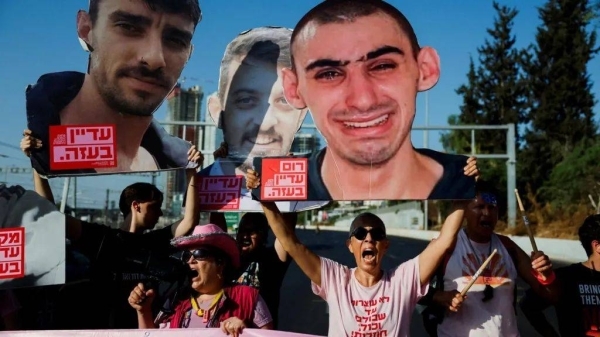
CAIRO — Arab mediators are awaiting a formal response from Israel after Hamas said it had accepted a new proposal for a Gaza ceasefire and hostage release deal. The plan was presented by Qatar and Egypt, which are trying to avert a major new Israeli offensive to occupy Gaza fully. Qatar said it was "almost identical" to a US proposal for a 60-day truce, during which around half of 50 hostages held in Gaza - 20 of whom are believed to be alive - would be handed over and the two sides would negotiate a lasting ceasefire and the return of the rest. In recent days, Israel's government has said it would no longer accept a partial deal - only a comprehensive one that would see all the hostages freed. Local media quoted a senior Israeli official saying: "Israel's position hasn't changed - release of all hostages and fulfilment of other conditions defined for ending the war." Later this week, the Israeli cabinet is expected to approve the military's plan to occupy Gaza City, where intensifying Israeli strikes have already prompted thousands of people to Minister Benjamin Netanyahu announced Israel's intention to conquer all of Gaza - including the areas where most of its 2.1 million Palestinian residents have sought refuge - after indirect talks with Hamas on a ceasefire deal broke down last Monday night, a Hamas statement announced that the armed group and other Palestinian factions had approved a ceasefire proposal presented by Egyptian and Qatari mediators to their delegations in Cairo the previous official Taher al-Nunu told Al-Araby TV that they had not sought any amendments to the proposal, which he described as "a partial deal leading to a comprehensive deal".He also emphasised that on the first day of its implementation, negotiations would begin with the aim of agreeing a permanent ceasefire."We hope that the 60 days of ceasefire will be sufficient to conclude a final agreement that will completely end this war," he foreign ministry spokesman, Majed al-Ansari, told reporters in Doha on Tuesday that the proposal was "98%" similar to the one presented by US Middle East envoy Steve Witkoff."I won't go into the details of the language that is on the table right now. But what I can say is that it is very close, almost identical to what was there on the table," Ansari said."It is within the confines of the Witkoff plan... It's a continuation of that process. Obviously, it's in the details where the devil lies."Witkoff had proposed a 60-day truce that would see Hamas release 10 living hostages and the bodies of 18 dead hostages in two phases, in exchange for hundreds of Palestinian prisoners and detainees held in Israeli jails. He also said that negotiations on a final agreement to end the war would begin on the first day of the accepted Witkoff's plan, but Hamas rejected it, partly because it did not include a guarantee that the temporary ceasefire would lead to a permanent media reported that Israeli officials were examining the new proposal and Hamas's to public broadcaster Kan, Netanyahu has not ruled out the possibility of a partial deal despite his recent statements that he will only accept a comprehensive Saturday night, his office put out a statement saying that Israel would "agree to a deal on condition that all the hostages are released in one go, and in accordance with our conditions for ending the war".Those conditions included the disarming of Hamas, the demilitarisation of Gaza, Israeli control of the Gaza perimeter, and the installation of a non-Hamas and non-Palestinian Authority governance, it said in a video on Monday that he had discussed with senior Israeli military commanders their "plans regarding Gaza City and the completion of our missions"."Like you, I hear the reports in the media, and from them you can get one impression — Hamas is under immense pressure," he President Donald Trump meanwhile wrote on social media: "We will only see the return of the remaining hostages when Hamas is confronted and destroyed!!! The sooner this takes place, the better the chances of success will be."However, the families of hostages fear the new offensive in Gaza City could endanger those being held Sunday night, hundreds of thousands of Israelis gathered in Tel Aviv to demand that their government agree a deal with Hamas to end the war now and bring all the hostages home. Netanyahu accused the demonstrators of hardening Hamas's negotiating Israeli military launched a campaign in Gaza in response to the Hamas-led attack on southern Israel on 7 October 2023, in which about 1,200 people were killed and 251 others were taken least 62,004 people have been killed in Gaza since then, according to the territory's Hamas-run health of Gaza's population has also been displaced multiple times; more than 90% of homes are estimated to be damaged or destroyed; the healthcare, water, sanitation and hygiene systems have collapsed; and UN-backed global food security experts have warned that the "worst-case scenario of famine is currently playing out" due to food shortages. — BBC

Saudi Gazette
11 hours ago
- Saudi Gazette
Burkina Faso expels top UN official over child rights report
NAIROBI — Burkina Faso's junta has expelled the UN's top official to the West African nation over a report about children caught up in the militant conflict. Carol Flore-Smereczniak was declared "persona non grata" because of her role in drafting the report that came out in March. Covering a two-year period, the study detailed more than 2,000 cases of reported child recruitment, killings, sexual violence and abuse — blaming insurgents, government soldiers and civilian defense forces. The military government, which came to power in September 2022 and is led by Capt Ibrahim Traoré, said it had not been consulted by the UN, saying the report contained unfounded allegations. It did not cite any documentation "or court rulings to support the alleged cases of violations against children attributed to the valiant Burkinabé fighters", the government's statement said. Since 2015, rebels affiliated with al-Qaeda and the Islamic State group have waged an insurgency that has killed thousands of people and forced millions to flee their homes. It has prompted political instability, with two military coups in 2022. Capt Traoré took power promising to deal with the dire security situation within "two to three months". Ms Flore-Smereczniak was appointed in July 2024 — more than 18 months after her predecessor was expelled. From Mauritius, she has worked in areas experiencing or recovering from conflict for more than two decades, holding posts in Ivory Coast, Chad and Malawi, according to the UN. The UN representative before her, Italian Barbara Manzi, was declared "persona non grata" by the junta in December 2022 not long after publishing a blog post describing how the crisis was affecting education and health services, forcing many to close down. The UN has not yet officially commented on the latest expulsion, but the UN chief had expressed his regret over the decision to expel Ms Manzi whilst reiterating the UN's desire to engage with the junta to support Burkinabés. There have been concerns over the effectiveness of Capt Traoré's operation to quash the militants — with the junta rejecting the assistance of former colonial power France in favor of Russia. In the first half of 2025, militant group JNIM said it had carried out over 280 attacks in Burkina Faso — double the number for the same period in 2024, according to data verified by the BBC Rights groups have also accused the army of targeting civilians as well as suppressing political activity and the freedom of expression. Last year, the military government announced it was extending junta rule for another five years. It also said that Capt Traoré, who has built up the persona of a pan-Africanist leader, would be allowed to run for president in 2029. — BBC
