


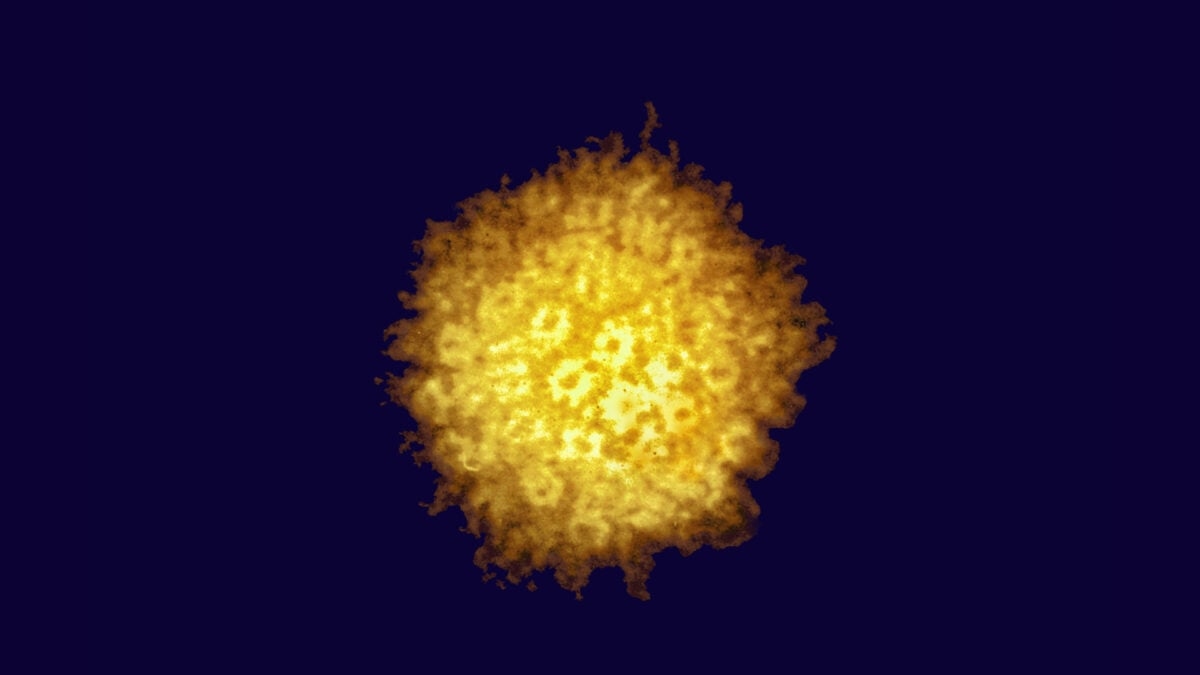
The Next Big Cancer Treatment Could Be Herpes
Researchers at the University of Southern California and others conducted the study, a Phase I/II trial of people with advanced, treatment-resistant melanoma. About a third of patients given the modified virus, in combination with immunotherapy, saw their tumors substantially shrink, while some even experienced a complete regression of their cancer. A larger, definitive trial of the experimental therapy, code-named RP1, is already underway, and the Food and Drug Administration will decide on an approval later this month.
Scientists have been intrigued about the promise of cancer-fighting, or oncolytic, viruses for over a century, according to study author Gino In, a medical oncologist at USC's Keck School of Medicine. But it's only recently that this potential has started to look within reach.
'Most progress has been made just in the last few decades, thanks to advances and progression in gene editing technologies, which have allowed researchers to specifically design oncolytic viruses that are more effective and safer,' In told Gizmodo.
HSV-1, the primary cause of cold sores, has emerged as a particularly promising candidate for cancer treatment. HSV-1 is a relatively large virus, meaning scientists can replace or add new genes without too much trouble. And though it does use our cells to replicate, like any virus, it doesn't insert its DNA into a cell's genome directly, eliminating the risk of certain mutations (an important consideration for safety). A typical HSV-1 infection also isn't life-threatening and can be treated with antiviral medications if needed, further limiting its potential danger.
These properties have allowed scientists to create strains of the virus that can selectively target cancer cells. The first herpes-based cancer therapy (T-VEC) was approved in the U.S. in 2015 for some cases of metastatic melanoma. But researchers like In are especially excited by the new generation of these treatments.
A Cancer-Fighting Version of Herpes Shows Promise in Early Human Trial
RP1 is the brainchild of biotech company Replimune, and it's one of several cancer-fighting viruses that the company is currently developing. Compared to the typical HSV-1 virus, RP1 has been weakened, meaning it shouldn't be able to cause severe infections. It's also been modified to not only target cancer cells, but to also boost the immune system's natural tumor-killing ability.
'These changes make RP1 both safer and better at killing cancer cells than natural HSV-1,' In explained. And while RP1 might be a viable treatment on its own, Replimune is also testing whether it can be even more effective when paired with other existing immunotherapies.
This latest study involved 140 patients from the company's IGNYTE trial of RP1 conducted across several sites, including at USC. The participants had late-stage melanoma that was unresponsive to earlier immunotherapy treatment. They received both RP1 and nivolumab, an immunotherapy drug commonly used for melanoma, every two weeks for up to four months. If patients responded to the initial treatment, they continued taking nivolumab alone for up to two years.
By the study's end, a third of patients saw their tumors decrease in size by at least 30%, the researchers found, and almost one in every six patients had their tumors disappear entirely. Importantly, this shrinkage was seen in tumors directly injected with RP1 as well as uninjected tumors throughout the body—indicating its immune-boosting potential worked as hoped. The combination therapy also appeared to be safe, with most patients only experiencing minor adverse events like fatigue or other flu-like symptoms.
The findings were presented earlier this year at the annual meeting of the American Society of Clinical Oncology and are set to be published soon in the Journal of Clinical Oncology.
'This study provides an important new approach for patients with immunotherapy-refractory melanoma; this is very important since about half of all melanoma patients do not benefit from immunotherapy,' said In. 'So it provides a new type of treatment, one that is both effective and well tolerated.'
Experimental Therapy Fights Brain Cancer with Modified Herpes Virus
Early trials are primarily intended to vet an experimental treatment's safety and optimal dosing, not its effectiveness. But given the general outlook of these normally untreatable cases, there's certainly reason to be optimistic here.
Last year, Replimune launched a Phase III trial that will test RP1 combined with nivolumab in around 400 people with treatment-resistant melanoma. But even before this study concludes, RP1 could become available to the public. In January, the FDA agreed to consider the combination therapy for accelerated approval, a process that allows a novel treatment to be tentatively approved with less direct evidence of its effectiveness (further trial data is still required to secure a full approval). The FDA's decision on RP1 is scheduled for July 22.
In and the USC team will continue to study their data to better understand how RP1 works. But they expect RP1 to become a new option for these resistant melanoma cases, and In notes that RP1 is also being tested for other kinds of cancer. If things keep going right, virus-based therapies like RP1 could soon become the next frontier of cancer treatment.

Try Our AI Features
Explore what Daily8 AI can do for you:
Comments
No comments yet...
Related Articles
Yahoo
 17 minutes ago
- Yahoo
XtalPi Signs MOU with Dong-A ST for Joint Research and Development of Immunology and Inflammation Therapies
CAMBRIDGE, Mass., Aug. 19, 2025 /PRNewswire/ -- XtalPi announced on the 20th that it signed a Memorandum of Understanding (MOU) with Korea's leading pharmaceutical company Dong-A ST, to jointly develop therapeutics for immunological and inflammatory diseases. This collaboration will be based on XtalPi's intelligent and automated drug discovery platform, which integrates artificial intelligence (AI), quantum physics, and large-scale automated robotic experiments. The two companies plan to co-identify targets and discover first-in-class or best-in-class drug candidates using XtalPi's proprietary AI-driven drug discovery platform. The XtalPi platform combines the speed and generative power of AI with the accuracy of its robotic lab-in-the-loop to accelerate drug discovery and vastly expand the explorable chemical space. This integrated workflow spans deep-learning-based molecule design, quantum physics and molecular dynamics simulations for predicting drug-target interactions, automated chemical synthesis, and experimental validation of candidate compounds' key pharmaceutical properties. Leveraging its expertise in immunology and inflammation as well as its experience in small molecule drug development, Dong-A ST will actively participate throughout the entire R&D process—including candidate validation, efficacy and safety testing, and the formulation of preclinical and clinical development strategies. The company also plans to explore strategies for pipeline expansion and assess commercialization potential. Through this partnership, Dong-A ST aims to strengthen its pipeline in the immunology and inflammation space and expand its R&D scope beyond small molecule therapeutics into areas such as targeted protein degradation (TPD), biologics, antibody-drug conjugates (ADC), and gene therapies. John Wang, Senior Vice President of Drug Discovery at XtalPi, stated: "The combination of Dong-A ST's extensive expertise and XtalPi's proven AI-robotics platform is well-positioned to translate scientific innovation into competitive precision medicines. Together, we aim to rapidly discover and rigorously validate novel drug candidates across multiple modalities to unlock unique market opportunities, and deliver transformative therapies for global patients." Jae-Hong Park, Head of R&D at Dong-A ST, remarked, "This collaboration marks a pivotal step in expanding Dong-A ST's R&D capabilities," adding, "By leveraging synergies with XtalPi's AI platform, we expect to accelerate the development of next-generation treatments for immune and inflammatory diseases." Meanwhile, both Dong-A ST and XtalPi operate open innovation offices in Boston, USA. This geographic proximity will facilitate closer and more efficient collaboration throughout the drug discovery process. About Dong-A ST Dong-A ST Co., Ltd. ( was established in 1932 and is a leading Korean pharmaceutical company engaged in the development, manufacturing, and commercialization of ethical drugs, biosimilars, medical devices, and diagnostics. Its key products include Stillen (gastritis), Zydena (erectile dysfunction), Motilitone (functional dyspepsia), and Imuldosa (ustekinuma biosimilar). Leveraging strong R&D capabilities and a history of innovation, Dong-A ST is expanding its pipeline in immunology, inflammation, neurological disease, metabolic diseases, and oncology, while advancing into new modalities such as biologics, ADCs, TPD, and gene therapies. About XtalPi XtalPi Holdings Limited (XtalPi, was founded in 2015 by three physicists from the Massachusetts Institute of Technology (MIT). It is an innovative R&D platform powered by quantum physics, artificial intelligence, and robotics. By integrating first-principles calculations, AI algorithms, high-performance cloud computing, and standardized automation systems, XtalPi provides digital and intelligent R&D solutions for companies in the pharmaceutical, materials science, agricultural technology, energy, new chemicals, and cosmetics industries. View original content to download multimedia: SOURCE XtalPi Inc. Sign in to access your portfolio


CNN
19 minutes ago
- CNN
FDA warns against eating certain shrimp sold at Walmart amid investigation into radioactive contamination
Federal agencies Food & healthFacebookTweetLink Follow The US Food and Drug Administration on Tuesday urged the public not to eat certain bags of frozen raw shrimp sold at Walmart, citing concerns about unsanitary conditions and radioactive contamination found in shipments from the same supplier. The FDA said that a radioactive isotope, cesium-137, was detected in a sample of breaded shrimp detained at US ports – in Los Angeles, Houston, Savannah, and Miami – from an Indonesian supplier named BMS Foods. Those contaminated shipments never reached the US market. However, because Walmart's raw frozen shrimp came from the same supplier – and the agency said it 'appears to have been prepared, packed, or held under insanitary conditions whereby it may have become contaminated with Cs-137' – officials advised consumers to avoid eating them. The levels of cesium detected – about 68 becquerels per kilogram – were well below the FDA's intervention level of 1,200 Bq/kg. Still, regulators issued the advisory out of caution, citing the potential risks of cancer from long-term, low-dose exposure and problems at the supplier's facility. The advisory applies to 2-pound Great Value bags of white vannamei shrimp, all carrying a best-by date of March 15, 2027. They were distributed to Walmart stores in at least 13 states: Alabama, Arkansas, Florida, Georgia, Kentucky, Louisiana, Missouri, Mississippi, Ohio, Oklahoma, Pennsylvania, Texas and West Virginia. The agency is advising consumers who purchased the shrimp to throw it away or return it, and, said an investigation is ongoing in conjunction with Indonesian seafood regulatory authorities. Walmart confirmed to CNN that it 'immediately recalled the product from impacted stores.' CNN has also reached out to the supplier for comment.
CNN
19 minutes ago
- CNN
FDA warns against eating certain shrimp sold at Walmart amid investigation into radioactive contamination
The US Food and Drug Administration on Tuesday urged the public not to eat certain bags of frozen raw shrimp sold at Walmart, citing concerns about unsanitary conditions and radioactive contamination found in shipments from the same supplier. The FDA said that a radioactive isotope, cesium-137, was detected in a sample of breaded shrimp detained at US ports – in Los Angeles, Houston, Savannah, and Miami – from an Indonesian supplier named BMS Foods. Those contaminated shipments never reached the US market. However, because Walmart's raw frozen shrimp came from the same supplier – and the agency said it 'appears to have been prepared, packed, or held under insanitary conditions whereby it may have become contaminated with Cs-137' – officials advised consumers to avoid eating them. The levels of cesium detected – about 68 becquerels per kilogram – were well below the FDA's intervention level of 1,200 Bq/kg. Still, regulators issued the advisory out of caution, citing the potential risks of cancer from long-term, low-dose exposure and problems at the supplier's facility. The advisory applies to 2-pound Great Value bags of white vannamei shrimp, all carrying a best-by date of March 15, 2027. They were distributed to Walmart stores in at least 13 states: Alabama, Arkansas, Florida, Georgia, Kentucky, Louisiana, Missouri, Mississippi, Ohio, Oklahoma, Pennsylvania, Texas and West Virginia. The agency is advising consumers who purchased the shrimp to throw it away or return it, and, said an investigation is ongoing in conjunction with Indonesian seafood regulatory authorities. Walmart confirmed to CNN that it 'immediately recalled the product from impacted stores.' CNN has also reached out to the supplier for comment.
