


Heading for Vatican, cardinal recalls Pope Francis' love for East Timor
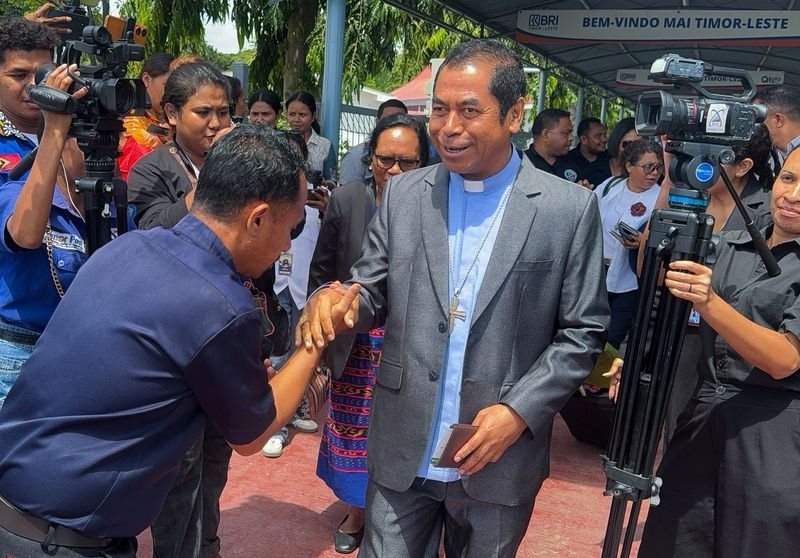
DILI, East Timor (Reuters) - The first ever cardinal of Roman Catholic-majority East Timor had barely had time to process the news of Pope Francis' death when he received the summons to attend the conclave that will elect the new pontiff half a world away in the Vatican.
More than 97% of East Timor's 1.3 million people are Roman Catholics, making it one of the largest majorities in the world. Along with the Philippines, it is also one of only two predominantly Christian countries in Asia.
Cardinal Virgilio do Carmo da Silva, 57, recalled the strong bond between Francis and the Timorese people in an interview with Reuters at the airport of Dili, East Timor's capital, before flying to Rome, some 12,500 km (7,500) miles away.
"'I'm in love with Timor'," Silva recalled Francis telling him during the pontiff's trip last year. More than 600,000 people - nearly half of East Timor's population - turned out then to see Francis.
Silva, who was made a cardinal by Francis in 2022, said he had been preparing to lead a Mass for the late pope when he received the missive from the Vatican to head to Rome.
"Probably, I will join the meeting on Thursday," Silva said, joking that he was already late.
Cardinals already in Rome decided on Tuesday that Francis' funeral would take place on Saturday, setting the stage for a solemn ceremony that will draw leaders from around the world.
A conclave to choose a new pope normally takes place 15 to 20 days after a pontiff's death, meaning it should not start before May 6. Some 135 cardinals are eligible to participate in the highly secretive ballot that can stretch over days.
"We need a good discernment. I'm happy to participate," said Silva.
Asked about the strongest candidates, he said it could be anyone, adding: "For myself I cannot come with a certain candidate in my mind."
At present there is no clear frontrunner to succeed Francis.
Francis often clashed with conservatives who saw him as overly liberal and too accommodating to minority groups such as the LGBTQ community.
"I think what we need (is) a pope who is not more conservative or more progressive, but somebody who is neutral in order to keep the Church going in that direction," Silva said.
"That's what's in my mind. But the others, I don't know what they think. There should be a balance."
(Reporting by Ananda Teresia in Dili; Writing by Gibran Peshimam; Editing by Gareth Jones)
Hashtags

Try Our AI Features
Explore what Daily8 AI can do for you:
Comments
No comments yet...
Related Articles

The Star
 3 hours ago
- The Star
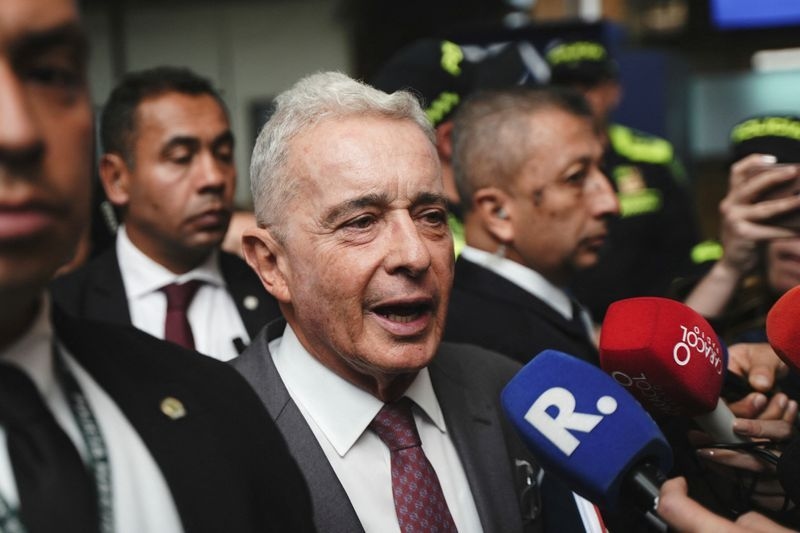
Court rejects house arrest for Colombia ex-president Uribe during appeal
FILE PHOTO: Former Colombian President Alvaro Uribe speaks to the press after attending his first criminal trial hearing, pleading not guilty to procedural fraud and witness bribery charges, in Bogota, Colombia February 10, 2025. REUTERS/Nathalia Angarita/File photo

The Star
4 hours ago
- The Star
Ukrainian attack cuts power in Russia-controlled Zaporizhzhia
Firefighters work at the site of a Russian missile strike, amid Russia's attack on Ukraine, in Zaporizhzhia, Ukraine August 18, 2025. REUTERS/Stringer (Reuters) -A Ukrainian drone attack late on Tuesday knocked out power to areas of Ukraine's Zaporizhzhia region under Russian control, the Moscow-installed governor said. Russian forces hold well over half of Zaporizhzhia region in Ukraine's southeast. But Kyiv maintains control of the region's main administrative centre and its attacks have periodically knocked out electricity in Russian-held areas. Russia in 2022 annexed the Zaporizhzhia region, along with neighbouring Kherson as well as Donetsk and Luhansk in Ukraine's east, about seven months after invading its smaller neighbour. "The reason for the power cuts in Zaporizhzhia region is yet another enemy terrorist drone attack on high-voltage equipment," Moscow-appointed Governor Yevgeny Balitsky wrote on the Telegram messaging app. Balitsky said repair crews were restoring power and switching affected areas to reserve lines. He said the work was made more difficult "by the danger of repeat strikes and by darkness". Ukrainian shelling and drone attacks knocked out power in June for more than 24 hours to at least 700,000 residents across the area. That attack appeared to be the largest of its kind on Russian-held territory since the war began. The Russian-held Zaporizhzhia nuclear power station, Europe's largest with six reactors, was operating as normal, unaffected by the power cuts, the plant's director of communications, Yevgenia Yashina, told Russia's RIA news agency. The plant produces no electricity but needs power for cooling and monitoring systems to maintain safety. Ukraine and Russia regularly accuse each other of staging attacks on the plant, seized by Russian forces in the first weeks of the February 2022 invasion. In the part of Kherson region under Ukrainian control, Governor Vyacheslav Prokudin said in a Telegram post that Russian shelling killed a resident of a small town north of the regional capital. And the governor of Ukraine's Dnipropetrovsk region, to the north, Serhiy Lysak, also said on Telegram that Russian shelling killed a resident of Nikopol, a frequent target of Moscow's attacks on the north bank of the Dnipro River. (Reporting by Ron Popeski; Editing by Cynthia Osterman)
The Star
9 hours ago
- The Star
Explainer-Does Trump have the power to ban mail-in ballots in U.S. elections?
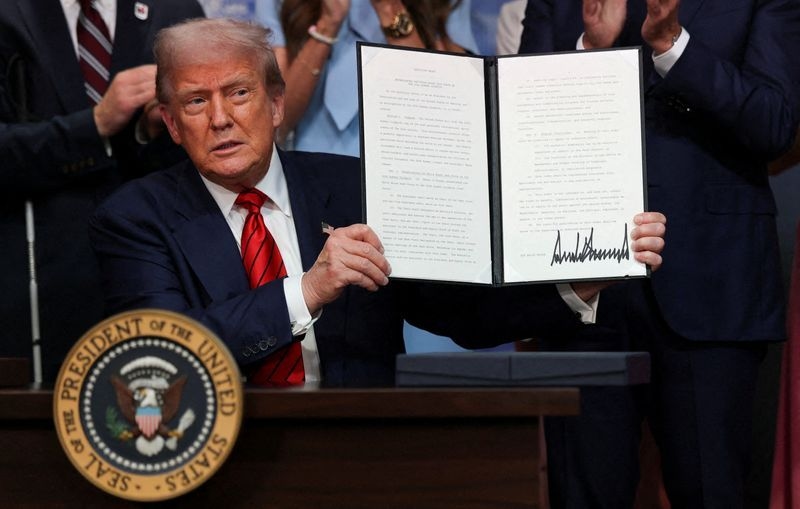
FILE PHOTO: U.S. President Donald Trump holds up an executive order in the South Court Auditorium on the White House campus in Washington, D.C., U.S., August 5, 2025. REUTERS/Jonathan Ernst/File Photo (Reuters) -U.S. President Donald Trump wants to ban mail-in ballots in federal elections, a form of voting popular with many Americans. About three in 10 ballots were cast through the mail in the 2024 general election, according to the U.S. Election Assistance Commission. Trump, a Republican, does not have clear legal authority to do this, though his allies in Congress and state governments could enact policies barring the practice. Here is a look at Trump's authority and how the law could be changed. CAN TRUMP UNILATERALLY BAN MAIL-IN BALLOTS? Only states and the U.S. Congress can pass laws regulating elections. A unilateral ban by the president on mail-in ballots would likely exceed Trump's limited authority to enforce existing law. In a Monday social media post, Trump said mail-in ballots are susceptible to fraud and that he would lead a movement to ban them, beginning with an executive order bringing "honesty" to the November 2026 midterm elections. Republicans have filed scores of lawsuits seeking to end mail-in voting in recent years, citing possible fraud. Democrats generally support mail-in ballots as a way to expand access to voting. Voter fraud in the U.S. is extremely rare, multiple studies have shown. White House representatives provided a general statement about Trump's election policies but did not answer questions about his legal authority to ban mail-in ballots or what an executive order would say. COULD TRUMP'S ALLIES BAN MAIL-IN BALLOTS? States are responsible for administering their votes under the U.S. Constitution, and Republican-controlled legislatures could pass laws banning mail-in ballots so long as they do not conflict with federal law. Congress could ban the use of mail-in ballots in federal elections and override state laws protecting their use, but Trump's Republican Party has slim majorities in Congress and would face difficulty getting past opposition by Democrats. Republicans hold 53 Senate seats. To pass a mail-in ballot ban they would need to end the filibuster, a longstanding tradition requiring 60 of the chamber's 100 members to approve most legislation. State and federal laws banning mail-in voting could be challenged in court as unconstitutional impediments to voting. WHAT OTHER POWERS DO PRESIDENTS HAVE OVER ELECTIONS? Presidents in the U.S. have some discretion in enforcing election laws, and Trump could try to use those powers to end or restrict mail-in voting, though it is unclear how. In June, a federal judge blocked parts of an executive order by Trump requiring voters to prove they are U.S. citizens and attempting to prevent states from counting mail-in ballots received after Election Trump administration is appealing. "The Constitution does not grant the president any specific powers over elections," said U.S. District Judge Denise Casper, an appointee of Democratic President Barack Obama. (Reporting by Jack Queen, editing by Ross Colvin and Rosalba O'Brien)
