


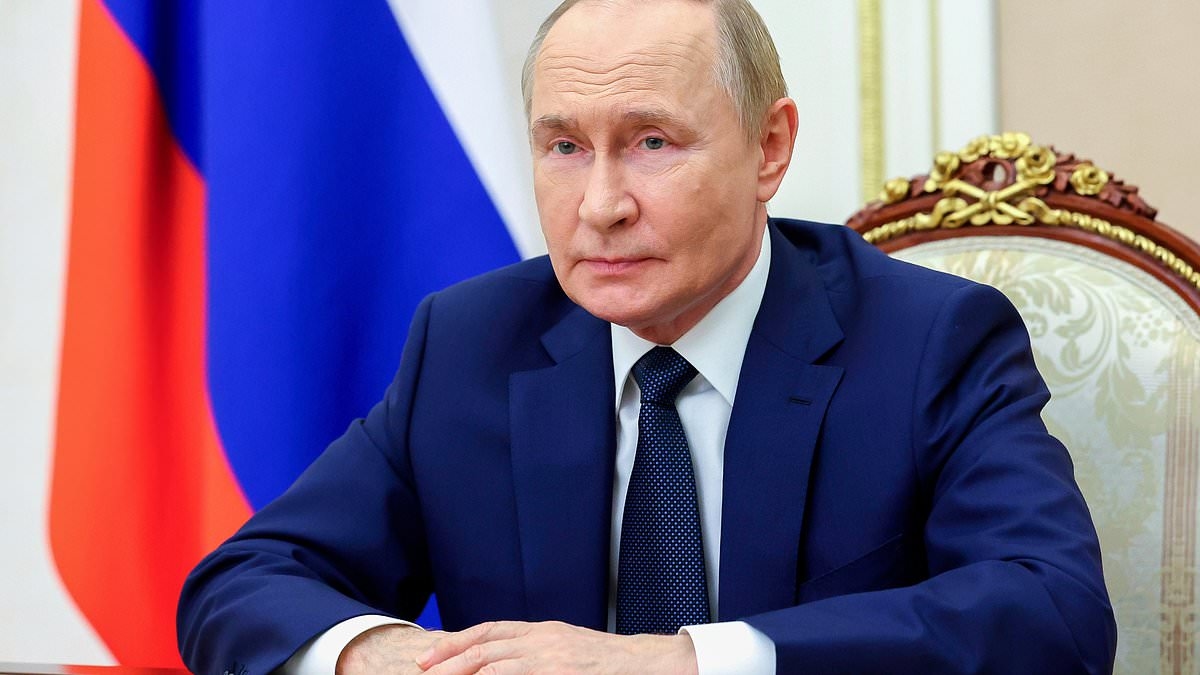
Is this the hot mic moment that gives away what REALLY happened at White House summit? Fears Putin will pull out of Ukraine talks as Trump commits to US security guarantees
The Kremlin branded a 40-minute phone call between Trump and Putin on Monday as 'frank' and only 'fairly constructive' - moments after the US President said on social media that he discussed plans for a summit in the next two weeks between the leaders of Russia and Ukraine.
Volodymyr Zelensky has also said that he's 'ready' to sit down for face-to-face talks with Vladimir Putin to end the Ukraine war.
It follows yesterday's extraordinary Oval Office love-in with Donald Trump that saw the two presidents swap praise and promises, a stark contrast to their explosive meeting in the same setting earlier this year.
The meeting was also attended by European leaders, including Keir Starmer, Italy 's Georgia Meloni and French President Emmanuel Macron.
But the tensions behind the scenes were seemingly revealed when Trump appeared to be reassuring French President Emmanuel Macron that Russian President Vladimir Putin was serious about making peace in Ukraine.
In a hot mic moment on Monday, President Donald Trump appeared to be reassuring French President Emmanuel Macron that Russian President Vladimir Putin was serious about making peace in Ukraine.
'I think he wants to make a deal. I think he wants to make a deal for me,' Trump whispered to Macron in the White House East Room before their meeting started. 'Do you understand that? As crazy as it sounds.' After the meeting, Trump also said that Putin 'had accepted security guarantees for Ukraine'.
Vladimir Putin has failed to commit to peace talks with fears growing he will drop out at the last minute
President Donald J. Trump on the phone with President Putin in the Oval Office. pic.twitter.com/RkWReNAT2b
— The White House (@WhiteHouse) August 19, 2025
Macron appeared skeptical that Putin was serious about ending the three and a half year conflict that Russia had started. But he later suggested that Geneva could host a peace meeting between Putin and Zelensky.
Meanwhile, the Finnish president also urged caution about the prospects for peace in Ukraine - as he labelled his Russian counterpart as 'untrustworthy'. Despite the meeting, Putin launched 270 drones and 10 missiles in an overnight attack.
Speaking after he left Trump's historic talks in the White House with Zelensky and other European leaders, Alexander Stubb said: 'Putin is rarely to be trusted.
'So now it remains to be seen whether he has the courage to come to this type of meeting.
'Does he have the courage to come to a trilateral meeting, or is he once again playing for time?'
Stubb's rhetoric was in stark contrast to that of President Trump who hailed the success of Monday's talks in the White House.
Mr Trump told reporters: 'If everything works out well, we will have a tri-lat [between himself, Zelensky and Putin] and have a good chance of ending the war.'
President Zelensky also said he is ready to sit down for face-to-face talks with Vladimir Putin at the extraordinary Oval Office love-in.
It comes as William Browder, an expert on Russian foreign policy, warned that Putin's life depends on the continuation of the Ukraine war.
Writing in Monday's Daily Mail, he said: 'For Vladimir Putin, an outbreak of peace means certain death–by assassination, overthrow and execution, or in an international prison cell as a war criminal.
'The Russian president's only credible hope of survival in the gangster state he has himself created is to prolong the "special military operation" in Ukraine or to win in such outrageously successful terms that he can turn his attention to other former client states, other victims.
'Survival, after all, was Putin's objective in launching the invasion in 2022.'
French president Emmanuel Macron, however, called for stepping up sanctions against Russia if Putin backtracks on peace in Ukraine.
He told reporters: 'President Trump believes we can get an agreement and believes that President Putin also wants a peace accord.
'But if at the end this process is met by refusal, we are also ready to say that we need to increase sanctions.'
Monday's meeting, which was praised by Zelensky as the best he had with Trump, saw the two presidents swap praises as they sought to make progress towards peace.
However, lots of questions remained unanswered early on Tuesday morning as to what that would look like or how it would come about.
Fresh from his Alaskan summit with Vladimir Putin, Mr Trump said he was prepared to provide military support to Kyiv in the event of a peace deal.
'We will give them very good protection, very good security,' the President said.
'There'll be a lot of help when it comes to security. It's going to be good.'
Mr Trump refused three times to rule out putting American boots on the ground though any assistance is more likely to come in the form of air support.
The hastily arranged scenes at the White House saw a contingent of European leaders, including Sir Keir Starmer, put summer holiday plans on hold to stand with Mr Zelensky.
They were locked in talks on Monday night as Mr Trump pledged they would 'come to a resolution today on almost everything, including probably security'.
He had earlier spent an hour with just his Ukrainian counterpart, presenting him with a giant battlefield map showing the 20 per cent of the country under Russian control.
The 'possible exchanges of territory, taking into consideration the current line of contact' was up for discussion, the President said.
Responding calmly to a provocative first question from an American journalist over whether he is prepared 'to keep sending Ukrainian troops to their deaths', Mr Zelensky said he was ready to sit down with Putin.
'We support the idea of the United States, of personally President Trump, to stop this war, to make a diplomatic way of finishing this war', he said. 'And we are ready for a trilateral, as the president said. This is a good signal about trilateral. I think this is very good.'
The meeting was a complete contrast to the pair's bust-up in February, which saw Mr Zelensky effectively kicked out of the White House, with the US President this time complimenting his opposite number for his 'fabulous' military-style suit.
Mr Trump opened graciously, saying it was 'an honour' to receive the Ukrainian President and that the two men have had 'a lot of good talks', making 'substantial progress'.
Mr Zelensky responded in turn, saying thank you seven times in his opening speech after he was dressed down by Vice President JD Vance for his supposed ingratitude over American support.
In another dramatic day of diplomacy over the future of Europe:
Sir Keir joined the leaders of France, Germany, Italy, Finland, the EU and NATO in supporting Mr Zelensky in an unprecedented day at the White House
The US President was due to phone Putin directly on Monday to update him on the talks
Any trilateral summit could be held between Putin, Mr Trump and Mr Zelensky as early as this week in Europe
Furious Russian officials on Monday accused Britain of undermining American efforts to end the conflict in Ukraine
Mr Zelensky arrived dressed in a black jacket, shirt, and trousers as he tried to show Mr Trump respect whilst not breaking his pledge to forego a suit until the end of the war.
The European leaders were each met by a guard of honour outside the White House as protesters outside waved placards reading: 'Do not abandon Ukraine.'
Mr Trump smiled as he personally greeted Mr Zelensky, shaking his hand before putting his arm around the Ukrainian President and ushering him inside.
Inside the Oval Office, Mr Zelensky deftly handed Mr Trump a letter from his wife, Olena Zelenska, for the First Lady Melania Trump to thank her for raising the plight of 20,000 Ukrainian children his forces have kidnapped with Putin.
But on hammering out a peace deal, Mr Trump admitted it's 'a tough one' saying while he has ended six wars he 'thought this maybe would be the easiest one... and it's not the easiest one.'
Of the wars he has ended, he said, none had come after a ceasefire, with a complete and lasting end to hostilities being his goal.
That was challenged by both Emmanuel Macron and Friedrich Merz, who pushed for a pause in the fighting before any future meetings.
Mr Trump responded by saying he liked the idea of an immediate ceasefire to 'stop the killing immediately,' but that would be left to Mr Zelensky and Putin.
At the end of the press conference, Mr Trump revealed he was going to call the Russian dictator straight after the meeting of leaders.
'I just spoke to President Putin indirectly, and we're going to have a phone call right after these meetings today, and we may or may not have a trilat,' he said.
'If we don't have a trilat, then the fighting continues, and if we do, we have a good chance.
'I think if we have a trilat, there's a good chance of maybe ending it. But he's expecting my call when we're finished with this meeting.'
There were hopes on Monday night that a summit between the three leaders could take place as early as this week in Europe.
While Mr Trump favours Rome, Moscow reportedly prefers Geneva.
It marks a remarkable turnaround, as there were growing fears of a cataclysmic breakdown of the trans-Atlantic alliance after Putin apparently succeeded in winning over Washington to his worldview in Alaska last Friday.
He appeared to get everything he wanted at the summit in Anchorage, with the Trump administration dropping its desire for an immediate ceasefire to halt the Russian advance and reportedly agreeing that Ukraine should cede all of the Donbas - a huge territory Moscow has failed to take for 12 years.
In a separate hot mic moment, a brief conversation between Italy's leader Giorgia Meloni, Finnish president Alexander Stubb and Trump. Meloni starts off by thanking Trump 'for being fair'. Stubb then asks if he does 'this everyday'. They then break into a side conversation where Trump says someone is a 'good golf player'.
JD Vance looks on during a meeting with US President Donald Trump and Ukrainian President Volodymyr Zelensky
Trump, centre, speaks with Italy's Prime Minister Giorgia Meloni, right, and France's President Emmanuel Macron, left
Meanwhile, Mr Trump blasted back at his 'stupid critics' before on Monday night's gathering, writing on his Truth Social platform: 'I know exactly what I'm doing.'
Speaking on board his flight to Washington earlier in the day, Sir Keir insisted that 'we've got to get this right'.
He said: 'This war in Ukraine has been going on for a really long time now, three-plus years.
'It's hugely impacted the Ukrainians who've suffered hugely but it's also affected Europe - it's impacted every single family and community in the United Kingdom.
'And so everybody wants it to end, not least the Ukrainians, but we've got to get it right. We've got to make sure there is peace, that it is lasting peace, that it is fair and that it is just.'
Hashtags

Try Our AI Features
Explore what Daily8 AI can do for you:
Comments
No comments yet...
Related Articles


The Guardian
 35 minutes ago
- The Guardian
Ukraine war briefing: Squeeze on Putin to accept direct peace talks with Zelenskyy
The Russian leadership continued to obfuscate on Wednesday, after European leaders and Donald Trump said Vladimir Putin had agreed to a one-on-one meeting with Volodymyr Zelenskyy to kickstart peace talks. Sergei Lavrov said Moscow did not reject any format for Ukraine peace talks but the Russian foreign minister appeared to apply the brakes, saying any leaders' meeting 'must be prepared with utmost thoroughness'. On Tuesday, a Kremlin aide said only that Putin was open to the 'idea' of 'raising the level of representatives of the Ukrainian and Russian sides' at a future meeting. The White House also announced that Viktor Orbán, the pro-Putin Hungarian prime minister, and Trump had discussed the possibility of talks being held in Budapest. As with the Kremlin, there was no apparent confirmation of this conversation from the Hungarian side. A war crimes warrant could oblige Hungarian authorities to arrest a visiting Putin, but Hungary is withdrawing from the international criminal court. Orbán explicitly committing to play host could place unwanted pressure on the Russian ruler from one of his few allies to accept the meeting as an inevitability. Austria and Switzerland also said they would be ready to host the meeting. Switzerland said that during Putin's visit it could set aside its international criminal court obligations. 'This has to do with our diplomatic role, with international Geneva as [the European] headquarters of the United Nations,' said Ignazio Cassis, the Swiss foreign minister. The French president, Emmanuel Macron, said Geneva was a potential location for the talks. The Austrian chancellor, Christian Stocker, said his country supported any initiative leading to a just and lasting peace protecting Ukrainian and European security. Donald Trump has ruled out sending US troops to Ukraine to enforce a potential peace deal, tempering a promise to provide Kyiv with security guarantees in conjunction with European allies, write Andrew Roth and Pjotr Sauer. In a phone interview with Fox News, Trump did however say that Washington may be willing to provide air support to Ukraine in order to backstop a deal, in what would still be a remarkable shift in his administration's policy on the conflict. Putin opposes Ukraine joining Nato – Trump told Fox that 'there'll be some form of security. It can't be Nato. They're willing to put people on the ground. We're willing to help them with things, especially, probably, if you could talk about by air.' Trump conceded that Putin might not want to make a deal after all, saying: 'We're going to find out about President Putin in the next couple of weeks.' Nato military leaders are expected to meet on Wednesday to discuss Ukraine and the way forward, a US official and Nato official have told the Reuters news agency. The US official, speaking on condition of anonymity, said Gen Dan Caine, chair of the US joint chiefs of staff, was expected to teleconference in, but plans could still change. The Pentagon did not immediately respond to a request for comment. Another Nato official said the alliance's top military commander, Alexus Grynkewich, would brief the leaders on the results of the Alaska meeting between Trump and Putin last week. Following Monday's meeting in Washington, Russia launched its biggest air assault in more than a month on Ukraine, with 270 drones and 10 missiles fired, the Ukrainian air force said. The energy ministry said the strikes caused big fires at energy facilities in the central Poltava region, home to Ukraine's only oil refinery. The governor of Ukraine's Dnipropetrovsk region, Serhiy Lysak, said Russian shelling killed a resident of Nikopol, a frequent target of Moscow's attacks. A Ukrainian drone attack late on Tuesday knocked out power to Russian-controlled areas of Ukraine's Zaporizhzhia region, said the Moscow-installed governor, Yevgeny Balitsky. Kyiv maintains control of the region's main administrative centre and its attacks have periodically knocked out electricity in Russian-held areas. The illegally occupied Zaporizhzhia nuclear power station was unaffected, the plant's director told Russia's RIA news agency. The plant produces no electricity but needs power for cooling and monitoring systems to maintain safety. Russia and Ukraine exchanged more bodies of their war dead, the Moscow-run Tass news agency reported on Tuesday, citing a source. Moscow handed over the bodies of 1,000 Ukrainian soldiers and had received 19 bodies of its own fallen soldiers in return, it was reported. Ukraine appeared to confirm the exchange.

The Guardian
36 minutes ago
- The Guardian
There is no ‘Trump Doctrine' in foreign policy. Just chaos
All the elaborate efforts of the European allies to prevent Donald Trump from prostrating himself before Vladimir Putin came to naught at their summit meeting in Alaska. Flattering, coddling and petting the big baby appeared to have been in vain. Before the 15 August summit, the Europeans persuaded Trump to impose new sanctions if Putin would not agree to a ceasefire, which would serve as a prerequisite for any negotiations. But Trump willfully tossed policy like a stuffed animal out of the window of 'the Beast,' the presidential car as he eagerly invited Putin to join him for a triumphant chariot ride. The Europeans scrambled once again, trying to get the addled Trump back on the page he was on before the summit. Ukraine's president, Volodymyr Zelenskyy, sped to Washington to confer with Trump to try to pick up the pieces. At their last encounter, Trump jibed: 'You don't have any cards.' But Trump had just handed over his cards to Putin. Zelenskyy was not about to play the appeasement card. The European leaders gathered in an extraordinary posse to accompany Zelenskyy in an attempt to restore a unified western position. Unlike the last Zelenskyy meeting with Trump, he was not hectored. With the Ukrainian leader urrounded by a protective phalanx, Trump made agreeable sounding but vague gestures about a future summit with both Zelenskyy and Putin. Trump seemed favorable, if indefinite and imprecise, about western forces stationed in Ukraine to maintain its sovereignty. But the notion of a ceasefire, pressed again by the French president, Emmanuel Macron, and German chancellor, Friedrich Merz, had evaporated. While the European recovery effort took place at the White House, Russian bombs rained down. Trump dreams of receiving the Nobel peace prize. Before the summit, he called the Norwegian finance minister to lobby him. In Alaska, Trump melted again in the presence of Putin while the whole world was watching. The self-abasing embarrassment of his previous meeting in Helsinki in 2018 did not serve as a cautionary precedent. Now, he invited the sanctioned war criminal to US soil. He ordered uniformed US soldiers to roll out the red carpet, 'the beautiful red carpet' as the Russian foreign ministry called it. He applauded when Putin stood next to him. He patted Putin's hand when he clasped it with an affectionate gesture. Then the door of 'the Beast' opened for Putin. Trump's personal negotiator for the summit, Steve Witkoff, a New York real estate operator whose knowledge of Russian culture to prepare him for his delicate role may had been a bowl of borscht at the Russian Tea Room on 57th Street, was easy prey for Putin. Bild, the German newspaper, reported on 9 August that Witkoff had committed an 'explosive blunder'. According to Bild, Putin 'did not deviate from his maximum demand to completely control the five Ukrainian regions of Donetsk, Luhansk, Zaporizhzhia, Kherson and Crimea before the weapons remain silent … And even worse: Trump's special envoy Witkoff is said to have completely misunderstood some of the Russians' positions and misinterpreted them as an accommodation by Putin. He had misunderstood a 'peaceful withdrawal' of the Ukrainians from Kherson and Zaporizhzhia demanded by Russia as an offer of 'peaceful withdrawal' of the Russians from these regions'. 'Witkoff doesn't know what he's talking about,' a Ukrainian government official told Bild. An assessment that, according to Bild information, is also shared by German government representatives. Bild further reported: 'There was a telephone conference on Thursday evening between representatives of the US government – including the special envoy Witkoff and Foreign Minister Marco Rubio and Vice President JD Vance – and the European partners. As BILD learned, the American side was perceived as chaotic and ununited. This was primarily due to Witkoff, whose remarks about his conversation with Putin on Wednesday in the Kremlin were perceived as confusing. He himself seemed overwhelmed and incompetent to the Europeans when he spoke about the territorial issues in Ukraine.' The German newspaper also reported friction between Rubio and Vance, with the vice-president seeking to shut the European allies out of the process and Witkoff taking his side against the secretary of state. 'Apparently, there was also disagreement about the further course of action between Witkoff and Rubio, as the foreign minister emphasized that the Europeans should be involved in the further process, while Vance and Witkoff only wanted to inform Europe of the results of the further Trump steps.' Bild's report on Putin's position turned out to be completely accurate and its description of the Trump administration's unsettled position prophetic of the fiasco that would unfold. Little noticed in the US media accounts, Trump had presented Putin with enormous economic advantages, according to the Telegraph. He offered access to valuable Alaskan natural resources, opportunities to tap into the US portion of the Bering Strait, which would boost Russia's interests in the Arctic region. Trump promised to lift sanctions on Russia's aircraft industry, which would permit Russian airlines (and by extension the Russian air force) to return to US suppliers for parts and maintenance. Trump would give Putin approval for access to rare earth minerals in Ukrainian territories currently under Russian occupation. In Trump's new world order, Putin would be his partner, especially on the frontier of the Arctic, while Trump waged a trade war imposing harsh tariffs on every other nation. Ukraine stood as an obstacle to the gold rush. According to the Telegraph, Witkoff suggested to the Russians: 'Israel's occupation of the West Bank could be used as a model for ending the war. Russia would have military and economic control of occupied [parts of] Ukraine under its own governing body, similar to Israel's de facto rule of Palestinian territory.' Then, after Trump laid on lavish treatment for the Russian dictator at the US military base, marking his indifference to international condemnation, came the joint appearance, which exceeded the Helsinki disaster. An elated Putin and dejected Trump appeared on stage together. The announced joint press conference was a theater of the absurd. Its brevity contributed to the farce. There was no agreement, no plan for an agreement, and no press conference. Trump deferred to Putin to speak first, to set the tone and terms after which he would come on as the second banana to slip on the peel. A clearly delighted Putin reiterated his belief that Ukraine was a security threat to Russia, and that 'we need to eliminate all the primary roots, the primary causes of that conflict,' which was his language for the elimination of an independent and democratic Ukraine. He blamed Biden for the war he had launched. He affirmed Trump's presumptuous boast that there would have been no war had he been president. 'Today, when President Trump is saying that if he was the president back then, there would be no war, and I'm quite sure that it would indeed be so. I can confirm that.' A clearly glum Trump stepped to his podium. 'So there's no deal until there's a deal,' he said. He had pledged during the 2024 campaign that he could and would end the war on 'day one'. It had taken him 210 days to reach the 'No Deal'. Trump wistfully talked about doing business with Russia, his will-o'-the-wisp ambition since he attempted for decades to build a Trump Tower in Moscow even through the 2016 election. He threw Putin a bouquet. 'I've always had a fantastic relationship with President Putin, with Vladimir.' He blamed their inability to monetize their relationship to the inquiries that extensively documented Putin's covert efforts in the 2016 election to help Trump. 'We were interfered with by the Russia, Russia, Russia hoax,' Trump complained. He would not let it go, drifting incoherently into his grievances. 'He knew it was a hoax, and I knew it was a hoax, but what was done was very criminal, but it made it harder for us to deal as a country, in terms of the business, and all of the things that would like to have dealt with, but we'll have a good chance when this is over.' Then, Trump praised the Russian officials accompanying Putin. Chief among them was the foreign minister, Sergei Lavrov, who had arrived wearing a sweatshirt embossed with the Cyrillic letters 'CCCP', standing for the Union of Soviet Socialist Republics, signaling Putin's ultimate objective to restore the empire of the Soviet Union. The message was more than nostalgia; it was a mission statement. And Trump called Putin 'the Boss', not a reference to Bruce Springsteen. 'Next time in Moscow,' said Putin. The press conference was over. There were no questions. There were no answers. Trump fled from the stage. Before the summit, Trump threatened new sanctions if Putin did not agree to a ceasefire, but now he forgot he had ever said that. He spoke loudly and carried a tiny stick. On Air Force One, on the return to Washington, he gave an exclusive interview to his lapdog, Sean Hannity of Fox News, along on the ride for this purpose. Trump reverted to his tacit support for Putin's position. He put the burden on Zelenskyy to accede to Putin's demands, which were unchanged. Then, Trump spiraled down a wormhole, obviously anxious about his growing unpopularity and the prospect of the Democrats winning the congressional midterm elections, which has prompted him to prod the Texas Republicans to gerrymander districts and California Democrats aroused to counter it in their state. 'Vladimir Putin, smart guy, said you can't have an honest election with mail-in voting,' said Trump. 'Look at California with that horrible governor they have. One of the worst governors in history. He is incompetent, he doesn't know what he is doing.' Is this a subject that Putin actually spoke about in their discussion? Has he had experience with mail-in voting or even know what it is? Was it brought up by Trump during their car ride? Or was Trump simply making it up for his gullible Fox News audience? Whatever the reality, Trump's fear about losing control of domestic politics was at the top of his mind as he flew away from his charade in Anchorage. The shambolic scene left in Alaska represented the wreckage of Trump's attempt at diplomacy. Setting the stage himself, Trump babbled, whined and weakly sided with Putin. Trump's foreign policy team was exposed as incompetent, confounded and feckless. This was no best and the brightest, no rise of the Vulcans, but the circus of the Koalemosians, after Koalemos, the Greek god of stupidity. Apologists for Trump, in advance of this exemplary event, had suggested that there was such a conceit as a Trump doctrine. A former Trump official from his first term, A Wess Mitchell, has called it 'The Return of Great Power Diplomacy' in the May/June issue of Foreign Affairs. He described 'a new kind of diplomacy' that is 'diplomacy in its classical form' and 'an instrument of strategy'. He cited an ancient Spartan king, Archidamus II, the Roman Emperor Domitian, Cardinal Richelieu, and in his mélange did not neglect to throw in Metternich and Bismarck. (Kissinger, in his grave, must be weeping over the parading of Metternich's mannequin as a forerunner of Trump. Mitchell, in any case, dismisses Kissinger as a fake realist and an 'idealist', which would have been a revelation to Kissinger.) Left out of Mitchell's pantheon of great diplomatic influences through the ages is the influencer Laura Loomer, the loony far-right troll who has an open door to Trump, feeding him lists of national security officials he must purge. In Putin's shadow, Trump was bared as having no larger or smaller concept or strategy of Great Power politics. It would be unfair to accuse Trump of having an idea beyond his self-aggrandizement. If anything, he aspires to be like Putin, whom he called a 'genius' after his invasion of Ukraine. Putin has created and controls a vast kleptocracy. In 2017, Bill Browder, an American businessperson who had invested in Russia and has been targeted for assassination by Putin for exposing his corruption, testified before the Senate judiciary committee that Putin was 'the biggest oligarch in Russia and the richest man in the world'. Nobody, however, knows Putin's true personal wealth. Trump, the Putin manqué, is trying to turn the United States into a kleptocratic system. According to the calculations of David D Kirkpatrick in the New Yorker, in just six months of his second term his alleged personal profiteering, 'would disappoint the haters who saw Trump as a Putin-level kleptocrat. Yet some three and a half billion dollars in Presidential profits – even though my accounting is necessarily approximate – is a dizzying sum.' Meanwhile, three days before the Trump-Putin summit, the Trump family crypto business, World Liberty Financial, raised $1.5bn to buy the Trump family token. The CEO of World Liberty Financial, Zach Witkoff, son of Steve Witkoff, along with Eric Trump of WLF, will join the board of the investing company. That is the Trump doctrine. Sidney Blumenthal, former senior adviser to President Bill Clinton and Hillary Clinton, has published three books of a projected five-volume political life of Abraham Lincoln: A Self-Made Man, Wrestling With His Angel and All the Powers of Earth. He is a Guardian US columnist

Rhyl Journal
39 minutes ago
- Rhyl Journal
Trump offers assurances that US troops will not be sent to help defend Ukraine
Mr Trump also said in a morning TV interview that Ukraine's hopes of joining Nato and regaining the Crimean Peninsula from Russia are 'impossible'. The Republican president, Ukrainian president Volodymyr Zelensky and other European leaders held hours of talks at the White House on Monday aimed at bringing an end to Russia's war against Ukraine. While answering questions from journalists, Mr Trump did not rule out sending US troops to participate in a European-led effort to defend Ukraine as part of security guarantees sought by Mr Zelensky. Mr Trump said after his meeting in Alaska last week with Vladimir Putin that the Russian leader was open to the idea of security guarantees for Ukraine. But asked on Fox News Channel's Fox & Friends what assurances he could provide going forward and beyond his term that American troops would not be part of defending Ukraine's border, Mr Trump said: 'Well, you have my assurance, and I'm president.' Mr Trump would have no control over the US military after his terms ends in January 2029. Speaking later, White House press secretary Karoline Leavitt said that 'US boots will not be on the ground' as part of any potential peacekeeping mission. The president also said in the interview that he is optimistic that a deal can be reached to end the Russian invasion, but he underscored that Ukraine will have to set aside its hope of getting back Crimea, which was seized by Russian forces in 2014, and its long-held aspirations of joining the Nato military alliance. 'Both of those things are impossible,' Mr Trump said. Mr Putin, as part of any potential deal to pull his forces out of Ukraine, is looking for the withdrawal of Ukrainian troops from the Donetsk and Luhansk regions, as well as recognition of Crimea as Russian territory. Mr Trump said on Monday that he was arranging for direct talks between Mr Putin and Mr Zelensky. But the Kremlin has not yet said whether Mr Putin, who has resisted previous calls by Mr Trump and others for direct negotiations on ending the war, is committed to a face-to-face meeting with the Ukrainian leader. Asked whether Mr Putin had promised Trump that he would meet directly with the Ukrainian leader, Ms Leavitt responded affirmatively. 'He has,' she said of Mr Putin. Mr Trump, early on Monday during talks with Mr Zelensky and European leaders, said that he was pressing for three-way talks among Mr Zelensky, Mr Putin and himself. But after speaking to Mr Putin later in the day, Mr Trump said that he was arranging first for a face-to-face between Mr Zelensky and Mr Putin and that three-way talks would follow if necessary. 'It was an idea that evolved in the course of the president's conversations with both President Putin, President Zelensky and the European leaders yesterday,' Ms Leavitt said. But when discussing a phone call held after the meeting between Mr Trump and the Russian leader, Mr Putin's foreign affairs adviser Yuri Ushakov gave no indication that either a bilateral or a trilateral meeting with Ukraine had been agreed. Mr Trump said he believed Mr Putin's course of action would become clear in the coming weeks. 'I think Putin is tired of it,' Mr Trump said. 'I think they're all tired of it. But you never know. We're going to find out about President Putin in the next couple of weeks. That I can tell you.' Later on Tuesday, Senator Lindsey Graham told The Associated Press in a phone interview that if peace talks between Ukraine and Russia are not 'moving in the right direction' by the time Congress returns next month, then 'Plan B needs to kick in'. For months, the Republican senator has been pressing Mr Trump to support a bipartisan sanctions bill that would impose steep tariffs on countries helping fund Russia's war. On Tuesday morning, following a phone call with Mr Trump, Mr Graham signalled the president may now be willing to back the effort. 'Trump believes that if Putin doesn't do his part, that he's going to have to crush his economy. Because you got to mean what you say,' Mr Graham told reporters in South Carolina earlier on Tuesday.
