


Six Americans arrested for trying to smuggle rice into North Korea
The Americans, missionaries aged from their 20s to 50s, were apprehended on front-line Gwanghwa Island about 1.06am on Friday, local time.
Cops grabbed them before they could throw the bottles into the sea so they could float toward North Korean shores on the tides, two Gwanghwa police officers alleged.
They said the Americans are being investigated on allegations they violated the law on the management of safety and disasters.
The officers, who requested anonymity because they weren't authorized to speak to media on the issue, refused to provide personal details of the Americans in line with privacy rules.
Gwanghwa police said they haven't yet found what is on the USB sticks.
'Because the suspects do not speak Korean fluently, we plan to conduct further questioning with the assistance of an interpreter,' they said.
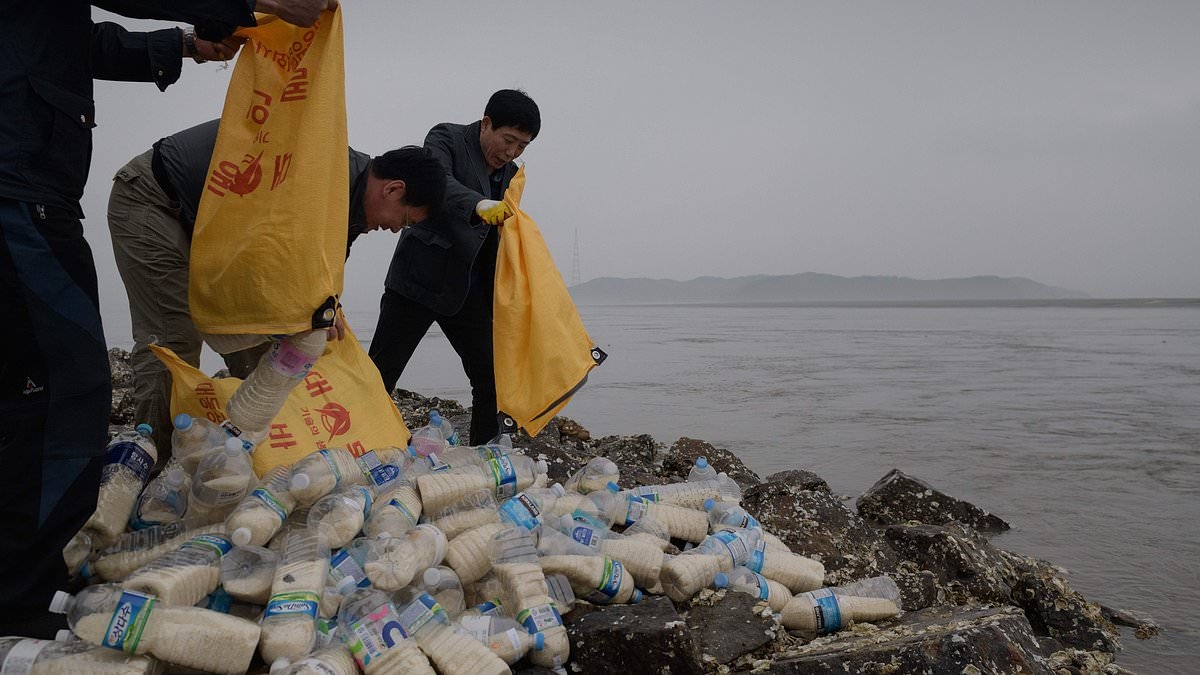
Plastic bags containing Bible passages are prepared prior to being thrown into the sea by North Korean defector activists on Ganghwa island, west of Seoul on May 1, 2018
The US Embassy in South Korea had no immediate public comment.
For years, activists have sought to float plastic bottles or fly balloons across the border carrying anti-North Korea propaganda leaflets and USB thumb drives carrying South Korean dramas and K-pop songs.
This practice that was banned from 2021-2023 over concerns it could inflame tensions with the North.
North Korea responded to previous balloon campaigns with fiery rhetoric and other shows of anger.
Last year the country launched its own balloons across the border, dumping rubbish on various South Korean sites including the presidential compound.
South Korea´s Constitutional Court struck down a controversial law in 2023 that criminalized the sending of leaflets and other items to North Korea, calling it an excessive restriction on free speech.
But since taking office in early June, the new liberal government of President Lee Jae Myung is pushing to crack down on such civilian campaigns with other safety-related laws to avoid a flare-up tensions with North Korea and promote the safety of frontline South Korean residents.
Police detained an activist on June 14 for allegedly flying balloons toward North Korea from Gwanghwa Island.
Police created a dedicated task force to prevent items crossing the border into the North, in response to Friday's arrests.
'We will strengthen coordination with relevant bodies to completely block these leaflet operations and respond strictly to any violations according to the law,' they said.
Lee took office with a promise to restart long-dormant talks with North Korea and establish peace on the Korean Peninsula.
Lee's government halted frontline anti-Pyongyang propaganda loudspeaker broadcasts to try to ease military tensions.
North Korean broadcasts have not been heard in South Korean front-line towns since then.
But it's unclear if North Korea will respond to Lee's conciliatory gesture after vowing last year to sever relations with South Korea and abandon the goal of peaceful Korean reunification.
Official talks between the Koreas have been stalled since 2019, when US-led diplomacy on North Korean denuclearization derailed.
Hashtags

Try Our AI Features
Explore what Daily8 AI can do for you:
Comments
No comments yet...
Related Articles


The Independent
 41 minutes ago
- The Independent
North Korean leader's sister says her country will never see the South as a diplomatic partner
The powerful sister of North Korean leader Kim Jong Un said her country will never see South Korea as a partner for diplomacy, state media reported on Wednesday in what was her latest taunt of Seoul's new efforts to mend ties. Kim Yo Jong, who is one of her brother's top foreign policy officials, denounced the ongoing South Korea-U.S. military drills as a 'reckless' invasion rehearsal and claimed Seoul's peace gestures conceal a 'sinister intention' against Pyongyang. Her comments came during a meeting on Tuesday with senior Foreign Ministry officials about her brother's diplomatic strategies in the face of persistent threats from rivals and a rapidly shifting geopolitical landscape, the North's official Korean Central News Agency said. On Monday, Kim Jong Un condemned the South Korean-U.S. military drills and vowed a rapid expansion of his nuclear forces as he inspected his most advanced warship being fitted with nuclear-capable systems. The North's news agency said Kim Yo Jong condemned the South as the 'top-class faithful dog' of the United States and that the reparation of inter-Korean relations desired by Seoul 'will never' happen. The siblings' back-to-back statements followed the latest outreach by South Korean President Lee Jae Myung, who said last week that Seoul would seek to restore a 2018 inter-Korean military agreement aimed at reducing border tensions, while urging Pyongyang to reciprocate by rebuilding trust and resuming dialogue. Since taking office in June, Lee has moved to repair relations that worsened under his conservative predecessor's hard-line policies, including removing front-line speakers that broadcast anti-North Korean propaganda and K-pop. In a nationally televised speech Friday, Lee said his government respects North Korea's current system and that the wealthier South 'will not pursue any form of unification by absorption and has no intention of engaging in hostile acts.' But he also stressed that the South remains committed to an international push to denuclearize the North and urged Pyongyang to resume dialogue with Washington and Seoul. Angered by expanding South Korean-U.S. military drills, Kim Jong Un last year declared that North Korea was abandoning long-standing goals of a peaceful unification with South Korea and rewrote the North's constitution to mark the South as a permanent enemy. Kim Yo Jong has repeatedly dismissed calls to revive negotiations aimed at winding down the North's nuclear and missile programs, which derailed in 2019 following her brother's collapsed summit with U.S. President Donald Trump during his first term. Since Russia's invasion of Ukraine, Kim Jong Un has made Moscow the priority of his foreign policy, sending troops and weapons to support President Vladimir Putin's war, while also using the conflict as a distraction to accelerate his military nuclear program. In her meeting on Tuesday, Kim Yo Jong suggested that Pyongyang seeks to compete with Seoul diplomatically, claiming the South 'will not even have a subordinate role in the regional diplomatic arena,' which she claimed will be centered on the North.


Reuters
an hour ago
- Reuters
Bessent says US has had very good talks with China on tariffs
Aug 19 (Reuters) - Treasury Secretary Scott Bessent told Fox News on Tuesday that the United States has had very good talks with China regarding tariffs as the countries attempt to reach a trade deal during a 90-day pause in tariff implementation. "China is right now the biggest revenue line in the tariff income," Bessent said in an interview on Fox News' "The Ingraham Angle" show. "We have had very good talks with China, I imagine we will be seeing them again before November," he added. "I think right now the status quo is working pretty well," Bessent said.

Reuters
2 hours ago
- Reuters
China's growing nuclear arsenal
HONG KONG, Aug 20 (Reuters) - Alongside a massive build-up in conventional military firepower, China has embarked on a rapid and sustained increase in the size and capability of its nuclear forces, according to the U.S. military and arms control experts. The commander of the U.S. Strategic Command, General Anthony Cotton, told Congress in March that the directive from Chinese leader Xi Jinping that China's military be ready to seize Taiwan by 2027 was driving a build-up of nuclear weapons that could be launched from land, air and sea. In its 2023 national defense policy, China renewed its longstanding pledge that it would not be the first to use nuclear weapons under any circumstances. The so-called 'no first use' policy also includes a promise that China will not use or threaten to use nuclear weapons against a non-nuclear armed state. In response to questions, the defense ministry in Beijing said 'a nuclear war cannot be won and must not be waged.' China, it said, adhered to a 'nuclear strategy of self-defense and pursues a no-first-use policy.' [Read the special report on Japan and South Korea's shifting nuclear policies.] In its annual report on Chinese military power, the Pentagon said despite China's public stance, its strategy probably includes a possible first use in response to conventional attacks that threaten the viability of its nuclear forces, command and control or that approximates the effect of a nuclear strike. Beijing would also probably consider nuclear first use if a conventional military defeat in Taiwan 'gravely threatened' the Communist regime's survival, the Pentagon said in the report published late last year. China's defense ministry said it opposed 'any attempt to hype up the so-called 'Chinese nuclear threat' in an effort to smear and defame China and deliberately mislead the international community.' China is expanding and modernizing its weapons stockpile faster than any other nuclear-armed power and has accumulated about 600 warheads, according to the Bulletin of the Atomic Scientists, a Chicago-based non-profit. It said China is building about 350 new missile silos and several new bases for road mobile launchers. It estimated that China's military, the People's Liberation Army, had about 712 launchers for land-based missiles but not all were assigned for nuclear weapons. Of those launchers, 462 can be loaded with missiles 'that can reach the continental United States,' it said. Many of the PLA's launchers are for shorter range missiles intended to attack regional targets but most of those were not assigned for a nuclear strike, the Bulletin's assessment said. In its report, the Pentagon estimated that the PLA would have more than 1,000 operational nuclear warheads by 2030, as it seeks to build a bigger force ranging from low-yield precision strike missiles to intercontinental ballistic missiles with multi-megaton explosive impact.
