


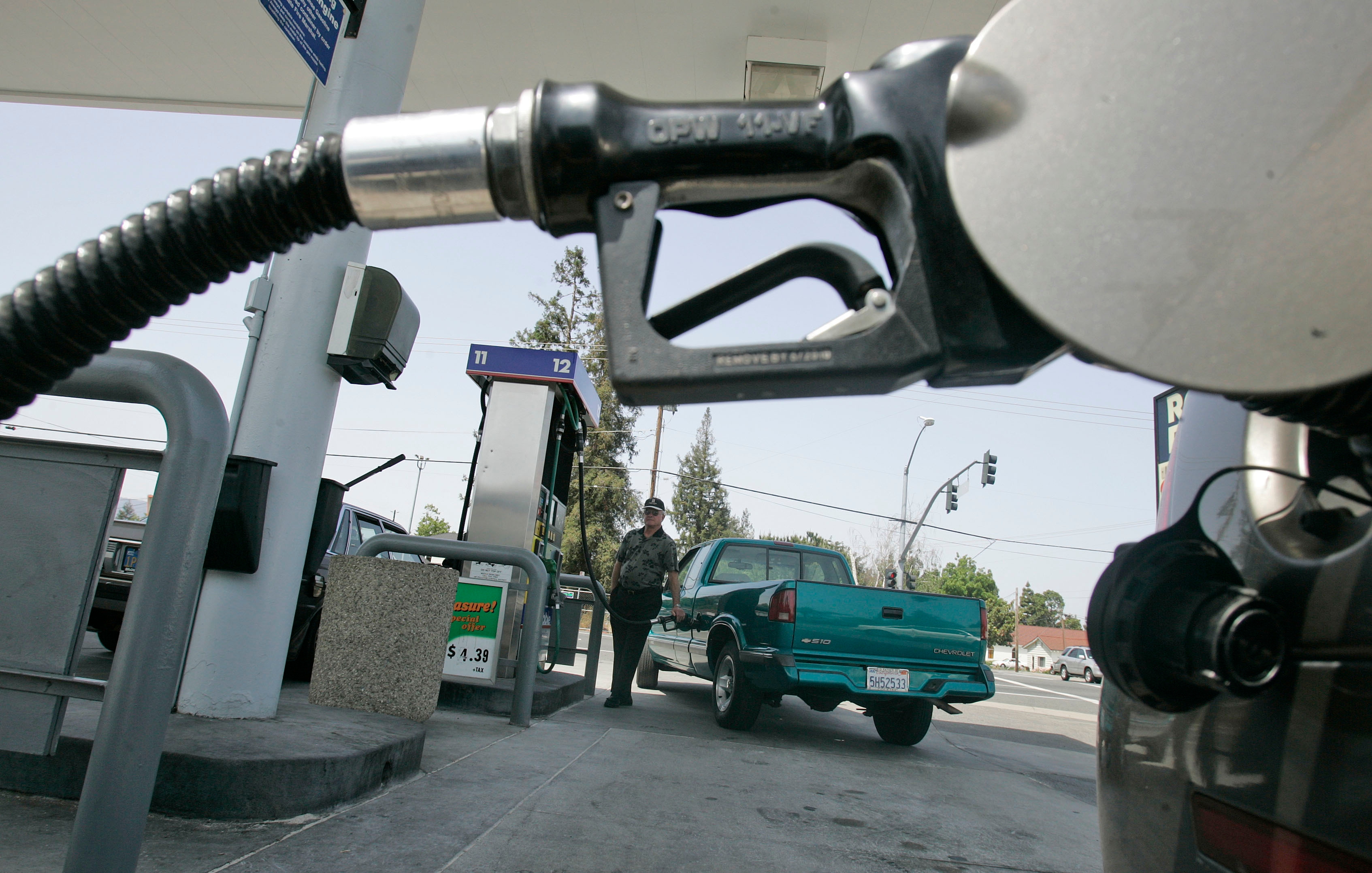
Jumping fuel prices are a gas, gas, gas
STEPPING ON THE GAS: Gov. Gavin Newsom and President Donald Trump are both basking in relatively low gas prices ahead of one of the country's biggest driving weekends.
But California regulators and lawmakers are also desperately scrambling to keep gas prices steady in an acknowledgement that Republican political attacks on the issue are sticking.
Tuesday could have been a doozy, after both the state's annual gas tax hike and closely watched amendments to the low-carbon fuel standard aimed at hastening the transition away from fossil fuels took effect — and didn't cause an immediate spike in gas prices.
'Republicans spent the last 6 months fearmongering that gasoline prices would 'increase by 65 cents on July 1,'' Newsom's office said in a press release Wednesday, pointing to data from AAA. 'Did this happen? The answer: No.'
But lawmakers are getting impatient. They advanced a bill Wednesday that would have the state immediately allow suppliers to blend more ethanol into gasoline — 15 percent, up from a limit of 10 percent now.
The move would make California the last state to switch to E15, a blend that a study last year by UC Berkeley and US Naval Academy economists found could lower gasoline prices by 20 cents per gallon.
It's something the California Air Resources Board has been studying since 2018 but hasn't yet greenlit. Ethanol, while less carbon-intensive than gasoline, comes with separate concerns related to growing corn for production. Assemblymember David Alvarez said needs to pick up the slack.
'The reason this bill is needed is due to regulatory delays that we've seen from the Air Resources Board,' he said at today's hearing.
CARB didn't immediately respond to a request for comment. But the concept dovetails with Newsom's budget language, which gives $2.3 million to help CARB finish the job.
Another idea, floated by Senate Democrats last week in a sweeping bill that also took aim at the low-carbon fuel standard, is to move away from another of the state's bespoke gasoline formulations: CARBOB, a '90s-era summer blend aimed at reducing smog, in favor of a West-wide blend that refineries in neighboring states would also produce.
That West-wide fuel standard concept has garnered a surprising amount of interest among environmental and clean transportation groups.
'I do think it's something worth examining,' said Katelyn Roedner, California director for the Environmental Defense Fund. 'Do we still need a special blend?'
And the E15 idea is getting good reviews, too. 'Generally speaking, it makes a lot of sense, provided we do it in a way that doesn't require expanding ethanol production capacity,' said Colin Murphy, co-director of the Low Carbon Fuel Policy Research Initiative at Davis' Institute of Transportation Studies.
But neither is a quick fix.
If California moves away from its low-smog formulation toward more reliance on outside sources, it would need to quickly build up its capacity to import more fuel while making sure not to undercut in-state refineries and potentially create more closures, Murphy said.
It's unclear, so far, what other states think of the idea, which would hinge on their buy-in to pull off. Spokespeople for the governor's office in Arizona, Nevada, Oregon and Washington didn't immediately respond to requests for comment on the bill.
But Arizona and Nevada rely on California for gasoline supplies and are the most likely candidates to have open ears. The governors of both states jumped into the Sacramento fray last year, lobbying against a special session bill that requires refineries to maintain backup fuel supplies for when facilities go down for maintenance.
And CARB cautioned that its E15 rulemaking could still take a while. CARB spokesperson Lindsay Buckley said that process could be finished sometime in 2026, 'assuming we get the staff and are able to start the rulemaking process later this year.' — AN
Did someone forward you this newsletter? Sign up here!
CEQA HANGOVER: State lawmakers are still advancing a suite of one-off bills poking holes into environmental reviews days after Newsom signed a sweeping overhaul of the California Environmental Quality Act in the name of speeding up housing development — though at least one said she's had enough.
'At least for me personally, it's going to be very difficult for me to support any CEQA exemption or streamlining bills moving forward, just because I think we need to tip the balance the other way now, just because CEQA has been really dismantled,' Sen. Caroline Menjivar said at a Wednesday hearing on several more of them.
Menjivar voted for the CEQA overhaul on Monday but declined to support bills waiving more environmental reviews for wildfire prevention projects near evacuation routes and for exploratory geothermal energy projects in the Senate Environmental Quality Committee on Wednesday.
Both bills passed with little to no other opposition. — CvK
SUN BURN: The board of a powerful irrigation district in the desert of Southern California has had enough with solar panels replacing crops.
The Imperial Irrigation District passed a resolution on Tuesday opposing new utility-scale renewable energy development on farmland in the Imperial Valley, where farmers grow alfalfa, lettuce and other crops but face increasing water restrictions that have forced some to leave their fields fallow.
Renewable energy developers see potential in the desert region's open spaces and have already covered nearly three percent of the region's total farmland with solar panels.
'It's time to draw a line,' said IID vice chair JB Hamby. 'Farmland in the Imperial Valley feeds this country and anchors our economy. … We support renewable energy — just not at the expense of our future.'
Hamby is currently locked in multi-state negotiations over dwindling Colorado River supplies, which irrigate the Imperial Valley's farmland.
The irrigation district will pass along its recommendation to local, state and federal land use decision makers, including the Imperial County Board of Supervisors. — CvK
GRID GAMES, CONT: The Public Advocates Office, an independent organization within California's utility regulator that lobbies on behalf of ratepayers, has taken its stand on a controversial grid regionalization proposal winding its way through the state Legislature: yes, if amended.
The position, detailed in a letter on Friday, matters because the proposal has divided environmental and ratepayer groups, with some saying the proposal would reduce costs and improve grid reliability and others saying it could undercut California's renewable energy goals.
The director of the Public Advocate's Office, Linda Serizawa, is largely taking the side of the business and utility groups who want to see state lawmakers reverse recent amendments to the bill. Those amendments gave California more control of the regionalization, but Serizawa wrote that may risk alienating other states interested in linking up with California. — CvK
— Tesla posted another drop in vehicle deliveries for the second quarter of 2025.
— Between rising seas and raging wildfires, California may be running out of safe places to build the housing it needs.
— Recycling firm Redwood Materials is hooking up used electric vehicle batteries and solar panels to power a data center in Reno, Nevada.
Hashtags

Try Our AI Features
Explore what Daily8 AI can do for you:
Comments
No comments yet...
Related Articles


Politico
 29 minutes ago
- Politico
In: EV incentives. Out: Sales mandates.
Presented by With help from Camille von Kaenel and Noah Baustin EV COMPLICATIONS: California drivers don't want to lose their electric vehicle tax incentives, but even voters in one of the bluest states are wary about reviving plans to phase out gas cars. Voters are split down the middle on whether California should stick to its guns on its Trump-blocked plans to phase out sales of gas cars by 2035, according to an exclusive POLITICO-Citrin Center-Possibility Lab poll. Only 46 percent of the more than 1,400 registered voters surveyed said they support the policy, while 47 percent said no. Yes, there was an obvious partisan split: 60 percent of Democrats said they backed the phase-out, compared to 40 percent of independents and 31 percent of Republicans. But the results offer a note of caution for Gov. Gavin Newsom, who directed the California Air Resources Board to start writing new vehicle emissions rules after Republicans revoked the state's sales mandates for cars and heavy-duty trucks in June. 'None of us really like the idea of government intervening to take something away from us,' said Dan Sperling, a former CARB member and director of the University of California, Davis' Institute for Transportation Studies. 'That's even the most liberal of us.' Poll respondents are more bought into Newsom's plan to backfill the soon-to-be-defunct $7,500 federal EV tax credit. Nearly two-thirds — 64 percent — said they would support state-funded tax incentives once the federal subsidy ends Sept. 30, as part of the Trump administration's ongoing attacks on clean energy policy. That question again showed a partisan divide, with 80 percent of Democrats saying they back the approach, compared to 60 percent of independent voters and just 43 percent of Republicans. But the overall result bolsters Newsom's push to backfill incentives that the Biden administration used to coax drivers off fossil fuels, as he suggested using cap-and-trade revenues to fund last year and directed state agencies to consider in a June executive order. But Jack Citrin, a veteran political science professor at UC Berkeley and partner on the poll, said a closer look at the poll results shows that Democrats need to keep affordability in mind. He pointed to the fact that 28 percent of respondents said they'd only support new EV incentives if gas prices aren't impacted and another 20 percent said they should be reserved for low-income buyers, reflecting the fact that cost of living was the top concern of voters polled. And 64 percent of respondents said gasoline prices are putting a significant, extreme or moderate burden on their household budgets. 'That reflects a concern with the cost of all of this,' Citrin said. 'Yes, we're for environmental protection. Yes, we're for all of this, just as long as it doesn't cost a lot.' The poll comes the same day that state agencies released a joint report with recommendations for countering Trump's assault, calling on lawmakers to bolster tax incentives, improve charging infrastructure and regulate facilities that attract polluting trucks, but offering few specific timelines or dollar figures. California Air Resources Board Chair Liane Randolph framed the report — which Newsom asked for in his June order — as a first step in the state's defense against a hostile federal government. 'Clean air efforts are under siege, putting the health of every American at risk,' she said during a press briefing. 'California is continuing to fight back and will not give up on cleaner air and better public health.' Sperling called the report a surprisingly 'modest document' and said it lacks the specificity he hoped to see. 'The word I would use is disconcerting,' Sperling said when asked about where California stands in its fight against Trump. — AN Did someone forward you this newsletter? Sign up here! INVEST OR TRADE: The cap-and-trade legislative games are off to the races. Assemblymember Jacqui Irwin, who's leading the Assembly's cap-and-trade working group, began circulating on Tuesday her draft legislative language to extend the state's signature climate program through 2045. The proposal, obtained by POLITICO, would also make moderate changes to how the carbon market is run and make several multiyear appropriations of its revenues for wildfire, water, air and energy programs. It's the first detailed proposal to come out of the Legislature and follows Newsom's May proposal to reauthorize the program largely as-is. Lawmakers are now staring down a three-week sprint to resolve their differences and pass a bill on cap and trade, which is not only the regulatory backstop that ensures California meets its climate targets but also a multibillion-dollar revenue engine that's brought in lower-than-expected revenues amid uncertainty about its fate after its 2030 expiration. That uncertainty is set to continue. Ahead of the California Air Resources Board's next quarterly auction scheduled for Wednesday, prices on California's carbon market 'barely responded' to news of the Assembly's proposed amendments, according to Alicia Robinson, CEO of Elevate Climate, a carbon market analytics firm. 'While the Assembly's draft language indicates forward progress, market participants seem to need less talk and more walk before they double down on buying allowances,' she said. Broadly, the proposal — which Irwin is planning to insert into her AB 1207 in the coming weeks — seeks a middle ground between business groups advocating for more free emissions permits in the name of lowering costs and environmental groups advocating for fewer free permits in the name of furthering emissions reductions. It instructs CARB to conduct its own analysis of the risk of businesses — and emissions — leaving the state as a result of the program, and to distribute free allowances accordingly. It also proposes letting businesses offset some of their emissions through investments in carbon dioxide removal technology and natural and working lands and would keep surplus permits off the market to prop up weaker-than-expected auctions. Nick Miller, a spokesperson for Assembly Speaker Robert Rivas, said in an email that the proposal 'reflects the Assembly's core values: advancing climate ambition while prioritizing affordability for California working families and businesses.' The Senate working group led by Sen. Monique Limón, meanwhile, has been circulating a draft framework, also obtained by POLITICO, to reduce free allowances over time and add a new border adjustment tax to insulate in-state industries. Senate President Pro Tem Mike McGuire did not respond to a request for comment Tuesday. — CvK THE DELTA BETWEEN THEM: The war of words over a controversial proposed tunnel to route water south around the Sacramento-San Joaquin River Delta is heating up. Newsom on Tuesday touted the Delta Conveyance Project as the 'most promising action' to protect the state's water delivery system from more extreme storms and droughts, higher temperatures and sea level rise. The occasion: His administration's first-ever report on adapting the State Water Project to climate change released Tuesday. The other occasion: the trailer bill he's backing — with no legislative sponsor yet — to streamline the tunnel's construction. In a now-familiar dance, environmental groups and Delta region lawmakers who oppose the 45-mile-long tunnel's construction because of its impacts on the local ecosystem immediately panned the report, while water agencies that would get its water praised it. The report also lists other strategies to climate-proof the State Water Project, which delivers water to 27 million Californians. Among them: correcting subsidence that's eating away aqueduct capacity, developing 2 million acre-feet of storage south of the Delta, using advanced weather forecasts to manage releases from Oroville Dam and permitting a physical barrier in the Delta to prevent saltwater from creeping up during low water years. — CvK TALK IT OUT: Three Assembly policy committees are coming together tomorrow for an oversight hearing on transportation fuels that will put representatives from oil, labor and environmental justice groups at the table amid a push to overhaul drilling regulations and avert two refinery closures. The joint Natural Resources, Transportation and Utilities and Energy committee hearing should offer an inside look at negotiations on a draft bill from Newsom that would boost oil drilling in Kern County — a proposal that's won plaudits from oil companies and enraged groups that say California is backtracking on its climate goals. The speaker list includes Zach Leary, senior director at the Western States Petroleum Association; Cesar Aguirre, co-director of Central California Environmental Justice Network's air and climate justice team; Mike Smith, chair of the United Steelworkers' national oil bargaining program; and Jeremy Martin, Union of Concerned Scientists' director of fuel policy. The committees will also hear from Benicia Mayor Steve Young, whose city is facing the planned closure of a Valero refinery, and Notre Dame professor Emily Grubert, who's studied clean energy transitions around the country. CARB's Randolph, California Energy Commission Vice Chair Siva Gunda and California Department of Conservation Director Jennifer Lucchesi will also speak. — AN HOT STUFF: It's August, California is about to be hit with a prolonged heat wave, and energy leaders are braced to protect the state's grid. Sound familiar? In August 2020, similar conditions forced the California Independent System Operator to launch rolling electricity blackouts as the grid was overwhelmed with demand from air conditioners across the state. Two years later, Newsom was forced to send out a statewide emergency alert pleading with residents to turn off their appliances during a September temperature spike. As 2025's heat wave approaches, energy officials are confident (mostly) that the state is out of the woods (almost). 'We are cautiously optimistic about the summer,' the CEC's Gunda said at a Senate Energy, Utilities and Communications Committee hearing Tuesday. 'Even under the conditions that we've experienced in 2020 and 2022, we don't expect any shortfalls in the grid,' Gunda said. 'This is because of the storage capacity that has come online.' After the 2020 blackouts, Californians, from the state's utilities to residents putting the tech in their garages, went on a battery-building bonanza, adding over 12,000 megawatts of energy storage to the grid, bringing the CAISO portfolio to about 13,500 MW. The additional storage helps grid managers supply enough energy to meet demand during the early evening, the trickiest time of the day as solar production plummets at the same time that residents arriving home turn on their appliances. 'Still, a long lasting West-wide heat wave coincident [with] a big potential fire could still put us on the edge, and that's something we want to watch carefully,' Gunda said. — NB PEAK OF THE FIRE: California's No. 1 — in homes at fire risk. The state has nearly 1.3 million homes at moderate or higher wildfire risk, representing $800 billion in reconstruction costs, according to a new report released Tuesday by property data and analytics company Cotality. Second-place Colorado has 318,000 homes at similar risk, representing $142 billion. California also claims eight of the 15 metropolitan areas with the most homes at risk: Los Angeles, Riverside, San Diego, Sacramento, San Francisco, Oxnard, Redding and Chico. — CvK — Suisun City is considering annexing thousands of inland acres from the tech-billionaire backed company California Forever to stay afloat amid rising seas. — See where forecasters are scheduling extreme heat and red flag warnings in California starting Thursday. — The House Oversight Committee is investigating whether the California High-Speed Rail Authority knowingly misrepresented the project's numbers in order to obtain federal funding.


Fox News
29 minutes ago
- Fox News
‘Tired of Democracy dying': Newsom redistricting push getting pushback for disenfranchising Californians
California Democratic Governor Gavin Newsom's redistricting effort is receiving pushback from Republicans in the state assembly who are accusing the Democrats of keeping them in the dark and of "disenfranchising Californians." GOP Assemblywoman Alexandra Macedo, vice chair of the California State Assembly Committee on Elections, slammed Democrats for giving her "barely 24 hours" to examine the redistricting bill before a Tuesday hearing – while Democrats, she claimed, had advance notice. Macedo vowed to defeat the redistricting push, saying, "We are in the super-minority, but we are effective, and we will defeat this." She added that by the time she received the bill's language as vice chair of the elections committee, several Democratic co-authors signed on. That, she argued, meant Democrats had a first look, while she had "barely 24 hours before committee tomorrow to prepare." Macedo warned that witnesses appearing at Tuesday's hearing could face legal consequences if they refused to answer her questions. "Let me warn anybody who will be testifying tomorrow. If you don't answer my questions tomorrow, attorneys will be making sure you answer them in a courtroom," she said, adding, "You can run, but you cannot hide." Despite Democrats dominating California politics, Macedo pledged, "We are not backing down from this fight." "You are disenfranchising Californians, and we are tired of democracy dying here," she said. "We will fight back." She added that if Republicans are not able to stop the redistricting plans in the assembly, then their victory will be "in a courtroom or it will be at the ballot box." Four GOP state lawmakers have filed a lawsuit in California's Supreme Court to stop the Democrat-controlled legislature from holding a vote by the end of this week to advance the redistricting push. Assemblywoman Kate Sanchez, one of the four Republicans behind the suit, told Fox News Digital that she joined the lawsuit because "Californians have already spoken clearly at the ballot box." "In 2008, voters approved Proposition 11 to take redistricting power away from politicians and give it to an independent citizens' commission," she said. "Two years later, with Proposition 20, voters doubled down and expanded that power to include congressional districts, passing it by a decisive 61% to 39%. Governor Newsom's plan is a direct attempt to undo that mandate and put politicians back in control. I'm standing up because this isn't about partisan advantage; it's about respecting the will of the voters who demanded fairness and transparency." Newsom announced he would advance a redistricting map in California to counter the Texas redistricting bill being pushed by President Donald Trump. On Friday, California Democrats and the Democratic Congressional Campaign Committee (DCCC) released a new district map that would likely eliminate five GOP congressional seats, theoretically nullifying the five additional seats Republicans would gain if Texas' redistricting push is successful. The California legislature introduced a constitutional amendment on Monday to be brought to a referendum vote in November. If passed by California voters, the amendment would allow the legislature to temporarily suspend its nonpartisan districting commission and move forward with its redistricting plans as laid out by the DCCC. Newsom's office declined Fox News Digital's request for comment, with a spokesperson saying he would "point you to the Legislature given this is about the legislative process." Fox News Digital also reached out to the office of Assembly Speaker Robert Rivas, a Democrat, but did not receive a response by the time of publication.

Fox News
29 minutes ago
- Fox News
Laura: Democrats can't stop rewarding illegal migrants
Fox News host Laura Ingraham discusses Democrats' response to illegal immigration on 'The Ingraham Angle.'
