


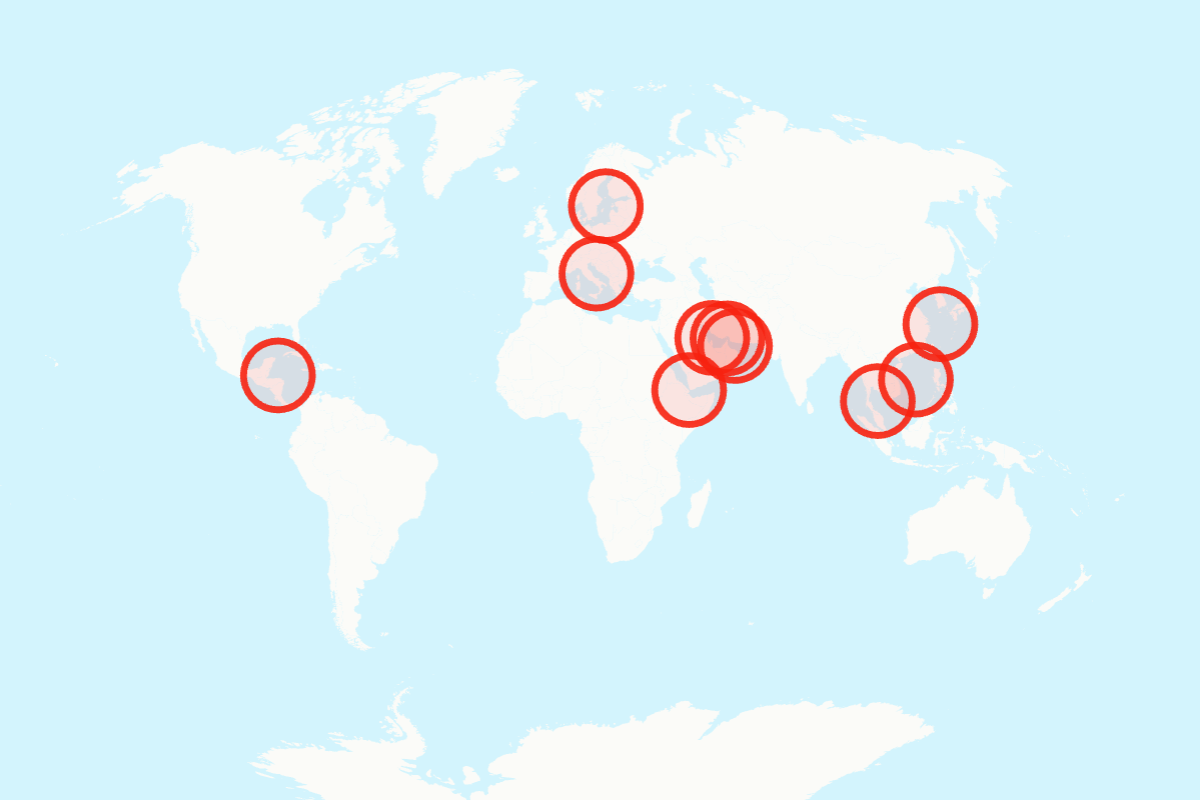
Map Shows Where US Challenged 'Excessive' Maritime Claims
Newsweek AI is in beta. Translations may contain inaccuracies—please refer to the original content.
A Newsweek map shows where the United States challenged "excessive maritime claims" through freedom of navigation operations during the fiscal year 2024.
The Pentagon said such operations aim to maintain the "global mobility of U.S. forces," demonstrating that they will continue to fly, sail, and operate "wherever international law allows."
China had the most maritime claims challenged, according to a report. A spokesperson for the Chinese Embassy in Washington, D.C., told Newsweek that the U.S. used freedom of navigation as an excuse to meddle in regional affairs and maintain its own "hegemony."
Why It Matters
The U.S. government has been carrying out a freedom of navigation program since 1979, aimed at preserving its national interest in exercising and asserting its rights, freedoms, and uses of the sea worldwide.
American warships and military aircraft are frequently deployed to challenge claims that Washington believes infringe on freedom of navigation, particularly in the South China Sea, where China's sweeping sovereignty claims overlap with those of other regional states.
What To Know
On August 14, a Beijing-based think tank, the South China Sea Strategic Situation Probing Initiative, said the Pentagon recently released its annual report of freedom of navigation for fiscal year 2024, which began on October 1, 2023, and ended on September 30, 2024.
The report, prepared by the Office of the Under Secretary of Defense for Policy, summarized America's operational challenges to purported excessive maritime claims asserted by a total of 11 countries across East and Southeast Asia, the Middle East, Europe, and Central America.
China had four claims—three in the South China Sea and one in the East China Sea—that were challenged by U.S. forces multiple times, while one of its claims—historic rights in the South China Sea—was challenged by the U.S. with its "international partners and allies."
The remaining Chinese claims in the South China Sea that were challenged involved the requirement for prior permission for the innocent passage of foreign navies through China's territorial sea, as well as straight baselines that do not conform with international law.
Innocent passage refers to the right to transit through the territorial sea of another state in a continuous and expeditious manner that must not be prejudicial to the peace, good order, or security of that state, according to the United Nations Convention on the Law of the Sea.
The United States Navy destroyer USS Dewey conducts routine operations while transiting in the South China Sea on May 12, 2025.
The United States Navy destroyer USS Dewey conducts routine operations while transiting in the South China Sea on May 12, 2025.
Mass Communication Specialist 1st Class Devin Monroe/U.S. Navy
Straight baselines delineate the waters over which a country claims full jurisdiction. Last year, Beijing released a list of 16 base points connected by straight baselines around Scarborough Shoal, an atoll that China seized from the Philippines in a 2012 standoff.
For the Chinese claim in the East China Sea, the Pentagon said China imposed restrictions on foreign aircraft flying through its air defense identification zone—established in 2013 for early warning purposes—without the intent to enter the country's territorial airspace.
In addition to China, the other countries whose claims were challenged by U.S. forces were Croatia and Estonia—both NATO allies—as well as Honduras, Iran, Malaysia, Oman, Taiwan—a U.S. security partner—the United Arab Emirates, Vietnam and Yemen.
Collin Koh, a senior fellow at the Institute of Defense and Strategic Studies in Singapore, told Newsweek on Monday that the U.S. freedom of navigation program is characterized by consistency and non-discrimination, as it does not distinguish between friends and foes.
This gives Washington a "moral high ground" in asserting its maritime freedoms against excessive claims and the creeping expansion of coastal states' maritime jurisdictions, he said.
The Pentagon has stated that its comprehensive freedom of navigation operations are conducted in an even-handed manner, challenging claims based on principle rather than on the identity of the coastal state asserting them, including those of allies and partners.
Case of South China Sea
Koh, who tracks U.S. freedom of navigation operations in the South China Sea, noted that there has been a drop in publicized operations in the region since the Biden administration, which could be attributed to Washington's concern about stabilizing relations with Beijing.
"I suppose [freedom of navigation operations] would continue to be run on an 'as and when needed' basis," the analyst said, adding that the second Trump administration is unlikely to regularize the operations in a way that would undermine its broader agenda with China.
America's naval capacity could also explain the reduction in the frequency of freedom of navigation operations, Koh said, adding that U.S. naval vessels assigned to tasks in the broader Western Pacific have many responsibilities that need to be prioritized.
"It is untenable for the U.S. to make an issue of 'freedom of navigation' when the South China Sea is one of the world's freest and safest waters for navigation," Liu Pengyu, spokesperson for the Chinese Embassy in Washington, D.C., told Newsweek on Sunday.
China respects the freedom of navigation and overflight to which countries are entitled under international law, including the United Nations Convention on the Law of the Sea, he said.
Vessels identified by the Philippine Coast Guard as Chinese naval ships are seen from the Philippine Coast Guard ship BRP Cabra during a supply mission in the South China Sea on August 26, 2024.
Vessels identified by the Philippine Coast Guard as Chinese naval ships are seen from the Philippine Coast Guard ship BRP Cabra during a supply mission in the South China Sea on August 26, 2024.
JAM STA ROSA/AFP via Getty Images
"However, there is a huge difference between navigation and trespassing, and between freedom and willfulness," the spokesperson continued, warning countries outside the South China Sea area—which he did not identify—not to "stir up trouble" in the region.
Meanwhile, America's allies and partners in the South China Sea would generally view freedom of navigation operations as helping to uphold the rules-based order, Koh said.
"I believe some [Southeast] Asian countries generally at least view that as a form of stabilizing presence in a similar light."
What People Are Saying
Liu Pengyu, spokesperson for the Chinese Embassy in Washington, D.C., told Newsweek: "We firmly stand against 'willful trespassing' and oppose any country conducting unlawful provocations in the name of 'freedom of navigation' to harm the sovereignty and security of coastal countries and undermine regional peace and stability."
Collin Koh, a senior fellow at the Institute of Defense and Strategic Studies in Singapore, told Newsweek: "There would naturally and understandably be concerns about whether [freedom of navigation operations] could result in close encounters between Chinese and American forces, resulting in potential inadvertent or accidental clashes."
What Happens Next
It is likely that the U.S. military will continue its freedom of navigation operations in the disputed waters of the East and South China Seas as part of Washington's broader efforts to counter China's growing maritime presence across the Western Pacific.
Hashtags

Try Our AI Features
Explore what Daily8 AI can do for you:
Comments
No comments yet...
Related Articles


USA Today
 25 minutes ago
- USA Today
White House launches official TikTok account: 'America we are BACK!'
WASHINGTON - The White House launched an official TikTok account on Aug. 19, taking advantage of the short video app's more than 170 million U.S. users to spread the messages of President Donald Trump. Trump has a soft spot for the popular app, crediting it with helping him gain support among young voters when he defeated Democrat Kamala Harris in the November 2024 presidential election. Lawmakers in Washington worry, however, that its U.S. user data could fall into the hands of China's government. Trump has been working on a deal for U.S. investors to buy the app from TikTok's Chinese parent, ByteDance. Past intelligence assessments have said the app's owners are beholden to the Chinese government and that it could be used to influence Americans. The new account, @whitehouse, went live on Aug. 19 with an initial video showing footage of Trump as he declares: "I am your voice." "America we are BACK! What's up TikTok?" the caption read. The TikTok account Trump used for his presidential campaign last year, @realdonaldtrump, has more than 15 million followers. The Republican president also relies heavily on his Truth Social account to deliver his message and posts occasionally on his X account. "The Trump administration is committed to communicating the historic successes President Trump has delivered to the American people with as many audiences and platforms as possible," White House Press Secretary Karoline Leavitt said. "President Trump's message dominated TikTok during his presidential campaign, and we're excited to build upon those successes and communicate in a way no other administration has before," she said. A 2024 law required TikTok to stop operating by Jan. 19 of this year unless ByteDance had completed divesting the app's U.S. assets or demonstrated significant progress toward a sale. Trump opted not to enforce the law after he began his second term as president on Jan. 20. He first extended the deadline to early April, then to June 19, and then again to Sept. 17. Extensions to the deadline have drawn criticism from some lawmakers, who argue the Trump administration is flouting the law and ignoring national security concerns related to Chinese control over TikTok. (Reporting By Steve Holland; Editing by Colleen Jenkins, Rod Nickel and Edmund Klamann)

26 minutes ago
Trump rules out US troops in Ukraine as Russia continues to hammer Ukrainian targets
Any effort to help enforce a possible peace deal between Russia and Ukraine will not involve American boots on the ground, Pres. Trump said.


UPI
26 minutes ago
- UPI
Tulsi Gabbard revokes security clearance for 37 intelligence officials
Aug. 19 (UPI) -- National Security Director Tulsi Gabbard has revoked the security clearances for 37 current and former intelligence officials, as directed by President Donald Trump. Gabbard acknowledged that the president directed her to revoke the security clearances in a social media post that she made on Tuesday afternoon. "Being entrusted with a security clearance is a privilege, not a right," Gabbard said. "Those in the intelligence community who betray their oath to the Constitution and put their own interests ahead of the interests of the American people have broken the sacred trust they promised to uphold," she added. Gabbard's post includes a copy of the department memorandum that was circulated on Monday and lists the 37 officials whose security clearances are revoked. Among those whose security clearances are revoked is Maher Bitar, who worked for Sen. Adam Schiff, D-Calif., when he was the House Intelligence Committee chairman during the first impeachment effort against President Donald Trump in 2019, The Hill reported. The Biden administration's National Security Council spokeswoman Emily Horne and Assistant Secretary of State for Intelligence and Research Brett Holmgren also are among those who lost their security clearances. Others with revoked clearances include officials who held senior positions within the State Department, the CIA, the National Security Agency, the Defense Department and the National Security Council, according to Politico. Several formerly advised Biden when he was the vice president under former President Barack Obama, and some also were involved in the investigation into claims that Trump colluded with Russia ahead of the 2016 election. The revocations are effective immediately, and those whose security clearances are revoked also have any related contracts or employment terminated and must surrender their credentials to security officers, Fox News reported. The revocations prompted criticism alleging that the Trump administration did so for political purposes. "Further proof of weaponization and politicization," Mark Zaid, a national security attorney, said in a post on X. He said most of those who lost their security clearances "are dedicated public servants who have worked across multiple presidential administrations." The Trump administration also revoked Zaid's prior security clearance. Many who lost their clearance also had spoken to media regarding decisions made by the Trump administration, according to The Hill.
