


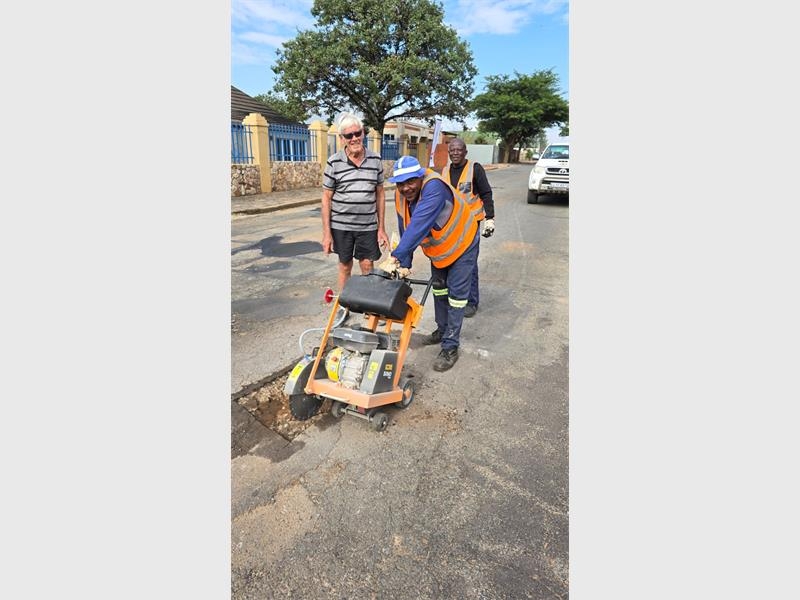
Concrete maestro joins fight against potholes in Heidelberg
Moolman explained the process of fixing potholes.
'We can only repair potholes in the streets of the town. Any national road with an R or an N and a number in its name is a provincial or national road, and the provincial municipality or the South African National Road Agency must repair the potholes on those roads,' he said.
He explained the process and said they could fix a pothole only once the road was dry. The recent heavy rains in Heidelberg contributed to the size and frequency of potholes, impacting the repair operations.
The process:
• The pothole is first cleaned of loose material, water and dirt to help create a solid base for the repair.
• The edges of the pothole are cut to create a neat, straight shape to ensure the new material can better adhere to the existing road surface.
• A mix of hot or cold asphalt is put in the pothole. Hot asphalt is often preferable for a lengthier, more durable repair.
• The asphalt is compacted with a roller or tamper to ensure it is firm and level with the rest of the road.
• The surface is smoothed and sealed to prevent water seepage from weakening the repair.
A rapid response is necessary to effectively manage and control potholes, particularly during the rainy season when large potholes can form overnight.
The Lesedi Local Municipality (LLM) works closely with the Heidelberg Hope team. However, residents must report potholes on the My Lesedi App.
'The LLM and Heidelberg Hope have a good working relationship, and pothole complaints are given to Heidelberg Hope,' said Nicolene Neveling, the Heidelberg Hope spokesperson.
'Between the LLM and Heidelberg Hope, we are doing our best to get to every pothole but prioritise those on the busier streets in town,' Neveling added.
She encouraged businesses and residents to get involved or help provide the repair materials.
For more information, call Neveling on 072 840 0205.
At Caxton, we employ humans to generate daily fresh news, not AI intervention. Happy reading!
Hashtags

Try Our AI Features
Explore what Daily8 AI can do for you:
Comments
No comments yet...
Related Articles
Yahoo
 9 minutes ago
- Yahoo
'I won't give up': Tulı́t'a teen says he'll stop at nothing to find missing friend
Julian McPherson was on his way home to Tulı́t'a, N.W.T. Tuesday evening so that he could help search for his missing friend, 16-year-old River Clement. "River's one of my closest friends," said Mcpherson, 19. "It's always me and River." Clement was last seen around 5 a.m. Friday morning according to RCMP. The police service said clothing and a cell phone believed to belong to the teenager had been found in a boat drifting on the Mackenzie River that morning. After four days, the police service said the search had become a recovery operation rather than a rescue. It's information McPherson is still grappling with. "I'm just so confused about it. Why was he down there, alone, like 5:30, 6 in the morning? Nothing makes sense to me," McPherson said from Délı̨nę, while checking that he'd packed everything for a flight back to Tulı́t'a on Tuesday afternoon. He was cutting short his trip to the nearby N.W.T. community to go home and help. McPherson said once his plane touches down, he'll do anything to find Clement – and he's going to try his hardest to bring him home safe. Mayor calls for donations for search "I won't give up until we find him," he said. Doug Yallee, the mayor of Tulı́t'a, told CBC News the search for Clement continued on Tuesday. A search and rescue aircraft would have eyes in the sky, while community volunteers would continue to search from the ground and on the water. He also asked that people send financial donations to help cover the cost of food and gas necessary for continuing the effort. "All donations we can use for the community of Tulı́t'a here to locate this young person." RCMP will continue to help with the search for River, the force said in its news release on Monday evening. Other departments have pulled back from the search or say they weren't mobilized at all. A sergeant with the Canadian Ranger patrol group that had been involved in the search said their effort was called off on Sunday. But in a post on Facebook Clement's aunt, Lynda MacCauley, said that many rangers were still volunteering with the search on their own time. A spokesperson for Canada's Department of National Defence said its Joint Rescue Coordination Centre (JRCC) in Trenton had received a call from RCMP about the search and had offered to help. When JRCC followed up with police, however, it was told that its help wasn't needed anymore.

Yahoo
9 minutes ago
- Yahoo
In opening trial statement, prosecution says Grand Forks man was 'brutally beaten to death' by defendant
Aug. 19—GRAND FORKS — A Grand Forks County prosecutor said the evidence that will be presented throughout Donald Joseph Bartlette's trial will show he beat a man to death — a man he was not only friends with, but whom he had been living with from time to time while experiencing homelessness. "On Oct. 24 of 2024, Anthony Kiehl was brutally beaten to death by the defendant," Assistant Grand Forks County State's Attorney Rachel Egstad said during her opening statement Tuesday afternoon, Aug. 19. Anthony "Tony" Kiehl, 49, was seen with Bartlette, 46, earlier that day, Egstad said. She said the two were also seen on surveillance footage entering Kiehl's apartment at approximately 6:11 p.m. "This was the last time Anthony would be seen alive by anyone other than the defendant," Egstad said. Samuel Gereszek, Bartlette's attorney, agreed in his opening statement that there was a fight that day, but said it was not Bartlette's intention to kill his friend. Gereszek said Kiehl came at Bartlette with a knife, stabbing him, then Bartlette fought back. The injury Kiehl sustained was "like one in a million," Gereszek said, and claimed a doctor involved in Kiehl's autopsy would later testify to that effect. "Donald Bartlette was stabbed," Gereszek said. "He responded with fists, and he got the most unfortunate shot in that you could possibly fathom." Gereszek also said the surveillance footage showing Bartlette returning to his friend's apartment a few times before ultimately leaving the building can be attributed to him checking on Kiehl, who was injured but appeared responsive. The injury proved fatal, though, and when another person arrived at Kiehl's residence that night, he was reported to a dispatcher as "cold" and "not breathing." Kiehl was pronounced dead at Altru Hospital shortly before 10 p.m., according to a police officer's testimony. During his opening statement, Gereszek also pointed to other parties who could have been involved in Kiehl's death, due to timing and proximity. He said surveillance footage would show other people entering and exiting Kiehl's apartment that evening — one who has been charged with involvement in the death, and one who has not. The first day of Bartlette's trial began shortly after 9 a.m. Tuesday, with jury selection, which wrapped up around 1 p.m. During that process, both the defense and prosecution asked various questions of the jury pool, which was comprised of a little more than 60 people. Aside from the standard questions about potential conflicts, the defense and prosecution asked the jury pool questions such as: what makes a good or bad juror, what is "self defense," can someone who starts a fight end up defending themselves later on in the altercation and can someone continue assaulting their attacker after the attacker stops pursuing them? After jury selection, court was in recess until 2:30 p.m. The 12 jurors and two alternates were then given opening instructions about their duties and certain legal definitions by Judge Jason McCarthy. The prosecution and defense gave opening statements, then the first witness was called to testify. Tammy Vanyo, Kiehl's probation officer, testified that on the morning of Kiehl's death, he called her. "(He) told me that there were two guys outside of his apartment, and he was scared," Vanyo said. She recalled Kiehl as respectful despite a distaste for law enforcement, and said she knew him to suffer from alcohol and substance abuse as well as a traumatic brain injury that he sustained in an accident. He was on probation for a prior drug conviction. Vanyo said she didn't know him to be paranoid, so she believed his concerns were valid, though she didn't imagine them to be that serious, with the limited information she had at the time. She advised him to go to a place in town where he felt safe. She said he should go to Mountainbrooke Recovery Center, which offered resources for the homeless population as well as those with mental health issues. Kiehl had been working on himself, according to Vanyo. He attended Alcoholics Anonymous meetings at Mountainbrooke, as well as Narcotics Anonymous meetings at Grand Forks' Northeast Human Service Center. "He was trying," Vanyo testified. The trial is expected to resume at 9 a.m. Wednesday morning, Aug. 20.
Yahoo
9 minutes ago
- Yahoo
Overview of the China Optics Valley Artificial Intelligence Innovation Conference & 2025 Forbes China AI Tech Enterprises Top 50 Release Ceremony
Wuhan, China--(Newsfile Corp. - August 19, 2025) - On June 27, in the grand banquet hall on the third floor of the China Optics Valley Technology Exhibition Center, the "China Optics Valley Artificial Intelligence Innovation Conference & 2025 Forbes China AI Tech Enterprises Top 50 Release Ceremony" took place, featuring the release of the comprehensive "China's Optics Valley Report", which highlighted major developments and broad insights for the global AI industry. Aiming for "China's Fourth AI Pole" In his opening speech, Shen Yue, a member of the Standing Committee of the CPC Wuhan Municipal Committee and Secretary of the Party Working Committee of the Wuhan East Lake High-tech Development Zone, revealed the "report card" and "roadmap": Industry Scale: By 2024, the AI industry in Optics Valley was expected to exceed 45 billion yuan, with a three-year goal of reaching 100 billion yuan, nurturing three leading companies worth 10 billion yuan and a thousand SMEs. Computing Power Base: With the leading intelligent computing/supercomputing center in China, the national storage base in the country, and the largest optical communication R&D base globally, comprehensive support for AI from storage to computing is ensured. Talent and Funds: A global talent attraction plan has been launched, offering up to 100 million yuan in support for top scientists; a 10 - billion - yuan humanoid robot master fund coordinated by Hubei provincial, Wuhan municipal and East Lake High-tech Development Zone governments is set to launch. Open Scenarios: A massive autonomous driving operational zone reaching 7.7 million people and covering 3,000 square kilometers, a big data pool of 12 million cervical cancer screenings ensures abundant data and scenarios for large models. "Pooling Strengths, Driving Breakthroughs" Industry Collaboration Signing Ceremony: Multiple AI Firms Establish Presence in Optics Valley of China During the "Pooling Strengths, Driving Breakthroughs" collaboration signing ceremony, several leading companies ranked in the 2025 Forbes China AI Tech Enterprises Top 50 list signed strategic cooperation agreements with the East Lake High-Tech Development Zone. Representing core AI sectors—including autonomous driving, XR-powered cultural tourism, industrial quality inspection, healthcare robotics, AIGC content generation, and intelligent computing infrastructure—these companies span a full-stack ecosystem, from foundational large models to end-to-end application scenarios. World-Class Brainstorming: Key Insights from Four Academicians and Experts AI Paradigm Leap From healthcare to cultural tourism, from industry to daily life, the conference highlighted ten transformative breakthroughs shaping the future of AI: Trusted Interaction: Achieving high accuracy in urban hotlines, bank counters services, and autonomous driving operations, elevating AI from mere "understanding" to active "management". AI-Native Creativity: Generating 33.27 million pixel-level images from a single prompt, compressing the traditional "shoot-edit-publish" process into minutes. Medical Scenarios: Diagnostic-level large models advancing evidence-based medicine into an "intent-driven" era, validated by millions of screening data in "no doctor" scenarios. Additionally, Integrating family doctors, fall monitoring, and emergency calls into service robots, deeply engaging with rural areas and communities to address the aging population. Cultural Tourism: Ultra-high-resolution immersive experiences bringing millennia-old murals to life, enabling a 25-minute journey along the Silk Road. Embodied Intelligence: Completing training-deployment loops in 45 days via simple voice commands, achieving a new paradigm of human-AI collaboration. Content Production: AI workstations scaling to 20 million users in 20 months, transforming diverse physical environments into trainable "embodied AI" interfaces. Industrial Quality Inspection: Nano-level defect detection setting new industry benchmarks and driving a national AI initiative targeting 2030. Manufacturing Methodology: Introducing a new industrial AI framework: "scene-first + model collaboration + five core capabilities." Computing Infrastructure Consensus: A shift toward inference dominance - predicting that inference compute demand will soon surpass training, redefining the next generation of AI factories. Autonomous Driving: Achieving global deployment across over 100 projects within three days, with remote safety operators leading commercialization efforts. The ten paradigms collectively outline a future vision of "AI being everywhere, seamlessly integrated into daily life." Four Roundtables, One Message: Scenarios Are King, Collaboration Is Key Addressing the integration bottlenecks in embodied intelligence, the tripartite complementarity of technology, scenarios, and funding, and the emerging consensus around smart manufacturing - defined by "data × model × software-hardware co-design," the four roundtable discussions converged on a shared conclusion: as of 2025, AI competitiveness no longer hinges on showcasing isolated technologies, but on who can fastest embed algorithms into real-world scenarios, integrate computing power into industrial workflows, and attract capital to secure global orders. Wuhan unveiled a series of initiatives to accelerate this transformation, including: A "humanoid robot marathon testbed," to advance embodied AI; A support package for SMEs featuring "computing power vouchers," open data access, and an industry-finance collaboration platform; Making Optics Valley of China the "World Optics Valley" in the AI Era The 2025 Forbes China AI Tech Enterprises Top 50 Award Ceremony was held with great acclaim, honoring: 50 core technology pioneers, 10 breakthrough AI applications, 10 cutting-edge technologies, 10 rising startups, and 15 influential leaders shaping the future of AI. At this pivotal moment, Optics Valley not only celebrate achievement but also illuminated the path forward: "From a beam of light to a city, from a city to an era." The sparks of AI innovation have ignited a torch in Optics Valley of China. Next stop, the World Optics Valley! Media contactContact: Austin LeeCompany Name: ForbesChinaWebsite: info@ To view the source version of this press release, please visit
