


LIVE NOW: CPDC Webinar on Subpoenas of 2 Bank CEOs
Hashtags

Try Our AI Features
Explore what Daily8 AI can do for you:
Comments
No comments yet...
Related Articles
Yahoo
 9 minutes ago
- Yahoo
US agrees to talks with Brazilian WTO delegates on tariffs
The United States has agreed to Brazil's request to enter talks with the World Trade Organization (WTO) to discuss the 50 percent tariffs imposed by Washington, according to a recent letter. Brazil approached the global trade body in early August after President Donald Trump raised duties on more than a third of US-bound exports from the Latin American powerhouse, including key items like coffee, beef and sugar. Trump hit Brazil with some of his highest tariff rates as punishment for what he calls a "witch hunt" against his ally, former far-right president Jair Bolsonaro, who is on trial for allegedly plotting to attempt a coup. "The United States accepts the request of Brazil to enter into consultations," read a letter dated August 15 from the Washington WTO delegation and published on the organization's website. "We stand ready to confer with officials from your mission on a mutually convenient date for consultations," it continued. The US letter cautioned that some of the issues raised by Brazil "are issues of national security not susceptible to review or capable of resolution by WTO dispute settlement." The WTO consultation process involves seeking a negotiated solution before moving into arbitration. Trump's tariff order also charged that the Brazilian government's recent policies and actions threatened the US economy, national security, and foreign policy. Unlike most countries targeted by Washington's reciprocal tariffs, the United States runs a trade surplus with Brazil, not a deficit. jss/nn/jgc/sla

Geek Wire
10 minutes ago
- Geek Wire
Protesters set up temporary encampment at Microsoft to pressure company on Israel contracts
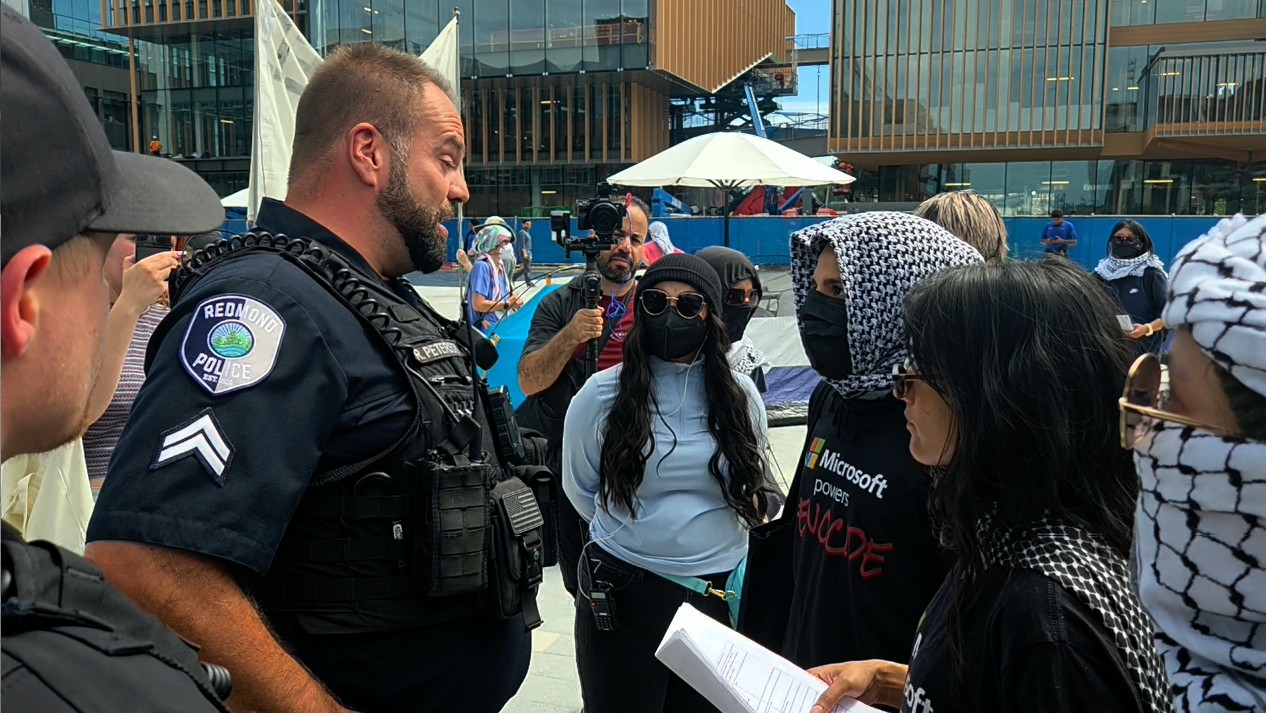
Redmond police explain to members of No Azure for Apartheid that they will be subject to arrest for trespassing if they don't leave the Microsoft campus Tuesday afternoon. (GeekWire Photo / Todd Bishop) Protesters took over part of Microsoft's Redmond, Wash., campus for more than an hour Tuesday — escalating their efforts to pressure the company to stop providing technology to the Israeli government and military. Members of the No Azure for Apartheid group, which includes current and former Microsoft employees, allege that the company's technology is being used in the surveillance, starvation and killing of Palestinians in Gaza. Microsoft has said it complies with its human rights commitments, and that its contracts with Israel's Ministry of Defense are standard commercial agreements, governed by its terms of service and AI Code of Conduct. The protesters created what they called a 'Liberated Zone' in the plaza of the company's East Campus, in front of the Microsoft sign, pitching tents and setting up a 'negotiations table' with a banner that read, 'Microsoft Execs, Come to the Table.' The space was filled with shrouds symbolizing the dead in Gaza, and a large plate reading, 'Stop Starving Gaza.' 'Regardless of your beliefs, regardless of whether or not your work today actually supports Israel, know that Microsoft's money does include blood money,' said one of the speakers at the protest, Julius Shan, a software engineer who said he has worked at Microsoft for nearly five years. A smattering of Microsoft employees looked on from the periphery as security guards and police arrived. One employee who was watching nearby said he empathized with the message but not the approach. 'This isn't going to change anything,' said the employee, who did not give his name. 'It's just going to annoy the people that are here.' The 'Liberated Zone' was in place for more than an hour on Microsoft's Redmond campus. Initially, the protesters appeared to be preparing for an extended encampment, reminiscent of student-led protests at universities during the 2023-24 academic year. In a press release shortly after the action began, the group said it was renaming the plaza 'The Martyred Palestinian Children's Plaza,' and offered interviews at the 'Anas Al-Sharif Media Tent,' named after a Palestinian journalist killed in Gaza last week. However, the group took down the encampment and moved to a nearby public sidewalk after City of Redmond Police told them they were trespassing on private property and would be subject to arrest. Microsoft has not issued a public statement about the latest protest. The company has said in past statements that it does not permit its technology to be used for unlawful surveillance or human rights abuses. Earlier this year, Microsoft said internal and external reviews found no violations. However, the company acknowledged its limited visibility into how its technology is deployed on private or on-premises systems Microsoft announced on Aug.15 that it is launching a formal review into allegations that its Azure cloud services were used by the Israeli military for mass surveillance of Palestinians. The company said it hired the law firm Covington & Burling LLP to lead the review, and pledged to make the findings of the review public once the process is complete. That move came after reports earlier this month in The Guardian, +972 Magazine, and Local Call cited sources alleging that the Israeli Defense Forces stored data from widespread phone monitoring of civilians in Gaza and the West Bank on Microsoft servers. Protesters walk past a security robot as they leave the Microsoft campus. (GeekWire Photo / Todd Bishop) At the time of the initial report by the Guardian, the company explained that its work with an Israeli intelligence unit focused on cybersecurity and that it was not aware of any civilian surveillance. The encampment Tuesday was part of a broader escalation by the group, which has spent much of the past year staging protests inside and outside company events, including Microsoft's 50th anniversary event in Redmond earlier this year, where protesters interrupted executives inside the event. Earlier this month, the group staged a loud protest outside the home of Teresa Hutson, corporate vice president of Microsoft's Trusted Technology Group — pouring red paint on the sidewalk symbolizing blood, and accusing her of being complicit in killing children in Gaza, according to video clips from the protest. The group's latest action comes amid reports of a growing humanitarian crisis in Gaza, and increasing concerns about famine. Hamas has agreed to a proposed 60-day cease-fire with phased hostage releases. Israeli officials today demanded the release of all hostages and said they were not interested in partial deals, according to the BBC.
Yahoo
27 minutes ago
- Yahoo
Why Oval Office map has played crucial role in Trump's view of Ukraine war
Russia has occupied a fifth of Ukrainian territory - and a big map showing the area shaded in red was put up in the Oval Office as if to emphasise that point for President Donald Trump's talks with Volodymyr Zelensky on Monday. "I assume you've all seen the map," Trump told Fox News on Tuesday. "A big chunk of territory is taken and that territory has been taken." The message from the White House to Ukraine is unmistakable. That land has gone and it is time to consider a territorial compromise with Vladimir Putin or, as some have termed it, land swaps. Zelensky's team had brought their own map to the meeting and the Ukrainian leader said later he had been "fighting with what is on that map" during his conversation with Trump, regarding "who controls what – not by hearsay, but in reality". Although he felt he had made some headway on correcting any false impressions, by Tuesday Trump's view was the same. It was clear, he said, that Russia's force was "so clearly much more powerful, and you know, it's not like they've stopped". Asked what the feeling was like in the room with European leaders regarding land swaps he said: "Now they're talking about Donbas, but Donbas right now is... 79% owned and controlled by Russia." Read more: Tracking the war in Ukraine with maps Before the war began in the east in 2014, Ukraine's wealthy mining region of Donbas made up about 16% of Ukraine's economic output. Putin is reported to have told Trump he wants the whole Donbas region as part of a broad peace deal. It would certainly save Russia's leader a considerable amount of blood and treasure. Zelensky said he had also argued about the percentages on the White House map that showed Russian control in a number of Ukrainian regions, ranging from 99% of Luhansk and 76% of Donetsk in Donbas; 73% of Zaporizhzhia and Kherson in the south-east; 4% in Kharkiv in the north-east; and 1% in Sumy and Mykolaiv. Analysis of latest data from the US-based Institute for the Study of War has resulted in similar figures to the White House, and any differences could be down to different methodology used, especially over the extent of Russian control of an area. Part could be under limited control or merely claimed by Moscow. In areas where the White House suggests 1% of a region is under Russian control, that may reflect only that the Russians have some limited presence, as in Mykolaiv in the south, or where they have largely been repelled, as in Sumy in the north. Whatever the real figure for Russian control in Donetsk, the fortress cities of Kramatorsk and neighbouring Slovyansk in Donetsk region are still home to large populations. Local officials say about 242,000 people live in Ukrainian-controlled areas of Donetsk region, and no Ukrainian head of state would consider handing their territory to Moscow. Although Russian forces have made advances in recent months, ISW estimates that seizing the remainder of the Donetsk region would "very likely take Russian forces multiple years to complete after several difficult campaigns". Zelensky said the Ukrainian map he had shown Trump showed in the past 1,000 days Russia had managed to occupy less than 1% of Ukrainian territory. Analysts from Ukraine's DeepStateUA mapping group said that translated to 5,842 sq km since November 2022. While Russia did achieve operational success during the early days of the full-scale invasion, DeepState points out a large proportion of occupied territory was then liberated. Russia has, however, made undeniable advances in the past two to three months, even if more broadly the front line has shifted little since the early months of the war. Defence analyst Konrad Muzyka, who heads Rochan Consulting, says the Russian advance has clearly accelerated in some areas of the east around Kupiansk in Kharkiv region and Kreminna in Luhansk. "We are seeing far more fires and the Ukrainians are not really able to deploy enough firefighters to put them out," he told the BBC. Muzyka cites a lack of Ukrainian manpower to defend a long front line but also Russia's increased use of drones targeting soldiers, their equipment and particularly their artillery. Meanwhile, Russia has recently been able to recruit 30-35,000 soldiers a month and even with the heavy losses they have sustained on the ground they have been able to build up large operational and strategic reserve forces, he says. But Russia's rapid gains in limited areas of the east have not so far been matched elsewhere. One attempted Russian land grab 10-15km into Ukrainian-controlled territory near Dobropillya in Donetsk region was successfully fought off by Ukrainian forces last week, according to Ukraine's military leaders. And although Russia does hold some pockets of land in the Sumy and Kharkiv regions, Ukraine is still in control of an estimated 6,600 sq km of Donbas. Putin has not just laid claim to broad swathes of Ukraine, he has already annexed four regions as well as Crimea, even though many areas are out of his reach. The UK's defence intelligence update estimated recently that based just on Russia's "incremental battlefield advances so far in 2025" it would take 4.4 more years just to seize the four regions of Luhansk, Donetsk, Zaporizhzhia and Kherson. That alone explains the different perspectives of Trump and Zelensky when it comes to maps showing the 1,200km front line in Ukraine. "Thank you for the map, by the way, it was great," Zelensky told him despite their differences, "I'm thinking how to take it back." Four key takeaways from Ukraine talks in Washington Zelensky leaves White House unscathed as he buys more time
