



Scientists sound the alarm for Nullarbor's fragile limestone caves and unique underground creatures
Beneath it lies an internationally significant limestone cave system, a fragile home to globally unique creatures, and a time capsule of life since the Pliocene.
As the Western Green Energy Hub's assessment process begins under state and federal environment laws, scientists warn the development threatens the treasures below.
The 'ultra-scale' hydrogen proposal for the far south-east corner of Western Australia includes desalination, hydrogen and ammonia production, marine export facilities and a network of pipelines, roads and power lines. Plans include housing for up to 8,000 workers – more than 200 times the population of nearby Eucla, a small town on the Eyre Highway halfway between Adelaide and Perth.
If approved, construction will occur in stages, and could take up to 30 years to complete.
Raymond Macdonald, Western Green Energy Hub's CEO, says the 2.2m hectare site's relatively flat terrain, with strong evening winds that complement daytime solar, means 'near-continuous' electricity generation.
But over the border in South Australia, a 2019 plan trying to safeguard the Nullarbor landscape and 'the world's largest semi arid limestone karst system' wants to avoid new development.
Until now, the Nullarbor's remoteness helped to protect it, says subterranean ecologist Dr Stefan Eberhard. 'If this project goes ahead, they propose to not just industrialise the whole place, but to urbanise it as well.'
Many people are familiar with the 'immense space and stillness' of the Nullarbor plain and spectacular cliffs bordering the Great Australian Bight, he says – but few know what lies beneath.
Sign up to get climate and environment editor Adam Morton's Clear Air column as a free newsletter
Stretching 200,000 sq km, the Nullarbor's underground cavescape has formed through karst processes – water dissolving limestone over thousands and millions of years.
'There's this incredible three-dimensional complexity, staggering beauty and scientific value,' Eberhard says.
Huge tunnels with cathedral ceilings contain 'exquisite' stalactites and stalagmites, some millions of years old, he says.
In a new book he contributes to, Eberhard documents the outstanding natural qualities of the Nullarbor karst he says make it deserving of world heritage listing: caves of great size, beauty and antiquity, rare cave animals, its record of ancient life forms. And aboveground: the vast and mostly treeless plain, and the world's longest escarpment. All of which are at risk from development, he says.
The Nullarbor's caves and underground spaces are teeming with invertebrate life, says Dr Jess Marsh, a conservation biologist and taxonomist specialising in spiders at the University of Adelaide.
'A lot of people think of it as a kind of barren land, whereas, in fact, in the caves beneath the surface, we find a whole range of really unusual and really highly specialised animals.'
In a recent survey of one large cave, Marsh documented thousands of unknown specimens, including 'a really exciting find': the 'very unusual looking' 2cm spider wasp, the only known species of cave-adapted wasp in the world.
Its features have adapted to living underground: no functional eyes, long legs, small wings. 'We think the female, at least, is flightless,' she says.
Sign up to Clear Air Australia
Adam Morton brings you incisive analysis about the politics and impact of the climate crisis
after newsletter promotion
A second cave revealed a population of what is likely to be a new species of large, eyeless cave spider – pale, slow-moving, graceful creatures, stringing their large webs between the rocks.
A handful of Nullarbor Tartarus cave spiders are already protected under WA state legislation, but these are 'just the very, very tip of the iceberg of the invertebrate life that's under there', Marsh says.
'Each of the currently described species of these spiders are only known from single caves, and it is possible that this new species may only occur in this one cave,' she says. This puts them at higher risk of extinction.
Most species are yet to be described. With thousands of caves on the Nullarbor still to be surveyed, Marsh says, 'there may be many more weird, wonderful and scientifically important species out there'.
Caves are also 'underground archives', says vertebrate palaeontologist Dr Liz Reed, from the University of Adelaide. 'As soon as they're open to the surface, they just keep collecting records of natural history and cultural history.'
Many of the Nullarbor's caves are cool and dry, 'like a tomb', she explains. Significant discoveries have included a mummified thylacine carcass – preserved with hair and tongue – and near-complete megafauna skeletons of marsupial lions, ancient tree kangaroos and giant cuckoos.
Stalactites and stalagmites preserve climate and pollen records dating back millions of years, offering insights into climate shifts and patterns of extinction.
Caves are fragile and easily disturbed, Reed says. 'More people have been on the moon than have been out to some of these chambers.'
The Western Green Energy Hub sits atop an area containing 4,500 known features, including more than 400 caves, 500 rockholes, 1,900 blowholes and 1,470 dolines, or sinkholes.
Macdonald says the project's 'core mitigation strategy is avoidance', and that there are plans to set buffer zones around key features. The company is now in discussions with federal and state regulators about studies of the karst landscape, required as part of approvals process.
'They put it slap-bang on the most intensively karstified area of the Nullarbor,' says Dr Susan White, a geomorphologist who specialises in karst landscapes at La Trobe University.
Scientists and cavers are still mapping what is out there, she says. A single entrance can open to an underground cavern stretching for kilometres. The Nullarbor's limestones are highly porous and permeable, she adds – full of holes and not very strong.
'You hit them with a hammer and they disintegrate,' she says. 'It's going to damage the conservation values of the Nullarbor, but it's also going to create problems for them.'
'This issue is not just about avoiding damage to a few caves,' Eberhard says. 'It's about protecting the whole landscape.'
Hashtags

Try Our AI Features
Explore what Daily8 AI can do for you:
Comments
No comments yet...
Related Articles


Auto Car
 2 hours ago
- Auto Car
JLR opens new energy farm that is the size of 36 football pitches!
Jaguar Land Rover (JLR) has opened a solar farm the size of 36 football pitches at its Gaydon headquarters as part of efforts to increase its energy independence. The 26-hectare, 18MW site can generate enough electricity to power a third of the British firm's base. The site is home to JLR's design, engineering and R&D teams. It is part of a move from JLR to source at least 30% of its global energy use from on-site renewables, while also reducing its reliance on grid energy – and therefore fluctuating energy costs – and improving its environmental impact. A similar project is being completed at its Wolverhampton Electric Propulsion Manufacturing Centre. There, one of the UK's largest rooftop arrays, featuring more than 18,000 panels, will open in the coming months. This will be able to generate around 9500 MWh of energy each year, meeting 40% of the site's needs. Next year, the marque will install 10MW of solar car ports at its Merseyside site. These include canopies and solar walkways – structures like these are quite common in hotter countries, such as Spain. They will mostly provide energy for EV charging. JLR's chief sustainability officer Andrea Debbane said the steps were 'important'. She added: 'They directly reduce our global operational emissions and help move us closer to our net zero goal, whilst delivering tangible value today and for the long-term.'


Daily Mail
2 hours ago
- Daily Mail
Why shopper is furious after spotting 'huge problem' with Aldi trolleys - but not everyone agrees
A disgruntled customer has sparked debate after spotting a 'problem' with Aldi 's shopping trolleys outside a store. The customer took particular issue with the supermarket after noticing there were hardly any smaller shopping trolleys available during a visit to a store in Victoria. He shared a picture on social media showing three rows of larger 212L carts, each measuring 1.1m high, lined up in the bay - but no smaller versions in sight. 'ALDI WHY!? Every Aldi I go to has hundreds of large trolleys and only three small trolleys? Why is it so back to front?' the furious shopper said. The man explained that he avoids using larger trolleys due to his back problems. 'I don't want to hurt my back any further,' he said. The irritated shopper speculated that the smaller trolleys had disappeared because other customers were abandoning them along their walk home. It's understood there are no current plans for Aldi to phase out smaller trolleys. His post was met with dozens of comments, but not everyone agreed with him. 'Your back issues are not Aldi's problem,' one said. 'You can fit a small trolley's worth of goods into a big trolley, but you can't fit a big trolley's worth into a small trolley... therefore, big trolleys have more utility?' another pointed out. 'If small and big trolleys are troubling you, you may be missing the bigger picture here. Aldi has a system that utilises trolleys all the way through the shopping process to maximise efficiency. Those efficiencies result in lower prices for you. Just use the bigger trolley and get on with enjoying life,' one added. Meanwhile, another shopper weighed in, saying the man was lucky to have trolleys at all as their local Aldi store's bay is always empty during peak shopping hours. 'Not sure when they collect them because even on a Saturday morning, the trolley bay is empty from Friday night shopping,' they added. Back in June 2022, an Aldi spokesperson told Daily Mail the smaller trolleys were designed to provide shoppers - particularly pregnant mums and elderly people - with 'greater convenience'. 'We recognise that customers are looking for greater convenience when they visit our stores, as it's almost impossible not to pick up the excellent value products on offer,' the Aldi spokesperson said at the time. 'That's why we're introducing smaller trolleys across all our locations, so our customers can more efficiently pick up products while doing smaller grocery shops.'
Daily Mail
4 hours ago
- Daily Mail
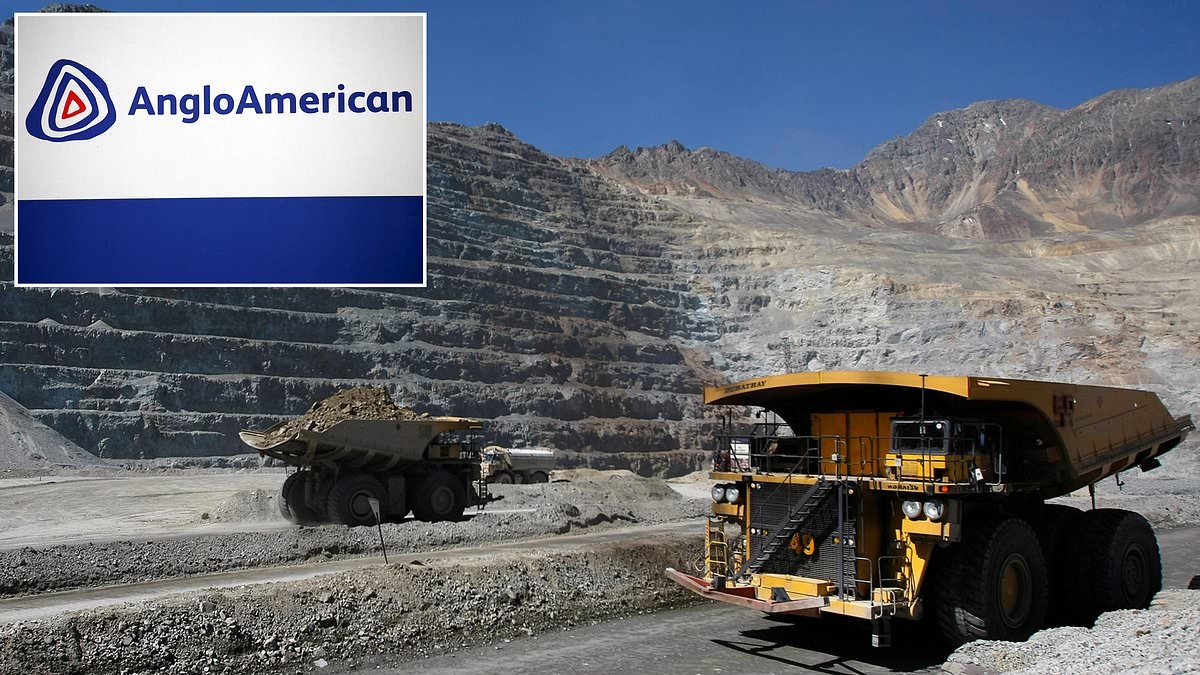
Anglo American suffers £3bn blow as US rival pulls out of deal to buy its Australian coal mines
Anglo American suffered a setback yesterday after a US rival abandoned plans to buy its coal mines. Peabody Energy said it was pulling out of its £2.8billion purchase of the London-listed mining giant's Australian steelmaking coal business. The US company blamed a 'material adverse change' in circumstances following an explosion at the Moranbah North mine in Queensland's Bowen Basin. The site has remained closed since March. It comes as a blow to Anglo as it seeks to restructure having fended off a £39billion takeover bid from BHP. Anglo boss Duncan Wanblad said he was 'very disappointed' and insisted the blast at Moranbah North 'did not constitute' a material adverse change. Wanblad said 'it would have been better for all parties to avoid a legal dispute' but added the firm would 'shortly initiate an arbitration to seek damages for wrongful termination' of the deal. BHP posted its lowest profits for five years as weak demand in China sent iron ore prices down. Earnings fell 26 per cent to £7.8billion last year.
