



Jordan jails 4 for 20 years in case linked to Muslim Brotherhood
Earlier in April, the kingdom's intelligence service announced it had arrested 16 suspects and 'foiled plans aimed at targeting national security, sowing chaos and sabotaging within Jordan.'
Jordan then announced last week that it was banning the activities of the Muslim Brotherhood, a transnational Islamist movement, accusing it of manufacturing and stockpiling weapons and planning to destabilize the kingdom.
On Wednesday, Jordan's state security court said in a statement that it had sentenced four of the 16 defendants to 20-year jail terms and unspecified fines.
The four were convicted of 'possession of explosives, weapons and ammunition with the intent to use them illegally and commit acts that would disrupt public order and threaten social safety and security, in violation of the provisions of the Anti-Terrorism Law,' it said.
The statement did not specify whether they were members of the Muslim Brotherhood, but state television had previously broadcast what it described as confessions from three of the 16 suspects admitting they were members of the Islamist group.
The Brotherhood later issued a statement distancing itself from the individuals and saying they acted on their own motives.
Interior Minister Mazen Al-Faraya announced on April 23 that the government had decided to 'ban all activities of the so-called Muslim Brotherhood and to consider any activity (carried out by it) a violation of the provisions of the law.'
The Muslim Brotherhood has continued to operate in Jordan despite a ruling by the country's top court dissolving it in 2020, with authorities turning a blind eye to its activities.

Try Our AI Features
Explore what Daily8 AI can do for you:
Comments
No comments yet...
Related Articles


Saudi Gazette
 15 hours ago
- Saudi Gazette
US State Department revokes 6,000 student visas
WASHINGTON — The State Department has revoked more than 6,000 international student visas because of violations of US law and overstays. The agency said the "vast majority" of the violations were assault, driving under the influence (DUI), burglary and "support for terrorism". The move comes as the Trump administration continues its crackdown on immigration and international students. While the State Department did not specify what they meant by "support for terrorism", the Trump administration has targeted some students who have protested in support of Palestine, arguing they had expressed antisemitic behaviour. Of the 6,000 student visas that were revoked, the State Department said about 4,000 of those were revoked because visitors broke the law. Another 200-300 visas were also revoked for "terrorism done under INA 3B", the State Department said, referring to code that defines "terrorist activity" broadly as acts that endanger human life or violate US law. Earlier this year, the Trump administration paused scheduling visa appointments for international students. In June, when they restarted appointments, they announced they would ask all applicants to make their social media accounts public for enhanced screening. They said they would search for "any indications of hostility toward the citizens, culture, government, institutions, or founding principles of the United States". State Department officers were also instructed to screen for those "who advocate for, aid, or support designated foreign terrorists and other threats to national security; or who perpetrate unlawful anti-Semitic harassment or violence". Secretary of State Marco Rubio told lawmakers in May that he estimated "thousands" of student visas had been rescinded since January. "I don't know the latest count, but we probably have more to do," Rubio told US lawmakers on 20 May. "We're going to continue to revoke the visas of people who are here as guests and are disrupting our higher education facilities." Democrats have pushed back against the Trump administration's effort to revoke student visas, describing it is an attack on due process. More than 1.1 million international students from over 210 countries were enrolled in US colleges in the 2023-24 school year, according to Open Doors, an organisation that collects data on foreign students. — BBC


Leaders
4 days ago
- Leaders
Syria Coastal Violence Likely Involved War Crimes: UN
A recent UN report has accused Syria's interim government forces and Assad loyalists of likely committing war crimes during March's sectarian violence, which killed around 1,400 people, mainly civilians. The UN Syria Commission of Inquiry found no evidence that Damascus authorities ordered the attacks. However, it documented revenge killings, torture, abductions, and inhumane acts across Alawite-populated areas in Latakia, Tartus, Homs, and Hama. Systematic Targeting of Civilians Coastal violence in the Alawite heartland exposed divisions after Islamist-led rebels ousted ex-President Bashar al-Assad in December, beginning when former regime loyalists ambushed security forces, sparking clashes between largely Sunni government forces and mostly Alawite Assad loyalists. Authorities sent reinforcements, joined by thousands of fighters, turning the operation into sectarian revenge killings. After decades of Assad brutality in mainly Sunni Syria, many associate Alawites, 10% of the population, with the old regime. Furthermore, the commission urged the government to expand accountability efforts. 'The scale and brutality of the violence documented in our report is deeply disturbing,' said Paulo Sergio Pinheiro, chair of the UN Syria Commission of Inquiry. He called on interim authorities to pursue accountability for all perpetrators, regardless of affiliation or rank. While dozens of alleged perpetrators have been arrested, the violence's scale warrants expanding these efforts. The report warned of continuing retaliatory attacks amidst heightened fear, urging the interim government to address them urgently. It documented gross human rights violations in 16 Alawite-populated locations across Latakia, Tartus, Homs, and Hama governorates in early March. Sectarian Violence and Its Aftermath Perpetrators went door-to-door, asking if civilians were Alawite before taking men and boys away to execute. Most victims were Alawite men aged 20-50, but women and children as young as one were also killed in house raids. Armed individuals filmed themselves committing serious human rights violations, including severe beatings, executions, and walking alongside dead bodies. Fearful of reprisal, families kept their loved ones' bodies at home for days or left them in streets for later mass burials, with hospitals overwhelmed as corpses piled up. Thousands fled to neighboring Lebanon or a Russian airbase for safety, with the report stating that many survivors and Alawites have since relocated within Syria or sought refuge abroad. The report concluded that consistent patterns of targeted violence against civilians indicate these acts were not random or isolated. The commission conducted over 200 interviews with witnesses and victims and accessed coastal areas and affected communities. After 14 years of civil war and documented human rights abuses, rebels overthrew Assad in December, forming an interim government, led by former rebel Ahmed al-Sharaa. The report identified the post-Assad security vacuum and online disinformation and hate speech about Alawites as contributors to retributive attacks. As clashes escalated between former and pro-government factions, foreign fighters joined government forces mobilized to coastal regions. Government Response and Recommendations The government instructed civilians not to take up arms and warned fighters against harming civilians, establishing curfews. In Tartus, checkpoints prevented fighters from entering, sparing the city from violence seen elsewhere. Additionally, a July government inquiry identified 298 alleged perpetrators within military factions and 265 linked to former government fighters. In June, officials reported 42 arrests for alleged abuses and established a complaints office for security and police misconduct cases. The commission recommended strengthening the court system to ensure justice, providing reparations for survivors, and building community trust, among other measures. Sectarian violence has continued elsewhere in Syria since March, as hundreds died in Suweida clashes last month. Bedouin and Druze fighters and the Syrian army face accusations of killing civilians and extrajudicial killings. The government acknowledged reports of 'shocking violations' by individuals in military fatigues and told the BBC it would fully investigate all atrocity allegations. Short link : Post Views: 102
Saudi Gazette
4 days ago
- Saudi Gazette
Video of far-right Israeli minister taunting imprisoned Palestinian leader sparks outrage
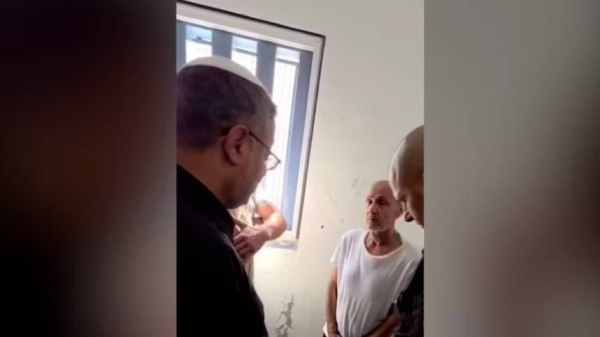
JERUSALEM — Israel's far-right security minister posted video footage of himself taunting the most high-profile Palestinian prisoner while visiting him in jail this week, in an encounter that has prompted outrage from supporters. The video is the first time that Marwan Barghouti, 66, who is serving five life sentences after being convicted in 2002 for his role in planning attacks that killed five Israeli civilians, has been seen for many years. He appears gaunt and frail, with his arms held together in front as he nods slightly. In the 13-second video, Itamar Ben Gvir taunts and threatens Barghouti, saying, 'Whoever harms the people of Israel, whoever kills children, whoever kills women, we will wipe them out.' Barghouti appears to try to respond, saying, 'You know...' before Ben Gvir promptly cuts him off. 'No no, you must know this, throughout all of history.' The video then abruptly ends. Ben Gvir posted the video on his Telegram channel on Friday morning. Opinion polls have consistently shown him as the most popular Palestinian politician, and his time in prison has only increased the admiration in which he is held by Palestinians. Despite his life sentences, some see him as a successor to the ageing Palestinian Authority President Mahmoud Abbas. Barghouti is only seen very rarely, and often years will pass between videos or images are seen by the public. Nevertheless, he remains hugely influential and is considered one of the few people who could unite Palestinian society behind a single leader. On multiple occasions, Palestinians have tried to secure his release, including reportedly in ceasefire negotiations during the current war. But Israel has refused to consider releasing Barghouti. The video ignited an almost immediate response from Palestinian officials, who condemned Ben Gvir's message and Barghouti's condition. Barghouti has been held in solitary confinement since the start of the war on October 7, according to his family and to the Palestinian Prisoners' Society. His wife, Fadwa Al Barghouti, said she didn't recognize him at first and 'maybe part of me doesn't want to acknowledge everything that your face and body express,' she said in a post on social media. 'They are still, Marwan, pursuing you and following you even in the solitary confinement cell where you've been living for two years. The struggle against the occupation and its symbols with you continues, and the chains are still on your hands.' It's unclear why Ben Gvir posted the video, which appears to be shot in a high-security prison in southern Israel where Barghouti is held. The far-right minister of national security is known for making provocative statements and served time in jail for anti-Arab incitement. Palestinian Authority Vice President Hussein Al Sheikh called Ben Gvir's threats 'the height of psychological, moral, and physical terrorism practiced against prisoners, and a violation of international and humanitarian conventions and norms.' Raed Abu Al-Humus, the head of the Palestinian Authority for Prisoners and Released Prisoners' Affairs, said he holds Ben Gvir 'fully responsible' for the Barghouti's life. He warned that the threatening visit was a 'dangerous indication of the intentions' of Ben Gvir. — CNN
