


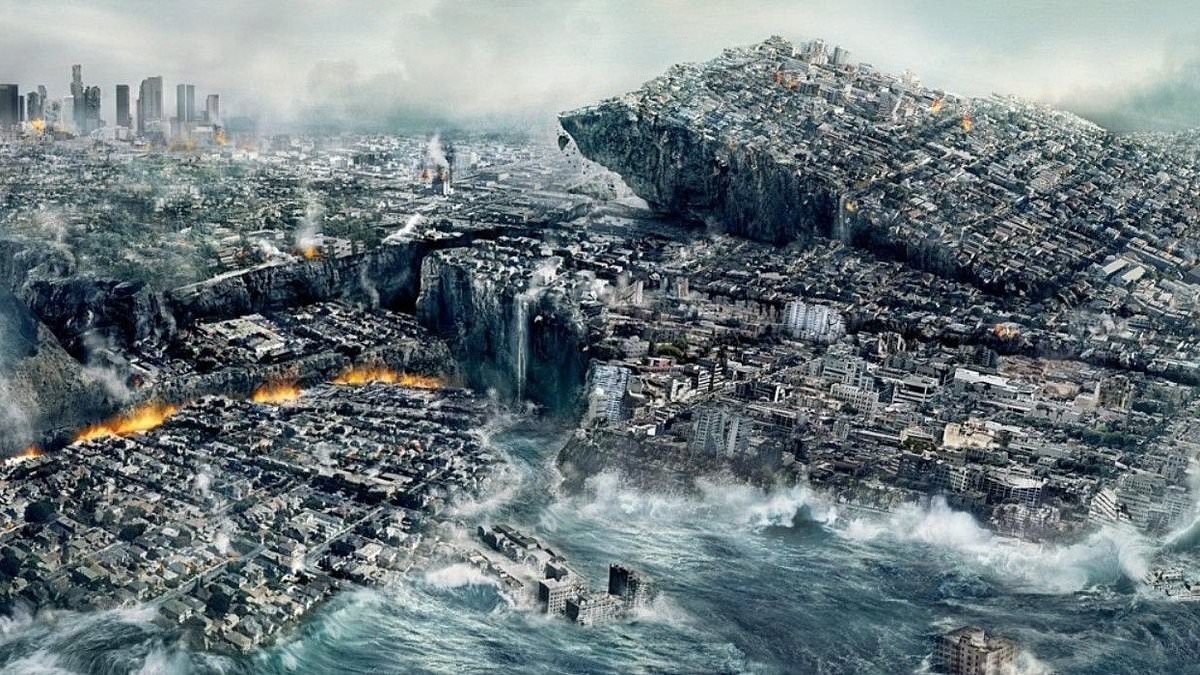
Urgent warning to brace for 'Ring of Fire' apocalypse as megaquake sets off devastating chain reaction that has MILLIONS in its path
The Ring of Fire is a 25,000-mile chain of volcanoes and earthquake zones that stretches around the Pacific Ocean, home to about 75 percent of the world's active volcanoes and frequent earthquakes.
Hashtags

Try Our AI Features
Explore what Daily8 AI can do for you:
Comments
No comments yet...
Related Articles


The Independent
 18 hours ago
- The Independent
One of the world's most active volcanoes Kilauea is set to erupt again
Molten rock is currently erupting from two vents simultaneously at Kilauea volcano, with lava shooting high into the sky and illuminating the night with a vivid red and orange glow across its summit crater. Scientists anticipate the volcano, renowned as one of the world's most active, will gush lava again in the coming days, marking its 31st eruption since December. While a select few residents and visitors will witness the spectacle firsthand at Hawaii Volcanoes National Park, hundreds of thousands more are expected to tune into popular livestreams. These online feeds are made possible by three camera angles set up by the US Geological Survey, offering a virtual front-row seat to the natural phenomenon. Among those captivated by Kilauea's power is Park Service volunteer Janice Wei, who rushes to capture photos and videos of Halemaumau Crater whenever an eruption begins. Native Hawaiian tradition holds that this crater is the sacred home of the volcano goddess Pele. Wei describes the sound of the molten rock, as it shoots skyward like a fountain, as akin to a roaring jet engine or crashing ocean waves, noting she can feel its intense heat from over a mile away. "Every eruption feels like I am sitting in the front row at nature's most extraordinary show," Wei shared in an email. Kilauea is situated on Hawaii Island, the largest landmass in the Hawaiian archipelago. It lies approximately 320 kilometres (200 miles) south of Honolulu, the state's largest city, which is located on Oahu. Here's what to know about Kilauea's latest eruption: Towering fountains of molten rock A lower magma chamber under Halemaumau Crater is receiving magma directly from the earth's interior about 5 cubic yards (3.8 cubic meters) per second, said Ken Hon, the scientist-in-charge at the Hawaiian Volcanoes Observatory. This blows the chamber up like a balloon and forces magma into an upper chamber. From there, it gets pushed above ground through cracks. Magma has been using the same pathway to rise to the surface since December, making the initial release and subsequent episodes all part of the same eruption, Hon said. Many have featured lava soaring into the air, in some cases more than 1,000 feet (300 meters) The fountains are generated in part because magma — which holds gasses that are released as it rises — has been traveling to the surface through narrow, pipe-like vents. The expanding magma supply is capped by heavier magma that had expelled its gas at the end of the prior episode. Eventually, enough new magma accumulates to force the degassed magma off, and the magma shoots out like champagne bottle that was shaken before the cork was popped. This is the fourth time in 200 years that Kilauea has shot lava fountains into the air in repeated episodes. There were more episodes the last time Kilauea followed this pattern: the eruption that began in 1983 started with 44 sessions of shooting fountains. Those were spread out over three years, however. And the fountains emerged in a remote area so few got to watch. The other two occurred in 1959 and 1969. Predicting Kilauea's future Scientists don't know how the current eruption will end or how it may change. In 1983, magma built enough pressure that Kilauea opened a vent at a lower elevation and started continuously leaking lava from there rather than periodically shooting out of a higher elevation. The eruption continued in various forms for three decades and only ended in 2018. Something similar could happen again. Or the current eruption could instead stop at the summit if its magma supply peters out. Scientists can estimate a few days or even a week ahead of time when lava is likely to emerge with the help of sensors around the volcano that detect earthquakes and miniscule changes in the angle of the ground, which indicate when magma is inflating or deflating. 'Our job is like being a bunch of ants crawling on an elephant trying to figure out how the elephant works,' Hon said. The lava fountains have been shorter lately. Steve Lundblad, a University of Hawaii at Hilo geology professor, said the vent may have gotten wider, leaving molten rock less pressurised. 'We're still gonna have spectacular eruptions," he said. "They're just going to be be wider and not as high.' Carrying stories of Pele Some people may see lava flows as destructive. But Huihui Kanahele-Mossman, the executive director of the Edith Kanakaʻole Foundation, said lava is a natural resource that hardens into land and forms the foundation for everything on Hawaii Island. Kanahele-Mossman's nonprofit is named after her grandmother — the esteemed practitioner of Hawaiian language and culture, and founder of a noted hula halau, or school. Hālau o Kekuhi is celebrated for its mastery of a style of hula rooted in the stories of Pele and her sister, Hiʻiaka. Kanahele-Mossman has visited the crater a few times since the eruption began. She initially watches in awe and reverence. But then she observes more details so she can go home and compare it to the lava in the centuries-old tales that her school performs. At the crater, she delivers a chant prepared in advance and places offerings. Recently she presented awa, a drink made with kava, and a fern lei. 'You as the dancer, you are the storyteller and you carry that history that was written in those mele forward,' she said, using the Hawaiian word for song. 'To be able to actually see that eruption that's described in the mele, that's always exciting to us and drives us and motivates us to stay in this tradition.' Visiting the volcano Park visitation has risen all eight months of the year so far, in part because of the eruption. In April, there were 49 per cent more visitors than the same month of 2024. Park spokesperson Jessica Ferracane noted that the last several episodes have only lasted about 10 to 12 hours. Those wanting to go should sign up for U.S. Geological Survey alert notifications because the eruption could be over before you know it, she said. She cautioned that visitors should stay on marked trails and overlooks because unstable cliff edges and earth cracks may not be immediately apparent and falling could lead to serious injury or death. People should also keep young children close. Volcanic gas, glass and ash can also be dangerous. Those visiting at night should bring a flashlight.


The Sun
a day ago
- The Sun
Bright orange shark spotted for the ‘first time ever' after being reeled in by fisherman in catch of a lifetime
A GIANT first-of-its-kind shark has been reeled in off the coast of Costa Rica. The exceedingly rare shark, measuring in at over six feet long, exhibited a rare pigmentation condition causing it to appear orange. 4 4 The shark was thought to have xanthism, a rare pigmentation condition, affecting the fur, scales or skin of animals. It creates yellow or golden colours in the animal but has never been observed in cartilaginous fish, a group that includes sharks, rays, and skates, in the Caribbean before. The rare catch appeared to also show traits of albinism, with the shark boasting a pair of striking white eyes. The nurse shark usually has brown skin which helps them blend into the seabed. Based on the size of the shark researchers from the Federal University of Rio Grande concluded the unusual colour did not affect the shark's survival. Animals with albinism or xanthism are much more visible which scientists believe lowers their survival rate in the wild. The bright colouring caused by the pigmentation conditions makes affected animals easy targets for predators. Both conditions can also increase sensitivity to sunlight and make it difficult for animals to find mates. This makes the discovery of a shark that survived to adulthood with both conditions all the more significant. It is unclear whether the unusual colouring offered any advantages to the shark or if it simply managed to thrive despite being more visible. Rare giant 'spaceship-like' sea creature that grows up to 2.5 metres spotted off Scots coast The striking fish was reeled in by some pals on a sport fishing trip in the Caribbean. Its discovery prompted questions for marine biologists about genetic diversity in Caribbean nurse shark populations. Scientists are now asking whether this is a one-time occurrence, or if it could signal a new genetic trend in the local population. Xanthism is considered extremely rare across the animal kingdom. 4 4 It has been recorded in only a few species of fish, reptiles, and birds, but there have only been a handful of confirmed cases. In freshwater fish such as guppies, cichlids, and even goldfish, the condition sometimes produces striking yellow morphs. Certain birds, like parrots and canaries, have also displayed golden plumage linked to xanthism. Occasional reports in reptiles describe unusually yellow snakes or lizards.


Daily Mail
2 days ago
- Daily Mail
Scientists issue chilling warning about 'The Big One': Impending mega-earthquake on California's notorious San Andreas fault could be even BIGGER than we thought
It is predicted to be one of the most devastating earthquakes in history. And now scientists have issued a chilling warning about 'The Big One' – a mega–earthquake set to rock California 's notorious San Andreas fault. Experts from Caltech in Pasadena have studied a 7.7–magnitude earthquake that shook Myanmar in March along the Sagaing fault – a fault known for being eerily similar to San Andreas. That earthquake ended up rupturing a much longer section of the fault than scientists expected, killing thousands and causing widespread damage. According to the researchers, this suggests The Big One could also be even bigger than we originally thought. 'Future earthquakes might not simply repeat past known earthquakes,' said Jean–Philippe Avouac, co–author of the study. 'Successive ruptures of a given fault, even as simple as the Sagaing or the San Andreas faults, can be very different and can release even more than the deficit of slip since the last event. 'In addition, historical records are generally far too short for statistical models to represent the full range of possible earthquakes and eventual patterns in earthquake recurrence.' The devastating earthquake hit Myanmar on 28 March 2025, killing more than 2,000 people, and leaving 3,900 injured. The quake occurred when a section of the Sagaing fault ruptured, causing widespread damage along a swathe of territory down the middle of the country, including Sagaing, Mandalay, Magway and Bago regions and Shan State. In their new study, the Caltech team used satellite imagery of the Sagaing Fault's motion to understand exactly what happened – and whether a similar incident could happen in California. 'This earthquake turned out to be an ideal case to apply image correlation methods that were developed by our research group,' said Solène Antoine, first author of the study. 'They allow us to measure ground displacements at the fault, where the alternative method, radar interferometry, is blind due to phenomenon like decorrelation [a process to decouple signals] and limited sensitivity to north–south displacements.' Based on studies of previous tremors along the Sagaing fault, the researchers expected that the earthquake would occur on a 186–mile (300–kilometer) section of the fault, where no large earthquakes had occurred since 1839. The satellite images confirmed that this was the case – but that the fault actually slipped along a total of more than 310 miles (500km). In fact, the 310–mile section shifted by a whopping 9.8ft (three metres) after the quake. So, what does this mean for The Big One? Well, according to the researchers, it suggests The Big One won't look like anything we've seen before. Previous earthquakes on the San Andreas Fault include a 7.9–magnitude earthquake in 1857, which ruptured the fault from Monterey County all the way to Los Angeles County. Meanwhile, in 1906, an earthquake began just offshore of San Francisco, before rupturing in two directions, towards Humboldt County and Santa Cruz County. Instead, a future rupture could result in smaller, separate earthquakes. Or, it could be even bigger than those seen before – rupturing the fault all the way into San Bernardino, Riverside, and Imperial counties, and reaching a magnitude of 8. The researchers now hope to use their new models to better understand what The Big One will actually look like. 'Physics–based models provide an alternative approach with the advantage that they could, in principle, be tuned to observations and used for time–dependent forecast,' Professor Avouac added.
