


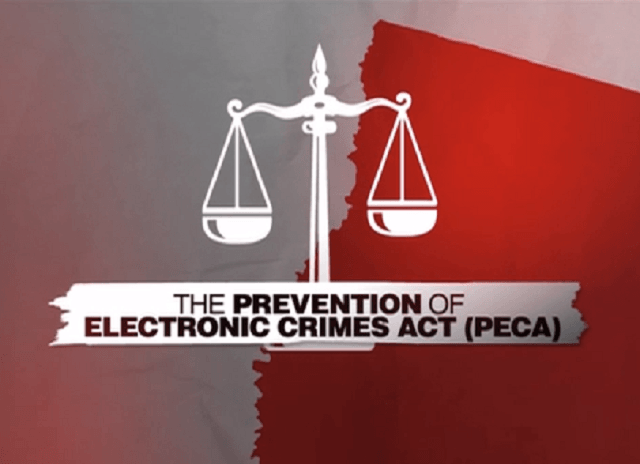
Senate panel urged to hear PECA concerns
The Joint Action Committee (JAC) of media organisations has written a letter to the Senate Standing Committee on Interior, expressing its reservations on the proposed amendments to the Prevention of Electronic Crimes Act, 2016 (PECA).
In the letter addressed to the committee chairman, Senator Faisal Saleem Rahman, JAC noted that the amendments to be introduced through the PECA (Amendment) Bill, 2025 can have significant implications for freedom of the press and freedom of expression.
These amendments, it said, have been introduced without any consultation or discussion with relevant stakeholders, including media and journalist organizations.
It said JACa representative body of all media organisations: PFUJ, CPNE, AEMEND, APNS and PBAis not against the enactment of laws that regulate media in a manner consistent with democratic norms.
"However, the process through which this amendment is being advancedhastily and without meaningful engagement with the stakeholderscontradicts the principles of fairness and the spirit of democracy.
"Such an approach erodes trust and raises serious concerns about the intent behind the bill, particularly its impact on constitutionally guaranteed rights such as freedom of expression and freedom of the press.''
JAC said legislation of such importance must be shaped through a transparent, participatory process, ensuring that the concerns, objections, and suggestions of all stakeholders are taken into account.
"Passing this law in its current form, without addressing these issues, will inevitably be seen as an attempt to stifle dissent and curtail freedoms that are guaranteed by the Constitution of Pakistan, which is neither acceptable nor justifiable in a democratic society.
JAC urged the committee chairman to give the representatives of JAC a hearing before the committee debates the amendment bill. "We would like to put up our serious concerns on certain aspects of this bill which seriously impede freedom of expression," it added.
Hashtags

Try Our AI Features
Explore what Daily8 AI can do for you:
Comments
No comments yet...
Related Articles

Business Recorder
 3 hours ago
- Business Recorder
Senate passes Anti-Terrorism Bill amid opposition walkout
ISLAMABAD: Amidst strong opposition, the Senate, Tuesday, passed three government bills including the Anti-Terrorism (Amendment) Bill, 2025, that allows detention of suspects at the hands of law enforcement agencies for more than three months. On the last day of the 353rd session, State Minister for Interior Talal Chaudhry presented the bill in the House that met strong opposition. Last week, the bill was passed by the National Assembly where it faced strong opposition too. In the Senate meeting, Pakistan Tehreek-e-Insaf (PTI) Parliamentary Leader Ali Zafar criticised the powers given to the law enforcement agencies to detain any suspect without presenting them in a court of law for three months. 'The country is burning in the fire of terrorism,' responded Law Minister Azam Tarar, defending the bill, saying it aimed at countering terrorism. Kamran Murtaza from Jamiat Uelma-e-Islam Fazal (JUI-F) criticised the treasury side for presenting the bill for passage without having it referred to the relevant committee first. 'Heavens would not have fallen had this bill been referred to the committee,' he said. The bill was finally passed by the House by majority vote following which the PTI staged a walkout from the House in protest. The Section 3(a)(1) of the Anti-Terrorism (Amendment) Bill 2025 provides that the government or— the armed forces or civil armed forces - for a period not exceeding three months - issue an order for the preventative detention of any person who has been concerned in 'any offence under this Act relating to the security or defence of Pakistan or any part thereof, or public order relating to target killing, kidnapping for ransom, and extortion, bhatta, or the maintenance of supplies or services, or against whom a reasonable complaint has been made or credible information has been received, or a reasonable suspicion exists of his having been so concerned, for purpose of inquiry: Provided that the detention of such person, including detention for a further period after three months, shall be subject to the provision of Article l0 of the Constitution.' The Section 3(b) of the bill says, 'Provided that where the detention order has been issued by the armed forces or civil armed forces under Sub-section (1), the inquiry shall be conducted by a joint investigation team (JIT) comprising of a police officer not below the rank of superintendent of police, intelligence agencies, civil armed forces, armed forces, and other law enforcing agencies.' The Section 3(c) of this bill says that Anti-Terrorism (Amendment) Bill, 2025 shall remain in force for a period of three years from its commencement. Apart from Anti-Terrorism (Amendment) Act, 2025, the other two bills passed by the House were Petroleum (Amendment) Bill, 2025 and Pakistan Land Port Authority Bill, 2025. The Petroleum (Amendment) Bill, 2025 aims at introducing 'IT-based tracking of petroleum products, to curb the smuggling of petroleum products.' The Pakistan Land Port Authority Bill, 2025 aims to 'establish a land port authority to provide and administer an integrated system of facilities for cross-border movement of goods and passengers at land ports in Pakistan and to make provision for its operation, management, development of land port and matters connected therewith and ancillary matter.' Through resolutions, the Senate extended the Capital Development Authority Amendment Ordinance 2025 and the National Agri-Trade and Food Safety Authority Ordinance, 2025 for 120 days. Meanwhile, the Interior Ministry, in a written reply shared in the Senate Question House, said that the Federal Investigation Agency (FIA) dismissed its 51 employees in the last three years for 'suspected collusion with human smugglers.' The Senate is prorogued. Copyright Business Recorder, 2025


Express Tribune
4 days ago
- Express Tribune
New bill targets online obscenity
Legislation on a new bill — Prohibition of Obscenity and Vulgarity on Digital Media Bill 2025 — is expected in the next National Assembly session. Introduced by PPP MNA Dr Syeda Shahida Rehmani, the bill seeks to curb obscene content online and entails penalties ranging from Rs100,000 to Rs1 billion. The proposed bill defines "digital media" and "prohibited content" as including online and offline platforms, applications, social media, and streaming services. It will apply to all content in the form of images, audio, videos, multimedia, films, web series, animated sketches, dramas, songs, short videos, live broadcasts, or advertisements viewable via digital media. Prohibited content includes sexual conversations, extramarital relations, sexual immorality, semi-nude attire, drug use, violations of public morality, hurting religious sentiments, mocking hijab, purdah, or the family system, ridiculing religious figures, and violating the ideology of Pakistan or cultural values. Under the bill, an authority, a board, and a tribunal will be established. Violations will be investigated by the National Cyber Crime Investigation Agency (NCCIA) and prosecuted under the Prevention of Electronic Crimes Act, 2016. The board will have eight members: two religious scholars, one woman and one man, two psychologists, one female civil society member, one media legal expert, one media professional responsible for seizing prohibited content, and a federal government representative as chairperson. The tribunal will consist of three members: a person qualified to be a high court judge, a media professional, and an IT expert, who will hear and decide cases related to digital media. The board will have the authority to ban prohibited content, make amendments, take suo motu action against obscene material, and recommend fines for violations, while the authority will act on the board's recommendations. Penalties under the bill include one-year imprisonment and a Rs500,000 fine for the first-time offense and three-year imprisonment and Rs5 million fine for the second offense. Offenses involving religion, women, children, or the family system will entail five-year imprisonment and Rs10 million fine. Digital media platforms and service providers will be required to report all uploaded content in Pakistan to the board within 15 days and, upon notice, block prohibited content within 24 hours and retain the record for three years. Rs50 million will be imposed on platforms for the first violation and Rs100 million fine for the second violation. Repeated violations will result in license cancellation and service blockage. All crimes under this act will be non-bailable and non-compoundable. The bill is expected to be approved by the NA after deliberation in the relevant standing committee. The PECA, a law enacted in 2016, was passed by lower and upper houses, aimed at addressing cybercrime and regulating electronic communication in Pakistan. It was meant to combat online offences such as hacking, data theft, and cyberbullying. Many journalists and media organisations have raised concerns regarding its implications on press freedom and freedom of expression. "The government has to learn the lessons as it was earlier used against the same party, which had passed the law in a haste," commented Mazhar Abbas, a senior member of PFUJ.

Express Tribune
5 days ago
- Express Tribune
Supreme Court unveils modernised 2025 rules
The Supreme Court on Thursday formally published the Supreme Court Rules, 2025, replacing the Supreme Court Rules, 1980 in what the court described as its commitment to modernization, digitalization, and to bring procedural clarity in the justice system in line with global governance of law. Framed under Article 191 of the Constitution, the new rules replaced "outdated provisions" and brought court procedures in line with contemporary legal, constitutional, and technological developments. According to a press release issued by the SC on Thursday, the rules came into immediate effect. The new rules were framed by a committee formed by Chief Justice of Pakistan (CJP) Yahya Afrifi. The committee comprised four SC judges — Justice Shahid Waheed, Justice Irfan Saadat Khan, Justice Naeem Akhter Afghan, and Justice Aqeel Ahmed Abbasi. According to a press releases issued by the apex court, the committee engaged with judges, the Pakistan Bar Council (PBC), the Supreme Court Bar Association (SCBA), and other bar associations. The final draft was placed before the full court and approved after detailed deliberation. Following the promulgation of the new rules, the SCBA issued a statement, stating that the SC did not consult with bars with regard to increase in court fees. It demanded that the SC withdraw its decision to increase the fees, noting that such increase in fees will not help in dispensation of justice. Later in the day, the SC issued a public notice inviting suggestion to improve the rules. The notice said the new rules are conceived as a living document-responsive to the needs of the bench, the bar, the litigants, and adaptable to emerging legal and technological developments. It said that in the spirit of transparency and inclusivity, the CJP has constitute a committee under Rule 1(4) of Order I of the Supreme Court Rules, 2025, to make recommendations for addressing any difficulty that may arise in giving effect to its provisions. Interestingly, the committee comprises the same four judgesJustice Waheed, Justice Khan, Justice Afghan and Justice Abbasiwho were part of the committee that framed the rules. "The SC invites suggestions and feedback from judges, members of the bar, litigants, and the general public in this regard. Submissions will be compiled and reviewed by the committee and placed before the full court for consideration at the commencement of the new Judicial Year. "Suggestions may be sent in writing to the SC registrar," it added. The new rules The Supreme Court Rules, 2025 consist of seven parts, thirty-eight orders, and six schedules, with approximately 280 provisions amendedincluding 160 from the schedules. The rules include 60 new provisions while five outdated provisions have been deleted. The new rules include digital transition and technological enablement. Now all petitions and paper books must now be filed electronically while scanned copies are also mandatory. Notices, orders, certified copies, and pleadings will be issued digitally. Hearings through video-link are now permitted. It makes the authentication of affidavits by an Apostille mandatory. An Apostille is a certificate that simplifies the authentication of documents for international use, particularly for countries that are part of the Hague Apostille Convention. Parties and advocates are also required to provide updated phone numbers, email addresses, and digital app details. Now judicial documents sent via post will not be entertained. It provides litigant access to records and parties may inspect records or obtain copies online or in person. Applications marked urgent or requesting interim relief must be listed within 14 days or at the earliest practicable date. The SC registrar is authorized to ensure compliance with formats prescribed in the Sixth Schedule. Under the new rules, court fees are revised after decades; advocate and official expenses are also updated. However, criminal petitions are fee-exempt — except for certified copies. Copies are free for petitions submitted from jail while habeas corpus and Article 184(3) petitions related to criminal matters remain exempt from fees. The registrar may appoint advocates at state expense in death sentence cases. Counsel fees have also been enhanced. Under the rules, intra-court appeals have been introduced for orders under Article 184(3) and contempt proceedings. One review petition is permitted per judgment and it may be filed in person or through alternate counsel. Frivolous reviews may attract penalties and the security deposit has been increased. A party may revoke a power of attorney and appoint a new Advocate-on-Record. Transfer applications under Article 186A and Section 25A of the Family Courts Act, 1964, are now recognized. Constitutional Benches are formalized through a newly added chapter. The rules also introduce adjudication and procedural safeguards. Appeals from interlocutory orders will be heard by a bench of at least two judges; all other appeals, including those against acquittal will be heard by not less than three judges. Paper books will be delivered in advance to the Attorney-General, Advocate-General, Prosecutor-General, and respondents, with certification of service. The registrar may recall ex-parte orders upon sufficient cause. Compromise in compoundable offences is now formally accommodated. In acquittal appeals, the court may require surety or take coercive action if a respondent avoids appearance. Procedures for summoning records from lower courts have been streamlined. Under the administrative and structural reforms, the registrar is empowered to supervise staff and exercise procedural powers as assigned under the rules. Branch Registries are retained at all provincial capitals; filings are allowed at either Islamabad or the relevant registry. Under the rules, all fees, costs, security deposits, and allowances will be reviewed and revised every three years. Written tests for registration as advocate-on-record have been abolished and advocates with five years' standing may apply directly. The new rules also highlight courtroom conduct. Advocates may wear either a sherwani or a short black coat; wearing gowns is now optional. No concise statement is required in criminal appeals. In civil matters, if security for costs is not deposited within 30 days, leave to appeal stands rescinded unless otherwise ordered. Respondents may seek summary dismissal of frivolous or delay-motivated appeals. Procedural failures shall be treated as irregularities and will not nullify proceedings. Under the new rules, the court's inherent powers to ensure justice remain unaffected. "The Supreme Court Rules, 2025, reflect a transformative vision — integrating digital tools, promoting timely justice, and eliminating procedural rigidity. "With inclusive provisions and simplified processes, the rules usher in a new era of judicial efficiency and responsiveness in Pakistan. These rules have also been uploaded on the Supreme Court website for the information of the general public," said the official press release.
