



Starmer hails ‘real progress' made during White House summit on Ukraine war
US President Donald Trump said he spoke directly with Vladimir Putin to begin planning a meeting between the Russian leader and Mr Zelensky, which will then be followed by a three-way meeting involving himself.
He also said Moscow will 'accept' multinational efforts to guarantee Ukraine's security.
Speaking after the event, Sir Keir described the talks as 'good and constructive', adding: 'There was a real sense of unity between the European leaders that were there, and president Trump and president Zelensky'.
The Prime Minister highlighted 'two material outcomes' from the talks, firstly that the coalition of the willing 'will now work with the US' on security guarantees.
'That's really important for security in Ukraine, for security in Europe, and for security in the UK,' Sir Keir said.
'The other material outcome was the agreement that there will now be a bilateral agreement between president Putin and president Zelensky, that was after a phone call between president Trump and president Putin during the course of this afternoon, followed by a trilateral which will then add in president Trump.
'That is a recognition of the principle that on some of these issues, whether it's territory or the exchange of prisoners, or the very serious issue of the return of children, that is something where Ukraine must be at the table.
'These were the two outcomes that were the most important coming out of today. They're positive outcomes, there was a real sense of unity. We've made real progress today.'
Posting on his Truth Social platform after the meeting, Mr Trump also described the talks as 'very good', adding: 'During the meeting we discussed security guarantees for Ukraine, which guarantees would be provided by the various European countries, with a coordination with the United States of America.
'Everyone is happy about the possibility of PEACE for Russia/Ukraine.
'At the conclusion of the meetings, I called president Putin and began arrangements for a meeting, at a location to be determined, between president Putin and president Zelensky.
'After the meeting takes place, we will have a trilat which would be the two presidents plus myself.'
Before the White House talks, the US president said he would 'probably' be able to find common ground with the leaders on a plan to ward off future attacks on Ukraine.
He previously met with Mr Putin in Anchorage, Alaska, on Friday, where he declared there was 'no deal until there's a deal' to end more than three years of fighting in eastern Europe.
'The Alaska summit reinforced my belief that while difficult, peace is within reach and I believe, in a very significant step, President Putin agreed that Russia would accept security guarantees for Ukraine,' Mr Trump said on Monday.
'And this is one of the key points that we need to consider.'
He later said: 'We also need to discuss the possible exchanges of territory taken into consideration the current line of contact.'
Mr Trump's envoy, Steve Witkoff, had suggested measures similar to Nato's article five mutual defence provision – that an attack on one member is an attack on the entire bloc – could be offered by the US without Kyiv joining the alliance.
'We were able to win the following concession: that the United States could offer article five-like protection, which is one of the real reasons why Ukraine wants to be in Nato,' Mr Witkoff told CNN over the weekend, as he spoke about the Alaska summit.
Future three-way talks 'have a good chance' of stopping the conflict, the US president claimed.
But the president appeared to share conflicting views on whether a ceasefire was necessary to stop the war.
'I don't think you need a ceasefire,' he had originally said, before later explaining that, 'all of us would obviously prefer an immediate ceasefire while we work on a lasting peace'.
During the discussions, Sir Keir welcomed plans for a security guarantee, after Mr Trump introduced him at the negotiating table as a 'friend' on Monday.
He said: 'Your indication of security guarantees, of some sort of article five-style guarantees, fits with what we've been doing with the coalition of the willing which we started some months ago, bringing countries together and showing that we were prepared to step up to the plate when it came to security.
'With you coming alongside, the US alongside, what we've already developed, I think we could take a really important step forward today – a historic step, actually, could come out of this meeting in terms of security for Ukraine and security in Europe.'
Sir Keir also described potential future trilateral talks as appearing to be a 'sensible next step' and continued: 'So, thank you for being prepared to take that forward, because I think if we can ensure that that is the progress out of this meeting – both security guarantees and some sort of progress on (a) trilateral meeting of some sort to bring some of the difficult issues to a head – then I think today will be seen as a very important day in recent years.'
The PA news agency understands the Prime Minister disrupted his holiday plans over the weekend to join calls, including with Mr Trump and Mr Zelensky, before he headed to Washington, as reported in The Times.
Following the talks, Mr Trump said he also discussed 'the massive worldwide problem of missing children' with European Commission President Ursula von der Leyen.
Responding on X, Mr Zelensky said: 'This issue lies at the heart of the war's humanitarian tragedy – our children, broken families, the pain of separation. At least 20,000 children were taken.
'We are working tirelessly to bring every child home. The same applies for our prisoners of war and civilians held in Russia for years, some since 2014, in very bad conditions. Thousands of people still need to be freed – and this is a part of making peace.
'We will work to negotiate all-for-all prisoners of war exchange, and we are grateful to have strong friends who help.'
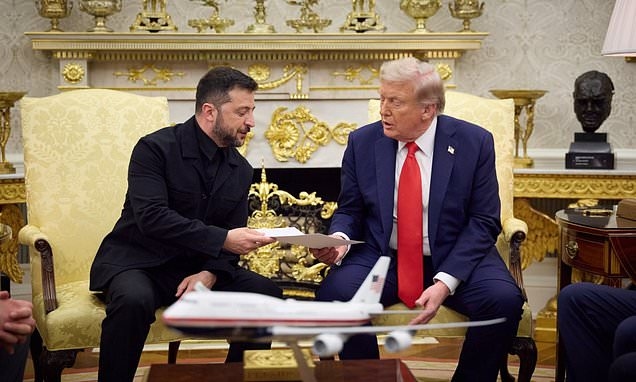
Mr Zelensky, whom Mr Trump greeted at the door of the West Wing with a handshake earlier in the evening, wore a black shirt with buttons and a black blazer to the meeting at the White House.
His attire had appeared to become a point of irritation for Mr Trump during a previous meeting in February.
Early in the meeting, the Ukrainian described the talks as 'really good', saying they had been 'the best' so far.
Mr Zelensky said: 'We are very happy with the president that all the leaders are here and security in Ukraine depends on the United States and on you and on those leaders who are with us in our hearts.'

Try Our AI Features
Explore what Daily8 AI can do for you:
Comments
No comments yet...
Related Articles

Daily Mail
 5 minutes ago
- Daily Mail
Opinion: Signals that prove Trump forced a historic reckoning
No one knows if there will be a peace deal between Ukraine and Russia. But this much is emphatically and impressively true: Donald Trump has already done something extraordinary — he has created a moment in which all parties can see two stark alternatives with sudden clarity. They can compromise and make a deal, or they can face the continuation of a grinding war with an uncertain duration and outcome. That sense of crossroads was on display at the White House on Monday in a tableau that was at once theatrical and substantive. Trump has managed, at least for now, to coax the United States, Europe, and Ukraine into a common position. That united front presents Vladimir Putin with what he has long tried to avoid: Western cohesion in the face of his aggression. The day unfolded with all the trappings of political theater. There was the banter about President Volodymyr Zelensky 's choice of wardrobe — a jacket that suggested a nod to formality rather than the olive drab sweatshirt that has become his wartime uniform. There was also a moment of personal warmth, when Zelensky handed Trump a letter from his wife to Melania Trump, written about the plight of children in the war zone. These gestures may appear minor, but in diplomacy such small signals help reinforce the larger message: unity, solidarity, and an insistence on treating each other as friends rather than supplicants or tetchy combatants. For Zelensky, a former actor who once made his living playing roles, Monday was a performance that mattered. He carried his lines with precision and his tone with care. The last time he visited Washington the chemistry soured and tensions spilled into public view. This time, the body language told a different story. Smiles, nods and a sense of easy rapport radiated from the Oval Office outward. Compared with Putin's frosty reception during his stop in Alaska on Friday — a visit the Kremlin had hoped would project strength — Monday's White House welcome stood as a vivid counterpoint. The most consequential takeaway from the day was the absence of daylight between Washington and its European allies. For years, Putin has relied on fissures within the transatlantic alliance, exploiting differences over energy, trade or the use of force. Yet on Monday, the alignment was clear: the US, Europe and Ukraine are working together to shape a peace plan. This is precisely the scenario Putin has sought to prevent, and brings the world to the essential questions now hovering over these fragile negotiations. Will Putin accept a combined European and American framework that offers Ukraine the security guarantees it needs to risk peace? And will Ukraine, whose soldiers have retaken and held swathes of territory at immense cost, truly be willing to cede land now under its control in exchange for ending the bloodshed? Neither question yields an obvious answer. For Putin, compromise has always been a synonym for weakness. For Ukraine, yielding territory risks validating aggression and betraying those who have died defending it. Yet the very posing of these questions, out loud and on equal terms, marks a shift in the conversation. The possibility of peace, however brutal, is now at least conceivable. If the answer to either or both questions is 'no,' then the burden will shift back to Trump. What will he do? Will he enforce punishing new sanctions designed to cripple the Russian economy? Will he authorize Ukraine to use American-supplied weapons to strike deeper into Russian territory? Will he risk escalation to demonstrate resolve? The options ahead are perilous, but they are his to shape. What is striking is how Trump — long painted as skeptical of NATO, dismissive of Europe and oddly solicitous of Putin — now finds himself in the role of transatlantic unifier. By engineering a moment when the allies stand shoulder to shoulder, he has created the conditions for a test: either Putin comes to the table, or he faces the combined weight of American and European pressure. This is not a neat choice between war and peace. It is instead what might be called a 'brutal peace.' Any deal will be painful, incomplete, and fraught with moral compromise. But it will still be peace. If Trump cannot deliver Putin to the table, then he must bring him to heel by other means. Either way, the calculus has changed. Diplomacy often depends on timing. Wars grind on until one side collapses or until leaders perceive that further bloodshed is more dangerous than negotiation. What Trump has done, at least for now, is force that moment of reckoning. He has made all sides look squarely at the costs of continuing the war versus the costs of ending it. It is too soon to know whether history will mark this week as a turning point. But it is fair to say that Trump, a man once derided as an opponent of Europe and a skeptic of alliances, has demonstrated a capacity to bring allies together in common cause against a murderous dictator. That alone is remarkable. It may yet be remembered as the moment when urgency became opportunity.


Channel 4
35 minutes ago
- Channel 4
‘There's a feeling of depression in Russian cities'
In Russia, the universally pro-Kremlin media have tried to downplay Volodymyr Zelenskyy's meeting with Donald Trump and European leaders – declaring that 'everyone looked gloomier than a thundercloud'. While an op-ed in the state news agency RIA Novosti warned that if future overtures didn't go well, there would be no more 'truly generous compromises', even threatening western Ukraine with the headline 'we'll have to go as far as Lviv'. We were joined by Andrei Soldatov who's one of Russia's leading investigative journalists who fled the country in 2020 and is now on Russia's most wanted list. His latest book is Our Dear Friends in Moscow – the Inside story of a broken generation.

Channel 4
35 minutes ago
- Channel 4
Trump rules out sending US troops to Ukraine in any peace deal
Nato military leaders will meet Wednesday to discuss security guarantees for Ukraine – as European allies try to work out the practicalities with talk of deploying a 'reassurance force' once hostilities cease. Donald Trump said he was now trying to arrange direct talks between Volodymyr Zelenskyy and Vladimir Putin – warning the Russian leader he would face a 'rough situation' if he didn't agree. And he said Ukraine would have to 'show some flexibility' to.
