


Netanyahu isolated in Trump's official Gulf tour
Listen to article
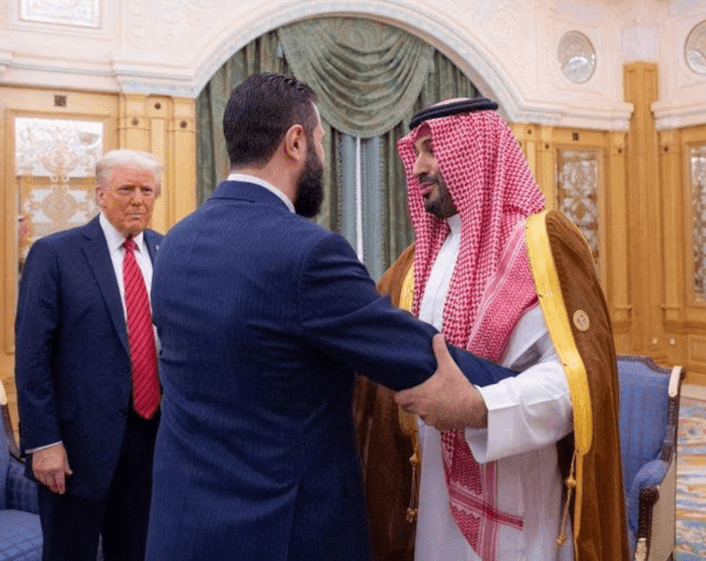
Nothing captured Israeli Prime Minister Benjamin Netanyahu's isolation more starkly this week than the image of US President Donald Trump shaking hands with Syria's Islamist leader Ahmed al‑Sharaa - a man Israel has branded "an al‑Qaeda terrorist in a suit."
"He's got the potential. He's a real leader," Trump told reporters after talks with Sharaa on Wednesday in Riyadh - a meeting brokered by his Saudi hosts, with whom the US president agreed a slew of arms, business and technology deals.
Trump's whirlwind four-day tour of Saudi Arabia, Qatar and the United Arab Emirates this week was more than just a diplomatic spectacle marked by lucrative investments.
It sealed the emergence of a new Sunni-led Middle East order - one that eclipses Iran's shattered 'axis of resistance', and leaves Israel sidelined, according to three regional and two Western sources.
Amid growing irritation in Washington with Israel's failure to reach a ceasefire in Gaza, Trump's tour was a snub to Netanyahu, a close US ally who was the first foreign leader to visit Washington after the president returned to office in January, the sources said.
The message was clear: in Trump's less ideological, more results-driven vision of Middle East diplomacy, Netanyahu could no longer count on unconditional US support for his right-wing agenda, the sources said.
"This administration is very frustrated with Netanyahu and that frustration is showing," said David Schenker, a former US Assistant Secretary of State for Near Eastern Affairs under Republican former President George W Bush.
"They're very, very transactional, and Netanyahu isn't giving them anything right now."
The sources said that the US was not about to turn its back on Israel, which remains a vital US ally whose support in Washington runs deep and is bipartisan.
But the Trump administration wanted to deliver the message to Netanyahu that America has its own interests in the Middle East and it does not like him standing in its way, the sources added.
US patience has been strained not just by the Israeli prime minister's refusal to countenance a Gaza ceasefire but also his objection to US talks with Iran over its nuclear program, according to sources familiar with the matter.
Netanyahu's office did not respond to requests for comment. It has made no public statements on Trump's regional visit.
A spokesperson for the White House's National Security Council emphasized Trump was a friend to Israel.
"We continue to work closely with our ally Israel to ensure remaining hostages in Gaza are freed, Iran never obtains a nuclear weapon, and to strengthen regional security in the Middle East," NSC spokesman James Hewitt said.
While publicly insisting US- Israeli relations remain strong, Trump administration officials have privately expressed irritation with Netanyahu's refusal to fall into line with Washington's positions on Gaza and Iran, according to sources familiar with the matter.
Six regional and Western sources said friction between the US and Israel was building before Trump's regional trip.
The tension began when Netanyahu flew to Washington on a second visit in April seeking Trump's backing for military strikes on Iran's nuclear sites - only to discover, to his shock, that Trump was opting for diplomacy.
An unbending advocate for a hardline stance against Tehran, Netanyahu was caught off guard, learning just hours before his meeting that negotiations were about to start.
In the following weeks, Trump's declaration of a ceasefire with the Houthis in Yemen, rapprochement with Syria's new Islamist leadership and bypassing of Israel on his Gulf visit showed how the traditionally close relations have become strained, the sources said.
David Makovsky, a fellow at the Washington Institute, where he directs a project on Arab-Israeli relations, said Washington and Tel Aviv "don't seem in sync on the big questions the way they were in the first hundred days" of Trump's presidency.
During his election campaign, Trump made clear he wanted a ceasefire in Gaza and the hostages there released before he returned to the White House.
But months into Trump's presidency, Netanyahu has continued to defy ceasefire calls, expanded the offensive, and offered no endgame or a post-war plan after 19 months of conflict. The death toll in Gaza has passed 52,900 in recent days, according to local health officials.
The war - which has sparked international outcry over the humanitarian crisis in Gaza - was triggered by Palestinian Islamist group Hamas' Oct. 7, 2023 attack on Israel that killed around 1,200 people and captured some 250 hostages.
Any hope that Trump could use his regional visit to cement his image as a peacemaker and announce a deal to end the bitterly divisive war were dashed.
Instead, Netanyahu - who is charged with war crimes in Gaza by the International Criminal Court - has doubled-down on his aim of crushing Hamas. Netanyahu is also on trial in Israel over corruption charges, which he denies.
As Trump wrapped up his visit, Israel launched a new offensive on Friday in Gaza. Israeli strikes have killed hundreds of Palestinians in recent days.
Trump's other key priority - expanding the Abraham Accords establishing diplomatic ties between Israel and Arab states to include Saudi Arabia - has also been blocked by Netanyahu's intransigence.
Riyadh has made it clear it will not normalize relations with Israel until the war has ceased and there is a path to Palestinian statehood, something Netanyahu rejects.
"He's got no strategy, no day-after plan on Gaza," Schenker said. "And he's standing in the way."
Publicly, Trump himself has dismissed any talk of a rift. In an interview with Fox News, broadcast after the regional visit, Trump denied being frustrated with Netanyahu, who he said faced "a tough situation" over the war in Gaza.
But Trump is forging ahead without Netanyahu. With unapologetic self-interest, the American president is driving a realignment of U.S. diplomacy toward wealthy Sunni states, anchored by oil-rich Riyadh.
One senior regional source said Trump's visit had crowned the influential role of Saudi Arabia as the leader of the Sunni Arab world. By contrast, years of Iranian overreach - and Israel's heavy military blows to its proxies Hamas in Gaza and Hezbollah in Lebanon - have left Shi'ite regional power Tehran diminished.
"Iran had the leading role; now Saudi Arabia has entered with other tools: the economy, money, investment," the source said.
Although Netanyahu led the fight against Iran, the new regional order is being shaped in Riyadh, Doha and Abu Dhabi.
These Gulf monarchies are eager to gain access to sophisticated weaponry to shield them from attacks by Iran and its proxies, as well as to secure advanced US chips and AI technology.
They have found a willing partner in a US president whose foreign policy can sometimes blur with his family's financial interests.
In Qatar, on the second leg of his tour, Trump was offered a luxuriously outfitted 747 Boeing jet, and welcomed with regal fanfare befitting a monarch. Amid a lavish ceremony, sword dances, a cavalry parade and royal banquet, Trump declared Qatar - which has provided major financial support to Hamas - was "absolutely trying to help" with the Israeli hostage crisis.
Trump's statement struck a nerve in Jerusalem, where officials view Doha as a strategic threat bankrolling one of their bitterest enemies.
Many Israelis "don't understand just how central Qatar has become to the US ", said Yoel Guzansky, a Senior Fellow at the Institute for National Security Studies at Tel Aviv University, noting it hosts the largest US military base in the Middle East.
While its ties to Hamas make Qatar a threat to Israel, its vast natural gas wealth, financial clout and diplomatic influence have turned it into an indispensable ally to Washington, Guzanksy added.
In total, the White House estimated the tour secured more than $2 trillion in investment commitments for the US economy - including major orders of Boeing planes, deals to buy US defense equipment, data and technology agreements. A Reuters tally of publicly announced deals put the total value at closer to $700 billion.
In Saudi Arabia, Trump agreed a record $142 billion arms deal with Riyadh, stoking Israeli fears over losing air superiority in the region if Riyadh gains access to Lockhead's F-35 jet.
At the same time, in a recalibration of US -Saudi ties, Trump offered Riyadh leeway on establishing relations with Israel, telling its rulers they could do so in their own time.
Now, Trump is negotiating a US-led civil nuclear investment for Saudi Arabia - another deal causing concern in Israel.
Sunni states also pushed their own diplomatic agenda. Trump's surprise announcement during his tour that he would lift sanctions against Syria - another major shift in US policy - came at the behest of Saudi Arabia and over the objections of Israel.
Until December, when Sharaa toppled Syrian autocrat Bashar al-Assad, Washington had a $10 million reward for his capture.
Gulf nations have also applauded Trump's truce with the Houthis in Yemen, part of Iran's regional 'axis of resistance', which put an end to a costly US military operation in the Red Sea. The announcement, which followed the opening of nuclear talks with Iran, came just two days after a Houthi missile struck Israel's Ben Gurion Airport.
"Israel is more and more looking like a spoiler, that stands in the way not just of the US, but the international community, as it tries to shape the region differently after the fall of al-Assad and Hezbollah, and maybe end the Gaza war," said Guzansky, a former coordinator of Iran-Gulf affairs at Israel's National Security Council.
While Netanyahu's right-wing government has maintained silence on Trump's visit, Israeli media has voiced concern that the country's standing with its most important ally has been eroded.
Opposition politicians have criticized the prime minister for leaving Israel sidelined while old alliances are reconfigured.
Former Prime Minister Naftali Bennett, who is preparing a return to politics, delivered a blistering indictment of Netanyahu's government, capturing the sense of alarm gripping many in Israel's political and security establishment.
"The Middle East is undergoing tectonic changes before our eyes, our enemies are getting stronger, and Netanyahu...and his gang are paralyzed, passive, as if they don't exist," the former prime minister and minister of defense said on social media platform X.
Hashtags

Try Our AI Features
Explore what Daily8 AI can do for you:
Comments
No comments yet...
Related Articles


Business Recorder
 2 hours ago
- Business Recorder
Oil prices fall as traders bet Russia sanctions could end soon
HOUSTON: Oil prices fell on Tuesday as traders thought a possible cease-fire in Russia's war with Ukraine might lead to easing or the end to sanctions on Russian crude oil, which would in turn boost global supply. Brent crude futures were down 50 cents, or 0.75%, at $66.10 a barrel at 10:38 a.m. CDT (1538 GMT). US West Texas Intermediate crude futures for September delivery, set to expire on Wednesday, were down 72 cents, or 1.14%, at $62.70 per barrel. The more active October WTI contract was down 66 cents, or 1.05%, at $62.04 a barrel. 'Even with this peace dividend, we have a record short position,' said Phil Flynn, senior analyst with Price Futures Group. 'Because of the size of the short position, people are betting on a cease-fire and if we don't get one there could be a bounce.' Following a White House meeting on Monday with Ukrainian President Volodymyr Zelenskiy and European allies, US President Donald Trump announced in a social media post that he had spoken with Russian President Vladimir Putin. Trump said arrangements were being made for a meeting between Putin and Zelenskiy, which could lead to a trilateral summit involving all three leaders. Suvro Sarkar, lead energy analyst at DBS Bank, said Trump's softened stance on secondary sanctions targeting importers of Russian oil had reduced the risk of global supply disruptions, easing geopolitical tensions slightly. Chinese refineries have purchased 15 cargoes of Russian oil for October and November delivery as Indian demand for Moscow's exports has fallen away, two analysts and one trader said on Tuesday. Zelenskiy described his talks with Trump as 'very good' and noted discussions about potential US security guarantees for Ukraine. Trump confirmed the US would provide such guarantees, though the extent of support remains unclear. Trump has pressed for a quick end to Europe's deadliest war in 80 years, but Kyiv and its allies worry he could seek to force an agreement on Russia's terms. 'An outcome which would see a ratcheting down of tensions and remove threats of secondary tariffs or sanctions would see oil drift lower toward our $58 per barrel Q4-25/Q1-26 average target,' Bart Melek, head of commodity strategy at TD Securities, said in a note.
Business Recorder
2 hours ago
- Business Recorder
S&P affirms ‘AA+' credit rating for US
WASHINGTON: S&P Global on Monday affirmed its 'AA+' credit rating on the US, saying the revenue from President Donald Trump's tariffs will offset the fiscal hit from his massive tax-cut and spending bill. Trump signed the 'One Big Beautiful Bill Act' into law in July after it was passed by the Republican-controlled Congress. The bill, which delivered new tax breaks, also made Trump's 2017 tax cuts permanent. 'Amid the rise in effective tariff rates, we expect meaningful tariff revenue to generally offset weaker fiscal outcomes that might otherwise be associated with the recent fiscal legislation, which contains both cuts and increases in tax and spending,' S&P said in a statement. 'At this time, it appears that meaningful tariff revenue has the potential to offset the deficit-raising aspects of the recent budget legislation.' The US reported a $21 billion jump in customs duty collections from Trump's tariffs in July, but the government budget deficit still grew nearly 20% in the same month to $291 billion. Interest on the public debt also continued to grow, hitting $1.013 trillion in the first 10 months of the fiscal year, an increase of 6%, or $57 billion, over the prior-year period due to slightly higher interest rates and increased debt levels. Since returning to power in January this year, Trump has launched a global trade war with a range of tariffs that have targeted individual products and countries. The Republican president has set a baseline tariff of 10% on all imports to the US, as well as additional duties on some items and trading partners. IMPACT OF TARIFFS S&P, which became the first ratings agency to cut the pristine US government rating in 2011, said the outlook on the US rating remains stable. The ratings agency said it expects the Federal Reserve, which Trump has criticized this year for not cutting interest rates, 'to navigate the challenges of lowering domestic inflation and addressing financial market vulnerabilities.' It projected the country's general government deficit to average 6.0% of GDP during the 2025-2028 period, down from 7.5% in 2024 and from an average 9.8% of GDP in 2020-2023. S&P said it could lower the rating over the next two to three years if already high deficits increase. 'The ratings could also come under pressure if political developments weigh on the strength of American institutions and the effectiveness of long-term policymaking or independence of the Federal Reserve,' it said. S&P, however, said it could raise the US rating in the event of sustained economic growth and adjustments to the US fiscal profile that would diminish recent increases in the country's debt burden. There was no reaction in markets on Tuesday to S&P's credit rating affirmation, which follows a US sovereign credit downgrade by Moody's in May, when that ratings agency cut the triple-A US rating by one notch, citing rising debt levels. The US national debt load surged above a record $37 trillion last week. James Ragan, co-chief investment officer and director of investment management research at D.A. Davidson, said the S&P rating affirmation was an acknowledgment of the meaningful tariff revenue generated so far. 'That's all good revenue (coming) in, but that's also a drag on the economy, so I think we don't know the impact of that going forward,' he said.
Business Recorder
2 hours ago
- Business Recorder
European stocks close at five-month highs
FRANKFURT: European shares closed at their highest level in more than five months on Tuesday as investors assessed the chances of an end of the war in Ukraine, following Monday's talks in Washington between US, Ukrainian and European leaders. The pan-European STOXX 600 index closed 0.7% up. Most major regional bourses also traded firmer. Markets were buoyed by hopes of more talks to resolve Russia's war in Ukraine after US President Donald Trump promised security guarantees for Kyiv at a summit with Ukrainian and a group of European leaders, though there was little clarity on the specifics. He said arrangements for a trilateral summit between the US, Russia and Ukraine were being made. On Tuesday, Trump said he hoped Putin would move forward on ending the war but conceded the Kremlin leader may not want to make a deal. European defence stocks fell 2.6%, marking their worst day in over a month, and were the biggest laggards on the STOXX 600 index. Shares in Italy's Leonardo fell 10.2%, the most on the index. Hensoldt and Renk Group fell 9.5% and 8.3% respectively, while Rheinmetall was down 4.9%. 'The rest of the market is edging cautiously higher... that really reflects what we think about the prospect of a peace deal - it's likely in some shape or form,' said Nick Saunders, CEO of stock trading platform Webull UK. 'What form that takes is going to be difficult to determine.' Consumer discretionary sectors led broader gains with automobiles and food and beverage stocks up 2.4% and 1.6% respectively. Luxury stocks surged on a boost from Moncler , up 4.9%, and Burberry rising 5.1%. Meanwhile, latest forecasts showed a dip in the outlook for European corporate health, marking a change of direction after several weeks of improvement. However, of the 259 STOXX 600 companies that have reported second-quarter earnings so far, almost 53% have exceeded analyst estimates, LSEG I/B/E/S data showed. The STOXX 600 has gained almost 10% this year driven by hopes of higher spending in the bloc, a shift to European assets in the first half of 2025 and rising expectations of a US interest rate cut. However, Saunders did not expect continued capital flow into Europe as global trade war fears had somewhat subsided. The Federal Reserve's annual Jackson Hole symposium will also be in focus this week. Investors will scrutinize any clues from Chair Jerome Powell and others on monetary policy, even as a September cut remains priced in. Among other stocks, JD Sports gained 6.9% after Deutsche Bank raised the British sportswear retailer's target price to 100 pence from 85 pence.
