


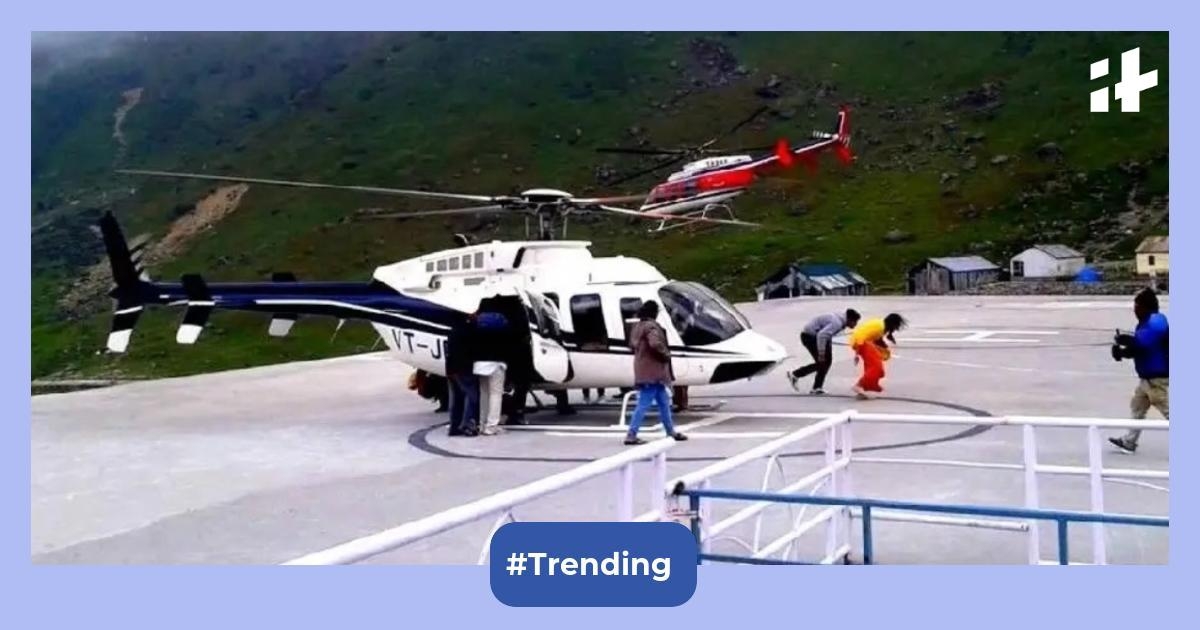
Kedarnath Helicopter Crash: 7 feared dead as pilgrim helicopter crashes in Uttarakhand, CM Dhami tweets in grief
According to Uttarakhand ADG (Law & Order), Dr. V. Murugeshan, initial reports indicated the chopper had gone missing in Gaurikund — only to confirm moments later that it had indeed crashed. On board were seven souls: five adults, the pilot, and a child, representing Uttarakhand, Uttar Pradesh, Maharashtra, and Gujarat.
Uttarakhand helicopter crash | Today, at around 5:20 am, a helicopter, which was going from Shri Kedarnath Dham to Guptkashi, has been reported to have crashed near Gaurikund. There were six passengers, including the pilot (5 adults and 1 child). The passengers in the helicopter… pic.twitter.com/AVGtuxWKGj
Official information about the Kedarnath Helicopter Crash
The Uttarakhand Civil Aviation Development Authority (UCADA) reported that the helicopter had just dropped off pilgrims at Kedarnath before taking off for Guptkashi. 'In view of relief and rescue, NDRF and SDRF teams have been dispatched,' UCADA confirmed to ANI. IG Garhwal, Rajiv Swaroop, added that the crash site is extremely remote, prompting immediate despatch of police and SDRF personnel.
CM Pushkar Singh Dhami posted on X (formerly Twitter) in Hindi: 'Very sad news has been received about a helicopter crash in Rudraprayag district. SDRF, local administration and other rescue teams are engaged in relief and rescue operations. I pray to Baba Kedar for the safety of all the travellers.'
जनपद रुद्रप्रयाग में हेलीकॉप्टर के दुर्घटनाग्रस्त होने का अत्यंत दुःखद समाचार प्राप्त हुआ है। एसडीआरएफ, स्थानीय प्रशासन एवं अन्य रेस्क्यू दल राहत एवं बचाव कार्यों में जुटे हैं। बाबा केदार से सभी यात्रियों के सकुशल होने की कामना करता हूँ।
The rugged Himalayan terrain and early morning conditions are hampering rescue efforts. Teams from SDRF, NDRF, and local police are battling difficult weather and limited access routes. Authorities are racing against time, hoping for survivors, but as of now, no confirmed signs of life have been reported.
Shadow of the Ahmedabad Air India Tragedy
This tragedy follows closely on the heels of a devastating aviation disaster. On June 12, Air India Flight AI 171, a Boeing 787‑8 Dreamliner carrying 242 people, crashed seconds after takeoff from Ahmedabad, destined for London Gatwick. CCTV footage captured the aircraft struggling to climb before plummeting into a hostel block at B. J. Medical College, killing 241 people onboard and at least 33 on the ground, making it the worst aviation accident in India in a decade.
The tragedy in Ahmedabad has stunned and saddened us. It is heartbreaking beyond words. In this sad hour, my thoughts are with everyone affected by it. Have been in touch with Ministers and authorities who are working to assist those affected.
One British-Indian passenger, Vishwash Kumar Ramesh, seated by an emergency exit, miraculously survived by jumping free just before the impact. The accident prompted an investigation focusing on engine performance, flap positioning, and air-traffic control procedures, a probe that has expanded to include safety checks across India's entire fleet of Boeing 787s.
To stay updated on the stories that are going viral, follow Indiatimes Trending.
Hashtags

Try Our AI Features
Explore what Daily8 AI can do for you:
Comments
No comments yet...
Related Articles


Hindustan Times
 an hour ago
- Hindustan Times
Kishtwar cloudburst: More bodies recovered, rescue work underway
With the recovery of three more bodies from the debris on Tuesday, the death toll in cloudburst-hit Chishoti village has mounted to 64, said officials. Search and rescue operation underway at cloudburst-hit Chisoti village, in Kishtwar district, on Tuesday. (PTI) 'On Tuesday, the rescuers recovered three more bodies and two body parts (arm and leg) from the debris. With this the toll has gone up to 64,' said Kishtwar district commissioner Pankaj Sharma. He informed that the bodies and limbs were sent to GMC Kishtwar for DNA profiling. 'We have taken DNA samples of kins and they are being matched with bodies being recovered from the debris,' he said. 'We had no clear picture about missing and dead but as the days proceeded, the kin of missing pilgrims came forward and shared the information at the command and control centre set up by the administration. Initially, 137 people were reported missing, out of whom 62 were rescued alive,' he said. 'The big boulders are being blasted with controlled explosions so as to search the debris beneath them,' he sai. As the rescuers recovered more bodies, the missing count has now come down to 39, he added. A police officer said that three bodies recovered today were decomposed. The rescuers conducted over half a dozen controlled explosions in the past three days to blow up giant boulders, which had been hampering the search. Sniffer dogs also helped recover a body part of one of the victim but the officials believed it be that of a body which was found on Day 1. The rescue teams are working at multiple locations, especially the major impact spot near a langar (community kitchen) site, sifting through the rubble using heavy machinery, including JCBs and sniffer dogs. A police officer said the rescue and relief operation is going on at war footing and a team is being dispatched downstream to check the area. The joint teams of police, army, National Disaster Response Force (NDRF), State Disaster Response Force (SDRF), CISF, Border Roads Organisation (BRO), civil administration, and local volunteers are engaged in the rescue efforts. Machail Mata yatra remains suspended The annual Machail Mata yatra, which began on July 25 and was scheduled to conclude on September 5, remained suspended for the sixth consecutive day on Tuesday. However, the authorities will allow a group of devotees carrying 'Charri' from Jammu and is expected to reach the shrine on August 21 or 22. At Srinagar, chief minister Omar Abdullah said that everyone was aware of the situation in Kishtwar. 'Day by day it is becoming almost impossible to rescue alive almost 70 people who are still missing. In this situation, our effort will be to recover as many bodies as possible and hand them over to the families with proper respect and arrangements,' he told reporters. The BJP government at the Centre was likely to announce a special compensation for cloudburst victims of Kishtwar and Kathua districts. Meanwhile, Doda district administration on Tuesday made registration of pilgrims for the Kailash Yatra mandatory and issued certain guidelines. The pilgrimage will commence Wednesday and conclude on Friday. Doda district commissioner Harvinder Singh said, 'Safety and security of devotees is our topmost priority. In view of recent cloudburst incidents at Padder amd Kathua and inclement weather, precautionary restrictions have been imposed.' 'Women and children not permitted to participate this year due to safety concerns. Chattergala route has been closed for pilgrims as it is vulnerable to heavy rivulets, gusty winds and unsafe terrain,' he said. The DC informed that the Yatra shall proceed only via traditional routes—Sungli, Nalthi and Drafda (Bhalla). 'A comprehensive deployment plan has been made. We are ensuring officials, medical facilities, disaster preparedness, water, shelter, communication and security at all major points. Since mobile connectivity is poor, we are relying on wireless phones.' He appealed to devotees to follow advisories strictly for their own safety. 'What has unfolded in Kishtwar and Kathua is known to all. We cannot take chances with the lives of the devotees. I appeal intending pilgrims to co-operate with the administration and abide by the advisory,' he added. Despite weather alerts and advisories issued by the MeT department and allied agencies warning of cloudbursts and heavy to very heavy rains that may trigger landslides, Kishtwar district administration, especially sub-divisional magistrate of Padder didn't take any proactive action on Chandi Mata Yatra to Machail in Kishtwar district. 'District administration including SDM Padder should have taken a serious cognisance of the weather alerts and advisories. They didn't act on time and the Mata Machail pilgrimage continued amid heavy rains. We all know how administration suspended Amarnath Yatra during heavy rains to avoid loss of human lives. Kishtwar district administration cannot escape the blame of being negligent,' said a senior police officer, who declined to be named.


Time of India
7 hours ago
- Time of India
Workshop for teachers in ‘modern Sanskrit teaching methods' at IIT Roorkee
Roorkee: To promote Sanskrit at the school level, a 12-day workshop aimed at training teachers in innovative and communicative methods of teaching the ancient language is underway at IIT Roorkee. Over 70 teachers from schools across the Roorkee block are participating in the workshop, which is designed to make Sanskrit instruction simpler, more engaging, and practical for students. The programme, which began earlier this week, will continue until Aug 29. The 'Training of Teachers' (TOT) workshop is a collaborative effort between the NGO Samskrita Bharati and the IIT-Roorkee Sanskrit Club. Organisers emphasised that the goal is to help learners connect with Sanskrit beyond traditional rote learning, fostering a deeper appreciation of the language. The event was inaugurated on Monday by IIT-R director prof KK Pant and Dr Anand Bhardwaj, director of Uttarakhand Sanskrit Education, at the Department of Management Studies (DoMS) of the institute. In addition to Sanskrit educators, the workshop includes teachers from Hindi, mathematics, and science disciplines, as well as BEd students and research scholars from the region. "The aim of this workshop is to equip in-service teachers with a simple, communicative, and practical approach to Sanskrit teaching, thereby inspiring students and instilling a sense of pride in India's rich linguistic and knowledge traditions," said Dr Bharti Sharma, faculty member at the local girls' degree college and president of the Roorkee unit of Samskrita Bharati. Stay updated with the latest local news from your city on Times of India (TOI). Check upcoming bank holidays , public holidays , and current gold rates and silver prices in your area.


News18
15 hours ago
- News18
Should We Learn Sanskrit?
Written By : Last Updated: Sanskrit has the benefit of a body of work, still not comprehended fully by human intellect, even today. Aa no bhadrāḥ krtavo yantu viśvataḥ 'Let noble thoughts come to us from all directions" – (Rg Veda I.89.1) There is a beautiful imagery in Sanskrit poetry of a donkey carrying sandalwood on its back not knowing what it is! As far as the donkey is concerned any load is the same as it doesn't have to do anything with it. That is not the case with human beings I believe. We should be knowing the value of everything we possess, including our heritage. Sanskrit language, which is one among them, is in news these days for many right or wrong reasons. But is it the problem of Sanskrit? Not definitely. Today, Sanskrit is not the mother tongue of many, the way Hindi, Tamil, Malayalam, Gujarati or any other Indian language is. It is a second language often learned in school, college, home or in a Pathashala. Still there are people who communicate in this language. A language is considered living only if people communicate in it on a daily basis. The Sanskrit word for language, 'bhasha' means 'that in which people talk'. (bhāshyate anena iti bhāshā). Every Hindu child is expected to know at least a few prayers in Sanskrit. The way every Parsi child is taught the Zorastrian prayers (Gathas) in the Avestan language which is no longer spoken. Sanskrit is considered to be one of the oldest of all living languages. Still this language, as we find today, is a complete one with a structured grammar (rather many grammars!), with a vast body of literature starting from the scriptures in oral and written form to modern literature. In between it holds a treasure of technical literature or Shāstra which is maligned day after day. In this world, there will be no population which doubts, blames or belittle its own cultural heritage openly like the Indians. Just because it is written in this ancient language. The fact that the language itself is refined (saṁskṛta) and has regenerative capacity shows the level of development of human intellect during the evolution of this language. Panini, who structured the grammar into sutras (aphorisms) in the Ashtādhyayi, a text of Sanskrit grammar, came centuries after the language came into existence. He himself quotes many grammarians prior to him and this is believed to be in 7th Century BC. Sanskrit has the benefit of a body of work, still not comprehended fully by human intellect, even today. It imparts knowledge on anything, be it karma, righteousness, rituals, statecraft, warfare, art, science, nature, astronomy, astrology, worship, economics, philosophy, after life and what not! Criticising the language just because some political ideology patronises it or some religion has its literature composed in it is not fair. In fact, this language is older than any political party or organised religion we see today. Further, none who criticise Sanskrit has learned it fully so as to appreciate its beauty or grandeur. Once upon a time, even Hebrew language suffered the fate of Sanskrit. This ancient language of Israel was facing extinction as it got reduced to the language of the clergy. People had stopped using it as the medium of daily communication. It was the sacrifice and efforts of a few lovers of this language, especially, Eliezer Ben-Yehuda, which brought it back to its glory. Today it is the official language of Israel. This happened in 1948. The people of Israel embraced the language and understood the value of the treasure they bequeathed. Even decades after the architect of Constitution, Dr. suggestion that Sanskrit should be made the official language of India, we are still sceptic about this language's worth and class. The benefit of learning Sanskrit are many. The modern-day computing accepts Sanskrit as the most ideal language for its functioning. Medical science has done ample research on the health benefits of daily chanting of Sanskrit mantras and verses too. But the Indian philosophy, which is non-materialistic, left the issue of utility to lesser mortals and exhorted the finer souls to learn it for one's own Self. Bhagavad Gita ordains it 'Elevate the self by the self" ( The perils of neglecting Sanskrit are more evident today. Every Indian language is anglicised today. Nothing against English, which is still the connecting language we value. The distancing from the roots is not good for any language, even though languages evolve over time. The farther we go away from Sanskrit, the more distanced we are from our mother tongue because not many Indian languages today can stand on their legs if Sanskrit is removed completely from its vocabulary, not even the Dravidian languages. The way there are loan words from the Dravidian languages in classical Sanskrit, there are immense number of loan words in the South Indian languages which belong originally to Sanskrit, and can be traced back to the proto-Indo European language family. The similarity of roots of words in Persian language and Sanskrit and the similarities between Avesta and Vedic Sanskrit points out to the common parentage of these languages. The mother of all languages, at least in this language family, is believed to be the now lost proto-Indo-European, which linguists have tried to reconstruct based on the remaining evidences from the Vedas and the Avesta. This is evident from the similar words of relations and numbers seen in almost all these languages. Pitar (father) in Sanskrit become pedar in Persian, bhratr (brother) becomes berathar and anghusta (thumb) becomes angosht. Ekam (one) becomes yek and dasha (ten) becomes daha. As the Vedas declare, 'ekam sad viprāḥ bahudhā vadanti" (Truth is one, but the wise speak it as many). Tamil, belonging to the Dravidian family of languages is one of the ancient and is a world treasure. When Sanskrit is promoted or preserved, there is a misconception that Tamil or any other Dravidian language is ignored or degraded. Languages can co-exist; they have done it beautifully for centuries. Prakrit co-existed with Sanskrit, as we see in Kalidasa's Abhijnāna Shākuntalam and many other works. Malayalam co-existed beautifully with Sanskrit and we have exquisite poetry in manipravālam (a combination of Sanskrit and Malayalam). Even today Indian languages co-exist with English, French, German and other foreign languages which our kids learn. In a sense, Sanskrit has the rare distinction of unifying the whole of India over the years as it was used as the connecting language when scholars from different regional languages came together to debate on various topics, the way English is used today. Learning multiple languages broadens the mind as linguistic and medical research confirms. Our children have the golden opportunity to learn many ancient languages easily in this country, which can make them better humans by imbibing the rich cultural heritage preserved in multiple languages. The joy of reading Chilappatikaram of Ilango Adigal in chaste Sangam Tamil is nothing less than the joy of reading Raghuvamsa of Kalidasa in Sanskrit. Thirukkural stands high and lofty the way Ramayana adorns our literary throne. A deeper learning of these two alone will tell us how similar were the thoughts of those brilliant sages who left them for us. Buddhist and Jaina literature used Sanskrit apart from Pali, Ardh-Magadhi, Prakrit and other similar languages. Preserving and understanding them is impossible without the knowledge of Sanskrit. Various projects are ongoing worldwide, to study, edit, translate and publish these valuable works preserved mostly in the form of manuscripts, for the benefit of posterity. It is our duty to handover these treasures in their actual glory, to future generations. It is with this noble intention that the Mughal prince Dara Shukoh, a devout Muslim, learned Sanskrit and translated the Bhagavad Gita and 51 Upanisads into Persian. Scholars from every part of the world have come to India to learn this language to understand the secret knowledge preserved in it. Even today it is taught in many foreign universities. But Indians are uniquely positioned in learning, propagating and preserving Sanskrit compared to other nations just because it is still a living language here. Instead of fighting over languages, should not we pause and reflect? We exist now and so we can think. We own this great treasure, and we are human beings who can differentiate between something which is valuable and not so. top videos View all Let noble thoughts alone come to us! The author is a former civil servant who resigned to learn Sanskrit and Vedanta. Views expressed in the above piece are personal and solely those of the author. About the Author Veena Raj Veena Raj is a former civil servant who resigned to learn Sanskrit and Vedanta. Click here to add News18 as your preferred news source on Google. tags : sanskrit view comments Location : New Delhi, India, India First Published: August 19, 2025, 15:14 IST News opinion Opinion | Should We Learn Sanskrit? Disclaimer: Comments reflect users' views, not News18's. Please keep discussions respectful and constructive. Abusive, defamatory, or illegal comments will be removed. News18 may disable any comment at its discretion. By posting, you agree to our Terms of Use and Privacy Policy. Loading comments...
