



Di Seven planets you go fit see in di night sky for di last time until 2040
Dis kind event, wey dem dey call 'planetary parade' no be common sight, and e go be di last time seven planets go dey seen at di same time so well until 2040.
Di best chance to see as many planets as possible go be just afta sunset on Tuesday, Wednesday, Thursday and Friday.
Four of di planets - Mercury, Venus, Jupiter, and Mars - go dey visible to di naked eye. Saturn go dey harder to see sake of say e go dey low for di horizon. You go need telescope to spot di oda two planets - Uranus and Neptune.
One good view of di horizon and clear skies go offer di best chance to spot dem all. However, di window to see all seven planets go dey very brief.
Dr Edward Bloomer, astronomer for di Royal Observatory Greenwich tok: "Rare opportunity to get seven planets for essentially one convenient place for you to look for dem."
As di sun set, Saturn and Mercury go also dey set, e go make dem particularly difficult to see.
"You really only get few minutes afta sunset to catch dem bifor dem drop below di horizon. Afta dat, you go still dey able to see Venus, Jupiter, and Mars clearly for much longer time," Dr Bloomer bin add.
Di planets wey dey our solar system dey orbit di Sun within roughly di same flat plane as di Earth.
As dem dey orbit for different speeds and distances from di Sun, moments dey wen e appear say dem line up from Earth perspective to create one ogbonge visual display, although di planets still dey separated by wide distances for space.
Venus and Jupiter go be di easiest to spot sake of dia brightness, while Mars go get one kain red colour.
"Uranus dey technically visible wit di naked eye, but you go need perfect eyesight and ideal conditions," Dr Bloomer explain.
To improve your chances to see as many planets as possible, Dr Bloomer advise to head to one location wit clear view of di horizon and minimal light pollution.
"If you just out come of your kitchen go your back garden, you go take time to adjust to di light levels. Give am small time - your eyes dey take about half an hour to fully adjust," Dr Bloomer tok.
"Avoid to dey look your phone, get comfortable, and make sure you get clear view of di horizon."
While dis na exciting opportunity, Dr Bloomer encourage pipo to make habit wia dem go dey look di night sky.
"See how tins change," e tok, e add say to dey observe di heavens na "chance to witness di ongoing mechanics of di solar system at work."
Di skies fit dey clear enough to see dem?
While di weather still never settle currently, clearer and calmer conditions dey expected to develop later in di week.
Tuesday evening go start clear, but cloud and rain go move in from di west later.
On Wednesday night, skies go dey generally cloudier wit showers of rain some times.
By Thursday, expect drier, clearer view of di night sky. Earlier for evening na di best, as mist and fog fit develop further into di night.
For Friday, high pressure dey expected to dominate, dry conditions go mostly dey wit clear spells. Soon afta sunset na di best time as mist and fog fit develop later.

Try Our AI Features
Explore what Daily8 AI can do for you:
Comments
No comments yet...
Related Articles


Sky News
 3 hours ago
- Sky News
New moon discovered orbiting ice giant Uranus
A new tiny moon has been identified orbiting the planet Uranus, according to NASA. The satellite, spotted by the James Webb Space Telescope, does not have a name yet and has been designated S/2025 U1. First spotted on 2 February by the space-bound telescope, it measures roughly six miles (10km) in diameter and joins 28 other known moons orbiting the icy giant. Maryame El Moutamid, from the Southwest Research Institute in Colorado and lead investigator on the project to study the rings and moons of Uranus, believes its tiny size is likely to be the reason why it has been invisible to telescopes until now. "It's a small moon but a significant discovery, which is something that even NASA's Voyager 2 spacecraft didn't see during its flyby nearly 40 years ago," she said. "No other planet has as many small inner moons as Uranus," said Matthew Tiscareno of the SETI Institute in Mountain View, California, a member of the research team. Mr Tiscareno said the "complex inter-relationships" between Uranus' moons and its faint rings suggest the planet's evolutionary history may have been a chaotic one. The newfound satellite is about 35,000 miles (56,000km) from the centre of the planet, with a near-circular orbit, according to researchers. All of Uranus' moons are named after characters from the works ofShakespeare and Alexander Pope. NASA said the new moon will be named after approval by the International Astronomical Union, which oversees the official naming process for astronomical objects. In 1986, the Voyager 2 probe became the first human-made object to fly past Uranus, giving humanity its first close-up views of the distant planet. The historic encounter yielded more than 7,000 photographs of Uranus and helped scientists discover two new rings and 11 new moons around the planet. The new addition could hint at more tiny moons waiting to be found.

Daily Mail
4 hours ago
- Daily Mail
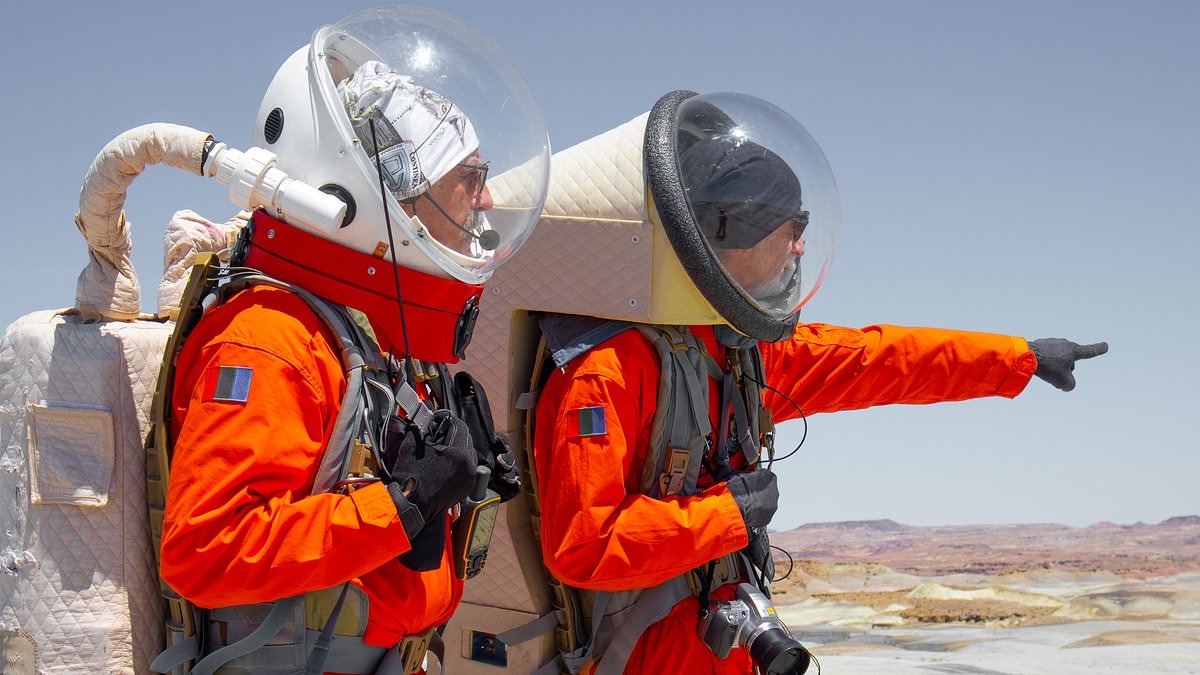
Desert missions, scorching space walks and defying gravity: The secret society living 'on Mars'... and punishing hell they're going through
An Air Force veteran who now commands 'space missions' in the Utah desert has said that humans are ready for life on Mars, and it may become a reality by 2030. David Laude, a founding member of the Mars Society, told the Daily Mail everyday Americans are already conducting innovative experiments that may become regular chores for the first colonists in space.


The Independent
a day ago
- The Independent
Scientists make ‘space mice babies' – and they could allow us to explore the universe
Scientists have created 'space mice babies' – and they offer hope for our plans to explore the universe. In the years to come, many people hope that humans are spending a lot more time away from the Earth, between space tourism and the exploration of other planets such as Mars. But those missions could be limited or even cancelled completely by the dangerous effects of spaceflight on the body, which can include wasting muscles and loss of bone density. Another fear that has long concerned those hoping for long mission into space is the danger that spaceflight could limit our ability to produce healthy children. It is therefore important to study how spaceflight might impact the germ cells that become egg and sperm, because any damage done to those cells could cause irreversible problems for future generations. Previous research has found that when those cells undergo spaceflight it can lead to abnormalities. But scientists still don't know how that might happen. Now a new study has attempted to solve that problem with the creation of a new kind of animal: space mice babies. Researchers at Kyoto University took stem cells from mice and froze them so they could be preserved. They were then sent to the International Space Station, where they were kept in a freezer for six months. When they came back down to Kyoto, the team examined them to see if there were any abnormalities, and could not find any. But to test further, they took those cells and put them into a mouse, where they eventually led to offspring after the mice mated. They found that the mice themselves appeared healthy and the genes worked as normal. They suggest that frozen germ cells stay fertile for at least six months in space. "It is important to examine how long we can store germ cells in the ISS to better understand the limits of storage for future human spaceflight," said first author Mito Kanatsu-Shinohara in a statement. The research suggests that similar cells could be frozen for future spaceflight. But more work is needed, including watching the mice throughout their lifespan as well as for any changes that might be seen in their offspring. The work is described in a new paper, 'Germline transmission of cryopreserved mouse spermatogonial stem cells maintained on the International Space Station', published in the journal Stem Cell Reports.
