


Erdogan to Iran: Talks only solution
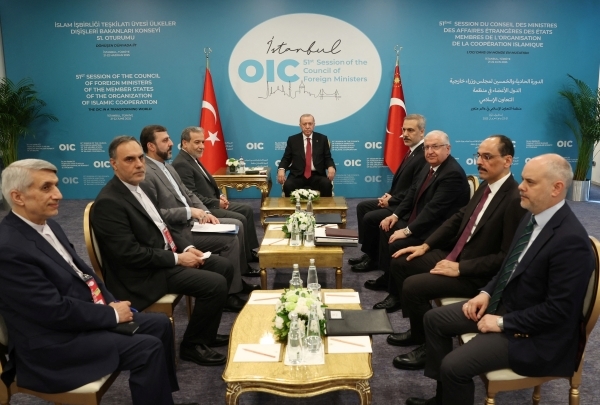
Erdogan met Foreign Minister Abbas Araqchi on the sidelines of an Organisation of Islamic Cooperation meeting in Istanbul. In a statement, his office noted that Erdogan said Israel had to be stopped immediately.
Erdogan said Turkey was ready to play a facilitator role to help resume the nuclear talks, adding "steps should be taken as soon as possible to open up diplomacy via technical and leaders-level talks between Iran and the US," his office added.
Meanwhile, the United Nations' Palestinian refugee agency UNRWA will open an office in Ankara, President Erdogan said on Saturday, urging Muslim countries to give the agency more support after Israel banned it.
Israel last year banned UNRWA, saying it had employed members of Palestinian Hamas who took part in the October 2023 attacks on Israel that triggered the Gaza war. Turkey has called Israel's assault on Gaza genocide and its move to ban UNRWA a violation of international law, particularly amid worsening humanitarian conditions in Gaza, which has been reduced to rubble with millions displaced.
Addressing foreign ministers of the Organisation of Islamic Cooperation in Istanbul, Erdogan said opening an Ankara UNRWA office would deepen Turkey's support for the agency.
"We must not allow UNRWA, which plays an irreplaceable role in terms of taking care of Palestinian refugees, to be paralysed by Israel. We expect our organisation and each member state to provide financial and moral support to UNRWA to thwart Israel's games," Erdogan said.
A Turkish diplomatic source said Foreign Minister Hakan Fidan and UNRWA chief Philippe Lazzarini were expected to sign an accord on the sidelines of the OIC meeting in Istanbul on establishing the office.
Turkey has given UNRWA $10 million a year between 2023 and 2025. In 2024, it also transferred $2 million and sent another $3 million from its AFAD disaster management authority.
Israel has handed responsibility for distributing much of the aid it lets into Gaza to a new US-backed group, the Gaza Humanitarian Foundation, which operates three sites in areas guarded by Israeli troops. The UN has rejected the GHF operation saying its distribution work is inadequate, dangerous and violates humanitarian impartiality principles.
Previously, aid to Gaza's 2.3 million residents had been distributed mainly by UN agencies such as UNRWA with thousands of staff at hundreds of sites across the enclave. - Reuters
Hashtags

Try Our AI Features
Explore what Daily8 AI can do for you:
Comments
No comments yet...
Related Articles


Observer
 5 hours ago
- Observer
Killing of aid workers surges during Gaza war
GENEVA: Aid worker killings rose nearly a third to almost 400 last year, the most deadly year since records began in 1997, and the conflict in Gaza is continuing to cause high death rates for humanitarian staff in 2025, U.N. and other data showed. In 2024, 383 aid workers were killed, nearly half of them in Gaza and the occupied Palestinian territories, the UN said on Tuesday, citing a database. "Attacks on this scale, with zero accountability, are a shameful indictment of international inaction and apathy," said Tom Fletcher, UN Under-Secretary-General for Humanitarian Affairs, in a statement. So far this year, 265 aid workers have been killed, according to provisional data from the Aid Worker Security Database, a US-funded platform that compiles reports on major security incidents affecting aid workers. Of those, 173 were in Gaza in Israel's near two-year offensive against the Palestinian enclave, launched after the deadly Oct. 7, 2023, cross-border attacks, the provisional data showed. This year, 36 aid workers have so far been killed in Sudan and three in Ukraine, the database showed. In one incident in Gaza that drew international condemnation, 15 emergency and aid workers were killed by Israeli fire in three separate shootings in March, before being buried in a shallow grave. Israel's military said in April that the incidents resulted from an "operational misunderstanding" and a "breach of orders". There had been "several professional failures" and a commander would be dismissed, it said. Aid workers enjoy protection under international humanitarian law but experts cite few precedents for such cases going to trial, with concerns about ensuring future access for aid groups and difficulty proving intent cited as impediments. "It is catastrophic, and the trend is going in the opposite direction of what it should," said Jens Laerke, UN humanitarian office spokesperson. Meanwhile, Cyprus has dispatched 1,200 metric tonnes of humanitarian aid for Gaza by sea via Ashdod in Israel, its foreign ministry said on Tuesday. The pre-screened cargo would be transferred without additional security checks on arrival in Ashdod and with international humanitarian organisation World Central Kitchen the final contractor and distributor, the Cyprus Foreign Ministry said. "The entire undertaking is under the auspices of the UN delivery mechanism," it said. Gaza has been devastated by Israel's nearly two-year-long military assault, which has killed more than 61,000 Palestinians, according to local health authorities who do not distinguish between fighters and civilians. The ground and air war has also created a hunger crisis, with aid encountering significant delays. More than 200 Gazans have died of malnutrition or starvation in the war, according to health authorities. Cyprus and Malta contributed the bulk of aid, and there were contributions from organisations from the United States, Italy, the Sovereign Order of Malta and Kuwait. Input of the United Arab Emirates to the operation was essential, Cyprus said. The east Mediterranean island has been used to transit aid to Gaza in the past. Facilities on the island remained at the disposal of the international community as an additional humanitarian channel, the foreign ministry said. Discussions are currently underway for a 60-day ceasefire in Gaza after previous talks ended in deadlock in late July. On the ground, there were no signs of a ceasefire nearing as Israeli gunfire, tank shelling and air strikes killed at least 20 Palestinians on Tuesday, according to Gaza health officials. Tanks completed taking control of the Zeitoun suburb, an eastern neighbourhood on Gaza City's outskirts, and continued to pound the nearby area of Sabra, killing two women and a man, medics said. Local health authorities said dozens of people had been trapped in their houses because of the shelling. The Israeli military said it was checking the report. — Reuters

Observer
7 hours ago
- Observer
Alaska summit wasn't about Ukraine
'When elephants collide, the grass suffers.' But the grass also suffers when elephants whisper. The recent Alaska meeting between US President Donald Trump and Russian President Vladimir Putin ended with no ceasefire in Ukraine, despite weeks of hype. That failure was the headline, but it masked the real story. The summit was not about Ukraine; it was about carving up influence, dividing corridors and replaying a century-old script that the Arab world knows too well. The Corridor Behind the Curtain If Ukraine were the real agenda, Alaska would have produced at least a road map for de-escalation. Instead, the unspoken focus was the South Caucasus. The US is advancing the Zangezur corridor, cutting across Armenia to link Azerbaijan with Türkiye and onward to Central Asia. For Ankara and Baku, it's a geopolitical victory; for Iran, it feels like encirclement; for Russia, it signals a slow squeeze on its influence. For Washington, the corridor is a chance to redraw Eurasia's map without firing a shot. For Moscow, tolerating Western-backed routes may be a price worth paying if it gets space to freeze Ukraine on its own terms. Alaska, therefore, was about bargaining over maps, not about saving lives. Sykes–Picot in a New Disguise The Middle East has seen this play before. The Sykes–Picot Agreement of 1916 divided Ottoman Arab lands between Britain and France, planting borders that still bleed. The Yalta Conference of 1945 carved Europe into Western and Soviet zones, condemning Eastern Europe to decades behind the Iron Curtain. The Molotov–Ribbentrop Pact of 1939 secretly split Eastern Europe between Nazi Germany and the Soviet Union, erasing nations from the map overnight. Each case followed the same pattern: great powers publicly spoke of peace, while privately negotiating partitions. Those absent at the table paid the price. Alaska feels like a modern Sykes-Picot this time not with ink on colonial maps, but with corridors, pipelines and digital arteries. Palestine: The Grass Beneath the Bargain Nowhere is the cost clearer than in Palestine. As Palestinians endure genocide, their survival is not at the centre of Alaska's chessboard. Both Washington and Moscow deploy Palestine as rhetoric, not as policy. The Israeli Occupation continues its genocidal campaign with tacit US protection; Russia frames itself as anti-Western but offers no tangible support. Just as Palestine was sidelined in the Sykes-Picot carve-up, it risks being sidelined again in today's global bargains. Unless Arab and Islamic states hardwire enforcement, through humanitarian corridors, sanctions on war crimes, and legal pursuit in the ICJ and ICC, Palestine will remain the perennial victim of great-power 'understandings.' Lessons for the Islamic and Arab World The Alaska summit carries three urgent lessons: 1. Corridors are the new borders. Whether Zangezur or Belt and Road, control over connectivity is control over power. The Arab world must invest in shaping, not just using, trade and energy corridors. 2. Never trust transactional peace. Yalta left Eastern Europe trapped; Sykes-Picot fractured the South West Asia North Africa region (SWANA). Alaska warns that Arab and Islamic states could see their resources and sovereignty treated as bargaining chips. 3. Make Palestine non-negotiable. Empty statements no longer suffice. Pair diplomacy with leverage: Gulf-backed humanitarian supply lines, targeted sanctions against inciters of genocide and Arab-led legal coalitions. Justice for Palestine must become the price of admission in any wider deal. Drawing Our Own Lines Alaska was not about Ukraine any more than Sykes-Picot was about Arab independence. Both were about outsiders scripting the future of others. A century ago, Sykes-Picot drew borders that ignored the will of the people. Today, corridors and resource routes risk becoming the new colonial ink. The Islamic and Arab world cannot allow history to repeat itself. Either we accept being 'the grass' under the feet of colliding elephants, or we become the gardeners, planting our own routes, setting our own rules and ensuring that Palestine is not erased from the map by silence. Alaska is a warning: If we do not draw our own lines, others will draw them for us. Khalid Al Huraibi, The writer is an innovator and an insights storyteller
Observer
14 hours ago
- Observer
Hamas accepts new Gaza truce plan
Gaza City: Hamas has accepted a new ceasefire proposal for Gaza, a senior member of the group said on Monday, after a fresh diplomatic push to end more than 22 months of war. Mediators Egypt and Qatar, backed by the United States, have struggled to secure a lasting truce in the conflict, which has triggered a dire humanitarian crisis in the Gaza Strip. But after receiving a new proposal from meditators, Hamas said it was ready for talks. "The movement has submitted its response, agreeing to the mediators' new proposal. We pray to God to extinguish the fire of this war on our people," senior Hamas official Bassem Naim said on Facebook. Earlier, a Hamas source said that the group accepted the proposal "without requesting any amendments". Egypt said it and Qatar had sent the new proposal to Israel, adding "the ball is now in its court". Israel has yet to respond. A Palestinian source familiar with the talks said mediators were "expected to announce that an agreement has been reached and set a date for the resumption of talks", adding guarantees were offered to ensure implementation and pursue a permanent solution. According to a report in Egyptian state-linked media Al Qahera, the deal proposed an initial 60-day truce, partial hostage release, release of some Palestinian prisoners and provisions to allow for the entry of aid. The proposal comes more than a week after Israel's security cabinet approved plans to expand the war into Gaza City and nearby refugee camps, which has sparked international outcry as well as domestic opposition. Out of 251 hostages taken during Hamas's October 2023 attack that triggered the war, 49 are still held in Gaza including 27, the Israeli military says, are dead. US President Donald Trump wrote on Truth Social: "We will only see the return of the remaining hostages when Hamas is confronted and destroyed!!!" "The sooner this takes place, the better the chances of success will be." Last week, Prime Minister Benjamin Netanyahu said Israel "will agree to an agreement in which all the hostages are released at once and according to our conditions for ending the war". Alluding to the dire humanitarian conditions for the more than two million people living in the Gaza Strip, where UN agencies and aid groups have warned of famine, Abdelatty stressed the urgency of reaching an agreement. "The current situation on the ground is beyond imagination," he said. Egypt said on Monday it was willing to join a potential international force deployed to Gaza, but only if backed by a UN Security Council resolution and accompanied by a "political horizon". — AFP
