


Women's rights advocates warn UN to confront backlash against progress
"International Women's Day is a powerful moment, and this year, more than ever, the call of gender equality has never been more urgent, nor the obstacles in our way more apparent, but our determination has never been more unshakable," said Sima Bahous, executive director of U.N. Women.
Bahous called on women everywhere to confront the backlash, emphasizing that their movement is powerful and growing.
"Equality is not to be feared, but instead to be embraced," she said. "Because an equal world is a better world."
Women in all parts of the world are facing challenges to their reproductive rights, personal safety, education, equal pay and political participation.
This year marks the 30th anniversary of a women's conference in Beijing that recognized women's rights as human rights, producing an action platform that has helped drive policy and progress.
The United Nations says more girls are in school and more women hold positions of power today than before, but they still face violence, discrimination and financial inequality.
"We cannot stand by as progress is reversed," U.N. Secretary-General Antonio Guterres told the gathering. "We must fight back."
At the current pace, he said, eradicating extreme poverty for women and girls will take 130 years.
"The fight for gender equality is not just about fairness," Guterres emphasized. "It is about power — who gets a seat at the table and who is locked out."
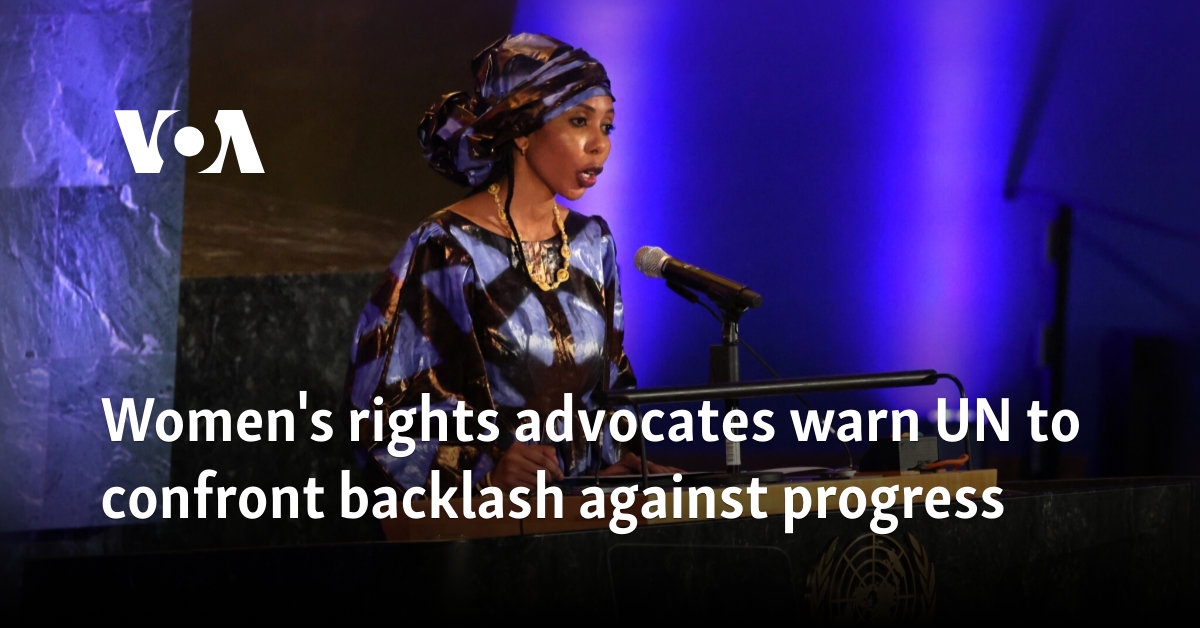
U.N. goodwill ambassador for Africa Jaha Dukureh endured female genital mutilation (FGM) as an infant. At age 15, she was forced into marriage with a much older man in her homeland, Gambia. Her organization, Safe Hands for Girls, works to end the practice of FGM and address the physical and psychological toll on its victims.
Dukureh told the gathering that governments have a duty to invest in social protection and education for women and girls.
"For all women and girls, economic independence is the foundation of freedom," she said. "A woman who can provide for herself can make choices. A girl who has an education can build her own future."
Commission on the Status of Women
On Monday, hundreds of women's advocates and activists will descend upon U.N. headquarters to hold their annual meeting known as the Commission on the Status of Women (CSW). The 10-day gathering is dedicated to the promotion of gender equality and the rights and empowerment of women.
Sarah Hendriks, director of policy for U.N. Women, told reporters on Thursday that anti-women's rights actors are increasingly well-funded and coordinated.
"Where they cannot roll back legal or policy gains altogether, they seek to either block or slow down their implementation," she said.
Thirty years after Beijing, Hendriks said, progress is still too slow, too fragile, too uneven and not guaranteed. She said U.N. Women is proposing an action agenda to accelerate progress on the sustainable development goals, of which goal number five focuses on achieving gender equality.
"It is our ambition that 2025 will be remembered as a pivotal year," she said. "That it will be remembered as a year that history looks back and says, 'This was the year that we refused to back down, that we held ground, that we refused to step back, that we indeed actually stood our ground.'"
CSW is expected to approve a political declaration by consensus on the first day.
Negotiations on the document have been going on for about two weeks. But how strong it will be and what will be missing from it — for instance, reproductive rights — remains to be seen.

Try Our AI Features
Explore what Daily8 AI can do for you:
Comments
No comments yet...
Related Articles

Voice of America
 14-03-2025
- Voice of America
Iraq says key Islamic State leader is dead
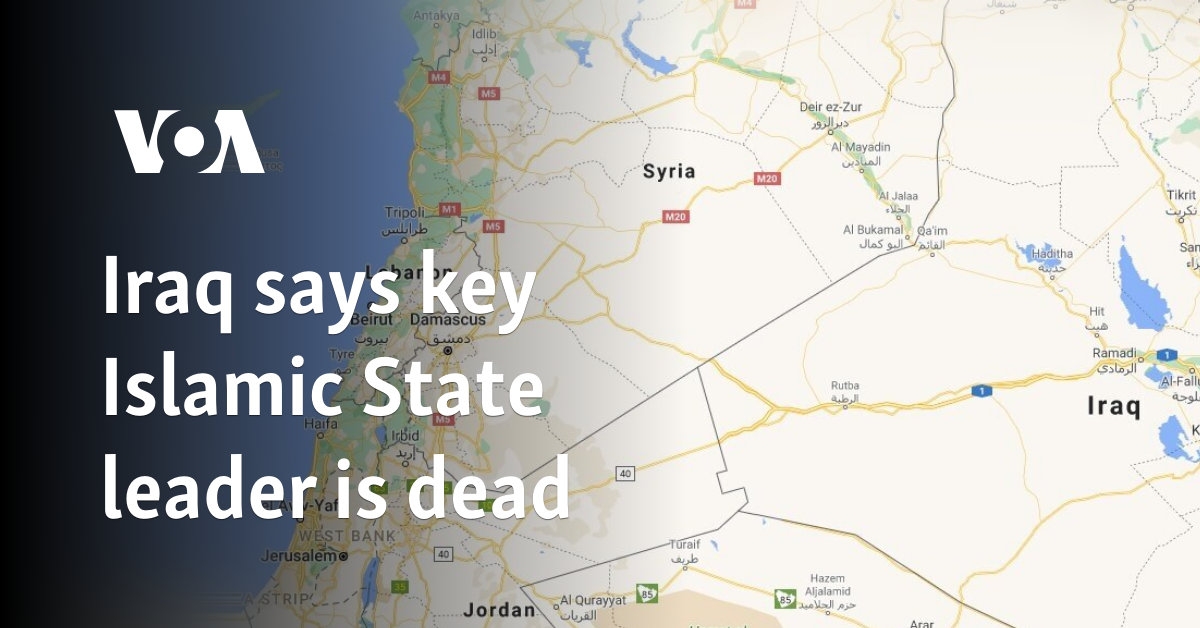
One of the Islamic State terror group's most senior leaders is reportedly dead, killed in what Iraq is describing as a U.S.-supported operation. Iraqi Prime Minister Mohammed Shia al-Sudani posted on social media Friday that the country's intelligence service "successfully eliminated" IS deputy caliph Abdallah Makki Muslih al-Rufay'i. Sudani did not say when or how al-Rufay'i was killed, calling the death a "significant security achievement." Iraqi special forces, in a subsequent post on the X social media platform, said al-Rufay'i was killed Thursday in an airstrike targeting his location in Iraq's Anbar desert. Officials said the strike was the result of a two-year effort to track his location, with breakthroughs coming in the past six months. The officials also said they arrested seven additional IS members, including two women, in a follow-up operation in Anbar. Intelligence collected at the scene of the airstrike further led to the arrest of another five people in the northern Iraqi city of Irbil. Iraqi officials said that al-Rufay'i, also known as Abu Khadija, was the top IS official for Iraq and Syria, and that he also played a key role in the group's external operations. A recent United Nations report, based on intelligence from U.N. member states, said al-Rufay'i ran IS operations across Iraq, Syria, Turkey and other parts of the Middle East. Other U.N. intelligence reports have identified al-Rufay'i as a member of IS' delegated committee, viewed as the terror group's most influential executive body. U.S. officials have yet to comment on the Iraqi claims. Various intelligence estimates put the number of IS fighters across Iraq and Syria at between 1,500 and 3,000, with the majority operating out of Syria. U.S. military officials warned in July of a possible IS resurgence in the region, saying the terror group was on a pace to more than double the number of attacks it had carried out in Iraq and Syria the previous year. More recently, in December, U.S. forces carried out a series of airstrikes against IS in Syria, hitting targets in areas abandoned by counterterror forces loyal to former Syrian president Bashar al-Assad. Despite those operations, intelligence shared by the U.N. indicated IS has been trying to take advantage of the fall of the Assad regime and resulting political turmoil. The U.N. report also said IS "maintained the ability to operate and replace field commanders." Yet while Iraq and Syria are central to IS' founding ideology, there has been a growing consensus among intelligence officials and experts that the terror group no longer sees the Middle East as its base for global operations. Officials, including those from the U.S., have said there is growing confidence that the group is now being led by Abdul Qadir Mumin, who has been based in Somalia, where he rose to prominence as the emir of the group's Somali affiliate, IS-Somalia. An offensive launched by forces in Somalia's Puntland region earlier this month, in part to chase after Mumin, has met with surprising success, pushing IS-Somalia out of some of its key strongholds. But the campaign has yet to find any traces of Mumin or other top IS leaders.
Voice of America
14-03-2025
- Voice of America
UN urges end to violence in Syria 14 years after Arab Spring protests
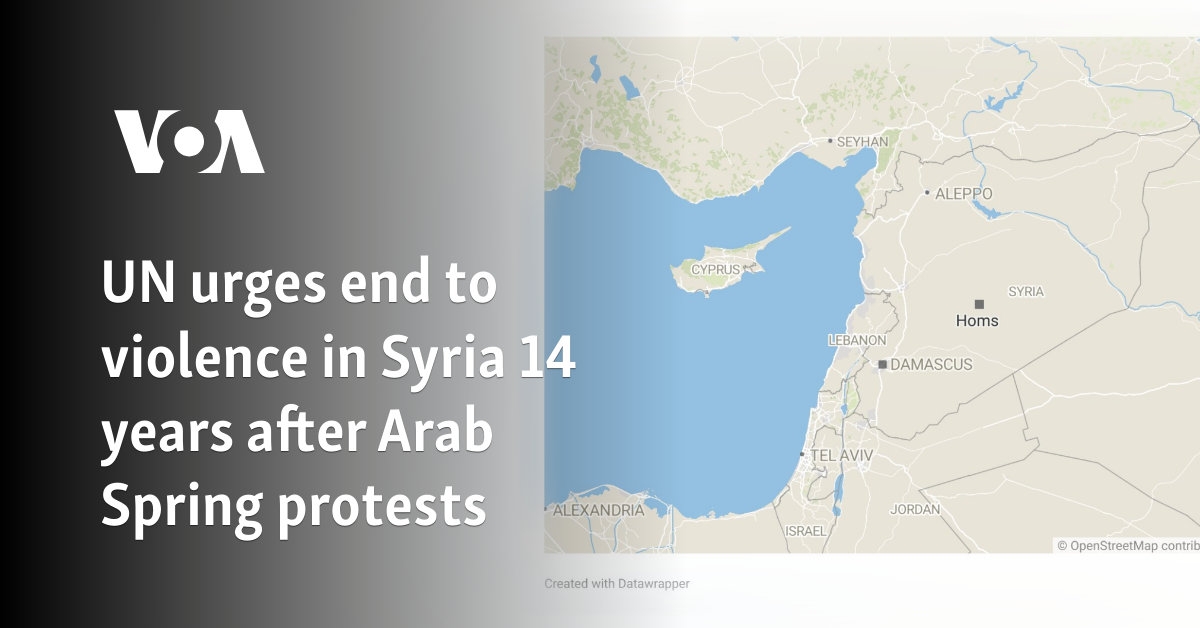
The U.N. special envoy for Syria is calling for an end to violence and for the protection of civilians, as the country grapples with renewed violence three months after the fall of President Bashar al-Assad. Geir Pedersen issued his appeal Friday, which is the 14th anniversary of the start of pro-democracy protests of al-Assad that led to more than a decade of civil war. 'What began as a plea for reform was met with staggering brutality, leading to one of the most harrowing conflicts of our time,' Pederson said. 'The conflict exposed the darkest depths of human cruelty. Families continue to mourn the loss of loved ones, communities remain fractured, millions remain uprooted from their homes, and far too many persist in their search for the missing.' The U.N. says the conflict displaced some 12 million people in Syria, including more than 6 million refugees. Assad was ousted in December 2024 but hope for a return to stability has been shaken by deadly violence that began March 6 in Syria's coastal region, where security forces clashed with fighters loyal to the former president, leading to hundreds of deaths, including many civilians. The fighters were members of the country's Alawite minority — the same religious group of which the Assad family is a member. Syria's transitional authorities said their forces in the sect's coastal region near the port city of Latakia came under a calculated attack from Assad loyalists in an attempted insurrection. Pedersen said Friday that recent agreements between Syria's transitional authorities and an armed group, the Syrian Democratic Forces (SDF), 'are a positive reminder of how important it is that Syria comes together in a manner that truly restores its sovereignty, unity, independence and territorial integrity.' He called for the creation of a 'credible and inclusive transitional government and legislative body; a constitutional framework and process to draft a new constitution for the long term that is credible and inclusive too; and genuine transitional justice.'
Voice of America
13-03-2025
- Voice of America
Can the US pry Russia away from China?
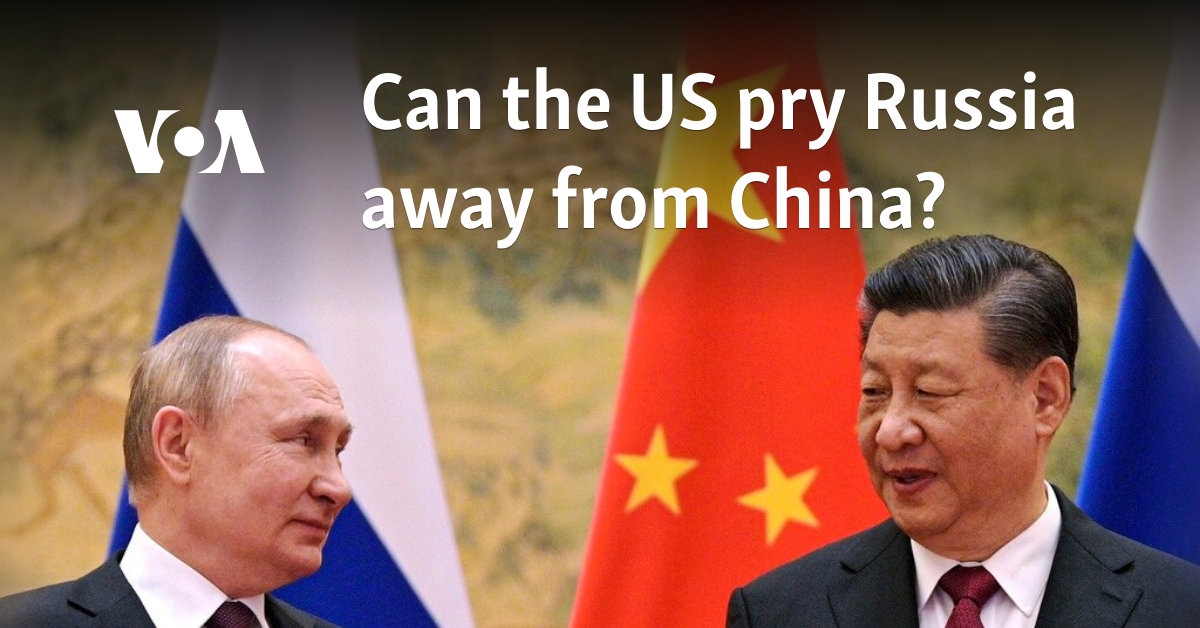
Western politicians have repeatedly called on China to limit or cease tacit support for Russia's bloody war against Ukraine. In response, China's leadership insists it is committed to peace and respect for the territorial integrity of other nations. But unlike most United Nations member states, China has never condemned Russia's full-scale invasion of Ukraine, and their military-diplomatic partnership — from joint bomber flights near the U.S. state of Alaska to votes in the U.N. Security Council — has only helped the Kremlin overcome its international isolation. While President Donald Trump has said he has good personal relations with both Russian President Vladimir Putin and Chinese President Xi Jinping, there is a consensus among experts in Washington that the China-Russia partnership poses a threat to U.S. interests, and that while Trump's predecessor, Joe Biden, tried to establish a strategic dialogue with China, the Trump team appears to be prioritizing normalized ties with Russia while punishing China over trade. As the White House talks about the possibility of restoring economic cooperation with Russia, some of its officials are hinting at lifting or reducing the sanctions Washington has imposed on Moscow in recent years. Charles Hecker, an expert on Western-Russian economic ties and risks, and author of the book Zero Sum: The Arc of International Business in Russia, says some Western companies will quickly return to Russia if sanctions are lifted, particularly those involved in energy, metals and minerals. 'There's only so much oil in Norway, and there's only so much oil in Canada; the rest of it is in some countries that have a very high-risk environment,' Hecker told VOA's Russian Service. 'And so, these kinds of companies are accustomed to business in these sorts of places, and they have the internal structures to help protect them. You know, there are energy companies doing business in Iraq right now. And I don't want to compare Russia and Iraq, but they are high-risk environments.' Still, Hecker cautions, their return to doing business in Russia wouldn't signal an overall U.S.-Russian rapprochement — let alone a fracturing of Sino-Russian relations. 'I think it will be very difficult for the West to pull Russia away from China,' he said. 'Allowing Western companies back into Russia doesn't necessarily change President Putin's hostility towards the West. President Putin remains antagonistic towards a Western-dominated political and economic system, and he has said over and over again that he wants to create an alternative political and economic environment – an alternative to the West. 'Part of that alternative includes China,' he added. 'You have never heard President Putin say anything ideologically against China. And the two are now important energy partners.' Limited popular domestic appeal U.S.-based FilterLabs analyzes public sentiment in regions where polling is problematic. According to a recently published assessment of popular attitudes expressed on Russian and Chinese social media networks, Sino-Russian relations are 'full of underlying tensions, mistrust, and diverging interests.' One of the report's authors, Vasily Gatov, told VOA its research found that 'the Chinese and Russian populations are far from happy with this alliance of their authorities.' "China does not perceive Russia as a reliable, safe and equal partner,' he said. 'Russia annexed the Amur Region from China; Russia adopted a completely colonial policy towards China during the 19th and early 20th centuries. Therefore, in my opinion, it is entirely possible to consider historical frictions as a vulnerability.' A media analyst at the University of Southern California's Annenberg School for Communication and Journalism, Gatov also noted that, despite the Kremlin's expectations, China's economic presence inside Russia today remains 'several times smaller' than that of either Europe or the U.S. before Russia invaded Ukraine. Thus, while Russian and China have overlapping interests, they are not 'marching in lockstep.' "They are very different, they have very different geopolitical focuses, very different political philosophies,' he said. Other experts, however, question the Filterlabs findings, warning that random Russian and Chinese opinions online are of limited value, especially as those casting the insights aren't likely to influence policy. "People who have the time and desire to comment on things on social media do not have much influence on how state policy is conducted,' Alexander Gabuev, director of the Berlin-based Carnegie Russia Eurasia Center, told VOA. 'And these people certainly do not have much influence on whether China transfers components for Russia's weapons or takes certain military technologies from it, since the people who comment on this simply do not have real knowledge of what is actually happening.' Gabuev added that 'the Chinese leadership has reasons to think that they have something to take from Russia in terms of military technology,' suggesting that China is extremely interested in gaining Russian experience in countering Western weapons during Russia's war in Ukraine. Does Trump see China as a threat? One critical question about whether Washington's improved ties with Russia will loosen the Sino-Russian pact, say some analysts, is how Trump perceives China. Ali Wyne, senior research and advocacy advisor on the U.S. and China at the International Crisis Group, describes Trump as an anomaly for U.S. policy. 'Widespread bipartisan agreement in Congress and from one administration to the next [is] that China is American's foremost strategic competitor,' he said. But 'President Trump, in many ways, is the most prominent dissenter from this alleged China consensus.' 'He doesn't view President Xi [Jinping] in adversarial terms,' Wyne said. 'He actually calls President Xi a 'dear friend' of his. And he believes that his personal rapport with President Xi will be the decisive dynamic in setting — or resetting — the U.S.-China relationship over the next four years.'
