


Massive art and culture hub coming to S.F. pier that's been empty for more than a decade
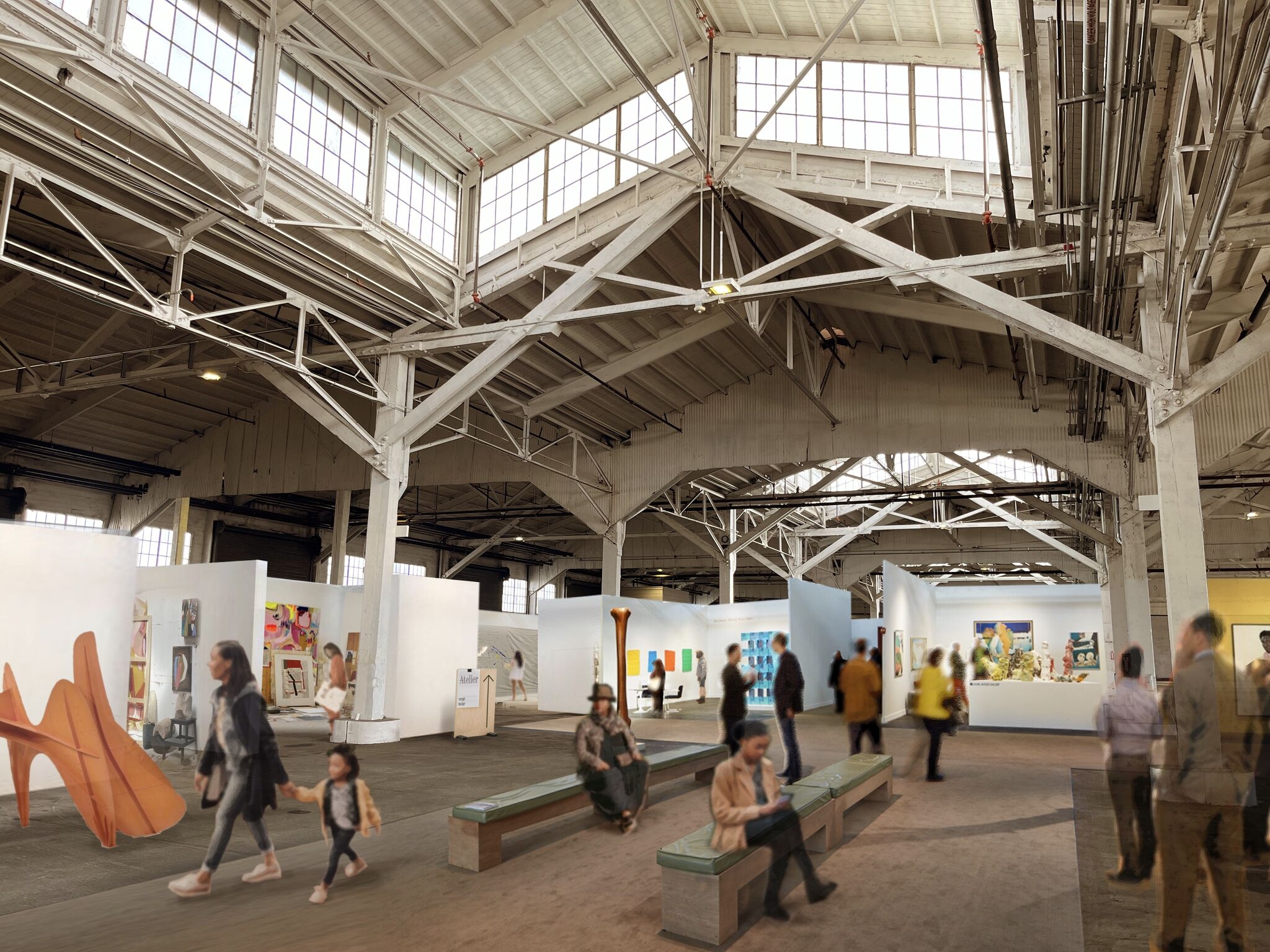
On Tuesday, the community-centered real estate organization, known as CAST, scored approval from the city's Port Commission to reimage a roughly 100,000-square-foot warehouse that spans Pier 29 and has largely sat vacant for more than a decade as artist studios and cultural programming.
The lease deal is for a two-year activation term, which will begin following a six month construction period in which CAST plans to make improvements to the property. The organization also has an option to request a two-year extension of its lease once it expires.
CAST's proposal for Pier 29 includes a partnership with Art + Water, a new organization by the Hawkins Project, which is a local nonprofit associated with the philanthropic endeavors of author Dave Eggers and artist J.D. Beltran, who also serves on the city's Arts Commission.
Eggers is the co-founder of 826 Valencia, a youth writing center located in the city's Mission District. At Pier 29, Art + Water will occupy some 30 'art pods' designed by CAST, which will span just over half of the existing warehouse. Some of the remaining space will be sublet to other arts groups, and a portion will be built out as convertible space for cultural programming and events that can accommodate up to 2,500 people.
Once the project is completed, it will become San Francisco's largest combined studio and exhibition space, according to the Port. It will also provide a vacant warehouse that has been empty since the 2013 America's Cup. The building was previously used for storage and parking, and burned down prior to the sailing competition but was quickly rebuilt, said Port Director Elaine Forbes.
'It was an amazing historic rebuild — we did it in nine months. It's a beautiful building that we haven't had much activity in,' she said.
Activating the stretch of the waterfront between the cruise ship terminal at Pier 27 and Fisherman's Wharf at Pier 39 has been a growing priority of the Port, Forbes said.
'We recognize there's this beautiful historic waterfront that isn't very busy, frankly, in that section and all the way up to Pier 39. We really want these piers to be able to welcome the public more and bring residents in and visitors in,' Forbes said, but added that the warehouse was designed for 'breakbulk' shipping — a method of transporting oversized and heavy cargo — and is therefore limited in regard to its future uses. On the flipside, the warehouse's large, barn-like open spaces and high vaulted ceilings provide flexibility for artistic and creative endeavors.
CAST's plan to convert the warehouse into a work and exhibition space for artists was 'just a great fit for us,' she said. The organization will invest about 300,000 of its own funds for tenant improvements, along with a $500,000 contribution from the Port.
'We get two years of low-cost artist studios, with hundreds and hundreds of subsidized artists coming to work in this waterfront venue. There's event space and creative space. And it just feels like such a nice match between what we have in this historic pier and how we could open it to the public for use,' Forbes said.
David Keenan, CAST's director of special projects, said that the organization has been working with the Port for nearly a year to secure the Pier 29 building.
'It's 100,000 square feet of open floor plan space that's kind of ideal for arts production, exhibitions and events. But, to actually get through regulation, we had to show that we are not going to impose a lot of impacts on the building … in order to not trigger major building code upgrades,' Keenan said. 'It's challenging for arts groups that are trying to maintain premises but keep them affordable.'
Commercial real estate prices in San Francisco have toppled due to the pandemic-induced downturn — in the Financial District, office vacancy reached a historic high of 37% last year. While tech firms and other companies have dumped thousands of square feet of once coveted office space on the market, CAST has seized upon the rare opportunity to own and lease real estate to serve the arts community in the heart of downtown.
Earlier this year, CAST purchased the historic Warfield Building in the city's Mid-Market neighborhood — once a tech hotspot that housed companies like Uber, Zendesk and X Corp. (formerly Twitter) and Block (formerly Square), all of which have exited the neighborhood in recent years — with plans to reposition the property as an arts and independent media hub.
And at the end of last year, CAST pounced at the opportunity to buy foreclosed property in the SoMa neighborhood that was once earmarked for a 16-story co-living tower. That building, located at 457 Minna St., will now provide space to community organizations serving the neighborhood's Filipino community.
'We are really trying to be an active player in a down market,' said CAST CEO Ken Ikeda. 'Our objective is to participate when we can reset the floor of affordability. We're really busy.'
City leaders have been hyperfocused on reviving the city's battered downtown in recent years, and have hailed efforts to support arts organizations taking space in the office-heavy economic core as one part of the solution. It's a stark but refreshing reversal to the years leading up to the pandemic, which saw many arts and culture groups being priced out of the area.
Last year, two San Francisco nonprofits submitted plans to build 100% affordable housing specifically for artists at 1687 Market St. The 100-unit housing project is slated to include a community center, studio space and a theater. It is funded by a $100 million gift from an anonymous benefactor.
'Our arts and culture are driving San Francisco's comeback, and this new space at Pier 29 is another exciting step in the right direction,' Mayor Daniel Lurie said in a statement to the Chronicle. 'By partnering with the Community Arts Stabilization Trust, we're creating the largest artist studio and exhibition space in the city — right on our iconic waterfront.'

Try Our AI Features
Explore what Daily8 AI can do for you:
Comments
No comments yet...
Related Articles


CBS News
 an hour ago
- CBS News
Art made from trash is treasured at San Francisco gallery exhibit
San Francisco artists are turning heads by turning rubbish into works worthy to be put on display at one of the city's most-renowned galleries. To most people, a dump is just a dump. But to Deena Qabazard, it's a full-service art supply store with a very flexible return policy. "Sometimes you look and you're like, 'No!' and then sometimes the unexpected car comes and you're like, 'Oh my goodness, fantastic!'" said Deena Qabazard, a Kuwaiti-American artist who has been mining the muck for years, looking to give old objects a new spark. On this particular morning, she scores a bracelet, a mirror, and a string of chandelier crystals, all ready for their second act. Back in her studio, those finds turn into collages of metal, textiles, and photographs, much of it pulled straight from the dump. "Now I'm kind of just playing around compositionally, what it looks like," Qabazard said. As climate concerns take center stage, repurposed art is getting more wall space and less side-eye from the art world. Exhibit A: The latest show from the city's garbage collector, Recology, which for 35 years has run an artist-in-residence program, now on display at the city's famed Minnesota Street Project. Deborah Munk, who runs the program, said 99% of the materials are what is referred to as upcycled. "Artists have been using trash for a long time, but maybe for different reasons because they couldn't afford it. But now, with all the environmental issues we're dealing with, it's becoming more apparent," Munk said. From self-portraits made with discarded mirrors and the artist's own hair, to installations built from pool floats left high and dry, and even one of Qabazard's earlier pieces, a weathered photograph, surrounded by scraps, all pulled from the city's trash and meant to reframe how we see beauty. "It's really important for younger generations to see we can reuse things and transform them, how they can expand our imagination," Qabazard said. The Recology San Francisco Artist in Residence exhibit runs through August 30 at Minnesota Street Project.


Forbes
5 hours ago
- Forbes
Avocado Luxury Organic Mattress Review: Our Testers Say This Nontoxic Mattress Is So Comfortable
Avocado mattresses have risen in popularity along with demand for sustainable, nontoxic materials, and we put the brand's high-end Avocado Luxury Organic Mattress to the test to determine whether it was worth the $4,800-plus price tag. The short answer? Yes, if you appreciate plush, marshmallowy comfort, and if its slew of safety certifications helps you sleep better at night. Our 13-person testing panel praised the Avocado Luxury Organic Mattress for its cloud-like comfort. ILLUSTRATION: FORBES / PHOTO: RETAILER Avocado is our favorite organic mattress brand because it touts more eco-friendly certifications than most of its competitors while also offering a range of firmness profiles to accommodate different sleepers. The Luxury Organic bed comes in three firmness levels—standard, plush and ultra plush—and our 13-person testing panel tried out the plush version of this bed. It's also worth noting that the softer models incur an upcharge; for a queen size, the plush version costs $800 more and the ultra plush costs $2,000 more than the standard bed. Forbes Vetted Forbes Vetted ratings are based on thorough evaluations by our editorial team to help you choose the best products with confidence. Type: Hybrid | Brand firmness rating: Ultra plush (3), plush (5) or medium (6) | Height: 13, 14 or 15 inches | Shipping: In-home delivery starting at $249 | Trial: 365 nights | Warranty: 25 years Best for: People with allergies Those who prioritize nontoxic materials and sustainability Side, back and combination sleepers Skip if: You prefer a firm mattress, such as stomach sleepers and those over 250 pounds You want top-notch motion isolation and edge support You don't want to spend extra on plush and ultra-plush versions Overall, our testing panel praised the plush model of the Luxury Organic bed for its ultra-soft and cradling feel. Based on this feedback, we named it the best organic option in our guide to the best luxury mattresses. 'This feels incredible to side sleep on,' says Forbes Vetted senior mattress and sleep editor Bridget Chapman, a dedicated side sleeper. 'It's like a giant fluffy cloud that envelops you in the best way.' Another tester adds, 'All of my pressure points sink in and are cradled in comfort. This is a top upgrade pick for side sleepers who want a statement bed that's the centerpiece of their bedroom.' We also found it's optimal for most back sleepers, but those over 250 pounds or with back pain should consider a firmer bed like the PlushBeds Royal Bliss or the Beautyrest Black. The Avocado Luxury Organic comes in three firmness levels—medium, plush and ultra plush—although the softer models come at an additional cost and have thick pillow tops. For every model, the brand sprinkles in a few touches to make your sleeping experience more luxurious, including over a dozen body-hugging comfort layers made from organic and natural latex, wool, silk, hemp and cotton. 'This definitely feels luxurious, particularly given its height and how plush this mattress is,' says one of our testers. 'It seems similar to what you would expect in a hotel mattress, and overall, I'm impressed.' Lastly, the mattress holds high 'green' standards and has earned certifications from Global Organic Latex Standard (GOLS), Global Organic Textile Standard (GOTS), Greenguard Gold, Oeko-Tex and the Rainforest Alliance, to name a few. For anyone who prioritizes both comfort and nontoxic materials, the Avocado Luxury Organic Mattress is well worth the investment (especially considering how much time you'll be spending in it). As a final tip, if you opt for the Ultra Plush model, keep in mind that its 15-inch height requires you to use deep-pocket sheets .
Yahoo
6 hours ago
- Yahoo
Mark Cuban Wants You To Stop Saving Money (And Do This Instead)
A little over half of Americans (56%) have less than $2,000 in savings, according to a 2024 Forbes survey. One in five Americans (20%) doesn't have savings at all. Read Next: Learn More: While saving is important, it's not the only way to build wealth. In fact, billionaire Mark Cuban argues that you shouldn't just save — you should invest instead. GOBankingRates broke down Cuban's advice on prioritizing investing your money over saving it. Aggressively Invest Instead According to Mark Cuban, saving isn't the best way to make your money work for you. The top 1% doesn't just save. They aggressively invest in things like real estate and alternative assets (like gold IRAs). A 2025 CAIS-Mercer study supports this idea. Of the financial advisors surveyed, 92% said they allocate their funds to alternative investments. Nearly all of them (91%) said they intend to increase allocations in the future. Take Mark Cuban's Advice With a Grain of Salt Leaving your money in a savings account, even one with higher-than-normal yields, might not be the best idea. After all, those yields may not even keep up with inflation. This means the value of your savings might fall rather than rise (depending on the account and how much you're contributing). But you might still want to have a little saved for emergencies. 'Every individual should have [three to six] months of lifestyle expenses in savings — a checking account and a high-yield money market account. Once they have this money in savings, they should start investing,' said Richard Craft, CEO of Wealth Advisory Group. You can save money for short-term goals — anything that takes under a year. But if you have long-term goals — anything over a year — investing is generally smarter. For You: Saving Could Cost You Millions Say you have a savings account with 4.00% APY and a $50,000 balance. After one year, you'd have roughly $52,000. In 10 years, you'd have around $74,000. This assumes nothing changes in that account — no withdrawals, deposits or changes in yield. Now, say you invest $50,000 in the stock market instead. According to the stock market has seen an average annual return of 10.8% over the past decade. Assuming average returns and no additional contributions, you'd have nearly $140,000 after 10 years. That's nearly double — all because you invested. When you think even longer term, you could potentially be losing out on a lot more than that. 'I think of investing and saving as one in the same,' said Paul Gabrail, founder and host at Everything Money. 'Saving for a 'rainy day' or for an emergency fund is not a wise financial move in my opinion. This could cost you millions in retirement.' He continued, 'Instead, all savings should go into investing. Essentially you are still saving; you're saving for retirement.' Consider Opportunity Cost While many experts suggest having an emergency fund, some take a different approach — one that may more closely align with Mark Cuban's. Saving comes with an opportunity cost, meaning the loss of a potential gain. 'If we're talking about saving for something like an emergency fund, then I think they should stop immediately and consider the opportunity cost,' said Gabrail. 'You can always use a credit card for a true emergency. Put that money towards investing in your retirement instead.' Take Your Risk Tolerance Into Account Not everyone has the same risk tolerance. And not everyone is in the same place in life financially. While going straight to investing might work for some, it's not the best move for everyone. Consider your goals and needs when choosing what to do with your money. When in doubt, speak with a professional for advice. More From GOBankingRates 3 Luxury SUVs That Will Have Massive Price Drops in Summer 2025 25 Places To Buy a Home If You Want It To Gain Value I'm a Retired Boomer: 6 Bills I Canceled This Year That Were a Waste of Money This article originally appeared on Mark Cuban Wants You To Stop Saving Money (And Do This Instead) Sign in to access your portfolio
