


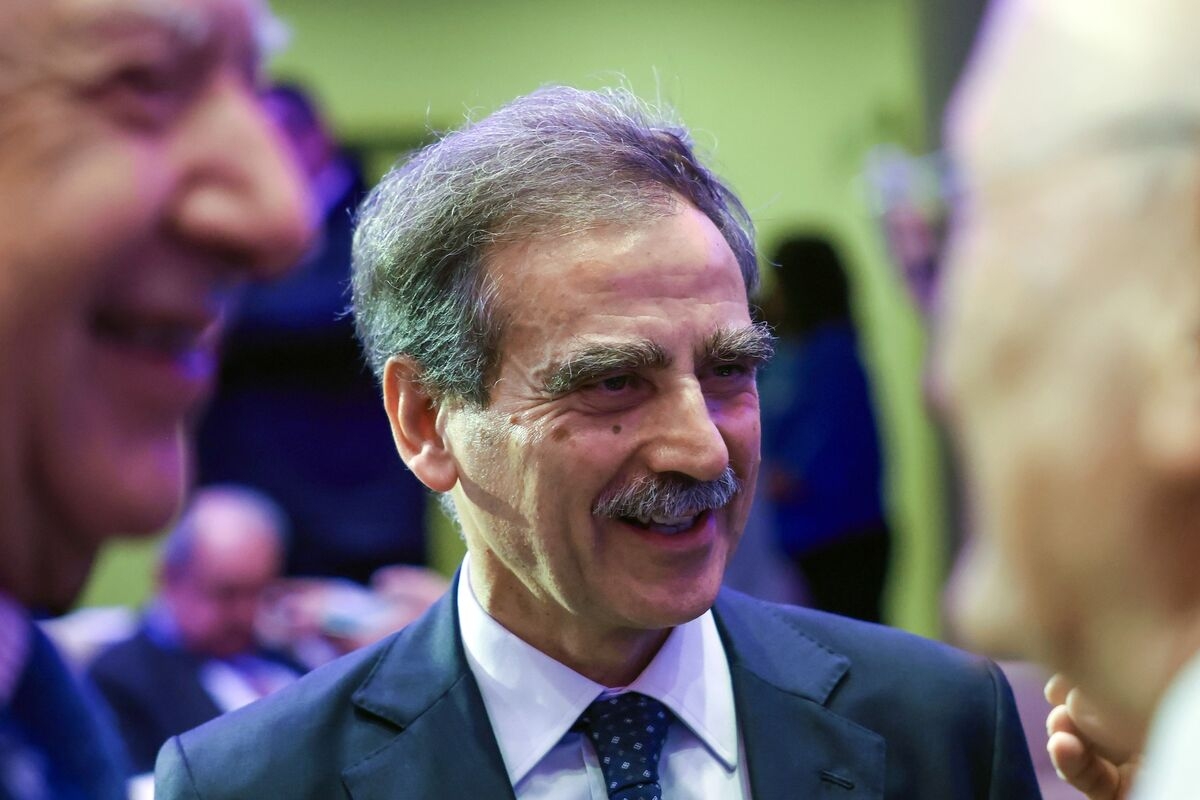
Paschi CEO to Meet Investors in Milan as Firm Pursues Mediobanca
The executive has scheduled meetings in Milan this week with US and European investment firms, asset managers and hedge funds to present his strategy and the rationale behind the lender's offer for Mediobanca, said the people, asking to not be named discussing private events.

Try Our AI Features
Explore what Daily8 AI can do for you:
Comments
No comments yet...
Related Articles

Yahoo
 an hour ago
- Yahoo
U.S. And Great Britain Move To Secure Strategic Advantage In Syria and Libya
With Russia focused on Ukraine, Washington is stepping up its efforts to ensure that Moscow cannot re-establish itself so easily in its previously vital strategic Middle East and North Africa strongholds of Syria and Libya. The U.S. and Great Britain were instrumental in the removal from power of longtime Libyan leader Muammar Gaddafi in 2011 and in the similar ousting of Syria's long-term president Bashar al-Assad in 2024. Over the 23 years, Washington and London appear to have learned that quickly putting into place a plan to ensure economic health of the country involved in an effective coup d'etat is a good idea from every angle. It minimises the chances of cultural and economic destruction wrought by unfettered migration of affected populations into Europe, it secures valuable energy rights for those countries helping to shape the new regime, and it prevents chief geopolitical rivals Russia and China from adding to their global sphere of influence. It is also crucial to note that major oil and gas projects legally entitle the international companies undertaking them to safeguard these assets in a foreign country by whatever security means they think appropriate, as agreed with the host nation. Given all this, the last few weeks have seen major moves by the U.S. and Great Britain to make sure that this time around the strategic advantage that they have engineered is both countries is not Syria, the beginning of July saw the U.S. remove Syria's Ministry of Oil and Mineral Resources from its sanctions list, together with the country's General Authority for Maritime Transport, and its two main refineries too. These actions augmented the removal of a broad range of sanctions on the country just a day earlier, including those preventing the importation of Syrian oil and oil products into the U.S. Together, the lifting of these sanctions are aimed at opening the way for the country to realise the still high potential of its oil and gas sector so that it can build a robust economy that is, according to the sanctions removal order: 'stable, unified and at peace with itself and its neighbors'. In this context it is apposite to note that before Syria's civil war began in March 2011 as part of the wider Arab Spring movement, it was a major oil producer, with output of around 400,000 barrels per day (bpd) of crude oil from proved reserves of 2.5 billion barrels. Prior to that – before the recovery rate started to decline due to a lack of enhanced oil recovery techniques being employed at the major fields -- it had been producing nearly 600,000 bpd. Europe imported over US$3 billion of oil per year from Syria up to the beginning of 2011, and many European refineries were configured to process the heavy, sour 'Souedie' crude oil that makes up much of Syria's output, with the remainder being the sweet and lighter 'Syrian Light' grade. Most of this – some 150,000-bpd combined – went to Germany, Italy, and France, from one of Syria's three Mediterranean export terminals: Banias, Tartus, and Latakia. As an adjunct to this, a multitude of international oil companies were operating in Syria's energy sector, including Great Britain's Shell, Petrofac and Gulfsands Petroleum, France's then-Total, the China National Petroleum Corporation, India's Oil and Natural Gas Corp, Canada's Suncor Energy, and Russia's Tatneft and Stroytransgaz. Russia was quick to expand its on-the-ground presence in the country's oil and gas sector as an adjunct to its launching full military support for al-Assad's regime from 30 September 2015, at the Syrian president's request, as analysed in full in my latest book on the new global oil market order. Heavy investment especially in the gas sector, allowed Moscow to leverage its influence across the country to such a degree that it became the Kremlin's key Middle Eastern outpost, with several militarily vital bases. These included the naval base at Tartus (Russia's only Mediterranean port), the air force base at Khmeimim, and the listening station just outside Latakia). However, following the 30 June and 1 July removal of sanctions on Syria by the U.S., American firms including Baker Hughes, Hunt Energy, and Argent LNG are working to revitalise the country's oil, gas and power sector, according to a senior source working in the European Union's security complex. 'They will be taking the lead here, [in Syria] alongside local [Middle Eastern] firms focusing on power generation, with British and European firms to step in after that initial work has been done,' he exclusively told last week. 'The initial focus [for the U.S.] will be on key oil-producing areas west of the Euphrates currently under control of the new Syrian government,' he added. It is a similar story for Libya, although British firms have adopted the lead role here in recent weeks. Before 2011 -- when the Arab Spring movement led to the removal of its own leader, Gaddafi -- Libya had easily been able to produce around 1.65 million barrels per day (bpd) of mostly high-quality light, sweet crude oil. Production had also been on a rising production trend at that point, up from about 1.4 million bpd in 2000. Although this output level was well below the peak levels of more than 3 million bpd achieved in the late 1960s, its National Oil Corporation (NOC) had plans in place before 2011 to roll out enhanced oil recovery techniques to increase crude oil production at maturing oil fields. There had also been plenty of interest from a slew of international oil companies to be involved in expanding production on existing fields and exploring new opportunities in oil and gas (after all, Libya still has 48 billion barrels of proved crude oil reserves – the largest in Africa). Russia was one such country, although the more chaotic conditions across the country resulting from fragmented political leadership meant Moscow was less able to cement firm control over it. Nonetheless, September 2023 saw General Khalifa Haftar – commander of the Libyan National Army (LNA) – travel to Moscow for talks with Russian President Vladimir Putin, whose Wagner mercenary soldiers provide support for LNA forces in Libya. Further talks between Haftar and senior Russian political and military figures have occurred at several points since then, according to the E.U. security source. As an adjunct to this, last year saw the arrest of Saddam Haftar -- General Haftar's son -- at Naples airport after his name appeared on an E.U. database over an arrest warrant issued in Spain for alleged weapons smuggling. This followed comments from former U.N. special envoy to Libya, Abdoulaye Bathily, that the country was becoming a mafia state dominated by gangs involved in smuggling operations, especially for arms. That said, earlier this year saw British oil giants BP and Shell sign a range of agreements with Libya's National Oil Company (NOC) aimed at boosting the country's oil and gas output recovery. BP said on 8 July that it had signed a memorandum of understanding (MoU) to evaluate options for redeveloping the giant Sarir and Messla onshore fields in the Sirte basin, and to assess potential unconventional oil and gas development. The firm's executive vice president for gas and low carbon, William Lin, stated that the agreement, 'reflects our strong interest in deepening our partnership with NOC and supporting the future of Libya's energy sector.' In the meantime, Shell is focused on exploring development possibilities for the Atshan oil field and other NOC-owned assets. Shortly afterwards during a visit to Tripoli by U.S. President Donald Trump's senior adviser for Africa, Massad Boulos, a cooperation agreement was signed between Mellitah Oil and Gas (a joint venture between the NOC and Italy's Eni), and U.S. construction consulting firm Hill International to manage a project which aims to boost Libya's gas output. More specifically, it involves the development from 2026 of two gas fields located offshore Libya with combined gas reach 750 million cubic feet per day. Perhaps the biggest sign of the U.S.'s high hopes for a new Libya was the announcement earlier this month that supermajor ExxonMobil had signed an MoU with the NOC to identify hydrocarbon resources in four offshore blocks located off Libya's northwest coast and its Sirte Basin. All of these on the-ground-developments in Libya and Syria will be very hard for Russia or China to undermine. By Simon Watkins for More Top Reads From this article on
Yahoo
2 hours ago
- Yahoo
Netanyahu to hold emergency meeting on Europe's recognition of a Palestinian state
Prime Minister Benjamin Netanyahu will hold a security-political meeting on Monday regarding Israel's response to European countries recognizing a Palestinian state. Prime Minister Benjamin Netanyahu will hold a security-political meeting on Monday evening regarding Israel's response to the intentions of European countries to recognize a Palestinian state in September. Smotrich is expected to demand the application of sovereignty over the West Bank and the immediate dismantling of the Palestinian Authority (PA). About three months ago, Smotrich announced the suspension of fund transfers to the PA and his intention not to extend the indemnification for Israeli banks transferring funds to the PA. This was done by canceling the indemnity provided to correspondent banks in relation to banks operating in the Palestinian Authority, his office confirmed on Tuesday. Until that moment, Smotrich had only occasionally delayed the transfer of funds from time to time, but had not ordered a complete halt. European countries to recognize a Palestinian State France and the UK are the two main European countries that plan to recognize a Palestinian State in the UN General Assembly in New York in September, alongside other European and non-European nations. Australia was the last to announce that it would recognize a Palestinian state, while Canada, another important Western ally, will also follow this route. Countries that still have not taken a position in this situation are New Zealand, whose Foreign Minister Winston Peters said he was carefully considering recognition of a Palestinian state, and Denmark, whose Prime Minister Mette Frederiksen said that while her country condemned Prime Minister Benjamin Netanyahu, she did not support recognizing a Palestinian state at this time. Palestinian Authority President Mahmoud Abbas is considering unilaterally announcing the transformation of the PA into a state during the upcoming General Assembly, London-based outlet al-Araby al-Jadeed reported. Avraham Bloch, Reuters, and Mathilda Heller contributed to this report. Solve the daily Crossword
Yahoo
2 hours ago
- Yahoo
Sen. Lindsey Graham says Trump ready to ‘crush' Russian economy if Putin avoids talks with Zelenskyy
WASHINGTON (AP) — Republican Sen. Lindsey Graham said Tuesday that he believes President Donald Trump is prepared to 'crush' Russia's economy with a new wave of sanctions if Russian President Vladimir Putin refuses to meet with Ukrainian President Volodymyr Zelenskyy in the coming weeks. Graham, who spoke with Trump on Tuesday morning, has pushed the president for months to support his sweeping bipartisan sanctions bill that would impose steep tariffs on countries that are fueling Russia's invasion of Ukraine by buying its oil, gas, uranium, and other exports. The legislation has the backing of 85 senators, but Trump has yet to endorse it. Republican leaders have said they won't move without him. 'If we don't have this thing moving in the right direction by the time we get back, then I think that plan B needs to kick in,' Graham said in a phone interview with The Associated Press on Tuesday. The Senate, now away from Washington for the August recess, is scheduled to return in September. Graham's call with Trump came less than 24 hours after high-stakes meetings at the White House with Zelenskyy and several European leaders. Trump and the leaders emerged from those talks sounding optimistic, with the expectation being that a Putin and Zelenskyy sit-down will happen soon. Still, Trump's comments to Graham, one of his top congressional allies, mark the latest sign that pressure is building — not just on Putin, but on Trump as well. 'Trump believes that if Putin doesn't do his part, that he's going to have to crush his economy. Because you've got to mean what you say,' Graham told reporters in South Carolina on Tuesday. As Congress prepares to return to session in early September, the next few weeks could become a defining test of whether lawmakers and international allies are prepared to act on their own if Trump doesn't follow through. Connecticut Sen. Richard Blumenthal, the lead Democrat pushing the bill with Graham, says there is a 'lot of reason for skepticism and doubt' after the meetings with Trump, especially because Putin has not made any direct promises. He said the Russian leader has an incentive to play 'rope-a-dope' with Trump. 'The only way to bring Putin to the table is to show strength,' Blumenthal told the AP this week. 'What Putin understands is force and pressure.' Still, Republicans have shown little willingness to override Trump in his second term. They abruptly halted work on the sanctions bill before the August recess after Trump said the legislation may not be needed. Asked Tuesday in a phone interview whether the sanctions bill should be brought up even without Trump's support, Graham said, 'the best way to do it is with him.' 'There will come a point where if it's clear that Putin is not going to entertain peace, that President Trump will have to back up what he said he would do,' Graham said. 'And the best way to do it is have congressional blessing.' The legislation would impose tariffs of up to 500% on countries such as China and India, which together account for roughly 70% of Russia's energy trade. The framework has the support of many European leaders. Many of those same European leaders left the White House on Monday with a more hopeful tone. Zelenskyy called the meeting with Trump 'an important step toward ending this war.' German Chancellor Friedrich Merz said that his expectations 'were not just met, they were exceeded.' Still, little concrete progress was visible on the main obstacles to peace. That deadlock likely favors Putin, whose forces continue to make steady, if slow, progress on the ground in Ukraine. French President Emmanuel Macron told reporters after talks at the White House that Trump believes a deal with Putin is possible. But he said sanctions remain on the table if the process fails. ___ Associated Press reporter Meg Kinnard contributed to this report from Florence, South Carolina.
