


Civil service still in demand, PSC expects 1.3 million applications this year, says chairman
Its chairman, Datuk Dr Ahmad Jailani Muhamed Yunus, said the estimate was based on application trends and the encouraging response to the Kembara Kerjaya PSC outreach programme.
"In previous years, we received up to 1.2 million applications and this year, we may reach 1.3 million. This indicates that interest in civil service careers remains high, despite the discontinuation of the pension scheme.
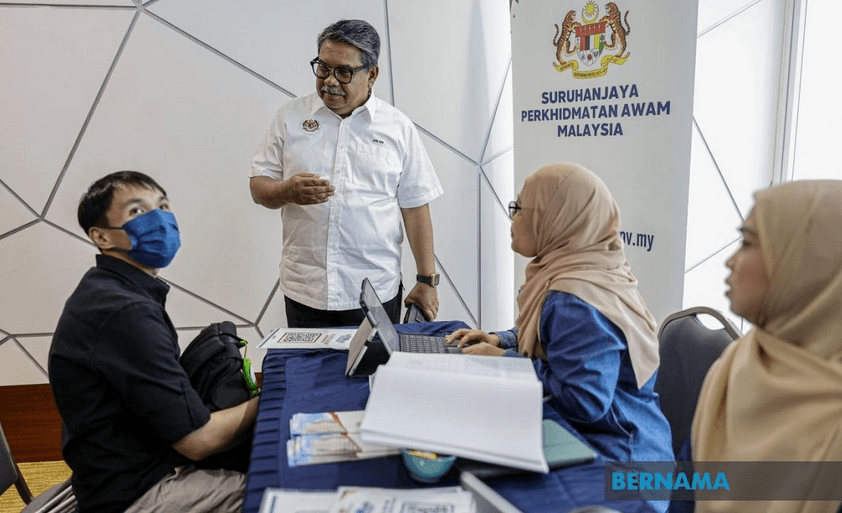
"Therefore, we are intensifying our outreach efforts to ensure that job-seeking youths are well-informed of current opportunities in the public sector through the PSC," he told reporters at the Kembara Kerjaya SPA @ Penang 2025 programme here Saturday (June 21).
The programme aims to raise awareness and provide exposure to PSC services, to help individuals chart a career path in the public service.
Ahmad Jailani said the Kembara Kerjaya programme has been held in Sabah, Sarawak, Terengganu and Penang during the first half of this year, attracting more than 10,000 visitors.
Besides physical events, the programme is also conducted virtually and has drawn significant traffic to the PSC website.
He said the next edition will be in Kelantan next month, followed by Putrajaya, Melaka, Perak, Johor and Kuala Lumpur, to provide the public with a platform for direct and interactive engagement with PSC personnel.
"Visitors will also receive guidance on application procedures, status updates and recruitment consultations through SPA briefing sessions during the programme," he said.
He added that the programme involves personnel from all major PSC divisions and the PSC Outreach Squad, who conduct briefings, consultations and other activities to highlight the commission's roles, services and information to target groups. - Bernama
Hashtags

Try Our AI Features
Explore what Daily8 AI can do for you:
Comments
No comments yet...
Related Articles


The Sun
 2 hours ago
- The Sun
F1 revival debate heats up
PETALING JAYA: The idea of reviving Formula 1 (F1) races at the Sepang International Circuit (SIC) has sparked scepticism, with experts warning that the multi-million ringgit price tag could outweigh potential benefits amid the country's current economic and social pressures. Economist Prof Geoffrey Williams said the government should avoid using public funds to finance the event, which Malaysia hosted for nearly two decades before dropping it in 2017. 'If hosting F1 is viable from an economic and business perspective, it should be funded entirely by the private sector. If it is not viable from a private investment perspective, then government investment makes no sense either.' Williams added that F1 should serve as a lesson from the past rather than an aspiration for the future. 'It was not sustainable and did not deliver the economic, social or multiplier effects often claimed by proponents of government involvement. If it had delivered benefits, it would still be running. It did not, hence it was discontinued.' A businessman, who wanted to remain anonymous, echoed these concerns, calling the potential cost unnecessary and misaligned with national priorities. 'Spending US$70 million (about RM295 million) for a single Formula 1 race is totally unnecessary. Once setup and related costs are included, Malaysia could pay more than RM300 million for just one event,' he said. He suggested the funds could instead uplift struggling Malaysians. 'That RM300 million could subsidise 20,000 B40 families with RM15,000 each, helping them financially to own their first home. Supporting 20,000 families would directly benefit at least 100,000 Malaysians.' The businessman also questioned the need to return to F1 given Malaysia's long history with the sport. 'We have hosted F1 for 19 consecutive years. Isn't that enough? With more countries vying to host, fees will only rise. The owners of F1 are savvy and business-minded, not generous. A wiser approach would be to use that money to improve the lives of Malaysians rather than compete for prestige.' SIC chief executive officer Azhan Shafriman Hanif was reported as saying the circuit has not ruled out hosting F1 again but stressed it would require serious funding, strategic planning and nationwide commitment before any proposal could move forward. He added that SIC is ready to coordinate a potential comeback, acting as a bridge between government stakeholders and F1 management. Malaysia last hosted an F1 race in 2017, before ending a 19-year run that began in 1999.

The Sun
3 hours ago
- The Sun
Concern over citizenship switch
PETALING JAYA: Thousands of Malaysians are relinquishing their citizenship for Singapore, a trend that has surged in recent years, highlighting concerns over economic prospects, political stability and long-term security at home. Monash University Malaysia adjunct senior research fellow Dr Koh Sin Yee said such decisions are rarely impulsive, reflecting careful long-term planning. 'The sharp jump in 2023 and 2024 could be linked to circumstances in 2022 and 2023 or even earlier. 'These may be personal, family-related or tied to perceptions of economic and political uncertainty,' she said. Koh cautioned against oversimplifying migration into 'push' and 'pull' factors. 'One person's 'push' factor could be another's 'pull.' Choosing where to hedge one's future doesn't necessarily mean a loss of belonging to Malaysia,' she added. Institute of Southeast Asian Studies–Yusof Ishak Institute senior fellow Dr Lee Hwok Aun highlighted Singapore's proximity and cultural familiarity, particularly for ethnic Chinese Malaysians. 'In recent years, jobs in technology, finance and other industries have made Singapore even more attractive, sometimes more than destinations like Australia,' he said. To stem the outflow, Malaysia must expand domestic opportunities, strengthen fairness and ensure stability with quality jobs and improved quality of life. Universiti Kebangsaan Malaysia sociologist Dr Velan Kunjuraman said Singapore's prosperity and political stability strongly appeal to Malaysians seeking security and opportunity. 'The two nations share deep historical roots, but Singapore's high GDP, efficient governance and accessibility offer clear advantages. 'For many, commuting daily from Johor Bahru makes the move even more practical,' he said. He added that these decisions often reflect Abraham Maslow's hierarchy of needs, where long-term welfare and security outweigh patriotic attachment. 'It's usually about career prospects, family well-being or education rather than a rejection of Malaysian identity. Globally, people are re-evaluating national belonging through a more pragmatic lens,' he said. Generational differences also influence decisions, he added. Younger Malaysians tend to see mobility as a pathway to advancement while older individuals may view Singapore as a 'safe upgrade' – familiar yet economically superior. Universiti Teknologi Malaysia industrial and organisational psychologist professor Dr Siti Aisyah Panatik said citizenship renunciation is seldom impulsive, involving careful evaluation of identity, belonging and security. 'Singapore's governance, healthcare and job opportunities often outweigh the emotional cost of giving up Malaysian identity.' She said cultural and linguistic similarities between the two societies reduce the psychological burden of migration. 'Many see the move not as rupture but as continuity – a way to maintain identity while accessing better opportunities,' she said. Citing Social Identity Theory, she observed that people increasingly define belonging not just by birthplace but by communities and institutions that support their aspirations. For Millennials and Gen Z, citizenship is a flexible tool for mobility, while older Malaysians are drawn by stability and better social protections. Siti Aisyah cautioned against framing the trend as disloyalty. 'This reflects a human pursuit of stability, security and growth. Citizenship today is less about heritage and more about where one can thrive and build a future,' she said. She stressed that Malaysia must address the root causes driving people away. 'If we close gaps in governance, fairness and opportunities, more Malaysians will see reasons to stay and contribute. 'The goal is not just to retain citizens but to create an environment where they genuinely want to belong,' she added. Home Minister Datuk Seri Saifuddin Nasution Ismail recently revealed that 6,060 Malaysians had renounced their citizenship as of June 30 this year. This follows a record 16,930 cases in 2024, up from 11,500 in 2023. By comparison, 2022 recorded 5,623 cases, while 2019 saw 13,362 before the pandemic temporarily slowed the trend.


The Star
3 hours ago
- The Star
AI reshapes, not replaces, say young Malaysians
PETALING JAYA: With concerns growing over artificial intelligence (AI) reshaping the workforce, young Malaysians say the latest technology should be viewed as an opportunity rather than a threat. Junior executive Zambri Jailani, 25, likened the advent of AI to the introduction of computers in the 1990s. 'Instead of threatening job opportunities, they became an important tool for us,' he said. Zambri said all generations should be ready to adapt to technological changes, adding that AI skills would help increase productivity and boost Malaysia's competitiveness on the global stage. For content writer Lee Zai Wen, 26, AI is already integrated into his work; however, he believes the technology is unlikely to replace his role in the foreseeable future. 'I use AI quite often to help create content, and while it does write well, the content sometimes lacks the expressive descriptions that help readers relate to it,' he said. Law student Carmen Ho, 25, said the legal sector was already experiencing the impact of AI, citing a case in the United Kingdom where a lawyer faced disciplinary action after citing fictitious cases generated by AI. 'With the rise of lawyers using AI, it is going to take more time and effort to vet documents, especially if fake cases are used,' she said. While acknowledging that AI could reduce the demand for some roles, Ho said the legal profession still requires human expertise. 'Trained eyes are still needed for legal research and identifying legal issues. Perhaps fewer lawyers will be needed with AI assisting, but legal minds are still necessary,' she said. Dr Muhammad Akmal Remli, director of the Institute for Artificial Intelligence and Big Data (AIBIG) at Universiti Malaysia Kelantan, said the priority should be to equip the local workforce with the right skills to adapt to the rapid changes brought by AI and automation. 'We must focus on reskilling and lifelong learning so workers are not left behind. In this environment, workers who know how to use AI tools will likely replace those who don't,' he said when contacted. Muhammad Akmal said that digital literacy, adaptability, problem-solving and creativity must be at the core of workforce development. He urged government, industry and education providers to collaborate in creating accessible training pathways, particularly for SMEs, rural workers and vulnerable groups. 'The goal is not just to produce more AI specialists but to ensure every worker – from retail to manufacturing – can apply digital and AI tools in their daily roles,' he said. On the jobs most exposed to disruption, he pointed to wholesale and retail, food manufacturing, global business services, electrical and electronics, and ICT, with roles such as cashiering, data entry, production line work, and basic coding or testing most at risk. He said workers in these areas must be supported through reskilling into adjacent roles – such as retail staff moving into e-commerce or logistics, or call centre staff into customer experience design. 'Workers should be trained to see AI as a co-pilot rather than a competitor. With clear transition pathways, at-risk jobs can evolve into new opportunities such as automation technicians, digital supply chain managers or sustainability specialists," he added.
