



Four dead as Colombia hit with wave of bombings, gun attacks
It was not immediately clear who was behind the attacks, but guerrillas who broke away from the once-powerful FARC rebel army are known to operate in that part of Colombia.
The attacks hit Cali -- the country's third largest city -- and several nearby towns, targeting police stations and other municipal buildings.
The National Police chief, Carlos Fernando Triana, told La FM radio that assailants had attacked targets with car bombs, motorcycle bombs, rifle fire and a suspected drone.
'There are two police officers dead, and a number of members of the public are also dead,' he said.
Police later said at least two civilians were among those killed, and 12 others were injured.
In the town of Corinto, an AFP journalist witnessed the tangled wreckage of a car that had exploded, and a scorched and badly damaged municipal building.
Corinto resident Luz Amparo was at home when the blast also gutted her bakery.
'We thought it was an earthquake' she told AFP. 'My husband said 'no, they are shooting.''
Her phone began to ring of the hook, and she went to her check on her store. As she rounded the corner the neighbors began to look in her direction.
'Everything was levelled,' she said.
Triana suggested the attacks may be linked to the third anniversary of the killing of FARC dissident leader Leider Johani Noscue, better known as 'Mayimbu.'
The bombings came days after the attempted assassination of a presidential candidate in Bogota, a brazen attack that already had the country on edge.
Conservative senator Miguel Uribe, 39, was shot twice in the head at close range by a 15-year-old alleged hitman while campaigning Saturday.
That attack has stunned Colombians and prompted speculation about who was responsible.
Thousands have taken to the streets in major cities to light candles, pray and voice their anger at the assassination attempt.
Many Colombians are fearful of a return to the violence of the 1980s and 1990s, when cartel attacks, guerrilla violence and political assassinations were commonplace.

Try Our AI Features
Explore what Daily8 AI can do for you:
Comments
No comments yet...
Related Articles


The Sun
 39 minutes ago
- The Sun
Trump says Ukraine peace deal would help him get to heaven
WASHINGTON: Donald Trump said Tuesday that a Ukraine peace deal could boost his chances of getting to heaven. The 79-year-old US president joked that his odds of making it through the pearly gates are currently low. Trump has previously said he wants to end Russia's war in Ukraine as part of his bid to win the Nobel Peace Prize. A day after hosting the leaders of Ukraine and several European nations at the White House, Trump said his motivations were not all earthly. 'I want to try and get to heaven if possible,' Trump told Fox News morning show Fox and Friends. I hear I'm not doing well, I hear I'm really at the bottom of the totem pole. But if I can get to heaven this will be one of the reasons. By traditional yardsticks the three-times-married, twice-impeached Trump is no saint. The billionaire Republican has been embroiled in a number of scandals over the years. Trump is the first president to have a criminal conviction, in his instance a hush money case involving payouts to a porn star. But Trump has taken on an increasingly religious tone since surviving an assassination attempt last year. He said at his inauguration in January that he had been saved by God to make America great again. Boasting strong support from America's religious right, Trump has embraced the trappings of faith far more strongly in his second term in the White House. He has notably appointed an official spiritual adviser, Paula White. White has led a number of prayer gatherings that have seen attendees lay their hands on Trump at White House events. Trump's Press Secretary Karoline Leavitt said Tuesday she believed the president was serious about his Ukraine comments. 'I think the president wants to get to heaven, as I hope we all do in this room,' Leavitt told reporters. The 27-year-old Leavitt herself holds prayer sessions before her briefings. - AFP

New Straits Times
41 minutes ago
- New Straits Times
Top military officers hold Ukraine talks after Trump rules out US troops
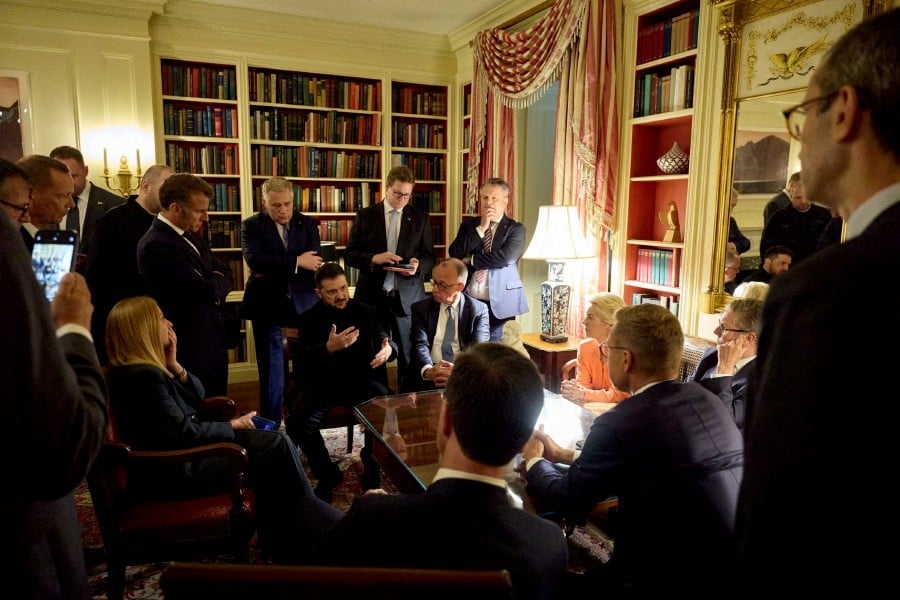
WASHINGTON: Top US and European military officers met in Washington Tuesday to discuss the mechanics of a possible Ukraine peace deal, after President Donald Trump ruled out sending American troops to back an agreement but suggested air support instead. In a flurry of diplomacy aimed at ending the war, Trump brought Ukrainian President Volodymyr Zelenskyy and European leaders to the White House on Monday, three days after his landmark encounter with Russia's Vladimir Putin in Alaska. But while Trump said Putin had agreed to meet Zelenskyy and accept some Western security guarantees for Ukraine, those promises have been met with extreme caution by Kyiv and Western capitals, and many details remain vague. Putin proposed holding the summit with Zelenskyy in Moscow, three sources familiar with a call between Trump and the Russian leader told AFP. One source said Zelenskyy immediately said no to meeting in the capital of his country's invader. Featured Videos As Western leaders push for an agreement, top US officer General Dan Caine held talks Tuesday evening with European military chiefs to discuss "best options for a potential Ukraine peace deal," a US defence official told AFP. The in-person talks precede a virtual meeting of military chiefs from Nato's 32 member countries on Wednesday, in which Caine is also scheduled to participate. Trump, long a fierce critic of the billions of dollars in US support to Ukraine since Russia invaded in 2022, earlier said that European nations were "willing to put people on the ground" to secure any settlement. "France and Germany, a couple of them, UK, they want to have boots on the ground," Trump said in a Fox News interview. "We're willing to help them with things, especially, probably, if you talk about by air." Asked what assurances Trump had that US boots would not be on the ground, he replied: "Well, you have my assurance and I'm president." The White House later doubled down on Trump's statements – but gave few new details on either the summit or the security guarantees. Press Secretary Karoline Leavitt told reporters that Trump "has definitively stated US boots will not be on the ground in Ukraine" and that the use of US air power was an "option and a possibility." Leavitt insisted that Putin had promised Trump he would meet Zelenskyy, and said top US officials were "coordinating" with Russia on a summit. Trump had dramatically interrupted his meeting with Zelenskyy and the Europeans at the White House on Monday to call the Russian leader. Allies have expressed doubts that Putin will go through with the meeting, but the Europeans are seizing on the possibility of a peace deal following the Trump talks. French President Emmanuel Macron and British Prime Minister Keir Starmer brought together around 30 of Ukraine's allies known as the "Coalition of the Willing" for virtual consultations. Starmer told them coalition teams and US officials would meet in the coming days to "prepare for the deployment of a reassurance force if the hostilities ended," a Downing Street spokesperson said. Russia has warned that any solution must also protect its own "security interests" and has ruled out Ukraine joining Nato. Foreign Minister Sergei Lavrov added that any meeting between the leaders "must be prepared very thoroughly." Lavrov's comments, and Putin's offer of Moscow as a summit venue, reinforced European fears that Russia was once again stalling. Macron said he wanted the summit to take place in Geneva, a historic venue for peace talks. Switzerland said it was ready to offer immunity to Putin, who faces an arrest warrant from the International Criminal Court over the war. Macron and German Chancellor Friedrich Merz have both said the summit could take place in two weeks. The White House declined to comment on a Politico report that it was eying Hungary's capital Budapest as a venue for a follow-up three-way summit including Trump. On the streets of Kyiv, there was skepticism about whether the latest talks can end the grinding conflict. "The main problem is Putin himself doesn't want it," said Anton, 32, who works in a warehouse. But in Moscow, some people were more optimistic. "I hope we can agree on mutually beneficial terms," said Vyacheslav, 23, who works for the government. --AFP
New Straits Times
41 minutes ago
- New Straits Times
Syrian, Israeli diplomats met in Paris to discuss 'de-escalation'
DAMASCUS: Syria's foreign minister met with an Israeli diplomatic delegation in Paris on Tuesday to discuss "de-escalation and non-interference in Syria's internal affairs", state news agency SANA reported. The latest in a series of US-mediated talks resulted in "understandings that support stability in the region", the agency said. Washington has been at work in recent weeks to try to resolve security issues in Syria and Lebanon, which its ally Israel says have prompted it to take military action. Despite a truce reached last November, Israel has continued to hit targets of the Iranian-backed Hizbollah group in Lebanon, and it has occupied territory and hit targets across Syria since last year's fall of dictator Bashar al-Assad. Tuesday's meeting in Paris follows one between Syrian Foreign Minister Assad al-Shaibani and Israeli Minister of Strategic Affairs Ron Dermer in Baku in late July, and another meeting in Paris before that. Israel and Syria have technically been at war since 1948, and the talks also discussed reviving a disengagement accord from 1974 that created a buffer zone between the two countries. "These talks are taking place under US mediation, as part of diplomatic efforts aimed at enhancing security and stability in Syria and preserving the unity and integrity of its territory," the agency said. The recent meetings between the two countries come after deadly sectarian clashes in July in southern Syria's Druze-majority Sweida province which left over 1,400 people dead. The clashes initially pitted local Druze fighters against Sunni Bedouin tribes but soon saw the involvement of Syrian government forces and Israel, with the latter saying it wanted to protect the Druze. Last month, Israel struck the Syrian presidential palace and the army headquarters in Damascus. The United States, an ally of Israel but who has expressed support for Syria's new leaders, announced a ceasefire between the two sides overnight on July 18.--AFP
