


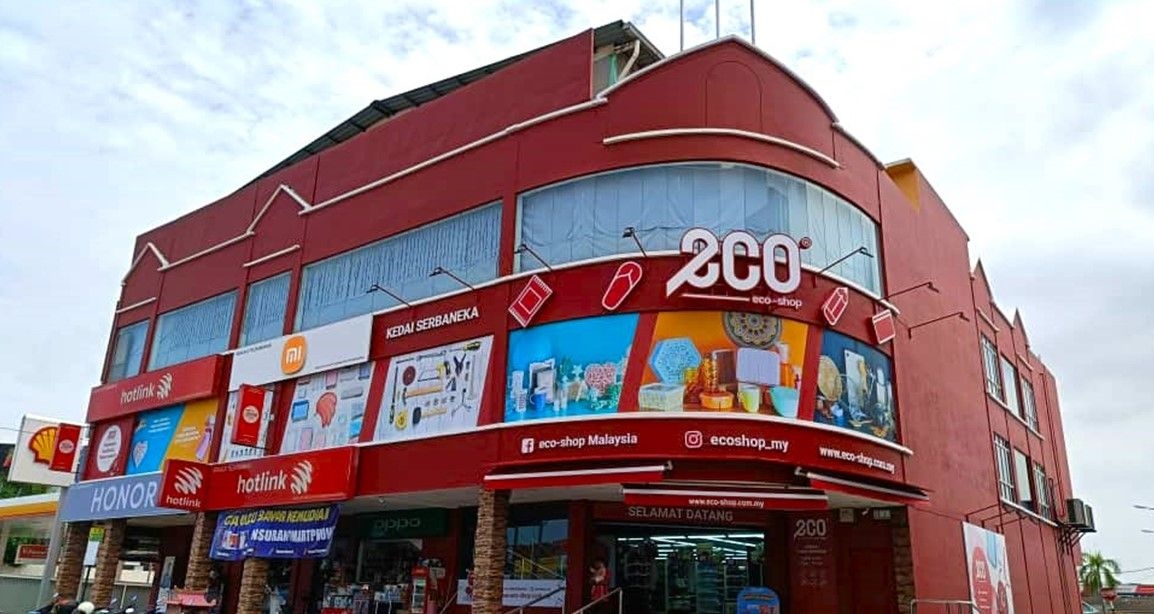
Eco-Shop eyes further expansion after strong 3Q results
Citing a report from Frost & Sullivan GIC Malaysia Sdn Bhd, the group said Malaysian dollar store retail sector penetration remains relatively low compared to more mature markets such as Japan, Canada, and the United States, and in terms of sales value, this sector is expected to grow at a compound annual growth rate of 14.2% in the next five years from to 2029.
Releasing its results for the third quarter ended February 28 yesterday (3Q25), Eco-Shop saw net profit soar 45% year-on-year (y-o-y) to RM61.7mil, as revenue also increased 17.2% to RM736.4mil.
The group attributed its turnover growth primarily to the expansion of its store network, with the opening of 26 new stores in 3Q25 compared to 14 in the corresponding period of last year.
'The total store count increased from 278 stores in 3Q24 to 349 stores in 3Q25. Additionally, the group's revenue was supported by a modest increase in same store growth (SSSG) of 0.6%,' said Eco-Shop in a statement to Bursa Malaysia.
At the same time, the strong profit margin was attributable to a more favourable product mix and the strengthening of the Malaysian ringgit against the Chinese yuan.
Cumulatively for the nine months ended February (9M25), Eco-Shop posted a net profit y-o-y growth of 35.9% to RM154.9mil, as revenue escalated 19% to RM2.1bil.
Eco-Shop said the strong performance over the three quarters was mainly due to the opening of 59 new stores during the period and an SSSG of 2.1%, aside from the strengthening of the ringgit against the yuan that also helped improve profitability.
The group did not declare any dividends for the year.
Looking ahead, Eco-Shop said it will continue to be vigilant and well-prepared to manage various cost and risk factors, including the upcoming electricity tariff hike effective from July 1, the implementation of the multi-tier levy system that could increase the cost of hiring foreign workers, and the enforcement of a mandatory 2% Employees' Provident Fund Board contribution for non-citizen employees.
'As our store network continues to grow, we anticipate greater demand for distribution and storage capabilities. To support this, we plan to strengthen our logistics infrastructure in Peninsular Malaysia.
'Construction of a semi-automated distribution centre on a 307,560 sq m
site in Klang, Selangor is expected to commence in the first quarter of 2026, with completion targeted for the financial year ending May 31, 2027,' it said.
Hashtags

Try Our AI Features
Explore what Daily8 AI can do for you:
Comments
No comments yet...
Related Articles


Malaysiakini
 3 minutes ago
- Malaysiakini
Misguided: Why the HRD levy must never be wage subsidy
LETTER | I refer to the recent proposal by Human Resources Minister Steven Sim to permit employers to utilise up to RM2 billion from the Human Resources Development (HRD) levy funds to pay the salaries of newly hired university and technical and vocational education and training graduates beginning Sept 1. Frankly, I am shocked. This proposal represents a fundamental departure from the original mandate and philosophy of the Human Resource Development Corporation (HRDCorp) - a mandate clearly enshrined in the Pembangunan Sumber Manusia Berhad (PSMB) Act 2001. It deserves serious scrutiny because it risks eroding both the integrity of the levy and the long-term development of Malaysia's human capital. Under Article 3 of the PSMB Act, the HRDCorp's principal purpose is to promote the training and development of employees, apprentices, and trainees through the imposition and utilisation of a training levy. Article 22(2)(a) further underscores that the levy must be expended only for activities that 'promote, develop and upgrade' the skills of employees, and for the establishment or maintenance of training infrastructure. In other words, the levy is not - and has never been - intended as a wage subsidy. It is a training fund designed to promote structured, continuous, and meaningful upskilling of the Malaysian workforce. Allowing these funds to be diverted towards paying salaries would effectively sever the vital link between levy contributions and training outcomes - a link that forms the very backbone of levy-based training systems across the world. It is arguably an ultra vires (beyond the powers) use of funds under the PSMB Act, which recognises the levy as a ring-fenced training fund. If the intention is to support graduate employment, then this should be done through normal fiscal channels, not through the misappropriation of a specialised fund established for a very different and critical purpose. Fundamental flaws There are several fundamental flaws in Sim's proposal. First, it sets a dangerous precedent: once the training levy is converted into a wage-subsidy mechanism, reversing the policy becomes politically difficult. The HRDCorp risks morphing into a politically driven institution rather than a professional body tasked with building workforce capabilities. Second, it will discourage employers from investing in genuine, future-focused skills development. Faced with the option of using levy funds to offset payroll costs, many companies - particularly small and medium enterprises - will logically opt to minimise training expenditure. In the end, real upskilling programmes will be crowded out. Third, it sends precisely the wrong message to graduates. The core challenge facing Malaysian graduates today is not the lack of a salary, but the absence of practical skills, real-world exposure, and industry-relevant competencies. What they urgently need are structured apprenticeship programmes, experiential learning opportunities, and industry placement schemes - not wage subsidies that do little to build capability. Damaging longer-term impact In the longer term, the impact will be even more damaging. Training budgets will shrink, high-quality upskilling programmes may be postponed or cancelled, and Malaysia's overall workforce competitiveness will decline. The HRDCorp was established specifically to safeguard against this scenario by ring-fencing training funds. Once that ring-fence is breached, the sustainability of the entire human capital development model is seriously compromised. Most importantly, graduate unemployment is a structural problem linked to the quality of higher education and its weak alignment with industry needs. It cannot be solved sustainably by permitting companies to use training funds to pay salaries. That would merely shift the burden from the public budget to the levy while leaving the underlying problems untouched. In a nutshell, Sim's proposal contradicts not only the letter but also the spirit of the PSMB Act. It undermines the long-term development of Malaysia's human capital by diverting resources away from genuine skills upgrading. If the government wishes to subsidise graduate employment, it should do so transparently through the general fiscal budget - not by dismantling a training levy system that was designed to build a competitive and highly skilled national workforce. The views expressed here are those of the author/contributor and do not necessarily represent the views of Malaysiakini.

Barnama
20 minutes ago
- Barnama
Kasut U Recognised As Official Footwear Partner For Pavilion Malaysia At Expo 2025 Osaka
GENERAL KUALA LUMPUR, Aug 20 (Bernama) -- East Coast footwear company Kasut U has been named the official footwear partner for Pavilion Malaysia at Expo 2025 Osaka, marking another milestone for the homegrown brand as it steps onto the global stage. Founded in 2002 in Kuala Terengganu under the name Kasut Sekeluarga, the company has since expanded into a regional brand with more than 50 outlets nationwide and a growing e-commerce presence. Kasut U managing director Gan Raymond said it has shown how Malaysian businesses can rise from small-town beginnings to achieve national relevance, and now, international recognition. He said the company is proud to provide product support to the Pavilion Malaysia team, and the recognition provides the local brand with an international platform to demonstrate its value at an event, which draws millions of visitors from around the world. 'When the Pavilion Malaysia team takes its first steps into Expo 2025 Osaka, those steps will be carried by more than shoes. They will carry a story of resilience, transformation, and the ability of Malaysian brands to stand strong in a competitive global marketplace,' he said in a statement. At an event where Pavilion staff and performers will spend long hours on their feet, he said Kasut U's choice to prioritise comfort over flashy designs is intentional. 'It signals that Malaysian design is about solving real human needs in practical, enduring ways. 'Our best-selling range was selected for its comfort and durability, and we have gone further by including insoles designed to meet the physical demands of the expo environment," he said, emphasising that Kasut U's product choice for the Pavilion Malaysia team reflects more than practicality, it is also a statement about wellness. Gan said that the Pavilion's theme, 'Weaving a Future in Harmony,' reflects Malaysia's blend of tradition and innovation - values that Kasut U, as a brand rooted in family values yet forward-looking in product design and market expansion, fully embodies.


Malaysian Reserve
28 minutes ago
- Malaysian Reserve
Malaysia's debt market slowdown to persist
Budget deficit on track to meet the 2025 target of 3.8% of GDP as govt continues efforts to reduce federal debt MALAYSIA'S debt capital market (DCM) is set to slow further in the second half of 2025 (2H25) as the government presses ahead with efforts to reduce federal debt, Fitch Ratings said. The budget deficit is on track to meet the 2025 target of 3.8% of GDP, which Fitch noted is 'primarily to reflect the government's continued efforts to reduce federal debt'. However, the ratings agency expects 'rising funding requirements from banks and substantial upcoming corporate debt maturities' to support a notable rise in non-sovereign issuance, helping to sustain overall market activity. 'Issuance could be supported further by the first Overnight Policy Rate (OPR) reduction in five years to 2.75% in July 2025,' Fitch added. Total DCM issuance fell 27% year-on-year (YoY) in the 1H25 (1H25) to US$41.1 billion (RM173.44 billion). Sovereign issuance dropped 63%, partly offset by a 63.5% surge in bank and corporate issuances. As a result, the sovereign share of total issuance fell to 36% from 71.3% in 1H24, though sovereign debt still accounted for about 60% of total DCM outstanding in 1H25. Fitch cautioned that 'additional pressure on DCM growth could arise from ringgit volatility, interest-rate movements, commodity-price fluctuations, US tariffs and global geopolitical uncertainties'. The Malaysian DCM 'is one of the most developed among emerging markets, with a mature regulatory framework and continued supply, issuer and investor diversity,' Fitch said. Outstanding debt stood at US$580 billion in 1H25, up 5% YoY, with the majority denominated in ringgit (92%) and the rest mostly in US dollars (7%). About 76% of Malaysia's ringgit DCM debt had remaining maturities of 10 years, or more, 'reflecting the government's focus on longer tenors to mitigate refinancing risk,' Fitch said. Malaysia leads the global sukuk market with 34% of sukuk outstanding across all currencies, and 27.5% of global environmental, social and governance (ESG) sukuk. It also has the second-largest sukuk issuance volume globally after Indonesia. Sukuk accounted for 59% of Malaysia's outstanding DCM, although issuance fell 30% YoY. 'Fitch rates US$14.8 billion of sukuk outstanding by Malaysian issuers, all of which is investment grade and has 'Stable' outlooks,' it said. Domestic investors held 86.4% of the ringgit-denominated DCM debt in 1H25, led by banks, the Employees Provident Fund (EPF) and insurers. The share held by foreign investors rose to 13.6% (1H24: 13.1%), with sukuk making up 4.1%. Fitch noted that the lower proportion of foreign sukuk holdings is 'partly due to Gulf Cooperation Council (GCC) Islamic banks' sharia intricacies, with few repo and hedging options'. Foreign investors made up 21.8% (1H24: 21.7%) of government debt, driven by 'asset managers, central banks or governments, banks and pension funds, and inclusion in global bond indices'. The Securities Commission Malaysia is advancing its regulatory framework for tokenised capital market products, with Public Consultation Paper No 1/2025 circulated in May 2025. Fitch said 'such an initiative could attract a wider base of investors'. — TMR This article first appeared in The Malaysian Reserve weekly print edition
