



AP PHOTOS: As more Argentines go childless, pampered dogs become part of the family
Hashtags

Try Our AI Features
Explore what Daily8 AI can do for you:
Comments
No comments yet...
Related Articles


BBC News
 3 days ago
- BBC News
Global News Podcast The Happy Pod: Mountaintop matchmaking
In the Swiss mountains, handwritten notes left on mountain peaks have been turning scenic climbs into unexpected matchmaking journeys, bringing nature lovers together one hike at a time. Dubbed 'Mountain Tinder', couples are meeting through notebooks tucked into mountaintop letterboxes. The movement is spreading beyond Switzerland, inspiring similar efforts as far away as Argentina. With no swipes or algorithms, it's a love story written in the clouds. Also: the couple in Tasmania who have taken tackling homelessness into their own hands; a group of actors who bring the joy of theatre to remote communities in Finland -- by touring on a boat; and how Strictly Come Dancing's first celebrity with Down's Syndrome is inspiring others.
BBC News
12-08-2025
- BBC News
Argentina's wild new coastal escape
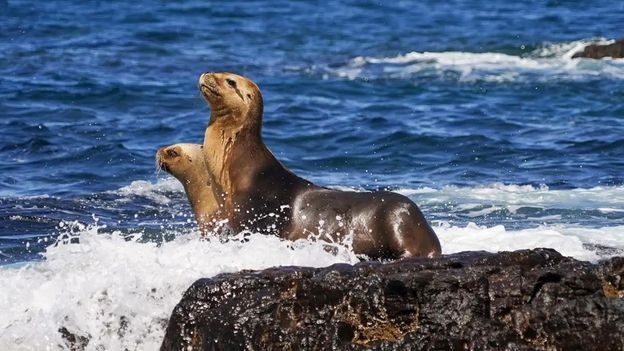
Argentina's newest park blends marine protection with local-led tourism, offering wild swims, eco-lodges and a thriving new future for a once-overlooked coastline. From my window seat on the three-hour flight from Buenos Aires to Comodoro Rivadavia, I watched the land shift from green to gold. Lush river delta gave way to straw-coloured steppe, eventually turning a vivid cobalt where high desert meets the sea. I was heading to Patagonia Azul, a newly declared provincial park on Argentina's South Atlantic coast. This is not the Patagonia of postcards. There are no snow-capped peaks, trout-filled lakes or gleaming glaciers. Instead, this protected territory stretches across more than three million hectares – nearly the size of Yosemite – where arid plains collapse into a rugged, wind-battered coast. Patagonia Azul is one of South America's most recent marine conservation efforts. More than 60 islands and islets rise from the Atlantic here, forming the most biodiverse stretch of Argentina's coastline. Long gravel roads cut through remote hills where guanacos graze and elusive pumas roam, while the sea harbours kelp forests, sea lion colonies, penguins, dolphins and four whale species. Just 200 nautical miles offshore lies the edge of Argentina's Exclusive Economic Zone, a boundary closely monitored but frequently breached by foreign industrial fishing fleets, drawn by the region's rich marine life. The designation of Patagonia Azul as a provincial park in April 2025, covering both land and sea, aims to spotlight this undervisited coast as a model for immersive, sustainable tourism and protection.


Daily Mail
08-08-2025
- Daily Mail
Painful unintended consequence for Canadians boycotting US vacations because of Trump
Canadians boycotting the US over the Trump administration are spending more money on their vacations, as they head to more distant destinations, per a new report. According to Flight Centre Canada data provided to CBC News, Canadians are spending more money traveling to other countries when compared to last year. Canadian travel to Argentina jumped by 148 percent, 137 percent to Japan, 114 percent to Denmark and 101 percent to Curacao. Meanwhile travel to Aruba increased by 71 percent, to Portugal by 61 percent and Spain by 35. President Donald Trump 's attacks on Canada 's economy and threats to make it the 51st state have infuriated Canadians, who are canceling trips to the US in big numbers. Kelly Bergquist, a resident of Alberta, told CBC News the trade war between DC and Ottawa made her cancel her yearly trip to the US. She last went to the US last summer, when she attended a concert in Las Vegas, but next year she is heading for the Balkans - even if it means spending more money. 'I just don't really want to support them right now. If they're going to do that to us, I don't want to give any money to them,' Bergquist said of the US government. She added: 'I could have easily done a Mississippi River cruise or done any kind of cruise that basically goes out of the States or things like that. But as of right now, I'm just putting all that aside until we kind of see where things are going.' Canadians have long been the top international travelers to the US, driving $20.5 billion in spending last year. But Canadian air travel to the US dropped by 13.5 percent in March compared to a year earlier, and those crossing the border by car fell by more than 30 percent, data from Statistics Canada revealed. The US gets more visitors from Canada each year than from any other country, according to the US Travel Association, an industry trade group, which said the 20.4 million visits from Canada last year generated $20.5 billion in spending. In April, Trump brushed aside the decline in tourism from Canada to the United States, saying: 'There's a little nationalism there I guess, perhaps. It's not a big deal.' Since Trump started his second term, there have been well-publicized reports of tourists being stopped at US border crossings and held for weeks at immigration detention facilities before being allowed to fly home at their own expense. On March 3, Canadian Jasmine Mooney, an actor and entrepreneur on a US work visa, was detained by border agents in San Diego. She was released after 12 days detention. Before Mooney's release, British Columbia Premier David Eby expressed concern, saying: 'It certainly reinforces anxiety that... many Canadians have about our relationship with the US right now, and the unpredictability of this administration and its actions.' The shift has led vacation hotspots such as Palm Springs to run campaigns to try and lure back the Canadian visitors businesses depend on. Airlines have been forced to switch tack by cutting flights to US destinations and increasing frequency to Mexican alternatives. Air Canada reported on Friday that its Canada to US routes have seen a 7 percent drop in the first quarter of the year. Meanwhile the drop in Canadian tourism to the US led California Gov. Gavin Newsom, a frequent target of Trump, to announce an ad campaign this month meant to lure Canadians back to his state, citing a 12% year-on-year drop in February.
