


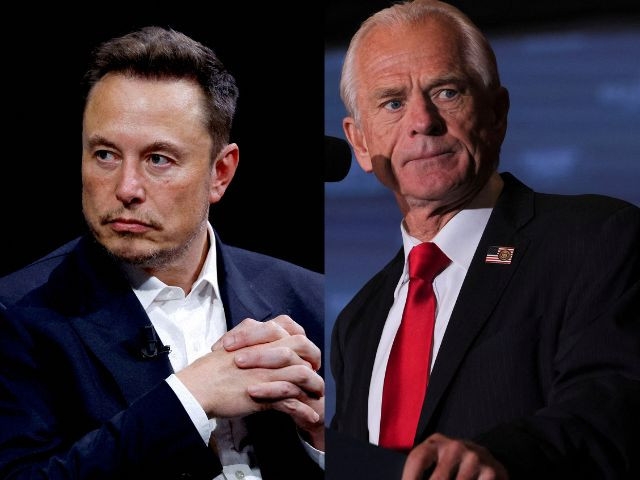
White House brushes off Musk–Navarro clash: 'Boys will be boys'
The White House on Tuesday played down a fiery public feud between Tesla CEO Elon Musk and Trump's senior trade adviser Peter Navarro, after the two clashed over the administration's aggressive new tariff strategy.
White House Press Secretary Karoline Leavitt addressed the dispute during her briefing, describing the clash as little more than a difference of opinion.
'These are obviously two individuals who have very different views on trade and on tariffs,' Leavitt said. 'Boys will be boys, and we will let their public sparring continue.'
The feud ignited over the weekend after President Donald Trump imposed sweeping tariffs affecting imports from multiple countries — a move supported by Navarro but publicly criticised by Musk.
Navarro, a vocal supporter of protectionist trade policies, suggested in a interview that Tesla doesn't fully qualify as a US manufacturer due to its reliance on components from overseas.
He argued that Trump's tariffs were meant to bring manufacturing back to American cities like Akron and Flint.
Musk fired back sharply on social media, calling Navarro 'truly a moron' and 'dumber than a sack of bricks.'
In another post, he used a slur, referring to the adviser as 'Peter Retarrdo,' and claimed Navarro's statements were 'demonstrably false.'
'Tesla has the most American-made cars,' Musk wrote. 'By any definition, we are the most vertically integrated US auto manufacturer.'
Tesla has topped Cars.com's American-Made Index since 2021, based on where parts are sourced and where vehicles are assembled.
Despite the personal tone, the White House brushed off the controversy, framing it as part of a broader culture of openness in the administration.
'The president takes all opinions in mind, and then he makes the best decision based on the best interests of the American public,' Leavitt said.
This isn't the first time Musk has diverged from Trump publicly, but the trade dispute marks a more pronounced policy split between the president and one of his highest-profile allies.
Musk has previously advocated for free trade, even calling for zero tariffs between the US and Europe during a public event in Italy.
Navarro, when asked by CNBC about the dispute, downplayed it: 'Everything is good with Elon, no problem.'
Hashtags

Try Our AI Features
Explore what Daily8 AI can do for you:
Comments
No comments yet...
Related Articles


Business Recorder
 4 hours ago
- Business Recorder
S&P affirms ‘AA+' credit rating for US
WASHINGTON: S&P Global on Monday affirmed its 'AA+' credit rating on the US, saying the revenue from President Donald Trump's tariffs will offset the fiscal hit from his massive tax-cut and spending bill. Trump signed the 'One Big Beautiful Bill Act' into law in July after it was passed by the Republican-controlled Congress. The bill, which delivered new tax breaks, also made Trump's 2017 tax cuts permanent. 'Amid the rise in effective tariff rates, we expect meaningful tariff revenue to generally offset weaker fiscal outcomes that might otherwise be associated with the recent fiscal legislation, which contains both cuts and increases in tax and spending,' S&P said in a statement. 'At this time, it appears that meaningful tariff revenue has the potential to offset the deficit-raising aspects of the recent budget legislation.' The US reported a $21 billion jump in customs duty collections from Trump's tariffs in July, but the government budget deficit still grew nearly 20% in the same month to $291 billion. Interest on the public debt also continued to grow, hitting $1.013 trillion in the first 10 months of the fiscal year, an increase of 6%, or $57 billion, over the prior-year period due to slightly higher interest rates and increased debt levels. Since returning to power in January this year, Trump has launched a global trade war with a range of tariffs that have targeted individual products and countries. The Republican president has set a baseline tariff of 10% on all imports to the US, as well as additional duties on some items and trading partners. IMPACT OF TARIFFS S&P, which became the first ratings agency to cut the pristine US government rating in 2011, said the outlook on the US rating remains stable. The ratings agency said it expects the Federal Reserve, which Trump has criticized this year for not cutting interest rates, 'to navigate the challenges of lowering domestic inflation and addressing financial market vulnerabilities.' It projected the country's general government deficit to average 6.0% of GDP during the 2025-2028 period, down from 7.5% in 2024 and from an average 9.8% of GDP in 2020-2023. S&P said it could lower the rating over the next two to three years if already high deficits increase. 'The ratings could also come under pressure if political developments weigh on the strength of American institutions and the effectiveness of long-term policymaking or independence of the Federal Reserve,' it said. S&P, however, said it could raise the US rating in the event of sustained economic growth and adjustments to the US fiscal profile that would diminish recent increases in the country's debt burden. There was no reaction in markets on Tuesday to S&P's credit rating affirmation, which follows a US sovereign credit downgrade by Moody's in May, when that ratings agency cut the triple-A US rating by one notch, citing rising debt levels. The US national debt load surged above a record $37 trillion last week. James Ragan, co-chief investment officer and director of investment management research at D.A. Davidson, said the S&P rating affirmation was an acknowledgment of the meaningful tariff revenue generated so far. 'That's all good revenue (coming) in, but that's also a drag on the economy, so I think we don't know the impact of that going forward,' he said.

Express Tribune
6 hours ago
- Express Tribune
Trump hopes for end to Ukraine war but admits Putin might reject any proposal
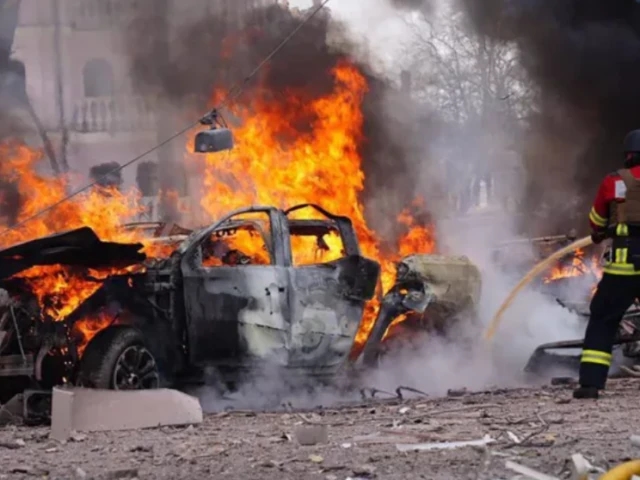
A Ukrainian emergency responder works to extinguish a fire at the site of a missile attack in Sumy on April 13, 2025. PHOTO: Ukrainian Emergency Service via AFP US President Donald Trump said on Tuesday he hoped Russia's Vladimir Putin would move forward on ending the war in Ukraine but conceded that the Kremlin leader may not want to make a deal at all, adding this would create a "rough situation" for Putin. In an interview with the Fox News "Fox & Friends" programme, Trump said he believed Putin's course of action would become clear in the next couple of weeks. Trump again ruled out American troops on the ground in Ukraine and gave no specifics about the security guarantees he has previously said Washington could offer Kyiv under any post-war settlement. "I don't think it's going to be a problem (reaching a peace deal), to be honest with you. I think Putin is tired of it. I think they're all tired of it, but you never know," Trump said. Read More: Europe seeks clarity as Trump promises security guarantees for Ukraine "We're going to find out about President Putin in the next couple of weeks ... It's possible that he doesn't want to make a deal," said Trump, who has previously threatened more sanctions on Russia and nations that buy its oil if Putin does not make peace. Ukraine and its European allies have been buoyed by Trump's promise of security guarantees to help end the war during an extraordinary summit on Monday but face many unanswered questions, including how willing Russia will be to play ball. Ukrainian President Volodymyr Zelenskiy hailed the talks at the White House as a "major step forward" towards ending Europe's deadliest conflict in 80 years and setting up a trilateral meeting with Putin and Trump in the coming weeks. Zelenskiy was flanked by the leaders of allies including Germany, France and Britain at the summit. His warm rapport with Trump contrasted sharply with their disastrous Oval Office meeting in February. But the path to peace remains deeply uncertain and Zelenskiy may be forced to make painful compromises to end the war, which began with Russia's full-scale invasion in February 2022. Analysts say more than 1 million people have been killed or wounded in the conflict. Russian attacks While the Washington talks allowed for a temporary sense of relief in Kyiv, there was no let-up in the fighting. Russia launched 270 drones and 10 missiles in an overnight attack on Ukraine, the Ukrainian air force said, the largest this month. The energy ministry said Russia had targeted energy facilities in the central Poltava region, home to Ukraine's only oil refinery, causing big fires. However, Russia also returned the bodies of 1,000 dead Ukrainian soldiers on Tuesday, Ukrainian officials said. Moscow received 19 bodies of its own soldiers in return, according to the state-run TASS news agency. "The good news (from Monday's summit) is that there was no blow-up. Trump didn't demand Ukrainian capitulation nor cut off support. The mood music was positive and the trans-Atlantic alliance lives on," John Foreman, a former British defence attache to Kyiv and Moscow, told Reuters. "On the downside, there is a great deal of uncertainty about the nature of security guarantees and what exactly the US has in mind." Ukraine's allies held talks in the so-called "Coalition of the Willing" format on Tuesday, discussing additional sanctions to crank up the pressure on Russia. The grouping has also agreed that planning teams will meet U.S. counterparts in the coming days to advance plans for security guarantees for Ukraine. Also Read: Trump changes tack on Ukraine after Putin meet NATO military leaders were expected to meet on Wednesday to discuss Ukraine, with US General Dan Caine, the chairman of the Joint Chiefs of Staff, expected to attend the meeting virtually, officials told Reuters. "We are now actively working at all levels on the specifics, on what the architecture of the guarantees will look like, with all members of the Coalition of the Willing, and very concretely with the United States," Zelenskiy said on X. 'Tiptoeing around Trump' Russia has made no explicit commitment to a meeting between Putin and Zelenskiy. Foreign Minister Sergei Lavrov said on Tuesday that Moscow did not reject any formats for discussing peace in Ukraine but any meeting of national leaders "must be prepared with utmost thoroughness". Putin has said Russia will not tolerate troops from the NATO alliance in Ukraine. He has also shown no sign of backing down from demands for territory, including land not under Russia's military control, following his summit with Trump last Friday in Alaska. Neil Melvin, director, International Security at the Royal United Services Institute think-tank, said Russia could drag out the war while trying to deflect US pressure with a protracted peace negotiation. "I think behind this there's a struggle going on between Ukraine and the Europeans on one side, and the Russians on the other, not to present themselves to Trump as the obstacle to his peace process," Melvin said. "They're all tiptoeing around Trump" to avoid any blame, he said, adding that on security guarantees, "the problem is that what Trump has said is so vague it's very hard to take it seriously".

Express Tribune
6 hours ago
- Express Tribune
No Air Force One yet; optics secured
The writer is an Economist based in Islamabad. For insights and updates, follow on Twitter: @SalmanAneel or reach out via email at aneelsalman@ Is he coming or not? The question is hanging in Islamabad's diplomatic air like smog before monsoon. No official itinerary. No confirmation. And yet, the entire capital is abuzz with speculation, prepping for the possibility that Donald J Trump may soon be setting foot on Pakistani soil — with a camera crew in tow. Top media outlets have already done the classic Islamabad two-step: break the story, then retract it. The White House issued a dry-as-toast denial: "No trip scheduled at this time." But with Trump, absence of confirmation often is the confirmation. Denial, after all, is part of the build-up. Because Trump is not a president in the conventional sense. He is a performer playing a president, on a stage where policy is the prop and optics are the plot. Let's rewind the show. In June, Trump rolled out the red carpet for Pakistan's Army Chief at the White House — a move so unorthodox under a civilian government that even the most seasoned analysts blinked twice. Then came the hammer on India. First a 25% tariff, and then an additional 25% blow for Delhi's ongoing flirtation with Russian oil. And in the same breath, Trump was touting a "massive oil exploration deal" with Pakistan. He even brokered the Indo-Pak ceasefire in May which he keeps mentioning in his speeches. This isn't diplomacy. It's pageantry, choreographed to disrupt the old order while staging a new one — centred entirely around Trump. If the visit materialises, expect theatre. Not handshakes over policy documents, but a fireworks display of "deals" and declarations. A press conference about American companies exploring Pakistan's untapped oil reserves — even if the oil's more rumour than resource. Trump doesn't care about whether deals are signed or implemented. He cares that the announcement makes a splash. And he'll certainly paint the Pakistan visit as a strategic masterstroke. "We punished India, and look — Pakistan welcomed us." Expect a trade narrative: crypto, IT, minerals. Expect energy promises. Expect vintage Trump logic, where tariffs on one partner prove that another was the better option all along. He may even try to revive his peace-broker persona. Cue a speech at a local university, maybe even a soundbite about deserving the Nobel Prize. But beneath the showmanship, Pakistan must ask: what's really on offer? This is where we need to be careful. Trump is not pivoting to Pakistan because of shared values or vision. He's pivoting because we're currently the convenient headline. In this moment, Islamabad is not the favourite — it's the foil. And the minute the optics shift, so will the attention. So how should Pakistan play it? First, keep it real. If Trump wants a show, let him have it — but behind the curtains, ask for substance. Frame every conversation with facts, feasibility, and follow-up. Announcements are nice. Agreements are better. Second, use the spotlight. Push for serious engagement in energy, rare earths, Fintech. Pitch ourselves not as a hedge against India, but as a regional hub with value beyond geopolitics. Third, protect the sovereignty clause. This is not the moment to nod along to every soundbite. Make sure any cooperation is framed around mutual benefit — not someone else's election season optics. Finally, think beyond Trump. Engage Congress. Reconnect with think tanks. Make the case to American institutions that Pakistan isn't a wildcard, but a partner with a plan. Trump is just one act in the American playbook. We should be speaking to the full cast. Whether Air Force One lands or not, the stage is already set. The visit may be imaginary, but the impact isn't. For now, Trump has recast Pakistan not as a pariah, but as a possibility. For a transactional politician, that's as close to a compliment as it gets. And so we wait. For the motorcade that may never arrive. For the handshake that may remain hypothetical. But most of all, for the headlines that — confirmed visit or not — have already shifted the South Asian narrative. In the end, this is classic Trump. Promise big. Say little. Deliver drama. Whether or not Air Force One touches down at Nur Khan, one thing is clear: Trump's foreign policy was never about alliances. It was always about audience. And right now, Pakistan is in the spotlight. Let's not miss the cue.
