


A rare cold snap stuns Uruguay, hitting the homeless hard and causing 7 deaths
The polar front first dumped the mass of freezing weather on Uruguay on Monday, shocking a coastal nation with flat terrain accustomed to mild winters in the Southern Hemisphere.
Light snow dusted parts of the country for the first time in four years as temperatures hit minus 3 Celsius (26 Fahrenheit) and windchill readings dipped far below that. But the freeze was breaking on Thursday, with temperatures expected to rise across the country in the coming days.
As health officials issued numerous warnings about the dangers of frostbite and hypothermia, homeless people faced potentially devastating circumstances.
Outreach workers fanned out around the city, trying to convince people to come indoors. The seven homeless people who died from exposure to the cold were found in various parts of the country — one man who had been sleeping under a bridge, another in a bus station, another in a tent near the river.
The homeless population in the economically stable nation of 3.4 million has steadily climbed in recent years, with the Ministry of Social Development in 2024 reporting over 2,700 homeless people — the vast majority in the capital of Montevideo.
President Yamandú Orsi this week invoked rare executive emergency authorities that empowered police and other officials to forcibly remove homeless people from the streets, citing a level of risk for the rough sleepers that Uruguay has seldom seen.
"The possibility of mandatory evacuation has been applied for the first time because the scale of the problem really requires other tools,' said Leandro Palomeque, director of Uruguay's National Emergency System.
Authorities opened 32 new warming centers and three more sprawling evacuation spots — including by converting public gyms and a police academy — and prepared some 1,000 extra beds.
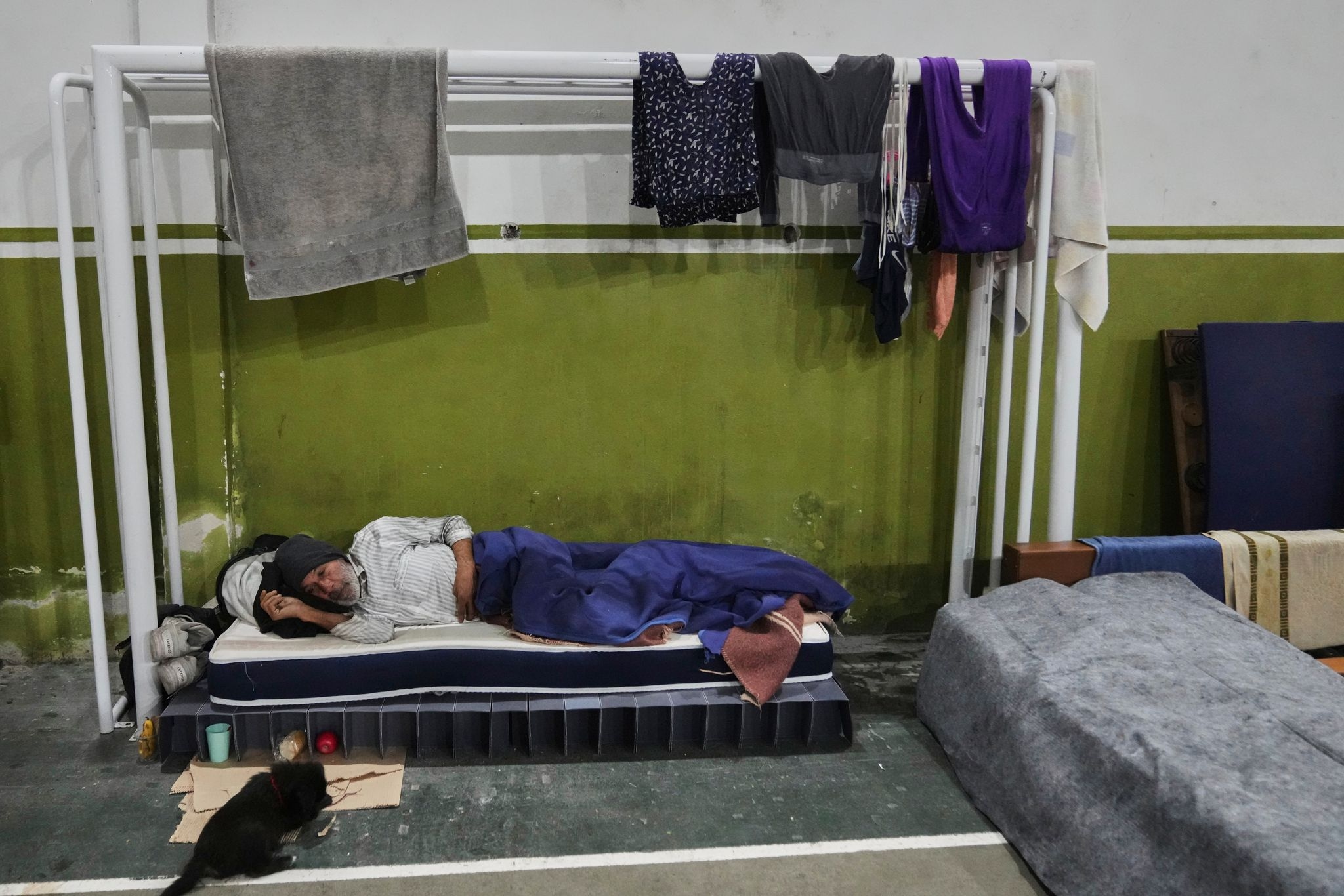
Inside one shelter late Wednesday, social workers distributed blankets and hot meals to scores of people who warmed themselves around the steaming vats of meat stew, their faces flushed from the searing winds.
Some said police forcibly removed them from the street.
'I was lying on a small table, and the police came and told me I couldn't be on the street,' said Mauricio Rodríguezs. ' I didn't want to come.'
Others, reaching the limit of how much they could withstand, sought out a warm bed.
'The worst time of winter is dusk, when the cold starts to set in and your body can't take it anymore,' said Lucas Bilhere, 19, wrapping himself in a blanket in the Montevideo evacuation center.
His puppy, Alaska, pranced around the orderly rows of vinyl mattresses strewn with donated sheets where hundreds of people slept bundled-up on the polished gymnasium floor. Rumpled shirts and damp socks hung from the nets of soccer goals.
Unlike in normal shelters, the warming centers allowed homeless people to bring pets and personal belongings and remained open during the daytime.
As much as Bilhere said he dreaded this wintry weather, he feared just as much what would happen when the cold snap passed and the emergency shelters closed.
'My dream is to have my own home ... and sleep warm,' he said. ' I wish that for everyone.'
Hashtags

Try Our AI Features
Explore what Daily8 AI can do for you:
Comments
No comments yet...
Related Articles


New York Post
 2 hours ago
- New York Post
Hurricane Erin set to bring deadly waves to NY, NJ — as it powers through Atlantic
New York and New Jersey — along with most East Coast states — are facing threats of life-threatening rip currents and massive waves from Hurricane Erin as the massive Category 2 cyclone creeps continues to churn off the coast. The warnings extend from Georgia all the way to Atlantic Canada, and forecasters predicted waves up to 20 feet high in some areas as the hurricane continues its slow-moving trip north — despite the storm being hundreds of miles from shore. Erin, the first hurricane of the 2025 season, weakened from a Category 4 behemoth to a Category 2 overnight but is still ripping sustained gusts of more than 100 miles per hour on Tuesday, according to the latest update from the National Hurricane Center. Advertisement But what it's lost in steam, it will gain in size, forecasters said. 'While you may be seeing that the hurricane is weakening … the storm is still going to be a very large storm once it gets further north,' Fox Weather Meteorologist Cody Braud told The Post. 'As it moves north it's going to expand its wind field in size and as that happens you get more energy being dispersed toward the coast in the form of waves,' he said. Advertisement 3 Homes along the Atlantic Coast in Dare County, N.C. ahead of expected impacts from Hurricane Erin. AP 'That's why the intensity is not really the key factor in this story. It's more about the very large size of Erin, and as it's moving north it's growing in size, sending out more waves as the waves are getting bigger and all of these waves are going to go somewhere, and they are going to be slamming into the East Coast,' Braud said. The brunt of the storm will be felt on North Carolina's Outer Banks, where a tropical storm warning has been declared and vacationers were ordered to evacuate the barrier islands. A tropical storm warning has also been issued for parts of Virginia. Tropical storm warnings have not been declared north of Virginia, but officials have warned of rip currents, immense waves, storm surge and flooding as it gets closest to the coast on Wednesday through Friday — about 200 to 300 miles offshore, Braud said. Advertisement 'Thankfully, there's no chance the system itself making a direct landfall, but we will kind of get the indirect effects of it as it kind of moves in parallel to the East Coast,' he said. 3 Hurricane Erin weakened from a Category 4 to Category 2 storm overnight Monday. AP Waves in off the tri-state area and further north likely won't reach the 20-25 foot monsters possible off North Carolina but 'it all really depends on how close the storm actually gets,' Braud said. If the storm remains far enough off the coast, it's very likely New Yorkers would not even notice any strange weather unless they went down to the beach and saw the raging ocean, he said. Advertisement But on the coast, the danger from waves and currents will be so severe that Mayor Eric Adams announced Tuesday that all city beaches will be closed to swimmers Wednesday and Thursday. Beaches themselves will remain open, but anybody caught trying to swim, surf or do anything else in the waves will be be booted by life guards and park officers. Several New Jersey beaches were put under similar restrictions, with Gov. Phil Murphy urging residents to stay out of the water. New York Gov. Kathy Hochul announced Tuesday afternoon that a High Surf Advisory is in effect Wednesday through Thursday for all Atlantic Ocean beaches in the state and will likely need to be extended. 'As Hurricane Erin passes the East Coast, I am asking all New Yorkers to prepare for the possibility of dangerous conditions along our beaches and coastal cities and towns,' Hochul said in a statement. 'New Yorkers are no strangers to hurricanes — that is why I'm urging those living in areas that may be impacted to stay safe and exercise caution until the hurricane tapers off later this week.' The storm is currently about 650 miles southwest of Bermuda, with maximum sustained winds of 105 miles per hour. 3 Mandatory evacuations have been ordered for part of the Outer Banks. AP The hurricane force winds extend from the eye up to 80 miles and tropical-storm-force winds extend up to 205 miles from the Advertisement The storm continues to move northwest at a slow pace of just 9 mph, but is expected to turn north and out to sea by the end of the week.

New York Post
9 hours ago
- New York Post
Texas declares measles outbreak over, health officials say
The Texas measles outbreak that sickened 762 people since late January is over, state health officials said Monday. It's been more than 42 days since the last new case was confirmed, meeting the threshold public health officials use to declare measles outbreaks over. The last person to have an outbreak-related case got a rash on July 1, according to state data. Two unvaccinated Texas children died of the virus earlier this year, and 100 people were hospitalized throughout the outbreak, which spread to 37 counties. The outbreak was linked to outbreaks in Canada and Mexico, and other U.S. states. 4 The Texas measles outbreak that sickened 762 people since late January is over, state health officials said Monday. AP The U.S. is having its worst year for measles in more than three decades, as childhood vaccination rates against the virus decline and more parents claim exemptions from school requirements. The U.S. has confirmed 1,356 cases as of Aug. 5, according to U.S. Centers for Disease Control and Prevention data. The nation's third measles death was an unvaccinated adult in New Mexico who died in March. West Texas was the nation's measles epicenter for months. The virus started spreading there in close-knit, undervaccinated Mennonite communities in Gaines County. Even with that outbreak over, Texas will likely see more cases as the virus spreads worldwide, officials said. 4 The U.S. has confirmed 1,356 cases as of Aug. 5, according to U.S. Centers for Disease Control and Prevention data. AP At least 19 U.S. states have had measles outbreaks this year. Across the border in Chihuahua, Mexico, an outbreak that started with a child who visited Gaines County has ballooned to 3,854 cases and 13 deaths. Another in Ontario, Canada, started in October, sickening 2,362 so far and killing one. And 1,762 have been sickened in Alberta, Canada. Start your day with all you need to know Morning Report delivers the latest news, videos, photos and more. Thanks for signing up! Enter your email address Please provide a valid email address. By clicking above you agree to the Terms of Use and Privacy Policy. Never miss a story. Check out more newsletters Before the outbreak, most Texas doctors had never seen a measles case because of how uncommon it has become, said Texas Department of State Health Services Commissioner Jennifer Shuford. 4 The U.S. is having its worst year for measles in more than three decades, as childhood vaccination rates against the virus decline AFP via Getty Images 4 Even with that outbreak over, Texas will likely see more cases as the virus spreads worldwide, officials said. AP She credited testing, vaccination, monitoring, and education with helping to end the outbreak. 'I want to highlight the tireless work of the public health professionals across the state who contributed to the containment of one of the most contagious viruses,' Shuford said in a statement. Measles causes a rash and respiratory symptoms that can lead to severe complications or death. It is prevented by the measles, mumps, and rubella vaccine, which is required for most young kids before they start school.
Yahoo
9 hours ago
- Yahoo
Mom Thought She Just Had Dry Skin. Months Later, She Had Hole 'The Size of a Quarter' in Her Nose After Skin Cancer Diagnosis
Amanda Anderson, 43, received the diagnosis in June after first noticing a "small irritated spot" on her nose in January NEED TO KNOW Amanda Anderson, a mother of four, discovered a small spot on her nose that she thought was dry skin But after several appointments, doctors determined it was actually basal cell carcinoma She underwent surgery to remove the spot and documented her journey online A mother of four thought she just had a bit of dry skin on her nose, months before receiving a shocking diagnosis. Amanda Anderson, 43, from Layton, Utah, first noticed she had a small spot on the side of her nose in January of this year; however, she wasn't initially concerned, as she said her skin often gets dry during the winter months, per SWNS. Anderson ended up getting the spot checked out just to be on the safe side and was given a cream. When the spot came back and started to bleed and scab, Anderson booked another appointment with the doctor, only to be told she didn't have anything to worry about. After having a gut feeling that something was wrong, Anderson went to another medic, who then booked her in for a biopsy in June, before the results came back as basal cell carcinoma on June 23. She was scheduled for surgery three days later to remove the spot. Per the Mayo Clinic, "Basal cell carcinoma is a type of skin cancer. Basal cell carcinoma begins in the basal cells — a type of cell within the skin that produces new skin cells as old ones die off." "Basal cell carcinoma often appears as a slightly transparent bump on the skin, though it can take other forms. Basal cell carcinoma occurs most often on areas of the skin that are exposed to the sun, such as your head and neck," the site adds. Anderson has documented her skin cancer journey on TikTok, writing in the caption of one of her videos, "WEAR YOUR SUNSCREEN!!" "I had a small irritated spot on my nose for 6 months. I finally went into the dermatologist. It wasn't a huge shock to find out it was Basal Cell Carcinoma," she added. "Getting it removed was a HUGE shock. I had no idea what I was getting into!" Anderson wrote, sharing in the clip that she'd had Mohs surgery, and that medics ended up having to do three passes. She wrote over the video per the AP, "It was sooo much bigger than I was expecting," confirming she had 50 plus stitches. The clip featured multiple images showing Anderson's cancer journey, including her having a hole cut from her nose to remove all the cancer cells. The Mayo Clinic describes Mohs surgery as "a procedure used to treat skin cancer," adding, "This surgery involves cutting away thin layers of skin. Each thin layer is looked at closely for signs of cancer. The process keeps going until there are no signs of cancer." "The goal of Mohs surgery is to remove all of the skin cancer without hurting the healthy skin around it. Mohs surgery allows the surgeon to be sure that all the cancer is gone. This makes it more likely that the cancer is cured. It reduces the need for other treatments or more surgery," the site states. Anderson recalled of her initial symptoms, "It was just a little dry spot on the side of my nose," adding, "With it being the winter it's common to have dry patches. I wasn't super concerned at the beginning," per SWNS. Anderson — whose father, Kirk Romney, 66, has also had skin cancer, and has had over 17 Mohs surgeries to remove cancerous cells from his face, neck and shoulders — insisted, "When I noticed the spot at first I wasn't too concerned." "It's typical to get dry patches because of the weather here in Utah," she added. Anderson said of receiving the skin cancer diagnosis, "It's hard to hear. It's on my face and as a woman we do everything we can to make sure our faces look as good as possible." "I'm obsessed about sun cream and shade - I have been my whole life," she added. "So it was a bit of a gut punch." Anderson added of doctors removing part of her nose to get the cancer out, "It was about the size of a quarter. They cut above and below the hole and fold the skin over." Never miss a story — sign up for to stay up-to-date on the best of what PEOPLE has to offer, from celebrity news to compelling human interest stories. Anderson, who continues to keep her followers updated regarding her skin cancer journey on TikTok, confirmed she won't need further treatment, but will have to have check-ups every six months. She said of now wanting to warn others, "The damage is done when you're young. I encourage my daughters to put sun cream on underneath their makeup." "I'm trying to build healthy habits in my kids," Anderson added. "People don't realize you can get sunburnt through the window of a car. We have to take care of our skin like you would your teeth. Skin cancer is so preventable." PEOPLE has reached out to Anderson for an update on her recovery. Read the original article on People Solve the daily Crossword
