



UNICEF: Millions of children at grave risk in Myanmar
The country's junta says the disaster killed more than 3,700 people and injured over 5,000. Many survivors in Sagaing near the epicenter are still living in tents and makeshift shelters.
Temples are caring for youngsters who lost their parents and homes. But the stress is taking a severe mental toll. The UN children's agency is warning of depression and PTSD.
UNICEF Regional Chief of Emergency Trevor Clark suggested there are difficulties accessing high numbers of children in need of mental health support.
He said: "We, based on humanitarian principles, will prioritize where the most vulnerable children are, and we'll get to them."
He also said the international community should be providing long-term support as the dire situation in Myanmar drags on.
Hashtags

Try Our AI Features
Explore what Daily8 AI can do for you:
Comments
No comments yet...
Related Articles

NHK
 7 hours ago
- NHK
North Korean leader refers to 'rapid expansion of nuclearization'
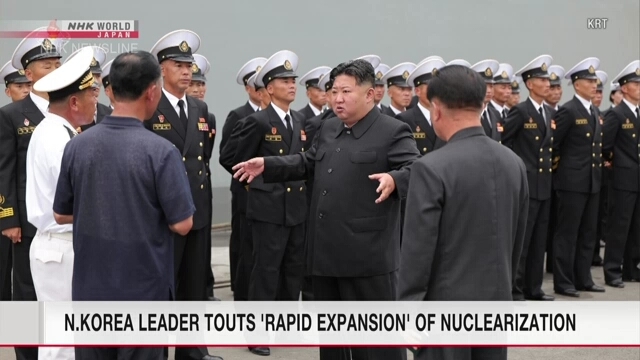
North Korean leader Kim Jong Un has reacted sharply to the start of joint military exercises by the United States and South Korea. He says the severe regional security environment will require Pyongyang to rapidly arm itself with nuclear weapons. Tuesday's edition of North Korea's ruling party newspaper, the Rodong Sinmun, says Kim on Monday paid a visit to a new destroyer launched in April. He is said to have observed an operational test of the vessel's weapons system. The report says Kim called the US-South Korea military drills "the most obvious manifestation of their will to ignite a war." He also described them as "the source of destroying the peace and security environment in the region." Kim is quoted as saying the security environment around North Korea is getting more serious by the day. He noted the prevailing situation requires Pyongyang to make a "rapid expansion of nuclearization." US and South Korean troops began their joint drills on Monday to prepare for a possible contingency on the Korean Peninsula. However, about half their field training exercises have been postponed until next month. Observers see this as a goodwill gesture by the administration of South Korean President Lee Jae-myung, which is seeking to resume dialogue with the North. Still, US and South Korean forces are stepping up their vigilance as Pyongyang has not ruled out taking countermeasures in response to the joint drills.

NHK
11 hours ago
- NHK
Former diplomat Lee Hyuk tapped as South Korea's ambassador to Japan
South Korean President Lee Jae-myung's administration is set to appoint former diplomat Lee Hyuk as ambassador to Japan. The 67-year-old Lee has worked three times at South Korea's embassy in Japan as secretary and minister. He also served as head of the Foreign Ministry's Asian and Pacific Affairs Bureau. He is known as a "Japan hand" having dealt with policies on Japan for many years. Lee is expected to assume the post with Japan's consent. In May this year, Lee wrote on South Korea's relations with Japan for leading South Korean newspaper, JoongAng Ilbo. He noted that while responding clearly and strictly on historical issues, it is separately time for Seoul to start full-fledged exchanges toward the future with Tokyo. On Saturday, President Lee is to start his first visit to Japan since taking office. He has repeatedly expressed his intension to develop ties with Japan, mainly on the economy. Lee Hyuk is expected to serve as a bridge between the two countries. South Korean media are reporting that Kang Kyung-wha, who served as foreign minister under former President Moon Jae-in's administration, will be appointed as ambassador to the United States.


Japan Times
16 hours ago
- Japan Times
Demystifying the manufacturing success of China
Chinese manufacturing has come a long way — and by some measures, it is stronger than ever. Whereas foreign-invested enterprises were the driving force behind China's manufacturing exports 20 years ago, most of these firms are now leaving China, having lost their market share to domestic competitors. And these dominant Chinese companies are not limited to the low-value-added production of the past. They are global leaders in many high-tech industries, such as semiconductors and electric vehicles, where they hold an absolute price advantage. Today's China is reminiscent of Japan and South Korea in their heyday. In the 1970s, Japan was producing high-tech products, including home appliances and automobiles, that outperformed American alternatives. And in the 1990s, South Korea emerged as a powerhouse in the electronics and automobile industries. The difference is that the per capita gross domestic product of Japan in the 1970s and South Korea in the 1990s was approaching half that of the United States, but China's per capita GDP, in nominal terms, amounts to less than 16% of America's today ($13,300, compared to $85,800). The obvious question is how a country with such low per capita GDP has managed to reach the technological frontier in so many sectors. Another, perhaps more interesting question is how China manages to keep the prices of the cutting-edge technologies it produces so low. In both cases, an important part of the answer is China's massive scale. If a country with a huge population can deliver high-quality education to its people, it will eventually accumulate disproportionate human capital. Such a country will learn more readily from advanced economies and develop its own innovative capacity earlier in its development. Though China had little trade with the West during the Mao era, it had a large contingent of elites who had studied at Western universities prior to the establishment of the People's Republic. This group played an extremely important role in advancing China's scientific research and technology sector, helping to industrialize the economy with technical assistance from the Soviet Union. More importantly, China successfully established a modern basic education system in the 1950s, making it free for all Chinese children despite the country's high levels of extreme poverty and also restructured its higher-education system. Most of China's prestigious universities at the time had been established by Western religious institutions and missionary groups during the late Qing Dynasty (which ended in 1911) and the early Republic of China period (1911-1949). But under Mao, China embraced the Soviet model of higher education, which emphasized vocational and technical training, with a special focus on science and engineering. Unlike the Western model, which emphasized liberal education, the Soviet system aimed to produce specialists with practical qualifications. Over the last 40 years, China has retained this basic model and made it increasingly accessible. Since the government's 1999 decision to expand university enrollment, the annual number of university graduates has surged from 1 million in 1999 to 12 million today, roughly half of whom hold degrees in science, technology, engineering or mathematics. Today, China has nearly five times as many STEM graduates as the U.S. and seven times as many engineers. This explains why, unlike American consumers, Chinese consumers enjoy effective, affordable and widely available after-sales and maintenance services on the products they purchase, from electronics to EVs. China has also seen the value of learning from the West, sending more than 6 million students to foreign universities over the last 40 years, the majority of whom have returned to China after completing their studies. This has contributed substantially to China's manufacturing catch-up, especially over the last two decades. But education was just part of the equation. China's 1979 decision to allow local firms to establish joint ventures with foreign companies led to technological upgrading in a broad range of sectors. Crucially, as China built up increasingly advanced manufacturing capabilities, it also developed supply chains and supporting infrastructure. Today, China's manufacturing sector depends on a robust network of suppliers, innovators, manufacturers and logistics providers. China's government has played a vital role in building and nurturing this ecosystem. But, contrary to the prevailing impression in the West, this is not an exclusively — or even primarily — top-down process. China is composed of 31 provinces, around 300 prefecture-level cities and about 2,800 counties and cities, and at every level, governments compete with one another to promote growth and industrial development. While the central government sets priorities, any policy it introduces to support specific industries functions, in practice, as a horizontal competition policy. This economic strategy — made possible by China's massive scale — has been essential to the rapid development and continued competitiveness of Chinese manufacturing. Zhang Jun, dean of the School of Economics at Fudan University, is director of the China Center for Economic Studies, a Shanghai-based think tank. © Project Syndicate, 2025
