


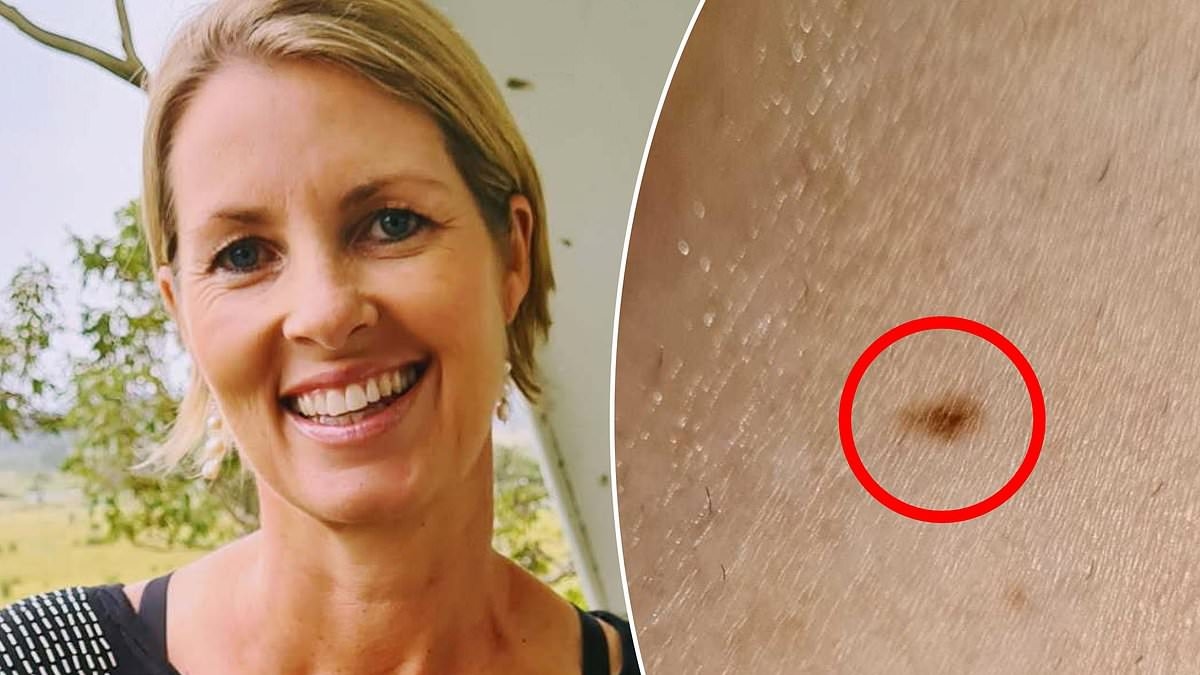
The doctor told me the unusual freckle on my back was 'nothing to worry about'. He was wrong... and the news only got worse from there
Melissa Bates, 49, from Stroud in the New South Wales Hunter Region, had always considered herself sun smart.
She didn't sunbake, wore protective clothing, and got annual check-ups.
As a theatre nurse with 16 years of experience, she thought she was doing everything right.
But at 43, during a routine visit to the doctor for her daughter's cold, Melissa's life changed.
'I wasn't even there for myself,' she told FEMAIL.
'The young GP registrar said he had some time to listen to my chest - because I also had a cold - and so I lifted my shirt up.
'That's when he noticed something on my back and said it looked really suspicious. He wanted to do a biopsy on the spot.'
Melissa asked for a second opinion from the senior GP at the practice who took a look and told her not to worry.
'He told me it looked fine and to just get it checked in a year,' she said.
Exhausted and sick with asthma, Melissa didn't follow up.
It wasn't until months later - after a cracked tooth while mountain bike riding landed her in town again - that the young doctor asked about the mole.
'He was so persistent. He said, "I still feel really strongly about it". So I finally agreed to the biopsy,' Melissa recalled.
The result? Melanoma in situ - the earliest form of skin cancer, confined to the top layer of skin.
Left untreated, it could have progressed.
'It was so lucky. That GP potentially saved my life,' she said.
Melissa underwent a wide local excision, only to find the margins weren't clear - meaning not all of the melanoma had been removed.
She sought out a plastic surgeon in Newcastle, where she was urgently re-operated on in a clinic room due to long hospital waitlists.
Unfortunately, that first scare wasn't the last.
Over the next several years, more melanomas appeared, one after another, all in situ, but each requiring surgery.
'In the space of a few years, I had nine of them,' Melissa said.
'They kept appearing near the same spot on my back. And then, on my arm and leg. Every three months I'd go back to the doctor and have another part of me cut out.'
Despite no family history and a careful lifestyle, Melissa became a regular at skin clinics.
Her experience was so profound that she completed a postgraduate dermatology degree and now splits her week between the operating theatre and working in dermatology at John Hunter Hospital.
'Now I watch people's skin like a hawk,' she said.
'I catch things all the time.'
But the experience also left emotional scars.
As a single mum to daughters Isabel, 16, and Amelia, 14, Melissa admits her greatest fear was what would happen if her cancer had advanced.
'They were only eight and ten when I was first diagnosed. I remember thinking, "What if this gets worse? Who's going to look after them? What happens to the farm, the animals, everything?"
'I didn't want to have to go through chemo or radiation. I didn't want to die of something that could have been caught earlier.'
Now, more than two years melanoma-free, Melissa remains vigilant.
She checks her skin constantly, keeps a photographic record of any suspicious spots, and teaches her daughters sun safety 'like it's second nature'.
'They wear hats, sunglasses, sunscreen - they're educated and that's key.'
She also credits mountain biking and a strong network of lifelong friends with helping her manage the mental toll.
'It's how I deal with the anxiety,' she said.
'That, and talking to my stepdad, who's a GP. He was shocked when I kept getting melanomas. He's all about statistics, and even he said my risk should've been almost zero.'
Melissa has changed GP clinics and has never returned to the senior doctor who told her to 'wait and see'.
'Take a photo. Right now. If you notice a spot, take a picture and compare it again in three months. Don't wait,' she advised.
'Because I did - and I was lucky. But it could have been so much worse.'
Moshy Dermatologist Doctor Ludi Ge told FEMAIL year-round skin protection is more important than ever with winter a critical time to not only remain vigilant about skin health but a prime time to get your skin checked.
'In winter UV levels can reach 3 or higher, which is sufficient to cause skin damage and photo ageing, while the cumulative effect of daily exposure, even in cooler months, increases the risk of skin cancer,' Doctor Ge said.
'People often associate sunburn with heat, but UV rays penetrate clouds and can harm the skin regardless of temperature, even when driving in the car.
'Skin cancers can appear in different forms including lesions like a mole or scab that won't heal, bleeding on light contact, changes in size and colour and flat moles that become raised or develop an irregular edge.'
Australia has the highest melanoma rates in the world killing one Australian every six hours. It is the most common cancer in Australians aged 20-39.
Latest cancer data released by the Australian Institute of Health and Welfare (AIHW) shows melanoma incidence rates are still on the rise in Australia, with 70 cases per 100,000 people in 2024 - up from 53 per 100,000 in 2000.
'While summer's intense sun prompts caution seeing people actively applying sunscreen when they're heading to the beach or playing sport, but in winter's cooler climate it can lull people into a false sense of security and they forget to apply sunscreen or wear a hat,' Dr Ge said.
'When it comes to skin checks people need to be monitoring areas that don't necessarily get the most exposure, including in between the fingers and toes, on the scalp and hairline, the soles of your feet and the abdomen.
'Don't let the cooler weather fool you, incorporating sun protection into your daily routine 365 days of the year and making skin checks an annual habit could save your life.'
Melissa's journey is a powerful reminder that even the most routine visit can become life-saving - and that listening to your gut, and to the right doctor, has never been more important.
Hashtags

Try Our AI Features
Explore what Daily8 AI can do for you:
Comments
No comments yet...
Related Articles


Telegraph
 9 hours ago
- Telegraph
‘I was on a cocktail of antidepressants and prescription drugs. It nearly cost me my sanity'
As a junior doctor in her mid-thirties, working an average of 80 hours a week while raising young children, Cathy Wield found herself both burnt out and attempting to deal with suppressed childhood trauma. 'As a child, my parents lived overseas, and I was sent away to boarding school from the age of nine,' recalls Wield, now 65. 'I hated it, and managed to bury the memories of what was a very difficult and traumatic time for me. But when my eldest child won a place at the Royal Ballet School, it meant she would be boarding. I was already exhausted and memories from my childhood started to surface.' Feeling she was in the midst of an emotional crisis, Wield booked a GP appointment. Little did she know that this would precipitate a cascade of dozens of prescription medicines for more than two decades, and as detailed in a memoir, Unshackled Mind, it would ultimately leave her with permanent thyroid and nerve damage. It began initially with a simple antidepressant. But this pill led to suicidal ideations – a known risk in some people who take SSRI medications – and following a spell in hospital, Wield found herself being prescribed dozens of drug cocktails at a time, from antidepressants to antipsychotics and sleeping pills. Her prescription records reveal that over a seven year period, she was prescribed 33 different psychiatric medications. In the throes of side effects which left her barely able to function, Wield was in no position to question the treatment she was getting. 'I was a zombie,' says Wield. 'The side effects were unbelievable. I lost my sexual function because of the drugs and just felt totally numb most of the time, but when I reported these symptoms, I was just told, 'Oh no, that's your depression.' I experienced weight gain, constipation, a condition called postural hypertension which means dizziness when getting out of a chair. I had several head injuries as a result of that. But no doctor at any stage during these years looked and said, 'The problem is the drugs.' It just never entered their heads.' Wield's case is a particularly acute example of the problems of polypharmacy, when people are prescribed more than five different medications at the same time. The issue has been highlighted through studies which have linked polypharmacy to a greater risk of hospitalisation, adverse drug reactions, falls, and reduced quality of life. In one paper, focusing on Liverpool University Hospital Foundation NHS Trust, adverse reactions to prescription medications were a cause of 16.5 per cent of all admissions, with researchers suggesting that the problem could be costing the NHS as much as £2 billion per year. 'We have seen a significant increase in the number of treatments prescribed over the previous two decades,' says Dula Alicehajic-Becic, a consultant NHS pharmacist. 'In England alone, more than one million people take 10 or more medications per day.' So why does this happen? The risks of taking too many pills Wield says that all the years of medication have left her with a permanently damaged thyroid due to treatment with lithium, a drug commonly prescribed for mood disorders, as well as small fibre neuropathy, chronic damage to the small nerve fibres which branch out from the brain and spinal cord to the rest of the body. She says that it manifests as a painful, burning sensation in her feet. 'My feet burn if they're warmed,' she says. 'So through the hot summer I have to put them in bowls of cold water, and I have to use ice slippers during the night which I keep in a freezer near the bed.' According to NHS psychiatrist Dr Louise Bundock, who works at the UK's only drug deprescribing clinic, helping stop medications they no longer need, adverse effects relating to mental health medications that mimic psychiatric symptoms are often perceived as the patient's condition worsening, prompting the prescribing of yet more drugs. 'In the worst cases they end up on multiple medications with multiple new psychiatric diagnoses, sometimes being admitted to a psychiatric hospital, and significant effects on their ability to function in all areas of their life, losing jobs, losing relationships and unable to take part in life in the way they did previously,' says Bundock. 'Often the individual themselves believe that they have become very mentally unwell, sometimes for decades.' Polypharmacy has also been identified as a specific risk in older adults over the age of 65. While more than half of people in this age group have at least two medical conditions meaning medicines are necessary, too many pills can increase risk of dizziness, sudden drops in blood pressure when a person stands up, and confusion, which can all lead to falls and fractures. According to Deborah Gompertz, a GP and deputy honorary secretary of the British Geriatrics Society, the balance can be delicate as older people metabolise medications less well, as their kidneys and liver may be less adept at excreting them, meaning they can be more affected by certain drugs. 'We want to optimise the treatment of their long-term conditions, keeping them safe, and helping them to live independently in the community, while still minimising risk of falls, hospitalisation, and potentially death,' she says. How many prescription pills is too many? Researchers and clinicians are keen to emphasise that in many cases, a drug cocktail is both appropriate and necessary. For example, the recommended treatment for chronic obstructive pulmonary disorder is a 'triple therapy' of three inhaled medications. However, there are some classes of prescription pills which carry greater risks, such as sedatives and anticholinergic drugs, particularly when people are taking more than five medicines. Anticholinergics can be prescribed for everything from overactive bladder to managing symptoms of Parkinson's disease. 'The higher the anticholinergic burden, the more at risk you are from a fall or confusion,' says Gompertz. For people taking psychiatric medications, Bundock says it is also key to be aware that symptoms such as increased anxiety, worsening low mood, obsessive and compulsive behaviours, suicidal thoughts and even hallucinations can actually be side effects of mental health medications such as antidepressants or sleeping tablets. Why is overprescribing happening? The good news is that overprescribing has been recognised nationally as a problem, but the reasons for it are multi-faceted and complex. Alicehajic-Becic suggests that some clinicians may overestimate the benefits and underestimate the risks of certain medications, while the increasing prevalence of over 65s with multiple health conditions can make it difficult for doctors to strike the balance of trying to manage chronic illnesses while keeping medication load manageable. Gompertz points out that some patients question why a doctor is removing one of their medications or reluctant to prescribe them an additional pill, often assuming that it is due to cost saving rather than concerns of side effects. Alicehajic-Becic says that the issue can also occur because older people with more than one health condition can be seeing multiple consultants. 'Health records are also not uniformly shared, hence information pertinent to a new prescription may not be available in real time,' she says. 'Payments are also given to providers to achieve a certain target, such as cholesterol lowering, which incentivises prescribing.' However when it comes to mental health, Wield feels that doctors need to stop being so quick to medicalise what she describes as 'normal distress'. 'When I look back to that first time when I sought help from the GP, I just needed time to recuperate,' she says. 'I was overwhelmed, overtired and I just needed support, and I wanted to talk to somebody. If I'd had simple talking therapy, I think I would have been fine. Instead, it's cost the NHS a huge amount of money and resources, and personally impacted myself, my family, and my career.' What can you do? Gompertz says that anyone taking multiple medications should be having a structured medicine review at least every six to 12 months, but in some cases, for example medicines like blood thinners, a review should be carried out on a three monthly basis. 'It's something that adult children with an elderly parent can be aware of,' she says. 'If you notice that your mum and dad have got a build-up of their medication at home, it could be an idea to talk to whoever's prescribing those medications for your parents. And if the person themselves feels they're getting side effects or not tolerating them, it's important to have that conversation.' When it comes to psychiatric medications, Bundock advises people to be aware of the possible side effects listed in the accompanying leaflets in the medication box, provided by the drug company. For people who have been on a number of these drugs for a period of time, it is also important not to stop them too abruptly. 'The longer someone has been on a mental health medication, the more important it becomes for it to be stopped slowly,' she says. 'Because there is the possibility of injury to the nervous system from these medications being stopped too fast.' Wield has now been mostly medication-free since 2018. These days she only takes three pills – a hypertension drug, a hayfever tablet and thyroid hormone replacement drug called levothyroxine. But decades of inappropriate polypharmacy have had a lasting impact on her life. 'I'm very fortunate that my husband stuck with me, because it was very, very difficult for our children growing up to have their mother in that state. And with my career, I did manage to return to work and become a specialist in emergency medicine, but I was not able to complete my training and progress to become a consultant. So it's had a huge impact on us financially as well.' Despite her experience, Wield says she's not interested in blaming any individuals for what happened to her, but she is determined to keep raising awareness to try and drive greater systemic change. 'It's driven me to become an activist to try and stop this happening to anybody else,' she says. 'I really do think the prescribing system and doctor's training needs to be addressed so that this doesn't happen to other people.'


The Independent
12 hours ago
- The Independent
How testing plane toilet waste could save lives
A study has found that testing aircraft toilet waste can help monitor the global spread of drug-resistant superbugs, often referred to as the 'silent pandemic'. Scientists analysed lavatory wastewater from 44 international flights arriving in Australia, detecting nine high-priority pathogens and superbugs. An antibiotic-resistance gene, not previously found in Australia's urban wastewater, was detected on 17 flights, suggesting its likely entry into the country through international air travel. Flights originating from Asia, particularly India, showed higher concentrations of antibiotic resistance genes compared to those from Europe and the UK. This research indicates that aircraft wastewater monitoring could serve as a valuable early-warning system for emerging superbug threats, complementing existing public health surveillance.

Daily Mail
12 hours ago
- Daily Mail
Inside the heartbreaking struggle haunting the tragic couple who plunged to their death from a harbourside footbridge in Sydney's CBD after a night at the casino
The married couple who plunged from a Sydney overpass had longed for a baby and were battling heartbreaking fertility struggles in the lead up to their death. Angela Nesbitt and Steven Dash left The Star casino, in Pyrmont, about 8.55am on Saturday before falling from an overpass near Sydney Harbour Bridge, onto Harbour Street, about 9.45am. Security guards asked Ms Nesbitt and Mr Dash, who lived in Sydney's south, to leave the casino following concerns over their 'erratic' behaviour. The couple, who lived in Sydney's south and wed in October 2022, had a well-documented history of mental health issues and had previously threatened self-harm. But Daily Mail can reveal the pair were also grappling with heartbreaking fertility struggles that weighed heavily on them in the months leading up to their death. Ms Nesbitt, 48, was a member of several online support groups for surrogacy and egg donation, desperate for the chance to have a baby of her own. On Christmas Day 2023, just over a year after her wedding, she signed up to one such community, taking her first tentative steps towards her dream. Around the same time the couple also posted a heartbreaking online advert in the 'looking for an egg donor angel' section of a website alongside a smiling photo of themselves. While egg donation in Australia is altruistic, with donors only paid their expenses and not paid for their eggs, a single round of IVF can cost up to $15,000. The average patient usually requires a minimum of three rounds of IVF treatment, with a total cost approaching $50,000. Police have confirmed the couple's visit to the casino, and whether they had been gambling, is under investigation. Security guards at The Star asked the pair to leave about 8.55am on Saturday, citing concerns about their 'erratic' behaviour. Police were alerted after a comment was reportedly made to security about self-harming, sparking fears for the couple's welfare. Officers began searching the Pyrmont and Darling Harbour area, but less than an hour later received reports two people had fallen from the overpass onto Harbour Street. Emergency services rushed to the scene but both Ms Nesbitt and Mr Dash were pronounced dead. Ms Nesbitt and Mr Dash's history of mental health issues is to be examined. Last year, police responded to an incident involving the couple, in which they reportedly threatened self-harm at the Queen Victoria Building. 'They are known to have a history of mental health issues,' a police source told the Daily Telegraph. 'They were at The Star for some time [but] the male was acting erratically so they asked him to leave. 'We believe a comment was then made to security at The Star about committing self-harm, and security did the right thing and called police. 'Officers were looking for the couple when they got the call (about their deaths).' In a statement released on Saturday, NSW Police confirmed officers had 'established there were no suspicious circumstances' surrounding the couple's death. Investigators conducted extensive inquiries, including sourcing mobile phone and CCTV footage. Ms Nesbitt and Mr Dash had recently travelled overseas together, sharing holiday snaps to their social media accounts. The couple's double suicide led to significant traffic disruptions after police taped off a crime scene and shut down major roads. Two southbound lanes from the Sydney Harbour Bridge were closed for several hours. Motorists were diverted onto the Anzac Bridge while officers carried out their investigation. Lifeline 13 11 14
