



Beijing moves drills closer to Taiwan, scientist's AI plea to China: SCMP daily highlights
subscribing
The People's Liberation Army launched joint exercises around Taiwan on Tuesday, marking Beijing's latest warning to the island's 'separatist forces'.
China and New Zealand have led the world's first crewed expedition to the depths of the remote Puysegur Trench, which cleaves through the floor of the south Tasman Sea, in a milestone mission hailed as a triumph of oceanic exploration.
Visitors look at a humanoid robot during the 2025 Zhongguancun Forum in Beijing on Thursday. Photo: EPA-EFE
China should address the risks of 'chaotic investment' in artificial intelligence and seek breakthroughs at the theoretical and philosophical level, rather than following Western paths to developing the technology, according to a leading Chinese AI scientist.

Try Our AI Features
Explore what Daily8 AI can do for you:
Comments
No comments yet...
Related Articles


HKFP
 9 hours ago
- HKFP
Jimmy Lai's nat. security trial: Judges question whether articles in pro-democracy Apple Daily ‘seditious'
Handpicked judges presiding over jailed media tycoon Jimmy Lai's national security trial have questioned whether content in his pro-democracy paper amounted to 'seditious publications,' as stipulated by the prosecution. The court continued hearing closing arguments on Tuesday after proceedings were twice delayed last week, first owing to bad weather and then to health concerns relating to the 77-year-old tycoon's heart. Delivering arguments for the seditious publications charge, lead prosecutor Anthony Chau referenced articles published in Lai's Apple Daily including an editorial calling for sanctions against Beijing and Hong Kong authorities. He said that those articles did not include 'rational criticism,' and that none of them provided recommendations or ventured 'to suggest any solutions.' But High Court judge Esther Toh, one of the three judges chosen to preside over the security trial, cast doubt on the prosecution's argument that critical articles must propose solutions to be considered not seditious. 'Did they actually have to venture that? You can write a critical article about the water problem, but do you have to venture to offer solutions?' Toh asked, appearing to reference a recent contract fraud case involving the drinking water supply at government offices. Judge Alex Lee pointed to Apple Daily articles calling for the now-shelved extradition bill which sparked widespread protests and unrest in 2019 to be withdrawn, saying: 'They were opposing the very introduction of the extradition bill… was that not a suggested solution?' The 2019 protests escalated into sometimes violent displays of dissent against police behaviour, amid calls for democracy and anger over Beijing's encroachment. Demonstrators demanded an independent probe into police conduct, amnesty for those arrested and a halt to the characterisation of protests as 'riots.' Lee on Tuesday added that an article could not be considered seditious if its purpose was to highlight pitfalls in governance, 'but if it was to defame the government causing the people to lose confidence or to turn hostile against the government, that would be a case of sedition.' Chau also referenced Lai's text messages directing the paper's English news division, which the court had earlier heard was set up to appeal for international support. Lai had told senior management that the paper was not supposed to have a 'balanced view' and only needed a view of the 'yellow' side — the colour associated with the city's pro-democracy movement, Chau added. Calls for sanctions 'in disguise' Besides the charge of conspiracy to publish seditious materials under colonial-era legislation, the tycoon also stands accused of two charges of conspiracy to commit foreign collusion under the Beijing-imposed national security law. He faces life behind bars if convicted. Based on Lai's prior exchanges with US politicians and diplomats, one could infer that the pro-democracy paper's criticism of the Chinese authorities were an 'indirect' means of calling on foreign governments to interfere, Chau told the court on Tuesday. That was after judge Toh asked whether the prosecution meant that the paper's articles were calls for sanctions 'in disguise.' The prosecution has alleged that Lai used his ties with foreign officials and politicians to impose sanctions against authorities in mainland China and Hong Kong. Beijing inserted national security legislation directly into Hong Kong's mini-constitution in June 2020 following a year of pro-democracy protests and unrest, criminalising subversion, secession, collusion with foreign forces and terrorist acts – broadly defined to include disruption to transport and other infrastructure. The move gave police sweeping new powers and led to hundreds of arrests amid new legal precedents, while dozens of civil society groups disappeared. Chau also maintained that the media baron had called for what the prosecution labelled 'Sanctions, Blockades, or Hostile activity' (SBHA) against the central Chinese authorities, despite not having made any open or direct requests for such actions after the enactment of Beijing's national security law in Hong Kong. The prosecution submitted that Lai had adopted a 'calculated and strategic approach' for foreign sanctions to be imposed on China and Hong Kong by deliberately and 'falsely' picturing the Chinese Communist Party in a negative light. Prosecutors named retired US army general Jack Keane, ex-US deputy secretary of defence Paul Wolfowitz, ex-US state department advisor Christian Whiton, and Mary Kissel, an advisor to then US secretary of state Mike Pompeo, as Lai's foreign connections, among others. Chau also told the court that Lai had admitted, during his testimony, that he continued international lobbying efforts even after the enactment of the national security law to inform foreign governments of what was happening in Hong Kong and to appeal for condemnation of the Hong Kong and Beijing authorities. However, he denied lobbying overseas governments to influence foreign policy. Chau is expected to conclude oral submissions of the prosecution's closing arguments on Wednesday.
HKFP
16 hours ago
- HKFP
Australia probes Nauru-China business deal
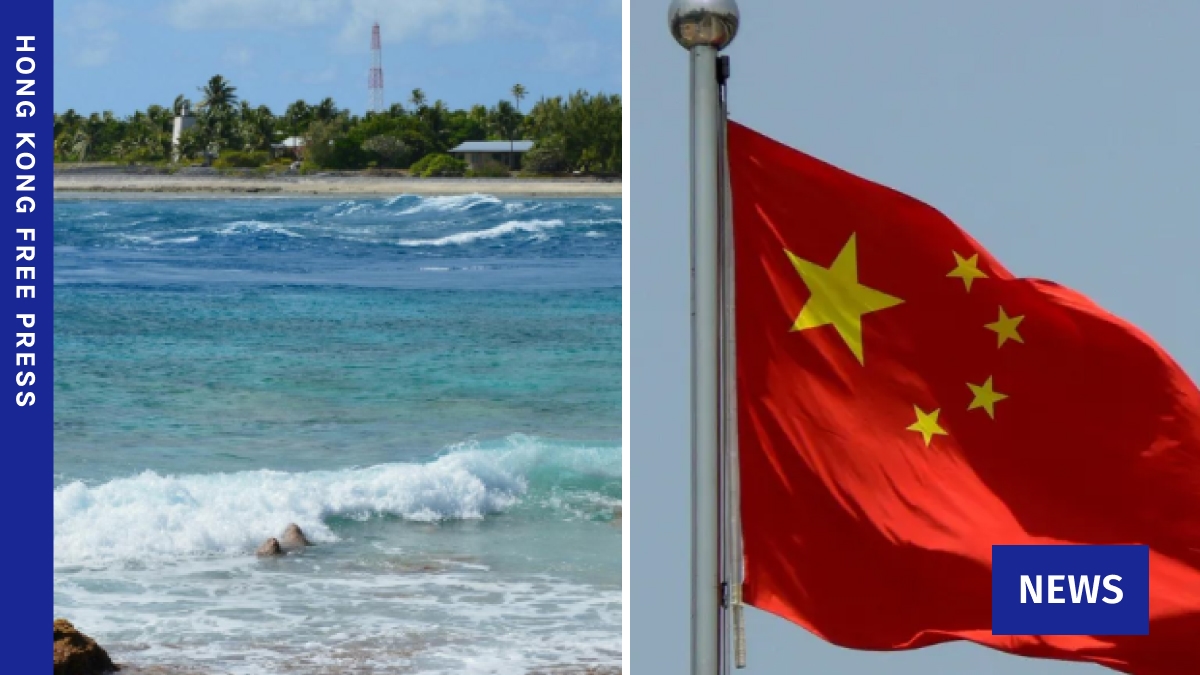
Australia was Tuesday investigating whether Pacific microstate Nauru breached a security treaty by inking a lucrative business deal with a Chinese company. Nauru last week announced it had signed a US$650 million economic development agreement with the China Rural Revitilisation and Development Corporation. Australian Minister for Pacific Island Affairs Pat Conroy said officials were looking into whether that deal complied with a recent security pact between Canberra and Nauru. '(Australia) is engaging with the government of Nauru about whether it activates parts of our treaty,' Conroy told reporters. 'That is a really important treaty for us — that helps position us as a security partner of choice with Nauru.' Australia and Nauru announced a landmark security treaty in December last year, advancing Canberra's aim of blunting China's growing regional influence. Under the deal, Nauru must seek Australia's agreement before it signs any bilateral accords on maritime security, defence and policing. Nauru also agreed to consult Australia if other parties look to strike agreements granting them access to critical infrastructure such as ports and airfields or its banking sector. In return, Nauru receives tens of millions of dollars to prop up its government budget and bolster its stretched police force. Nauru last year surprised many Pacific watchers when it abruptly severed diplomatic links with Taiwan in favour of Beijing. Nauru's Foreign Affairs Minister Lionel Aingimea travelled to Beijing to sign the business deal last week. The China Rural Revitilisation and Development Corporation agreed to invest in key sectors such as agriculture and fisheries, according to a Nauru government release. Nauru, population 12,500, is one of the world's smallest countries with a mainland measuring just 20 square kilometres (7.7 square miles). It is considered especially vulnerable to climate change.


AllAfrica
19 hours ago
- AllAfrica
Malaysia's bow to Moscow looking like a Faustian pact
Two weeks ago, Malaysian King Sultan Ibrahim Iskander embarked on his maiden trip to Russia at President Vladimir Putin's invitation, marking the first such visit by a sitting monarch ever since Malaysia formally established diplomatic relations with the Soviet Union in April 1967. His six-day exploratory tour of Moscow and Kazan came just three months after Prime Minister Anwar Ibrahim had visited the Russian capital to drum up support for Malaysia's BRICS accession bid, strengthen people-to-people cooperation, boost direct air connectivity and attract greater foreign direct investment (FDI) from the Kremlin. Kuala Lumpur currently chairs the Association of Southeast Asian Nations (ASEAN) bloc with which dialogue partner Russia has, in recent years, sought to bolster both commercial as well as cross-cultural engagement given its declining influence across Central Asia and the South Caucasus. If anything, the Russian elite considers Southeast Asia an extension of Moscow's 'near abroad' or 'backyard.' The region's predominantly semi-authoritarian regimes feel a certain kinship with wartime Russia and, in particular, Putin, who they view as an anti-imperialist crusader trying to cut the collective West down to size. Yet for Anwar – a lifelong Islamist zealot garbed in reformist wares – the Hamas-led massacre on October 7, 2023, that left 1200 innocent Israeli civilians dead was a cue to reorient Malaysia towards Russia, China and BRICS writ large. Notwithstanding the roughly 1.3 million Russian speakers living in Israel as dual citizens and Prime Minister Benjamin Netanyahu's personal friendship with Putin, the Kremlin adopted an overtly pro-Palestine posture following Operation Al-Aqsa Flood to appease Muslim-majority states and give wind to his multipolarity push. As a guest of honour at the 2024 Eastern Economic Forum (EEF) in Vladivostok, Anwar used the platform to malign Western countries for their wilful blindness vis-à-vis the ongoing Gaza conflict while moving heaven and earth to rally the international community behind Ukraine. India's Minister of External Affairs S. Jaishankar cast similar aspersions on the EU's selective outrage and rank hypocrisy regarding the Russo-Ukrainian war when he argued how 'Europe's problems are the world's problems, but the world's problems are not Europe's problems' at the 17th GLOBSEC Forum in Bratislava, Slovakia. Russia, for its part, is more than happy to let this narrative of 'Western double standards' take root in the Global South, not least because it thrusts disaffected developing nations into the Greater Eurasian nexus. Beyond its unwillingness to denounce Russia's illegal invasion of Ukraine or participate in Group of Seven (G7) sanctions against the Kremlin, Malaysia has allowed Moscow to obfuscate and stonewall its way out of accountability for the downing of Malaysia Airlines Flight 17 (MH17) in mid-2014 that killed all 298 passengers on board. Having been involved in frontline Malaysian politics for nearly four decades, it is no secret that Anwar has the king's ear and likely convinced him to pay an official courtesy call on Putin earlier this month. What remains unclear, however, is the horse trading that went on behind the scenes and, more importantly, the concessions Malaysia's most influential figure likely made during his 'dream' in-person meeting with the Russian autocrat. Although Anwar continues to eat, breathe and sleep the Palestinian cause as a means of deflecting attention away from his own domestic failings and growing legitimacy crisis, the embattled 78-year-old appears equally preoccupied with extracting whatever political mileage he can from Malaysia's ever-closer alignment with BRICS. The fact that neighboring Indonesia expeditiously joined the multilateral organization, seen by many as an emerging anti-US and Western bulwark in global affairs, as something of a wild card on January 1, 2025, suggests another ASEAN state – three of which have already been accorded 'partner' status – may well be the next in line. Malaysia, in line with Anwar's intense lobbying efforts, fancies itself a frontrunner for full-fledged BRICS membership. Over the last 12 months alone, the Malaysian leader visited China and India to secure the two Asian giants' blessings for his nation's BRICS candidacy while also attending the group's latest summit in Rio de Janeiro, Brazil. Meanwhile and for the sake of ensuring Malaysia is on the best possible terms with most, if not all, existing BRICS members and participants. In that direction Anwar backed Iran's right to self-defense when its nuclear facilities and main metropolises were bombed by Israel in early June, endorsed South Africa's International Court of Justice (ICJ) genocide case against the Jewish state and has shied away from criticizing the UAE for its outsized role in foisting the world's worst humanitarian crises upon both Sudan and Yemen. That said, and despite creating the illusion of a highly democratized, consensus-based admission procedure, Russia does have the final say on welcoming new entrants into the BRICS fold. It is worth recalling that the landmark enlargement wave at the start of 2024 after a nearly 14-year hiatus occurred during the Kremlin's rotating presidency whereas the concept of 'BRICS+' was agreed upon at the coalition's 16th annual forum in Kazan. Mindful of how significant a foreign affairs win Malaysia's fast-track entry into the non-Western alliance would be for its increasingly unpopular prime minister, Putin will doubtless put forward steep demands to sign off on its full-fledged BRICS induction – chief among which is burying the MH17 affair once and for all. This is precisely what he might have been angling for by hosting the Malaysian king who can, with a stroke of a pen, issue a royal pardon that would effectively absolve the Kremlin of any wrongdoing and neuter recent unfavorable rulings brought forth by International Civilian Aviation Organisation (ICAO) as well as the European Court of Human Rights (ECHR). In light of Azerbaijan Airlines (AZAL) 8243 plane crash en route to Grozny, Russia, late last year at the hands of Russian military forces and the subsequent Russo-Azeri diplomatic fallout over Putin showing no remorse for the 38 casualties or their families, Moscow can ill-afford to have two almost identical open wounds fester simultaneously. As such and owing to the lawsuit Baku has filed against Russia, there is a real sense of urgency on the latter's part to at least wish away the MH17 controversy and along with it any related public relations damage or legal obligation to compensate the victims' immediate relatives. Should Kuala Lumpur work hand in glove with Moscow to sweep this incident away by royal decree or otherwise, Europe will have no choice but to treat the Malaysian government as a hostile entity for practically condoning the murder of 196 Dutch nationals. Whereas China and India have been justifiably singled out for keeping Russia's economy afloat via their record consumption of heavily discounted Russian oil, the West must not lose sight of middle powers' skullduggery when it comes to replenishing the Kremlin's war chest. After all, wealthy Russians are not transiting through Beijing or New Delhi en route to Europe, nor are they snapping up luxury properties and stashing away their ill-gotten gains in Mumbai or Shanghai. Rather, the likes of Thailand, Turkey, the UAE and Kazakhstan bear some degree of culpability for sheltering Putin's subjects and insulating them from feeling the squeeze of unprecedented Western sanctions. As far as Malaysia is concerned, the EU does have a nuclear option at its disposal to strong-arm the country's Russophile upper echelons into reversing course. It would make eminently good sense for Brussels to issue Malaysia the same de facto 'with us or against us' ultimatum that Tbilisi found itself on the receiving end of over democratic backsliding and the ruling Georgian Dream party's borderline fetish for Kremlin-inspired governance. Much like Georgia, Malaysia is an Annex II state whose citizens enjoy short-term visa-free access to the Schengen Area and are bound to rise up against their Kremlin-friendly government if this privilege is yanked by the EU. Likewise, the UK can threaten to reimpose entry requirements on Malaysians – many of whom are enrolled in full-time education at British universities due to the 'Commonwealth' connection and will not want their visiting parents to face additional red tape. Unless smaller, albeit equally rogue and malevolent actors relative to China or India are made an example of, there is no silver bullet or panacea for achieving lasting peace in Ukraine. By giving Malaysia a pass for flaunting its camaraderie with Putin's Russia and globally-designated terrorist organizations such as Hamas, the West risks pushing the Southeast Asian nation and other like-minded Global South 'fence-sitters' further into emerging anti-Western blocs.
