


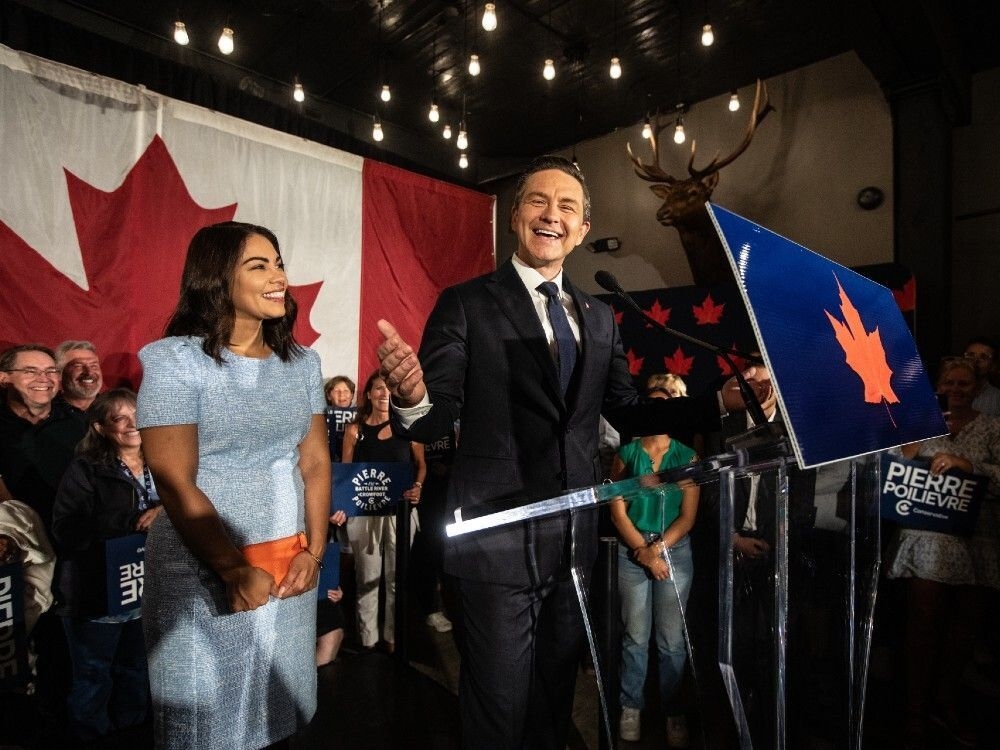
Pierre Poilievre now faces tougher challenges ahead after Monday's overwhelming byelection win
Article content
Poilievre won the rural east-central Alberta riding with 80.4 per cent of the vote, down slightly from the 82.8 per cent that former Battle River-Crowfoot MP Damien Kurek got in the spring federal election. Kurek stepped down in June to allow the Conservative leader to run in the byelection after Poilievre lost his Ottawa-area riding in the April 28 election.
Article content
Article content
Article content
Independent candidate Bonnie Critchley finished a distant second, receiving 9.9 per cent of the 50,434 ballots cast, a turnout of 58.8 per cent. Liberal candidate Darcy Spady was third, with 4.3 per cent support, in a byelection featuring over 200 candidates, the vast majority of them signed up by the Longest Ballot Committee, which has been running many candidates in high-profile ridings in an attempt to bring about electoral reform.
Article content
Article content
'Getting to know the people in this region has been the privilege of my life. In fact, I've had a hell of a lot of fun,' said Poilievre in his victory speech Monday night in Camrose.
Article content
This fall, Poilievre said the Conservatives will take on the Liberals over 'out-of-control' inflation, crime, immigration, cost of living and house prices.
Article content
'US and Chinese tariffs have actually worsened since Mr. Carney got elected. That was the election that he ran on getting a better deal,' he said before striking a conciliatory note, saying the Conservatives 'want to work with any party to put an end to the tariffs and get a fair deal for Canada.'
Article content
Critchley said Tuesday she was expecting more of the vote share, with polling suggesting she would win 16 per cent.
Article content
'I didn't lie, I didn't cheat — I did what integrity actually looks like — and I worked hard for it. Because I worked hard, I made (Poilievre) work hard for it.'
Article content
While Poilievre overwhelmingly won Monday, Mount Royal University professor Duane Bratt said Tuesday the Conservative leader's poll numbers against those of Carney heading into a leadership review early next year are going to matter more than winning the safest Conservative seat in the country.
Article content
With Poilievre at the helm, the Conservatives had a big lead heading into this spring's election, but ended up losing to Mark Carney's Liberals, who formed a minority government.
Article content
'He's been given time, but that doesn't mean that the grumbling is over,' said Bratt on Tuesday. 'There are still Conservatives who are upset with an election that they thought they had won.'
Hashtags

Try Our AI Features
Explore what Daily8 AI can do for you:
Comments
No comments yet...
Related Articles


CBC
 2 hours ago
- CBC
Are gas vehicles really being banned in Canada? Let's fact check that
Is Prime Minister Mark Carney really planning to ban gas vehicles? It's something Conservative leader Pierre Poilievre has said numerous times, most recently while visiting a farm near Saskatoon. Now that he's officially heading back to Ottawa after winning an Alberta byelection Monday, we decided to take a closer look at the country's zero-emission vehicle targets, and what he's said about them.


Toronto Sun
2 hours ago
- Toronto Sun
LILLEY: Carney's canola tariff dilemma
Get the latest from Brian Lilley straight to your inbox Canola grows. Photo by Shannon VanRaes / Bloomberg When China slapped Canadian canola seed with a 75.8% tariff last week, the price immediately dropped more than $1 per bushel. While it's still trading higher now than the 10% price drop in March after China's first round of tariffs, it's still a drop farmers will feel. This advertisement has not loaded yet, but your article continues below. THIS CONTENT IS RESERVED FOR SUBSCRIBERS ONLY Subscribe now to read the latest news in your city and across Canada. Unlimited online access to articles from across Canada with one account. Get exclusive access to the Toronto Sun ePaper, an electronic replica of the print edition that you can share, download and comment on. Enjoy insights and behind-the-scenes analysis from our award-winning journalists. Support local journalists and the next generation of journalists. Daily puzzles including the New York Times Crossword. SUBSCRIBE TO UNLOCK MORE ARTICLES Subscribe now to read the latest news in your city and across Canada. Unlimited online access to articles from across Canada with one account. Get exclusive access to the Toronto Sun ePaper, an electronic replica of the print edition that you can share, download and comment on. Enjoy insights and behind-the-scenes analysis from our award-winning journalists. Support local journalists and the next generation of journalists. Daily puzzles including the New York Times Crossword. REGISTER / SIGN IN TO UNLOCK MORE ARTICLES Create an account or sign in to continue with your reading experience. Access articles from across Canada with one account. Share your thoughts and join the conversation in the comments. Enjoy additional articles per month. Get email updates from your favourite authors. THIS ARTICLE IS FREE TO READ REGISTER TO UNLOCK. Create an account or sign in to continue with your reading experience. Access articles from across Canada with one account Share your thoughts and join the conversation in the comments Enjoy additional articles per month Get email updates from your favourite authors Don't have an account? Create Account China's latest canola tariffs are in retaliation for Canada imposing 100% tariffs on Chinese-made electric vehicles and 25% tariffs on Chinese steel and aluminum. The obvious answer to getting China's tariffs lifted on Canadian canola products is to lift our tariffs on EVs, steel and aluminum. The problem is, while the idea sounds sensible and simple, it's not that easy. In many ways, Canada is stuck between two economic giants involved in their own trade war. The Americans, under then-president Joe Biden, asked Canada to impose tariffs on Chinese goods. The claim is that these products are all heavily subsidized and dumped into North America to undermine our industries, harming our workers. Recommended video Your noon-hour look at what's happening in Toronto and beyond. By signing up you consent to receive the above newsletter from Postmedia Network Inc. Please try again This advertisement has not loaded yet, but your article continues below. While these tariffs came from Biden, Trump has left the American tariffs on these products in place. Any move to drop the tariffs on Chinese goods could have the impact of the United States imposing more tariffs on Canadian exports headed south. The problem for canola farmers, and this will give them no comfort, but canola is simply a product China likes to target in any dispute with Canada. For three years, starting in 2019, China had a ban on Canadian canola. That was in response to the arrest in Vancouver of Huawei executive Meng Wanzhou at the behest of the Americans in December 2018. China would go on to also kidnap two Canadians and hold them hostage, but on trade, they hit canola. In 2017, China began to complain that Canadian canola quality wasn't high enough and they slapped tariffs on seed exports. Let's be clear: These Chinese tariffs on canola should be removed but given China's past behaviour, there is no guarantee they would reciprocate. We could end up in a scenario where we remove our tariffs on Chinese goods, the United States places tariffs on more Canadian goods and China leaves their tariffs in place. This advertisement has not loaded yet, but your article continues below. Why would they do that? In order to obtain greater concessions from the Carney government, to try and encourage them to move Canada closer to China and away from the United States. This is what I mean about being caught in the middle of a bigger trade war between China and the United States. I understand the argument that the canola industry is strong, established, worth $40 billion and employs around 200,000 people while the EV sector is just starting to get off the ground. Allowing China to dump their vehicles into Canada, charging half the price it costs to make them, would seriously injure our entire auto industry, though not just the nascent EV sector. The tariffs Canada has imposed also extend to Chinese steel and aluminum though China is dumping their product, hurting our existing and vital steel and aluminum industries. This advertisement has not loaded yet, but your article continues below. China is simply a bad player, an untrustworthy trader and a market we should try not to rely on for any of our exports. Prime Minister Mark Carney has spoken often about diversifying our markets away from the United States; we should be doing the same with China. Replacing China would be difficult, but not impossible if markets like Japan, South Korea, India and Mexico were developed. That's a long-term solution for the next time China takes aim at our canola famers. In the meantime, there is simply a frustration across the Prairies that the Carney government favours Ontario and Quebec and doesn't care about them. That isn't helped by Carney's lack of action on this file. There may not be many good options but doing nothing is likely the worst option. Toronto Blue Jays NHL Money News Sunshine Girls World


Edmonton Journal
2 hours ago
- Edmonton Journal
Deachman: Will Alberta MP Pierre Poilievre show more contempt for Ottawa's public servants?
Article content One thing is for sure: with Pierre Poilievre officially back in the political ring, things in Ottawa aren't likely to be boring. Article content But which Poilievre will we see? Article content Article content On the one hand, it's possible that, after experiencing his first electoral defeat in April following seven consecutive victories, we might see a more introspective politician and man — one who doesn't take anything, and least of all voters from across the spectrum, for granted. Article content Article content Then again, it's also feasible that the newest Alberta MP, who blamed public service unions for his loss in Carleton four months ago — and who is no longer directly beholden to those same Ottawa voters — may start showing even more contempt for public servants and others he deems to have suckled for too long at the teat of Liberal/Eastern largesse. Article content Article content It's been 16 weeks since Carleton voters sent their longtime MP and wannabe PM packing. On Monday, the people of Alberta's Battle River-Crowfoot riding — or slightly more than 40,000 of them at least — sent him back to Ottawa to represent them. Article content Those who have wearied of Poilievre's endless 'Canada is broken' refrain and populist rhetoric might find some small shards of solace in the numbers: Poilievre did, after all, receive 13,000 fewer votes than Tory Damien Kurek got when he won the seat in April. And nearly 15,000 fewer Battle River-Crowfoot electors even bothered to show up this time, lowering turnout from 76 per cent in April to about 59 per cent (in comparison, almost 82 per cent of Carletonites cast ballots in April). Article content Article content But let's not kid ourselves. These are the straws clutched at by bitter losers. Poilievre's victory on Monday was a landslide. Sure, it was a safe seat, but in claiming just over 80 per cent of the votes cast, he barely even creased his parachute. And he did so —technically, anyway — on a write-in ballot, with Elections Canada refusing to cut down the forests necessary to print ballots with 214 candidates' names on them. Article content Article content Still, though, and with apologies to Michael Corleone, it kind of feels as though just when we thought he was out, they threw him back in. Article content But such is politics, and I have my fingers crossed that maybe a second Poilievre makeover will take. The last one, in 2023, saw PP jettison his wardrobe, optometrist and hair stylist to present a warmer, more relaxed persona. It was enough to (likely) defeat an extremely unpopular Justin Trudeau. But it didn't prevent Poilievre from alienating many voters with his endless yammering about the Liberals' 'lost decade' and blaming Trudeau 2.0, and later Carney, for pretty much any perceived shortcoming in the country. Trump's implacability? A global increase in food prices?
