



Highland red deer tracked by GPS in behaviour study
Dr Eilidh Smith from Durham University said they would be tracking and mapping red deer movements to assess their seasonal migrations and home range sizes.She added that this would build knowledge of how they respond to human activities such as fencing, culling and commercial stalking.Nicola Williamson, field officer for Affric Highlands, said red deer were a vital part of Scotland's upland landscapes and rural economies – but "increased populations have led to challenges in balancing ecological health, biodiversity, and land management objectives."She said strengthening understanding of how the animals moved across estates and habitats was "key to recovering ecosystems and improving deer health."
Hashtags

Try Our AI Features
Explore what Daily8 AI can do for you:
Comments
No comments yet...
Related Articles

Daily Mail
 a day ago
- Daily Mail
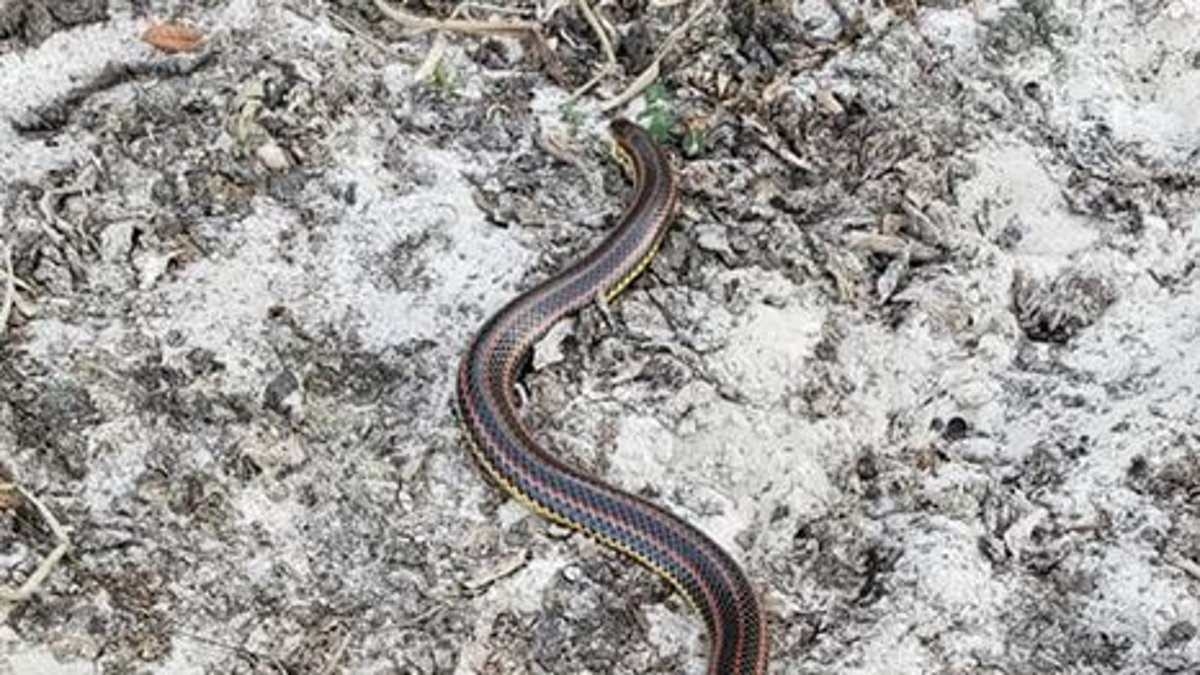
Seen the rare rainbow serpent? The government wants to hear from you…
Wildlife officials are urging Floridians to report sightings of the rare rainbow snake, a nonvenomous species whose population has declined in recent decades. Known for their striking iridescent black or violet-blue bodies with bright red stripes, rainbow snakes are semi-aquatic reptiles that primarily feed on American eels. Experts say declining eel populations and habitat loss have contributed to the species' dwindling numbers across Florida. 'We need help from Floridians and visitors to better understand where rainbow snakes still occur in the state,' said Kevin Enge, research scientist with the Florida Fish and Wildlife Conservation Commission (FWC). 'Every sighting report gives us valuable data about their current distribution and helps us assess the health of the species in Florida.' Rainbow snakes are typically found near rivers, springs, and brackish marshes. A subspecies was historically spotted in Fisheating Creek, Glades County, but has not been seen there since 1952. The FWC encourages anyone who encounters a rainbow snake to report it online, ideally with photos for confirmation. The snakes are visually striking and difficult to mistake for other species, with three red stripes along their back, yellow-marked lip and chin scales, and adults typically reaching three to four feet in length. They spend most of their time hiding under floating vegetation or burrowing near creeks, lakes, marshes and tidal flats, behavior that makes them uncommon even for herpetologists. The species' rarity has led to legal and conservation debates. In 2010, the Center for Biological Diversity petitioned to protect the South Florida rainbow snake under the Endangered Species Act, along with 403 other imperiled Southeast freshwater species. The following year, federal authorities declared the snake extinct, though experts say no thorough survey supported that conclusion. In 2020, Tracey Cauthen and Rebecca Boyer spotted a stunning four-foot-long rainbow snake while hiking in the Ocala National Forest, the first confirmed sighting in 50 years. While the rainbow snake is welcomed in Florida, the python is a different story due to its enormous jaws, which allow it to eat virtually anything. A study published in 2024 noted that the apex predator can eat anything as long as it can fit in its mouth. 'Burmese Pythons (Python bivittatus) are apex predators that are larger than all but a few snake species, and their prey, which are swallowed whole, cannot exceed the size of their maximal gape,' researchers led by the Conservancy of Southwest Florida wrote. 'Our study quantified the maximal gape of three large Burmese Pythons, including the longest specimen captured in Florida and one specimen that was captured while eating a deer. 'All three specimens had maximal gape diameters of 26 cm that exceeded the previously reported maximal value of 22 cm'. The experts explained that the python has a huge gape as its lower jawbones are not fused at the front, allowing its mouth to stretch wide. Their elastic skin also accounts for more than half the circumference of the maximal gape in large pythons, allowing them to consume prey six times larger than similar-sized snakes of some other snake species. This means that apart from foxes, bobcats, raccoons, these invasive snakes can also swallow deer, alligators and other prey whole in Florida. 'Watching an invasive apex predator swallow a full-sized deer in front of you is something that you will never forget. The impact the Burmese python is having on native wildlife cannot be denied,' the team shared.


BBC News
3 days ago
- BBC News
What body odour reveals about your health
We emit a barrage of whiffy chemicals through our pores and in our breath. Some are a sign that we might be getting ill – and could be used to diagnose diseases up to years in advance. It was obviously nonsense. That was how analytical chemist Perdita Barran reacted when a colleague told her about a Scottish woman who claimed she could smell Parkinson's disease. "She's probably just smelling old people and recognising symptoms of Parkinson's and making some association," Barran remembers thinking. The woman, a 74-year-old retired nurse called Joy Milne, had approached Barran's colleague Tilo Kunath, a neuroscientist at the University Edinburgh, at an event he was speaking at in 2012. Milne told Kunath that she had first discovered her ability after noticing her husband, Les, had developed a new musky odour years earlier. He was later diagnosed with Parkinson's disease, a progressive neurodegenerative illness characterised by tremors and other motor symptoms. It was only when Milne attended a group meeting for Parkinson's patients in her home town of Perth, Scotland, that she made the connection: all the patients had the same musky smell. "So, we then decided to test whether she was right," says Barran, who worked at the University of Edinburgh at the time but is now at the University of Manchester.


Times
4 days ago
- Times
Final snow patch melts, for the fourth year running
Summer heatwaves in Scotland have resulted in the country being declared snow-free for only the tenth time since the mid-1800s. Experts tracking the survival of snow patches around Scottish mountains have recorded the disappearance of the final snow patch of 2025 as the country experiences one of several heatwaves this year. It marks the fourth consecutive year that all Scotland's patches have disappeared. Seven of the ten snow-free years have been recorded since the turn of the century. Glennie found no snow in the Sphinx patch, above, but there were a few small, isolated patches in the Pinnacles patch earlier in the day on August 6 JOE GLENNIE Author and snow-patch researcher Iain Cameron is one of several snow lovers, or chinophiles, who have charted snow in Scotland's mountains. The mountaineer Joe Glennie, together with Colin and Campbell, a father and son, witnessed the disappearance of the final snow patch at 2.30pm on August 6. Cameron said: 'The most durable patch of snow historically is in the Cairngorms and is called the Sphinx, situated in a huge corrie of Braeriach — which is the UK's third highest hill — called Garbh Choire Mór. It is also the most remote corrie in the Cairngorms, requiring significant effort just to get there.' Ad hoc records have been kept for two centuries, first by the Scottish Mountaineering Club then by the naturalists Seton Gordon (1900-1940) and Adam Watson (1940-2000). Braeriach, seen in winter across the Lairig Ghru ALAMY As a teenager, Cameron became fascinated by a patch of lingering snow on Ben Lomond which he could see from the window of his childhood home in Port Glasgow, Inverclyde. He has become an authority on the subject, having kept records since 2000, and has published several books on the subject, including The Vanishing Ice. He said 'We are seeing less snow falling in winter and spring in general across the Highlands, which is the main reason for snow patches disappearing more often.' Iain Cameron with the shrinking Sphinx snow patch in 2023 NICK HANSON The Sphinx and Pinnacles patches are remote and inaccessible He pointed to challenging conditions experienced by the Scottish snowsports resorts, which experienced one of their worst seasons last winter. The Scottish Avalanche Information Service reported the lowest number of avalanches in 40 years, and described Scotland's most recent snowpack as 'lean'. Historically, most of Scotland's longest lasting snow patches lie in northeast-facing corries, where moisture-laden southwesterly Atlantic winds dump snow above 2,000ft. The snow blows over cliffs, settling in sheltered areas shielded from the warming winds of spring and summer. 'The depth needed to sustain the patches through summer and autumn is simply not there,' Cameron said. 'This is backed up by the decreased number of skier days experienced across the main ski resorts in Scotland. The reasons for this are debated, but a changing climate must certainly be considered the biggest one.'
