


Latest news with #AllySolosGlasses


Newsweek
 11 hours ago
- Business
- Newsweek
New AI Glasses Can Now Translate the World for Blind People
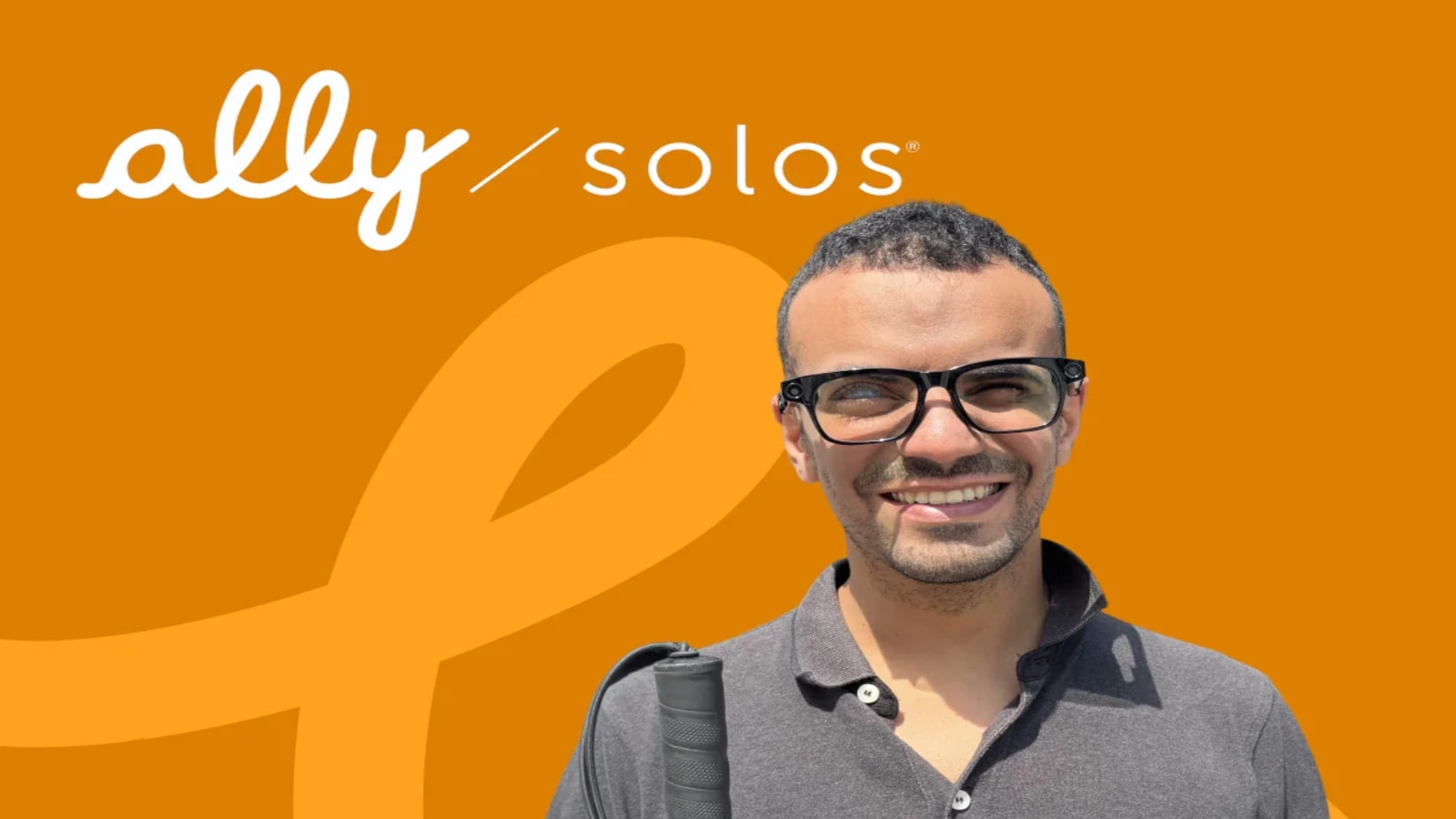
Based on facts, either observed and verified firsthand by the reporter, or reported and verified from knowledgeable sources. Newsweek AI is in beta. Translations may contain inaccuracies—please refer to the original content. Tech developers have introduced a pair of new AI-powered smart glasses to try to help the blind and other visually impaired people navigate the world. Dutch startup Envision, who in 2020 partnered with Google to launch the first commercially available AI glasses for blind and low-vision users, has teamed up with smart eyewear company Solos to create the Ally Solos Glasses. Dubbed "the first truly wearable AI glasses built for accessibility," the Ally Solos Glasses have been designed specifically to help people who are blind or have low vision. They aim to provide hands-free access to the world around them through natural voice interaction. "The Ally Solo Glasses are AI-powered smart glasses designed to give people who are blind or low-vision hands-free access to information," a spokesperson for Solos and Envision told Newsweek. "At their core, they combine a discreet camera, a lightweight speaker, and voice interaction with Ally, an accessible AI assistant. A wearer can simply ask the glasses to describe their surroundings, read text, recognize objects, or assist with daily tasks. Everything happens through natural voice conversation, without needing a phone or screen." From left: A man and a woman wear the Ally Solos Glasses in the street. From left: A man and a woman wear the Ally Solos Glasses in the street. Envision/Solos "Unlike general-purpose smart glasses, Ally Solos Glasses are purpose-built for accessibility," the spokesperson said. "Every feature is designed with blind, low-vision, elderly, and neurodiverse users in mind." The Ally website says that the glasses enable users to "read menus, recognize surroundings, objects, people, and much more," simply by speaking. This hands-free design, developers say, makes the glasses especially useful not only for blind and low-vision users, but also for older adults, people with cognitive disabilities, caregivers, and anyone who finds current tech difficult to use. Built upon Solos' AirGo platform, the glasses benefit from a robust software development kit that supports ongoing feature expansion. "Ally Solos Glasses are built upon Solos AirGo, one of the leading smart-glasses platforms with a robust SDK [software development kit]," the spokesperson said. "This enables users to also have the best smart glasses technology and features." A key differentiator of the Ally Solos Glasses is their global orientation. The developers emphasized the importance of multilingual capabilities and cultural adaptability. "Ally, the AI assistant, is multilingual and is being rolled out in several major world languages, with ongoing expansion based on user feedback," the spokesperson said. "Beyond just translation, the system is trained to adapt to different cultural contexts, such as recognizing non-Western scripts, local currencies, or unique environmental cues." The glasses are also intended to help those with limited literacy skills. "The glasses rely on conversational, spoken interaction rather than written prompts, which lowers barriers to use," the spokesperson noted. "While English support is the most mature today, additional languages are actively being introduced to ensure Ally is inclusive for diverse communities worldwide." A screenshot from a YouTube video showing a close-up of the Ally Solos Glasses. A screenshot from a YouTube video showing a close-up of the Ally Solos Glasses. Envision/Solos The Ally Solos Glasses represent a hardware evolution from the earlier Envision Glasses, which ran on Google Glass and processed tasks directly on the device. In contrast, the Ally Solos Glasses off-load processing to the user's smartphone, making the glasses significantly lighter and more comfortable. "This makes them much lighter, more comfortable, and longer-lasting on battery," the spokesperson said. "The integration with Ally also means you get constant software updates, richer conversational AI, and access to both free and Pro features that grow more powerful over time." Privacy and data protection were also central to the design of Ally Solos. "The glasses capture visual information only when the user initiates it, and all processing is done securely through the Ally app on the user's phone," the spokesperson said. "We follow strict GDPR and global privacy standards, and data is never shared without consent. We've built Ally with privacy by design principles. This means minimizing the amount of data collected, giving users control over what is stored, and ensuring that sensitive information is processed with the highest level of security." The Ally Solos Glasses are now available for preorder through the Ally website, with deliveries expected by October this year. Do you have a technology-related story to share? Let us know via life@ and your story could be featured on Newsweek.

Indian Express
2 days ago
- Business
- Indian Express
Ally Solos: These smart glasses use AI to help low-vision users see the world around them
Imagine a pair of smart glasses specifically designed for blind and low-vision users, allowing them to perceive the world around them. It's no longer science fiction: it's now a reality, thanks to artificial intelligence. This has been made possible by Envision, a startup founded by Karthik Mahadevan, who serves as the company's CEO, and Karthik Kannan, who serves as the CTO. Both Mahadevan and Kannan studied at the College of Engineering, with Mahadevan later earning a master's degree in Industrial and Product Design from Delft University of Technology. Their company has partnered with eyewear brand Solos to launch a new generation of smart glasses specifically tailored for blind and low-vision users. Dubbed Ally Solos Glasses, they can read text, describe the environment, perform web searches, and even recognize people, signs, and objects—all through audio cues delivered via built-in speakers. These glasses are built using the same frame as the AirGo Vision glasses that Solos launched last December, featuring multimodal AI and a ChatGPT-powered voice assistant. While much of the design remains similar, the Ally Solos glasses use Envision's own AI assistant, 'Ally,' instead of GPT-4o. This assistant is powered by a combination of foundational AI models, including Meta's Llama, OpenAI's ChatGPT, Google's Gemini, and Perplexity, according to the Ally website. The glasses also feature 2K resolution camera sensors on the frames to process visual information and connect via the Ally app on iOS and Android. The glasses have P67 rating for protection from dust and water, and USB-C chargeable ear stems that provide 'up to 16 hours of active use' on a single charge. It takes around 90 minutes to fully charge the ear stems, with 15 minutes of fast-charging providing around three hours of battery life. The basic idea behind the glasses is that the built-in cameras 'see for you,' enabling them to read menus, describe the environment, or even recognize people and objects through spoken commands. Although they are marketed primarily to blind and low-vision users, anyone can use these glasses, for example, to access translation features or scan and capture documents using the cameras. The Ally Solos Glasses are available for pre-order at a special launch price of $399, discounted from the regular price of $699. The frames come in two sizes (regular and large) and are available in black, gray, or brown. Shipping for pre-orders is expected to begin in October 2025. In recent years, major tech companies have been focusing on accessibility technology by either launching dedicated products or adding accessible features to mainstream devices. For example, Apple's Live Speech feature allows users to type what they want to say and have it spoken aloud across their Apple products, while Eye Tracking enables people to control their iPhone or iPad using just their eyes. Similarly, Google is using AI to power features like Guided Frame, which helps blind and low-vision Pixel users take well-framed photos through audio and haptic cues, as well as Lookout, which can identify objects and generate detailed image descriptions. Meta's Ray-Ban glasses, for instance, are already helping blind users navigate the world with greater ease.


The Verge
5 days ago
- Business
- The Verge
These smart glasses use AI to help low-vision users
Accessibility-focused tech provider Envision has partnered with eyewear company Solos to launch new smart glasses specifically designed for blind and low-vision users. Envision says the camera-equipped Ally Solos Glasses can read and translate text, describe surroundings, search the web, and recognize people, objects, and signs, feeding information to the user via open-ear speakers built into the ear stems. The Ally Solos Glasses are available to pre-order today for $399, which Envision says is a 'special launch pricing' that's discounted from $699. The frames come in two sizes — regular or large — and a choice of black, gray, and brown color options. Shipping for pre-orders is expected sometime in October 2025. They're built on the existing AirGo Vision glasses that Solos launched in December, which provide their own vision recognition features via OpenAI's GPT-4o AI model. Envision's version replaces GPT-4o with Envision's 'Ally' AI assistant, which is powered by a combination of foundation AI models, including Meta's Llama, OpenAI's ChatGPT, Google's Gemini, and Perplexity, according to the Ally website. The AI features work by connecting to the Ally iOS or Android app via Bluetooth. The glasses themselves have a strong IP67 rating for protection from dust and water, and USB-C chargeable ear stems that provide 'up to 16 hours of active use' on a single charge, according to the pre-order listing. It takes around 90 minutes to fully charge the ear stems, with 15 minutes of fast-charging providing around three hours of battery life. Accessibility features are already an established benefit on other smart glasses. Envision has previously released assistive eyewear built on the now-defunct Google Glass hardware, for example, and AI vision interpretation features provided by the Ray-Ban Meta smart glasses have already been embraced by the low-vision community. It's unclear how the Ally Solos Glasses' capabilities will compare to more affordable rivals, given $699 is considerably pricier than the $299 AirGo Vision and Ray-Ban Meta. Posts from this author will be added to your daily email digest and your homepage feed. See All by Jess Weatherbed Posts from this topic will be added to your daily email digest and your homepage feed. See All AI Posts from this topic will be added to your daily email digest and your homepage feed. See All Gadgets Posts from this topic will be added to your daily email digest and your homepage feed. See All News Posts from this topic will be added to your daily email digest and your homepage feed. See All Tech Posts from this topic will be added to your daily email digest and your homepage feed. See All Wearable
