


Latest news with #AvalancheEnergy


Geek Wire
 23-07-2025
- Business
- Geek Wire
Avalanche lands $10M state grant to build fusion energy R&D site in Washington
GeekWire's startup coverage documents the Pacific Northwest entrepreneurial scene. Sign up for our weekly startup newsletter , and check out the GeekWire funding tracker and venture capital directory . The Richland, Wash., space that will house the planned FusionWERX facility being built by Avalanche Energy. (Avalanche Photo) Seattle startup Avalanche Energy has landed $10 million from the Washington State Department of Commerce Green Jobs Grant Program to launch a first-of-its-kind, commercial-scale testing facility for fusion technologies in Eastern Washington. The facility, called FusionWERX, is a public-private partnership offering shared R&D resources to universities, companies, and government labs to support fusion power businesses, the sector's supply chain and production of radioactive materials. Fusion companies globally are chasing the vision for essentially limitless, carbon-free power created by smashing together light atoms. They're building super high-energy devices that use magnets and lasers to generate the conditions needed to achieve and sustain fusion. The Pacific Northwest is a fusion hub with companies that include Avalanche, Zap Energy, Helion Energy, Kyoto Fusioneering, Altrusion and ExoFusion in Washington state, and General Fusion in British Columbia, among others. Robin Langtry, co-founder and CEO of Avalanche Energy. (Avalanche Photo) 'By supporting Avalanche's FusionWERX facility, Washington is translating cutting-edge fusion science into family-wage jobs and a resilient clean-energy supply chain,' said Joe Nguyen, director of the Department of Commerce, in a statement. 'It's exactly the kind of community-driven innovation our Green Jobs program exists to champion.' Robin Langtry, co-founder and CEO of Avalanche, called the new funding 'an unexpected but very welcome surprise' that should create 12 permanent jobs in Richland, Wash., in the Tri-Cities. He did not share a total price tag for the effort. Work has already started on the interior of the site. FusionWERX aims to be one of the most advanced privately owned operations for handling tritium, a radioactive form of hydrogen. The facility is located in a building owned by the Port of Benton that was previously licensed for tritium operations. There are already interested customers for the space. Fusion Fuel Cycles, which is a partnership between Kyoto Fusioneering and Canadian Nuclear Labs, has signed a memorandum of understanding (MOU) to test multiple technologies. There are also potential collaborations in the works with the U.S. Department of Energy and Washington State University, Langtry said. Avalanche is developing compact, magneto-electrostatic fusion devices that use tritium as a fuel. Earlier this month, the startup hit a milestone by operating its desk-sized device at 300 kilovolts for multiple hours — a voltage density about twice that of lightning. Company leaders said they have the highest-voltage compact fusion device ever built, and can generate neutrons that are needed by industries such as advanced materials science, nuclear power and specialized medical treatments. Avalanche has signed its first neutron customer, who needs the subatomic particles for a process called 'advanced material doping treatment.' The startup didn't name the customer, but the process is most commonly used for semiconductor applications. Avalanche has raised $50 million to date from investors that include Chris Sacca's Lowercarbon Capital, Founders Fund, Toyota Ventures, Azolla Ventures and others. It previously received $8 million in government grants and contracts. The company is reportedly aiming to raise a Series B round of up to $100 million, according to Axios.
Yahoo
23-07-2025
- Business
- Yahoo
Avalanche Energy hits key milestone on the road to a desktop fusion reactor
For every technology, there comes a tipping point where it switches from theory to possibility. Robin Langtry believes that Avalanche Energy has reached that point. Avalanche recently operated its desktop fusion machine for hours on end while maintaining 300,000 volts, a figure the startup predicts will allow it to build a reactor capable of generating more energy than it consumes, the holy grail for any fusion company. Where other fusion companies need powerful magnets to generate energy, Avalanche's design uses intense electrical currents to draw fast-moving ions into tight orbits around an electrode. As the density and speed of the ions rises, they begin to collide and fuse, releasing energy in the process. 'Getting to really high voltages is the key thing,' Langtry, Avalanche's co-founder and CEO, told TechCrunch. And given that the company is building small reactors — targeting anywhere from 5 kilowatts to several hundred kilowatts — the density of that voltage, 6 million volts per meter, is important. 'That's the real unlock for us,' he said. With that sort of force, Avalanche expects it will be able to generate a large number of neutrons at low cost, which can be used to make radioisotopes and to evaluate materials for use in fusion reactors. The company was recently awarded $10 million from Washington State to build FusionWERX, a testing facility that other fusion companies and researchers can book time to study their own fusion technologies. Money for the grant comes from proceeds from the state's carbon marketplace. 'You can test your hardware, and then you get to leave with full ownership of your IP at the end of the day,' Langtry said. Sales of radioisotopes and rentals of the FusionWERX facility should make Avalanche profitable in 2028, he said. Langtry is forecasting that the company will generate $30 million to $50 million in revenue in 2029. With a path to revenue, and having hit the 300,000-volt milestone, Avalanche is rumored to be raising a Series A round. Langtry wouldn't comment specifically on the company's fundraising activities, though he did say that it's lining up the money needed to fulfill the 50% cost-match requirement of the Washington State grant. 'We've already got a pretty good chunk of it lined up,' he said. Raising money to launch FusionWERX is 'goal number one right now,' he added. 'Then all the other stuff is going to fall in place as those pieces start getting built.'


TechCrunch
23-07-2025
- Business
- TechCrunch
Avalanche Energy hits key milestone on the road to a desktop fusion reactor
For every technology, there comes a tipping point where it switches from theory to possibility. Robin Langtry believes that Avalanche Energy has reached that point. Avalanche recently operated its desktop fusion machine for hours on end while maintaining 300,000 volts, a figure the startup predicts will allow it to build a reactor capable of generating more energy than it consumes, the holy grail for any fusion company. Where other fusion companies need powerful magnets to generate energy, Avalanche's design uses intense electrical currents to draw fast-moving ions into tight orbits around an electrode. As the density and speed of the ions rises, they begin to collide and fuse, releasing energy in the process. 'Getting to really high voltages is the key thing,' Langtry, Avalanche's co-founder and CEO, told TechCrunch. And given that the company is building small reactors — targeting anywhere from 5 kilowatts to several hundred kilowatts — the density of that voltage, 6 million volts per meter, is important. 'That's the real unlock for us,' he said. With that sort of force, Avalanche expects it will be able to generate a large number of neutrons at low cost, which can be used to make radioisotopes and to evaluate materials for use in fusion reactors. The company was recently awarded $10 million from Washington State to build FusionWERX, a testing facility that other fusion companies and researchers can book time to study their own fusion technologies. Money for the grant comes from proceeds from the state's carbon marketplace. 'You can test your hardware, and then you get to leave with full ownership of your IP at the end of the day,' Langtry said. Techcrunch event Tech and VC heavyweights join the Disrupt 2025 agenda Netflix, ElevenLabs, Wayve, Sequoia Capital — just a few of the heavy hitters joining the Disrupt 2025 agenda. They're here to deliver the insights that fuel startup growth and sharpen your edge. Don't miss the 20th anniversary of TechCrunch Disrupt, and a chance to learn from the top voices in tech — grab your ticket now and save up to $675 before prices rise. Tech and VC heavyweights join the Disrupt 2025 agenda Netflix, ElevenLabs, Wayve, Sequoia Capital — just a few of the heavy hitters joining the Disrupt 2025 agenda. They're here to deliver the insights that fuel startup growth and sharpen your edge. Don't miss the 20th anniversary of TechCrunch Disrupt, and a chance to learn from the top voices in tech — grab your ticket now and save up to $675 before prices rise. San Francisco | REGISTER NOW Sales of radioisotopes and rentals of the FusionWERX facility should make Avalanche profitable in 2028, he said. Langtry is forecasting that the company will generate $30 million to $50 million in revenue in 2029. With a path to revenue, and having hit the 300,000-volt milestone, Avalanche is rumored to be raising a Series A round. Langtry wouldn't comment specifically on the company's fundraising activities, though he did say that it's lining up the money needed to fulfill the 50% cost-match requirement of the Washington State grant. 'We've already got a pretty good chunk of it lined up,' he said. Raising money to launch FusionWERX is 'goal number one right now,' he added. 'Then all the other stuff is going to fall in place as those pieces start getting built.'
Geek Wire
04-06-2025
- Business
- Geek Wire
Sparks fly: Seattle-area fusion startup rivals debate path to commercial power
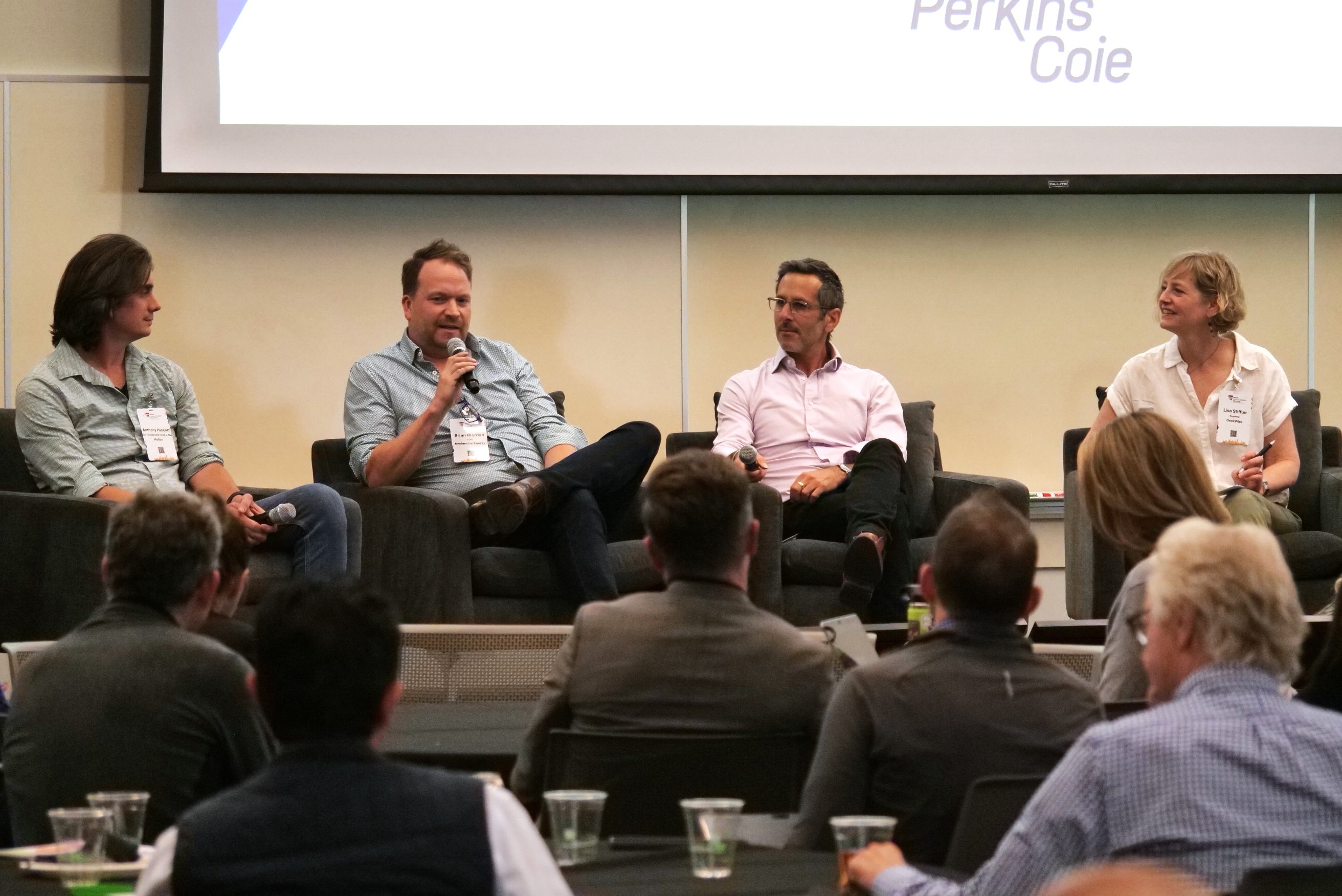
Sustainability: News about the rapidly growing climate tech sector and other areas of innovation to protect our planet. SEE MORE A fusion energy panel at the Technology Alliance's Seattle Investor Summit+Showcase, from left: Anthony Pancotti from Helion Energy, Brian Riordan from Avalanche Energy, Ben Levitt from Zap Energy and moderator Lisa Stiffler from GeekWire. (GeekWire Photo / Todd Bishop) The conversation got a little heated at a Seattle-area conference Tuesday when three companies vying to commercialize fusion power took the stage. The Pacific Northwest is a hub for fusion innovation, and Washington is home to Helion Energy, Zap Energy and Avalanche Energy, among others. It's a small and generally collegial cluster, but representatives from the trio of companies took some swipes at each other at the Technology Alliance event as they laid out their ambitions for commercial success. With more than $1 billion from investors, Helion has set the most aggressive timelines for deploying its technology. The Everett company aims to build and operate what could be the world's first fusion power plant — a 50-megawatt facility whose electricity is earmarked for Microsoft and is supposed to come online in 2028. 'We're focused on producing electricity and breaking down all of the barriers to make that happen in this decade,' said Anthony Pancotti, co-founder and head of R&D for Helion. Ben Levitt, the head of R&D for Zap, said the field is progressing and fusion is definitely coming — but on stage at the Seattle Investor Summit+Showcase, he questioned Helion's target. 'I don't see a commercial application in the next few years happening,' Levitt said. 'There is a lot of complicated science and engineering still to be discovered and to be applied.' Fusion, which powers the sun and the stars, requires super hot, super high-pressure conditions sustained over time. The goal for the companies is to engineer a technology that generates and captures more energy from smashing atoms together than is needed to produce the reactions — a target known as 'Q greater than 1.' Later this decade and into the next, 'you'll see small scale, not necessarily profitable fusion,' Levitt predicted. 'But you will see fusion demonstrations with greater output energy than input.' Helion is currently testing its Polaris reactor, a seventh-generation prototype that will be the same size as the planned commercial reactor. The sector is attracting interest from tech companies desperate for clean energy for their power-hungry data centers. Zap, which is located in Everett a short distance from Helion, hasn't set an expected date for the commercialization of its technology. The company is experimenting with its FuZE-Q fusion device and has built its Century system, a prototype including components beyond the reactor that will be needed to generate power for the grid. For Brian Riordan, co-founder and chief operating officer of Seattle's Avalanche, the question comes down to economics. 'Ultimately, I don't think the first [company] to 'Q greater than 1' is going to matter,' he said. 'What's going to matter is who can make it economical. The first car company in the U.S. was like Duryea Power Wagon Corp. or something, and nobody remembers because they didn't make it cheap enough.' (Riordan was close — it was Duryea Motor Wagon Company.) Avalanche is aiming for Q equals 1, a lower bar to clear, within about two years, Riordan said, but that would be in a prototype, not a commercial device. In 2022, Avalanche won a Pentagon contract from the Defense Innovation Unit (DIU) to develop a fusion device called the Orbitron for space propulsion and power generation. Its reactor system is among the compact — smaller than one of the event's conference tables, Riordan said. While the debate over timing and targets will be settled in coming years, the three panelists agreed that the most important thing is someone cracks the fusion challenge and unlocks this potentially vast source of clean energy. 'Good luck to everybody,' Levitt said. 'If fusion wins, we're all winners. We want to be the first, of course. But you know, any winner is a winner for humanity.'
