


Latest news with #FullertonHotel


AsiaOne
 10-08-2025
- Automotive
- AsiaOne
Apple Maps brings 3D landmarks and road-level realism to Singapore, Digital News
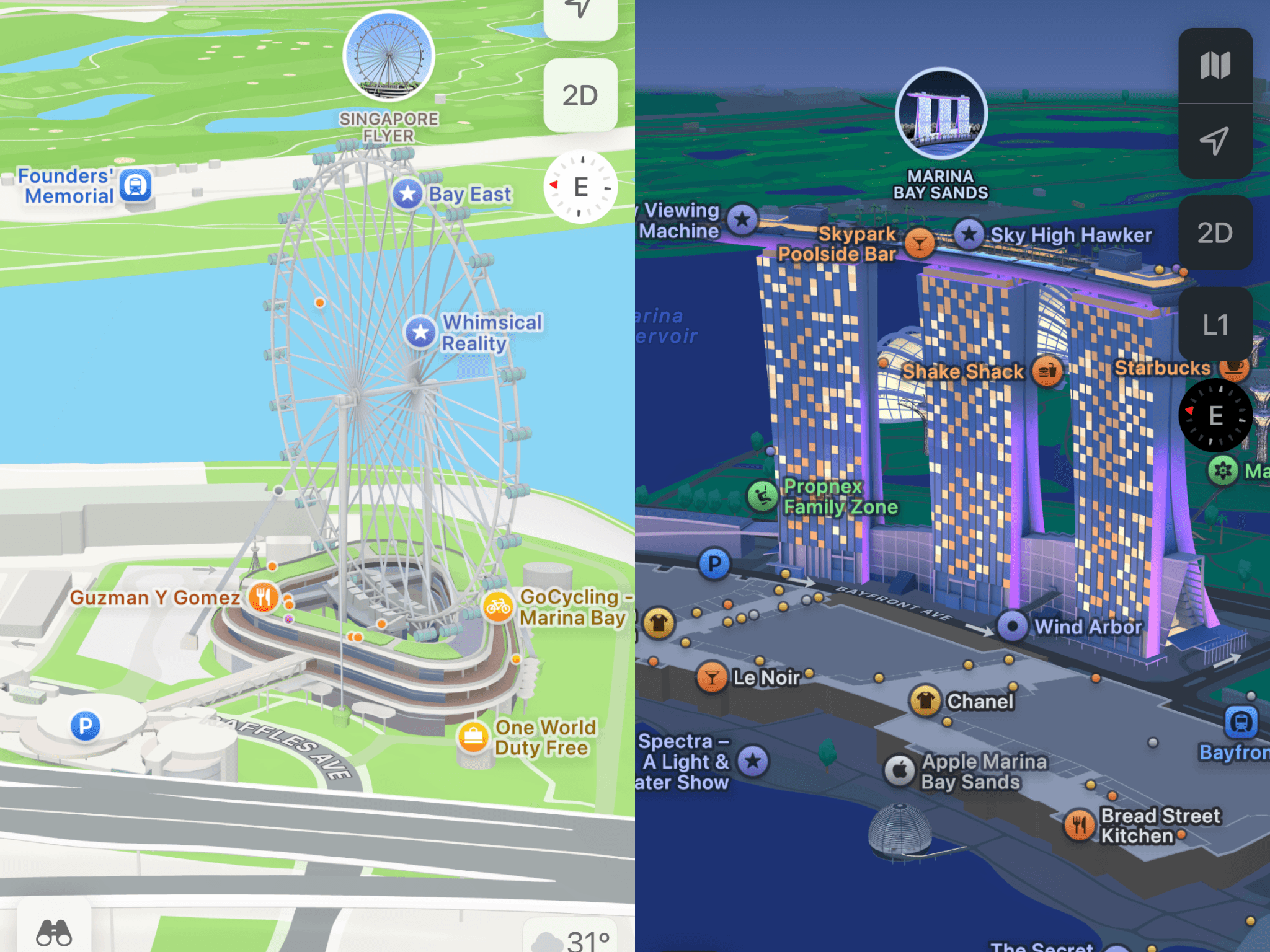
From today, Apple Maps looks a lot more like a video game — in the best way possible. Singapore becomes the first city in Southeast Asia to get Apple's Detailed City Experience, a visual overhaul that brings more realism, more context, and — if you buy into it - a stronger stance on privacy. At its core, the Detailed City Experience is a visually pleasing layer of polish. It includes visual enhancements like road markings, medians, turn lanes, and crosswalks, as well as custom-designed 3D landmarks including Gardens by the Bay, Fullerton Hotel and the National Gallery. Roads even slope to reflect elevation — and yes, you'll even see the iconic Ten Square building with its supercars stacked up in 3D. 'Subparcars' (sorry) in regular multi-storey carparks, however, won't get the same treatment; as of now, only select buildings will be getting this polish — understandably so — and at the end of the day, it's more like an easter egg, cherry on top and all of that stuff. The real benefit of the extra detailing lies in the driving experience. At complex junctions, Maps now switches to a windshield view that shows road-level guidance, helping drivers see critical highway entrances or exits early. The 3D perspective and clean interface are designed to reduce ambiguity, especially for newer drivers or those unfamiliar with local road layouts. There's also a new moonlit glow that activates in night mode for added clarity without harsh contrast. Apple's latest upgrade won't close the gap with Google, but it strengthens the foundation for more immersive features like Look Around, AR walking directions — and perhaps eventually, Vision Pro's spatial computing (speculative, of course)? Another perk is Apple's usual promise of privacy — a value it continues to double down on, even if it's not top of mind for most users. Apple processes data anonymously, often on-device, which partially explains the absence of crowdsourced discovery features. In Singapore, where Google Maps remains the default for most, this update won't shift the tide. For some, the visual upgrade might just give drivers a reason to reconsider using Apple Maps — especially if they've written it off in the past. At the very least, it'll show you which roads to avoid this National Day. [[nid:720576]] This article was first published in .

Time Out
08-08-2025
- Time Out
Singapore gets an exciting new Apple Maps update with 3D roads and iconic landmarks
The debate between iPhone and Android users never ends, but it looks like those in team Apple have the upper hand for now. Apple Maps – the iPhone equivalent of Google Maps – has just launched its Detailed City Experience in Singapore, a first for any country in Asia. This upgrade lets you view roads and landmarks in 3D, almost as though you're the main character on a quest in your own little RPG. Scroll through the map and check out landmarks like the Merlion, Fullerton Hotel, Gardens by the Bay, and Lau Pa Sat – not forgetting the iconic dome-shaped Apple store at MBS, of course. The attention to detail is remarkable: patterns and textures on building windows, staircases and slopes, and an abundance of trees reflecting our Garden City status. There's also a dark mode where venues are lit up. It's the perfect mirroring of real life. Drivers in particular will appreciate the windshield view, as opposed to the usual top-down view, so that they'll be able to navigate roads with added ease and realism. As the cherry on top, this new version of Apple Maps even features curated area guides with ideas on things to do and eateries to hit up, so you'll never have to look far when out exploring. How to activate the new Apple Maps Detailed City Experience Do note that the 3D upgrade on Apple Maps won't be applied automatically. What worked for us: searching landmarks like the Fullerton Hotel and swiping up on the 2D version to unlock the three-dimensional world. Alternatively, you can look for the button on the right of the screen to toggle between '2D' and '3D'.


CNA
08-08-2025
- CNA
The best way to celebrate SG60? A walk along the Singapore River
Recently, I took a long walk along the Singapore River. I've walked the river countless times before, but this time, as a retiree, I could afford to take it slow. What began as a leisurely stroll soon turned into a journey through the pages of our nation's history. And as I walked, I thought: How fitting that I am traversing the river of Singapore's history now, as we commemorate the 60th anniversary of our hard-won independence. My first stop was the Merlion statue overlooking Marina Bay, at what is now known as the Merlion Park opposite The Fullerton Hotel. At 8.6m high, this monument is tied to how Singapore got its name. The fish body represents the island's beginnings as a fishing village called Temasek. The lion's head, however, is less straightforward. As the story goes, a Palembang prince named Sang Nila Utama landed on our shores and named the island Singapura in the year 1299 – more than 500 years before the British arrived, although the actual date is now disputed among historians. "Singapura" is nowadays taken to mean "lion city" in Sanskrit, a literal translation. However, when I was in primary school in the 1960s, our history teachers told us that "singa" meant "lion" in Malay and "pura-pura" meant "false" or "phony". From what they taught, it was said that an aide to Sang Nila Utama had told him lions didn't exist in the region, so he must have seen a false lion – something that looked like a lion but wasn't. Despite the confusion and debate over the true origins of the Singapura name, I still prefer this version of a false lion. Somehow, it feels like something that could have happened. Trivia: The Merlion was designed in the early 1960s by Mr Alec Frederick Fraser-Brunner, the British curator of the former Van Kleef Aquarium who studies fish and aquatic creatures. It served as the corporate logo for the Singapore Tourist Promotion Board, now the Singapore Tourism Board, from 1964 to 1997. SINGAPORE'S GLOBAL PRESENCE The Merlion statue was unveiled on Sep 15, 1972, by then prime minister Lee Kuan Yew at what is now the Waterboat House Garden. It was later relocated to its current position in the Merlion Park in 2002. During the 2002 ceremony unveiling the statue at its new location, the prime minister spoke about how no one believed Singapore could become a major tourist destination because we lacked natural and historical attractions. He noted that in 2001, our tourist numbers exceeded 7.5 million – a vast leap from 91,000 in 1964, when the then Singapore Tourism Promotion Board was formed. Since that speech, Singapore has continued to make bold moves and investments to reinvent itself as a tourism destination with the building of billion-dollar attractions such as the Gardens by the Bay and two integrated resorts. In 2024, tourism arrivals hit 16.5 million and contributed almost S$30 billion to the economy. During my walk that day, I saw many tourists at Merlion Park taking photo after photo with the Merlion statue. It was gratifying to see our growth captured in the appreciation and admiration of these visitors. FORESIGHT AND VISION A little further along the riverbank, I came across the statue of Sir Stamford Raffles, the British administrator who established Singapore as a port city, on the very spot where he was said to have first landed in 1819. Once Singapore was established as a British trading outpost, the river got even busier. If I had been taking this walk in the 19th century, I would have been dodging and ducking coolies and wagons carrying sacks of produce and goods back and forth between the water and the offices, shops and godowns lining Boat Quay and Clarke Quay. When I first saw the Stamford Raffles statue as a schoolboy, I was struck by his stately pose: arms folded, weight balanced on one leg and eyes steadily looking out into the distance. Looking at it again now, I imagined Raffles looking upon this simple fishing settlement and thinking, "There's a future to be unlocked here." Beyond Raffles, I thought of the early leaders of Singapore – not just Lee Kuan Yew, but others including Goh Keng Swee, who established the Economic Development Board, and S Rajaratnam, who penned our national pledge. How fortunate we are to have had such visionary, forward-looking leaders who saw the bright future Singapore could have despite the many odds against us. THE RIVER AS SYMBOL OF SINGAPORE'S GROWTH During my stroll on this day, I saw crowds of smartly dressed young men and women seated in brightly lit restaurants or walking between shops and offices, chatting with their lunchtime companions. I used to be one of them. Many of them would have grown up in a highly developed Singapore. I wondered if these young people thought much of the living history they were passing through these days. In the 1970s, I would visit the river as a boy and see other boys diving and swimming at the mouth of the highly polluted river. Rubbish and waste covered the surface of the blackish water and a foul smell perpetually stained the wind – until the massive clean-up operation of the late '70s began, transforming the river into a shiny, gleaming waterway. In the late 1990s, I spent several years working in Raffles Place and frequently visiting Boat Quay and Clarke Quay for food, drinks and entertainment. In just a few short decades, the shophouses and godowns had become restaurants, pubs, karaoke joints and discotheques. The bumboats had been replaced by passenger cruises. With similar clean-up and revitalisation efforts extending to other parts of the island, the Singapore River encapsulated the rapid transformation of the whole country from a 'Third World nation' to first. Singaporeans of all ages now enjoy clean, tree-lined streets, orderly housing estates, shiny malls and skyscrapers. Looking at the young people around me now, I wondered: Did they ever think of a time when forex or financial traders bustling through this area were produce or merchandise traders? Or when the streets were narrower, the shophouses shabbier, the river blacker? PAST AND FUTURE SINGAPORE I passed by The Fullerton Hotel, once the General Post Office where I had gone to for postal services in the past – now no longer necessary thanks to the many localised post offices and digital mail services available to us. Next was Clifford Pier, the former landing point for passenger ships coming into Singapore, making it the first place where many immigrants and visitors first set foot in the country. Before me was Marina Bay. This area, with its iconic skyline shaped by the central business district and Marina Bay Sands integrated resort, is often admired by residents and foreigners alike. Google "Singapore" and the first few images you'll see are likely to be of the bay area. However, I found myself looking past the skyline to recall that the water before me was fresh water, not sea water. Since the building of the Marina Barrage, the bay has become a freshwater reservoir – a living testament to Singapore's commitment to safeguarding her water security. TAKE A WALK I am looking forward to our SG60 celebrations and am eagerly anticipating the National Day Parade and fireworks. During this time, there are many other ways for us to engage with our rich history: Madame Tussauds Sentosa has an immersive multimedia experience depicting old Singapore, and on Aug 8, the National Museum will launch Singapore Odyssea, a multimedia showcase taking visitors through 700 years of the nation's history. I applaud these efforts to connect Singaporeans with our past and forge a deeper sense of national identity. However, perhaps there's no better way to remember our humble beginnings and appreciate our many successes than in a simple walk along the Singapore River.

Straits Times
12-07-2025
- Business
- Straits Times
S'pore shows what's possible when digital innovation is matched with purpose: Britain's Lammy
Sign up now: Get ST's newsletters delivered to your inbox SINGAPORE – Singapore has proven over generations that it is not size that determines success but strategic clarity, and this is true too of technology, British Foreign Secretary David Lammy said on July 12. 'Singapore has shown what's possible when digital innovation is matched with long-term thinking and national purpose,' said Mr Lammy, speaking at the Fullerton Hotel on 'Diplomacy in the Digital Age'. Mr Lammy, who was on a one-day official visit to the Republic, highlighted how Singapore set up a National Computerisation Committee as early as 1981. He also cited the launch of the whole-of-government Smart Nation initiativ e in 2014, followed by the launch of a National AI Strateg y in 2019. 'Each time, your leaders were ahead of the game. Each time there was a broader lesson,' said Mr Lammy, noting that Singapore did not get ahead by just throwing money at the private sector and hoping for the best. Instead, serious public capabilities were built through deep technical expertise within the government and investment in areas like compute and data infrastructure, such as Singpass, he added. 'Starting in this job, I said that Britain needed to do more listening and less lecturing. A huge part of my trip this week has been to listen and, I hope, learn lessons on how we can pursue a similarly long-term strategy embracing technology,' said Mr Lammy. The British Foreign Secretary said any vision for the world of tomorrow must include a specific focus on the intersection of AI and diplomacy. Top stories Swipe. Select. Stay informed. World US slaps 30% tariffs on EU and Mexico; EU warns of countermeasures Singapore Casual racism should be tackled by getting more people to understand it is not acceptable: David Neo Singapore Pulling back the curtain: A backstage look at the 2025 NDP show segment Singapore $3 cashback for hawker centre meals and shopping at heartland stores with DBS PayLah initiative Asia Air India crash report shows pilot confusion over engine switch movement Singapore Body of 62-year-old man recovered from waters off East Coast Park Asia Aerobridge hits Qantas plane at Sydney Airport, damaging engine, delaying flight He acknowledged this was not yet a staple of foreign ministry and foreign ministers' discussions in his experience. 'But I believe that unless we lift our heads above the rat-race of crises and summits and examine the longer term trends reshaping our world, we will be boiled like the proverbial frog,' he asserted. Mr Lammy posited that AI was not just the next rung in the technological ladder, but would deliver a paradigm shift in the distribution and exercise of power. 'It will redefine how nations project influence, how threats emerge and how we defend ourselves. It will, therefore, transform how diplomacy is conducted,' he said in his speech. He underlined that AI would not solve all foreign policy issues, as it could not eliminate risk, nor remove the need for human judgment and the ability of people to build relationships based on trust. Nevertheless, he argued that diplomacy in 2025 needs machine speed and a human touch, which would help leaders make better decisions amid rising uncertainty. 'These capabilities are not science fiction. They are already being employed,' pointed out Mr Lammy, highlighting the DARPA and KAIROS projects in the United States that simulate complex political developments and anticipate conflict escalation, as well as the use of predictive analytics by Singapore's Ministry of Trade and Industry to flag risks to critical supply chains. 'The question before us is not whether AI will shape foreign policy. It is who will shape it, and how,' he said. Given that outside of the US and China, no country had the scale to deliver all the capabilities that decision-makers worldwide need independently, Mr Lammy said the need of the hour was more collaboration and more AI diplomacy within a perimeter of values. 'I want partners such as Britain and Singapore to align standards, share tools and develop models that reflect our shared principles,' he said, while also drawing attention to Britain's other partnerships with the US, the European Union and India. Mr Lammy concluded his speech by reiterating that Singapore had shown the world the power of long-term thinking and the importance of a vision, and expressed hope that the same approach could be used to break down the silos between foreign policy and technology. 'We live in a volatile world. Technology is reshaping our societies, making power more diffuse,' said Mr Lammy. 'Nations like Britain and Singapore need to equip ourselves with the tools to navigate these shifts and that means fusing AI and diplomacy, focusing on a long view of change and doubling down on our shared interests.' Mr Lammy's first visit to Singapore as foreign secretary 'reaffirms the substantive and longstanding relationship' between the two countries, the Ministry of Foreign Affairs (MFA) said in a press statement. During the course of the day, Mr Lammy paid a courtesy call on Prime Minister and Minister for Finance Lawrence Wong, who affirmed the strong and multifaceted relationship between Singapore and Britain. This includes cooperation in areas like trade and investment, defence and security, and science and technology, MFA said. They also discussed developments in the UK, and exchanged views on geopolitical issues, including trade and the situation in the Middle East. Mr Lammy was hosted to lunch by Minister for Foreign Affairs Dr Vivian Balakrishnan, during which the two leaders reaffirmed the close and longstanding ties shared by Singapore and the UK, which celebrate the 60th anniversary of the establishment of diplomatic relations this year. The duo discussed ways to strengthen UK-Singapore bilateral cooperation in areas like trade and investment, AI and innovation. Dr Balakrishnan welcomed Mr Lammy's stated intent for Britain to step up its engagement with Asean, and the ministers also exchanged views on international and regional developments. They also reaffirmed the shared commitment of both countries to uphold and strengthen international law and the multilateral trading system. Mr Lammy also met Deputy Prime Minister Gan Kim Yong, who is Minister for Trade and Industry and chairman of the Monetary Authority of Singapore. DPM Gan welcomed the UK's investment of £70 million (S$ 121 million) in Singapore's Financing Asia's Transition Partnership (FAST-P) initiative earlier this year, which is aimed at supporting green and transition financing in the region.
Straits Times
27-06-2025
- Entertainment
- Straits Times
Today in Pictures, June 27, 2025
Today in Pictures, June 27, 2025 The Fullerton Hotel in Singapore being lit up for a DrugFreeSG event, French soldiers taking part in a military exercise, and other photos from around the world in Today in Pictures.
