


Latest news with #LacallePou
Yahoo
 03-04-2025
- Politics
- Yahoo
Uruguay's Orsi Faces Pitfalls at Home and Challenges Abroad
Yamandu Orsi was sworn in as Uruguay's president on March 1, heralding a return to power for his left-wing Frente Amplio, or FA, coalition after its first stint in office from 2005 to 2020. In the runoff presidential election held in November, Orsi won 52 percent of the vote, narrowly besting Alvaro Delgado, the former Cabinet chief of outgoing President Luis Lacalle Pou, both from the conservative Partido Nacional, or PN. While Delgado was hurt by corruption scandals, crime and high poverty rates under Lacalle Pou, Orsi won votes by calling for cautious reform to boost growth and tackle inequality. He was also buoyed by the support of Jose 'Pepe' Mujica, the storied ex-guerrilla and former president who served from 2010 to 2015. At his victory celebration in November, Orsi emphasized that his government would promote 'freedom, equality, and the fraternity that is solidarity and respect for others.' Yet the FA's return to power comes at a less auspicious moment for Uruguay, both internationally and at home, than when it first governed in the early years of this century. Addressing a crowd of supporters in his inaugural speech on the 40th anniversary of the country's return to democracy, Orsi spoke of the need to 'rethink' the country's role in a 'highly unpredictable world, in a region that needs us beyond our dimensions and size.' It's in the area of foreign policy that Orsi has already marked the clearest departure from his predecessor. In August, the Lacalle Pou administration formally recognized Edmundo Gonzalez as president-elect of Venezuela, after a contested election in which incumbent President Nicolas Maduro claimed victory despite evidence that he had lost. In doing so, Uruguay joined then-U.S. President Joe Biden, Argentine President Javier Milei and the European Parliament in taking a tougher line on Venezuela's descent into naked authoritarianism. To get more in-depth news and expert analysis on global affairs from WPR, sign up for our free Daily Review newsletter. Yet one of Orsi's first acts was to rescind recognition of Gonzalez, albeit without formally recognizing Maduro either. The new stance triangulates between rival positions held by the FA's social-democratic and hard-left wings on the autocratic turn taken by the Chavista government in Caracas, and the conservative opposition was quick to criticize it. When the shift was revealed by Foreign Minister Mario Lubetkin in early March, Andres Ojeda—the third-place presidential candidate and Colorado Party senator—characterized Orsi as being 'servile to the Maduro regime.' Despite the likely political motivations, though, Orsi's stance on Venezuela also reflects a long-standing tradition in Uruguayan diplomacy of non-intervention, especially in fellow Latin American states. Still, there is a risk that perceived softness on Venezuela could irk the United States, a traditional ally and Uruguay's fourth-largest trading partner. That underscores a broader challenge facing the Orsi administration: the tightrope it must walk between maintaining friendly ties with Washington while cultivating strategic investment and deeper commercial ties with Beijing. China is now Uruguay's top export market, especially for its beef, and Chinese companies have invested heavily in the country's farming and energy sectors. Chinese officials have also expressed interest in developing Uruguay's telecommunications infrastructure and modernizing its ports, including by building a dedicated harbor facility for China's South Atlantic fishing fleet. Such activity at the mouth of the Rio de la Plata basin—a key corridor for South American grains, minerals, meat and narcotics—would likely draw the ire of U.S. President Donald Trump's administration. Still, while Lacalle Pou had sought a free trade agreement with China independent of the regional Mercosur trade bloc, Orsi said last October that such a deal was 'very far away' and 'would have to involve' Montevideo's Mercosur partners, lessening the geopolitical exposure of a deal involving Uruguay alone. More pressing for most Uruguayans will be a series of social challenges that have taken the shine off the continent's most stable and prosperous society. A fifth of Uruguayan children now live in poverty, and the same proportion of the population as a whole is classified as living in multidimensional poverty, a measure that captures access to housing, schooling and the social safety net. Youth unemployment has also risen to above 26 percent. And amid deepening penetration by transnational cocaine cartels, the country's jails are increasingly lawless and severely overcrowded. In polls, a third of Uruguayans say insecurity is their top worry, followed by joblessness, drug trafficking and poverty. So far, Orsi has promised only a few concrete measures to address this complex scenario. He has said he will hire 2,000 new police officers, create more jobs for young people and increase wages for low-income workers in order to tackle child poverty. With regard to prisons, the FA has proposed measures including non-custodial sentences, as well as incentives for the private sector to hire former inmates in an effort to reduce recidivism rates of 70 percent. Control of prisons may also pass from the Interior Ministry to a newly created Ministry of Justice and Human Rights. Most of these policy initiatives will probably receive the backing of the PN and Colorado, both of which campaigned on similar pledges and together hold the remaining 14 of the Senate's 30 seats. The right-wing Cabildo Abierto movement—whose leader, retired Gen. Guido Manini Rios, was once billed as Uruguay's version of former Brazilian President Jair Bolsonaro—lost its only three seats in October's congressional election, making governability easier for Orsi. However, there is less consensus around changes demanded by the powerful PIT-CNT labor federation, which is calling for reducing the working week from 48 to 40 hours; returning the retirement age to 60, after Lacalle Pou raised it to 65; and increasing pensions payouts. How Orsi handles such demands will be key to the performance of the economy. After GDP expanded by 3.1 percent in 2024—partly reflecting recovery from the previous year's drought—forecasters expect growth to slow to 2.4 percent in 2025. Orsi has tapped Gabriel Oddone, an experienced and orthodox figure, to serve as his economy and finance minister. A former Socialist Party member and professor of economic history, Oddone has repeatedly ruled out tax increases and spoken of the need to reduce bureaucracy in order to attract investment. After November's election, he also insisted that the retirement age will remain at 65, earning him a rebuke from Orsi, who defended Oddone's right to his opinion while stipulating, 'I'm the president.' Whether Oddone is afforded the freedom to try and energize the economy will be closely watched by investors. In his favor, Orsi—a former history teacher and two-term governor of Canelones, the semi-rural, working-class province where he grew up—has a personable, down-to-earth manner. He has chosen not to live in the presidential palace, following an example famously set by Mujica. He has a good working relationship with the opposition, including Lacalle Pou, with whom he shared an embrace after receiving the presidential sash on March 1. He will likely benefit from an ideological affinity with the leftist leaders of Brazil, Colombia and Chile, all of whom attended his inauguration. And Orsi shares a convergence of interests with Paraguayan President Santiago Pena, a conservative who is similarly keen to implement the Mercosur-European Union trade deal inked in December. Still, diplomatic tangles with Milei and Trump are eminently possible. In his first presidential address, Orsi spoke at length of Uruguay's birth as an independent nation 200 years ago, calling it the result of 'regional confrontations and negotiations.' There are likely to be more of both in the five years ahead. Laurence Blair is a freelance journalist covering South America and the author of 'Patria,' an alternative history of the continent to be published in November 2024. You can follow him on Twitter at @laurieablair. The post Uruguay's Orsi Faces Pitfalls at Home and Challenges Abroad appeared first on World Politics Review.

Arab Times
02-03-2025
- Politics
- Arab Times
Uruguay's new leftist president takes office, facing a financial balancing act
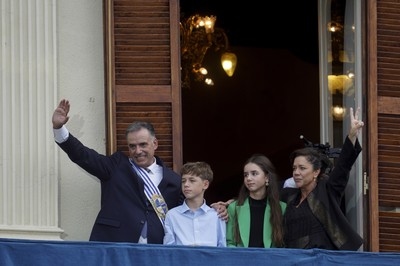
MONTEVIDEO, Uruguay, March 2, (AP): Yamandú Orsi, a telegenic left-leaning former mayor and history teacher, took office as Uruguay's new president on Saturday, at the helm of a government that has pledged to strengthen the social safety net while reversing years of economic stagnation. The inauguration of Orsi, 57, marks the return of Uruguay's Broad Front - a center-left mix of moderates, communists and hardline trade unionists - after a five-year interruption by the country's outgoing conservative president, Luis Lacalle Pou. Cheers erupted as Orsi recited the oath of office before Congress on Saturday in Uruguay's capital of Montevideo. Outside the chamber, in the city's main square, thousands of Uruguayans watching his swearing-in on giant screens shouted in support. The ceremony came three months after Orsi's presidential victory in a remarkably civilized election race between two moderates, praised as an antidote to the polarization gripping the region. In his speech, he took a dig at growing disillusionment with democratic norms across Latin America, which has resulted in a shift to the right, from neighboring Argentina to El Salvador. "We all know well that we have to treasure our democratic construction in times where exclusionary logic and expressions of distrust in traditional politics proliferate,' Orsi said in his inaugural address before a gathering of domestic and foreign leaders at the legislative palace in Montevideo. He declared: "Let us always be adversaries, but never enemies. And let us distance ourselves as far as possible from cynicism.' The night before the ceremony, Orsi dined in Montevideo with his like-minded regional counterparts, including Brazil's President Luiz Inácio Lula da Silva, Colombia's Gustavo Petro and Chile's Gabriel Boric. The friendly scene cemented Orsi as the latest in the region's swath of allied left-wing leaders - many of whom have struggled in recent years to combat rising inequality and stalling growth. Many Uruguayans saw Orsi as the nostalgia candidate, recalling the Broad Front's 15-year rule between 2005 and 2020. During that time, the coalition presided over a historic cycle of economic growth that reduced poverty and cemented the country's pro-business reputation. But in 2020, emerging problems like creeping inequality and surging crime ushered in Lacalle Pou's center-right government on promises of reforming the bloated state. Last year, public frustration over the persistence of those problems helped bring Lacalle Pou's tenure to an end, as an anti-incumbent wave swept across the globe.


Voice of America
02-03-2025
- Politics
- Voice of America
Uruguay's new leftist president takes office
Yamandu Orsi, a telegenic left-leaning former mayor and history teacher, took office as Uruguay's new president on Saturday, at the helm of a government that has pledged to strengthen the social safety net while reversing years of economic stagnation. The inauguration of Orsi, 57, marks the return of Uruguay's Broad Front — a center-left mix of moderates, communists and hardline trade unionists — after a five-year interruption by the country's outgoing conservative president, Luis Lacalle Pou. Cheers erupted as Orsi recited the oath of office before Congress on Saturday in Uruguay's capital of Montevideo. Outside the chamber, in the city's main square, thousands of Uruguayans watching his swearing-in on giant screens shouted in support. A civilized race The ceremony came three months after Orsi's presidential victory in a remarkably civilized election race between two moderates, praised as an antidote to the polarization gripping the region. In his speech, he took a dig at growing disillusionment with democratic norms across Latin America, which has resulted in a shift to the right, from neighboring Argentina to El Salvador. "We all know well that we have to treasure our democratic construction in times where exclusionary logic and expressions of distrust in traditional politics proliferate," Orsi said in his inaugural address before a gathering of domestic and foreign leaders at the legislative palace in Montevideo. He declared: "Let us always be adversaries, but never enemies. And let us distance ourselves as far as possible from cynicism." The night before the ceremony, Orsi dined in Montevideo with his like-minded regional counterparts, including Brazil's President Luiz Inacio Lula da Silva, Colombia's Gustavo Petro and Chile's Gabriel Boric. The friendly scene cemented Orsi as the latest in the region's swath of allied left-wing leaders — many of whom have struggled in recent years to combat rising inequality and stalling growth. Many Uruguayans saw Orsi as the nostalgia candidate, recalling the Broad Front's 15-year rule between 2005 and 2020. During that time, the coalition presided over a historic cycle of economic growth that reduced poverty and cemented the country's pro-business reputation. The coalition also launched pioneering social reforms that won Uruguay international acclaim, including the legalization of abortion, same-sex marriage and recreational marijuana. Problems emerge But in 2020, emerging problems like creeping inequality and surging crime ushered in Lacalle Pou's center-right government on promises of reforming the bloated state. Last year, public frustration over the persistence of those problems helped bring Lacalle Pou's tenure to an end, as an anti-incumbent wave swept across the globe. A cautious campaigner, Orsi — the former mayor of Canelones, an oceanfront district known for its cattle ranches and high-tech — vowed to implement "safe change" for Uruguay's 3.5 million people. Now he faces a difficult balancing act — between satisfying the demands of his more radical leftist constituents, which have called for unwinding some of the previous government's cost-cutting measures, while boosting competitiveness to spur much-needed economic development. "The country needs to recover a path of growth that generates not only a greater quantity but also quality of work," he said. "That allows a floor of salary dignity and, with it, a better distribution of income." With a fractious coalition, experts say many of Orsi's positions will become clear only after he takes office and is forced to make hard policy choices. A 'watch-and-see attitude' "The business community is taking a watch-and-see attitude until it's clear whether Orsi is in charge or whether his more aggressive leftist base is in charge," said Uruguayan economist Arturo C. Porzecanski, a global fellow at the Woodrow Wilson International Center for Scholars. "If Orsi doesn't come out on top and measures that set the clock back get passed, then that will dim the economic outlook for the coming years." Keeping a tight budget will make it difficult to meet expectations of the unionists that promoted a controversial referendum to increase pensions and reverse the former government's decision to raise the legal retirement age from 60 to 65. Orsi acknowledged the challenge in his speech, saying: "A lot of dialogue, an outstretched hand and the ability to understand the different sensitivities expressed by our community will be necessary." Last fall, Uruguayans shot down the proposed pension overhaul. Many praised the vote's outcome as a rare, level-headed rejection of budget-busting populism that has long beset the region. But union leaders — and their supporters, like Orsi's Communist labor minister — have continued to press their demands, challenging Uruguay's investor-friendly reputation. "The diagnosis is concerning when it comes to workers and their commitment to resolving disputes," Labor Minister Juan Castillo said last week, as powerful trade unions called a mass strike and multinational Japanese auto-part maker Yazaki shut down operations in Uruguay, citing high labor and production costs.


The Hill
01-03-2025
- Politics
- The Hill
Uruguay's new leftist president takes office, facing a financial balancing act
MONTEVIDEO, Uruguay (AP) — Yamandú Orsi, a telegenic left-leaning former mayor and history teacher, took office as Uruguay's new president on Saturday, at the helm of a government that has pledged to strengthen the social safety net while reversing years of economic stagnation. The inauguration of Orsi, 57, marks the return of Uruguay's Broad Front — a center-left mix of moderates, communists and hardline trade unionists — after a five-year interruption by the country's outgoing conservative president, Luis Lacalle Pou. Cheers erupted as Orsi recited the oath of office before Congress on Saturday in Uruguay's capital of Montevideo. Outside the chamber, in the city's main square, thousands of Uruguayans watching his swearing-in on giant screens shouted in support. A civilized race The ceremony came three months after Orsi's presidential victory in a remarkably civilized election race between two moderates, praised as an antidote to the polarization gripping the region. In his speech, he took a dig at growing disillusionment with democratic norms across Latin America, which has resulted in a shift to the right, from neighboring Argentina to El Salvador. 'We all know well that we have to treasure our democratic construction in times where exclusionary logic and expressions of distrust in traditional politics proliferate,' Orsi said in his inaugural address before a gathering of domestic and foreign leaders at the legislative palace in Montevideo. He declared: 'Let us always be adversaries, but never enemies. And let us distance ourselves as far as possible from cynicism.' The night before the ceremony, Orsi dined in Montevideo with his like-minded regional counterparts, including Brazil's President Luiz Inácio Lula da Silva, Colombia's Gustavo Petro and Chile's Gabriel Boric. The friendly scene cemented Orsi as the latest in the region's swath of allied left-wing leaders — many of whom have struggled in recent years to combat rising inequality and stalling growth. Many Uruguayans saw Orsi as the nostalgia candidate, recalling the Broad Front's 15-year rule between 2005 and 2020. During that time, the coalition presided over a historic cycle of economic growth that reduced poverty and cemented the country's pro-business reputation. The coalition also launched pioneering social reforms that won Uruguay international acclaim, including the legalization of abortion, same-sex marriage and recreational marijuana. Problems emerge But in 2020, emerging problems like creeping inequality and surging crime ushered in Lacalle Pou's center-right government on promises of reforming the bloated state. Last year, public frustration over the persistence of those problems helped bring Lacalle Pou's tenure to an end, as an anti-incumbent wave swept across the globe. A cautious campaigner, Orsi — the former mayor of Canelones, a beach town known for its cattle ranches and high-tech — vowed to implement 'safe change' for Uruguay's 3.5 million people. Now he faces a difficult balancing act — between satisfying the demands of his more radical leftist constituents, which have called for unwinding some of the previous government's cost-cutting measures, while boosting competitiveness to spur much-needed economic development. 'The country needs to recover a path of growth that generates not only a greater quantity but also quality of work,' he said. 'That allows a floor of salary dignity and, with it, a better distribution of income.' With a fractious coalition, experts say many of Orsi's positions will become clear only after he takes office and is forced to make hard policy choices. A 'watch-and-see attitude' 'The business community is taking a watch-and-see attitude until it's clear whether Orsi is in charge or whether his more aggressive leftist base is in charge,' said Uruguayan economist Arturo C. Porzecanski, a global fellow at the Woodrow Wilson International Center for Scholars. 'If Orsi doesn't come out on top and measures that set the clock back get passed, then that will dim the economic outlook for the coming years.' Keeping a tight budget will make it difficult to meet expectations of the unionists that promoted a controversial referendum to increase pensions and reverse the former government's decision to raise the legal retirement age from 60 to 65. Orsi acknowledged the challenge in his speech, saying: 'A lot of dialogue, an outstretched hand and the ability to understand the different sensitivities expressed by our community will be necessary.' Last fall, Uruguayans shot down the proposed pension overhaul. Many praised the vote's outcome as a rare, level-headed rejection of budget-busting populism that has long beset the region. But union leaders — and their supporters, like Orsi's Communist labor minister — have continued to press their demands, challenging Uruguay's investor-friendly reputation. 'The diagnosis is concerning when it comes to workers and their commitment to resolving disputes,' Labor Minister Juan Castillo said last week, as powerful trade unions called a mass strike and multinational Japanese auto-part maker Yazaki shut down operations in Uruguay, citing high labor and production costs.
Yahoo
01-03-2025
- Politics
- Yahoo
Uruguay's new leftist president takes office, facing a financial balancing act
MONTEVIDEO, Uruguay (AP) — Yamandú Orsi, a telegenic left-leaning former mayor and history teacher, took office as Uruguay's new president on Saturday, at the helm of a government that has pledged to strengthen the social safety net while reversing years of economic stagnation. The inauguration of Orsi, 57, marks the return of Uruguay's Broad Front — a center-left mix of moderates, communists and hardline trade unionists — after a five-year interruption by the country's outgoing conservative president, Luis Lacalle Pou. Cheers erupted as Orsi recited the oath of office before Congress on Saturday in Uruguay's capital of Montevideo. Outside the chamber, in the city's main square, thousands of Uruguayans watching his swearing-in on giant screens shouted in support. See for yourself — The Yodel is the go-to source for daily news, entertainment and feel-good stories. By signing up, you agree to our Terms and Privacy Policy. A civilized race The ceremony came three months after Orsi's presidential victory in a remarkably civilized election race between two moderates, praised as an antidote to the polarization gripping the region. In his speech, he took a dig at growing disillusionment with democratic norms across Latin America, which has resulted in a shift to the right, from neighboring Argentina to El Salvador. 'We all know well that we have to treasure our democratic construction in times where exclusionary logic and expressions of distrust in traditional politics proliferate,' Orsi said in his inaugural address before a gathering of domestic and foreign leaders at the legislative palace in Montevideo. He declared: 'Let us always be adversaries, but never enemies. And let us distance ourselves as far as possible from cynicism.' The night before the ceremony, Orsi dined in Montevideo with his like-minded regional counterparts, including Brazil's President Luiz Inácio Lula da Silva, Colombia's Gustavo Petro and Chile's Gabriel Boric. The friendly scene cemented Orsi as the latest in the region's swath of allied left-wing leaders — many of whom have struggled in recent years to combat rising inequality and stalling growth. Many Uruguayans saw Orsi as the nostalgia candidate, recalling the Broad Front's 15-year rule between 2005 and 2020. During that time, the coalition presided over a historic cycle of economic growth that reduced poverty and cemented the country's pro-business reputation. The coalition also launched pioneering social reforms that won Uruguay international acclaim, including the legalization of abortion, same-sex marriage and recreational marijuana. Problems emerge But in 2020, emerging problems like creeping inequality and surging crime ushered in Lacalle Pou's center-right government on promises of reforming the bloated state. Last year, public frustration over the persistence of those problems helped bring Lacalle Pou's tenure to an end, as an anti-incumbent wave swept across the globe. A cautious campaigner, Orsi — the former mayor of Canelones, a beach town known for its cattle ranches and high-tech — vowed to implement 'safe change' for Uruguay's 3.5 million people. Now he faces a difficult balancing act — between satisfying the demands of his more radical leftist constituents, which have called for unwinding some of the previous government's cost-cutting measures, while boosting competitiveness to spur much-needed economic development. 'The country needs to recover a path of growth that generates not only a greater quantity but also quality of work,' he said. 'That allows a floor of salary dignity and, with it, a better distribution of income.' With a fractious coalition, experts say many of Orsi's positions will become clear only after he takes office and is forced to make hard policy choices. A 'watch-and-see attitude' 'The business community is taking a watch-and-see attitude until it's clear whether Orsi is in charge or whether his more aggressive leftist base is in charge,' said Uruguayan economist Arturo C. Porzecanski, a global fellow at the Woodrow Wilson International Center for Scholars. 'If Orsi doesn't come out on top and measures that set the clock back get passed, then that will dim the economic outlook for the coming years." Keeping a tight budget will make it difficult to meet expectations of the unionists that promoted a controversial referendum to increase pensions and reverse the former government's decision to raise the legal retirement age from 60 to 65. Orsi acknowledged the challenge in his speech, saying: 'A lot of dialogue, an outstretched hand and the ability to understand the different sensitivities expressed by our community will be necessary." Last fall, Uruguayans shot down the proposed pension overhaul. Many praised the vote's outcome as a rare, level-headed rejection of budget-busting populism that has long beset the region. But union leaders — and their supporters, like Orsi's Communist labor minister — have continued to press their demands, challenging Uruguay's investor-friendly reputation. 'The diagnosis is concerning when it comes to workers and their commitment to resolving disputes,' Labor Minister Juan Castillo said last week, as powerful trade unions called a mass strike and multinational Japanese auto-part maker Yazaki shut down operations in Uruguay, citing high labor and production costs. ___ DeBre reported from Buenos Aires, Argentina. Associated Press writer Nayara Batschke contributed to this reporto from Sao Paulo.
