


Latest news with #MHz


Bangkok Post
 08-08-2025
- Business
- Bangkok Post
Peeling back the curtain on NT's great migration
National Telecom (NT) has migrated most of its 2 million subscribers on the 2100-megahertz, 2300MHz and 850MHz spectrum bands to its 700MHz band, following the expiry of its ability to use the three bands on Aug 4. NT president Col Sanpachai Huvanandana described the customer migration as "smooth". The state agency operated on the three bands with private telecom operators under partnership deals. What is NT's 700MHz network capacity? NT began service on its 700MHz network last year after it clinched a spectrum licence for the band in an auction in 2020. Col Sanpachai said the 700MHz network has the capacity to serve more than 4 million subscribers nationwide. However, NT is targeting select groups of customers, instead of fiercely competing with major players to woo customers. Are all of NT's users now on the 700MHz band? He said earlier there were more than 1,000 subscribers who used fixed mobile broadband service on the 2300MHz and 2100MHz spectrums. This group roams using NT's partner telecom networks. Col Sanpachai said if NT has to migrate this group to the 700MHz band, it will have to change the related equipment for them so they can access its 700MHz service. This process is technically complicated and will increase NT's costs, he said. In addition, previously there were more than 1,000 SIM cards using its 850MHz band to operate machine-to-machine systems such as ATM kiosks. The state agency already migrated them from the 850MHz network to its partners' networks to prevent service disruption. Col Sanpachai said after its contracts with banks for this ATM connectivity expire, NT will bid for the projects again using its own spectrum band. NT began migrating customers from the 850MHz, 2100 MHz and 2300MHz bands to 700MHz in early 2024. The company was formed through a merger of state telecom agencies TOT and CAT Telecom in 2021, and prior to the merger TOT partnered with Advanced Info Service (AIS) to provide mobile phone services on TOT's 2100MHz band. TOT also partnered with Total Access Communication (dtac) on TOT's 2300MHz band. CAT Telecom partnered with True Move H Universal Communication on CAT's 850MHz band. True and dtac merged to become True in early 2023. In 2023, NT transferred the right to use half of 20MHz on the 700MHz band to Advanced Wireless Network Co Ltd (AWN), an AIS subsidiary. NT and AIS also signed agreements for telecom equipment rental on NT's 700MHz spectrum and for nationwide roaming, aiming to enhance and expand the 4G/5G capabilities of both companies. What happens to the three expired bands? The National Broadcasting and Telecommunications Commission (NBTC) already auctioned off the three bands as well as other bands in June this year, with AIS and True the only bidders. AIS grabbed the rights to the 2100MHz band, while True bagged the 2300MHz and 1500MHz bands. There were no bids for the 850MHz band. The NBTC awarded both winners the spectrum licences on Aug 4 after they paid the first instalment of the licence on July 29. Can NT survive with only the 700MHz band in hand? A cabinet resolution in 2021 directed the Digital Economy and Society Ministry and the NBTC to discuss the allocation of an additional spectrum band to NT to provide a mobile phone service to the public and state agencies. The cabinet issued the resolution when TOT and CAT merged to become NT. NT is conducting a feasibility study on what spectrum bands it wants to use for such missions, said Col Sanpachai. Previously he told the Bangkok Post NT prefers the middle bands because they could efficiently enhance its service offering capability. The middle bands are those between 1000MHz and 6000MHz. Demand for smart solutions has increased from state agencies as they progress with their digital transformation process, said Col Sanpachai. If the NBTC allocates some bands to NT to provide smart solutions to state agencies, he said NT can create services that are cost-effective. In addition, Col Sanpachai said four companies have proposed business partnerships with NT as the state agency searches for new revenue streams. The proposed partners comprise AIS, True, and foreign IT equipment vendors. He said NT is open to strategic partnerships with both domestic and international companies, aiming to jointly revive its mobile phone service and broadband businesses. The state agency expects the partnership model to reinforce areas where it has limitations, such as the coverage of some services, said Col Sanpachai. Earlier NT reported its mobile service booked a loss of 4 billion baht in 2023, while its fixed broadband internet service is expected to report revenue of 2.4 billion baht for 2024, with a loss of 900 million baht. The company has an aggressive growth target for its cloud service of 10 billion baht by 2027, up from 4 billion per year at present. NT wants to cash in on rising demand for cloud services, which are expected to reach 500,000 virtual machines in three years. The company operates cloud services through its own brand NT Cloud and operates Government Data Center and Cloud Service, offering state units cloud services.


Mint
05-07-2025
- Business
- Mint
Telecom department and regulator clash over over key spectrum to Indian Railways
The department of telecommunications (DoT) and the Telecom Regulatory Authority of India (Trai) are sparring over the allocation of a portion of the key 700 MHz spectrum to the Indian Railways. The spectrum band is crucial for Indian Railways to deploy safety and security applications as a part of its indigenous radio-based train collision avoidance system (TCAS) or Kavach. In a letter dated 16 June, the telecom department told Trai that the assignment of an additional 5 MHz spectrum would be considered only once the 5 MHz spectrum already assigned in the 700 MHz frequency band was used. The back reference from DoT came on Trai's recommendations to assign additional spectrum to Indian Railways for its safety and security applications. Trai had sent the recommendations on 20 December 2024. In response to DoT's back reference on 4 July, the regulator expressed concern over the department's view on the spectrum allocation. 'It is imperative that an additional 5 MHz of paired spectrum in the 700 MHz band is assigned to the Indian Railways forthwith so that they can plan, design and implement an optimised communication network for meeting the bandwidth requirements of their safety and security applications in a timely manner,' Trai told the DoT. Another issue between DoT and Trai is on how much Indian Railways will be charged for the spectrum. The department wants the assignment of spectrum to bebased on the auction determined price (ADP) instead of a formula prescribed by DoT, which would be less expensive as per the regulator. ADP is the market price set during 5G auctions. The price of per megahertz (MHz) of spectrum in the 700 MHz band was set at ₹ 3,927 crore for commercial use. 'In order to harmonise all such administrative assignment of spectrum in the IMT (international mobile telecommunication) bands, the department is of the view that it may be appropriate to adopt the spectrum charging methodology of upfront payment of the ADP mechanism for all administrative assignment of spectrum in the IMT bands, henceforth on prospective basis,' DoT told Trai. It added that so far, Indian Railways has also not paid any spectrum charges for the already assigned 5 MHz spectrum in the 700 MHz band. DoT said this charging mechanism would allow for efficient use of spectrum, avoid hoarding/blocking of spectrum, and avoid accounting problems from the assignment of spectrum in phases. 'This upfront payment of ADP mechanism will also be applicable to the already assigned 5 MHZ of paired spectrum to the Indian Railways with prospective effect,' DoT said. Trai, however, said, 'Considering the critical role played by Indian Railways and NCRTC (National Capital Region Transport Corporation) in serving public and national interests, it would not be appropriate to levy spectrum charges for these entities based on ADP that reflects the value placed on the spectrum by entities intending to use it for commercial use.' 'The economic value of spectrum for entities such as Indian Railways and NCRTC is fundamentally different from that of commercial service providers, as it does not include revenue-generating activities like commercial use of internet, voice, or data services,' Trai added. Trai noted that spectrum charges for respective spectrum bands assigned administratively to various ministries/departments engaged in national safety and security, such as defence and space, are determined using the formula prescribed by DoT. 'The spectrum charges for these ministries/departments are not determined based on ADP. Further, since both NCRTC and Indian Railways require spectrum for the purpose of enhancing safety and security, there is no justification for levying spectrum charges based on ADP,' Trai told DoT. With a 45 MHz total size, the 700 Mhz band has already been allocated for the use of different government ministries/departments/agencies, which includes 10 MHz for the defence ministry, 5 MHz for Indian Railways, 5 MHz for National Capital Region Transport Corporation (NCRTC), and 10 MHz for BSNL. In the 2022 spectrum auctions, Jio acquired 10 MHz of the 700 MHz spectrum worth ₹ 40,000 crore. The remaining 5 MHz band has been sought by the Indian Railways. The 700 MHz band is considered a premium band for 5G services as it has the potential to offer wider coverage and in-building penetration.

Mint
01-07-2025
- Business
- Mint
Vodafone Idea share price gains over 2% after launch of 5G network in 23 cities
Vodafone Idea share price gained over 2% in early trade on Tuesday after the telecom company announced the next phase of its 5G network rollout in 23 cities. Vodafone Idea shares rallied as much as 2.01% to ₹ 7.59 apiece on the BSE. The debt-ridden telecom company, Vodafone Idea said it has deployed the 5G network in cities including, Ahmedabad, Agra, Aurangabad, Kozhikode, Cochin, Dehradun, Indore, Jaipur, Kolkata, Lucknow, Madurai, Malappuram, Meerut, Nagpur, Nashik, Pune, Rajkot, Sonepat, Surat, Siliguri, Trivandrum, Vadodara and Vizag. This expansion, covering all its priority circles of the country, will be executed in a phased manner, it said. The telecom operator had previously launched its fifth-generation mobile services in five cities: Mumbai, Delhi-NCR, Bengaluru, Chandigarh, and Patna. 'It is part of Vi's broader strategic rollout in 17 priority circles where it has acquired 5G spectrum. Users with 5G-enabled devices in the newly announced cities will be able to access Vi 5G services as the services go live. As an introductory offer, Vi is providing unlimited 5G data on plans starting from ₹ 299,' Vodafone Idea said in a release on June 30./ Meanwhile, since April last year, Vodafone Idea has deployed 4G on the 900 MHz band across approximately 65,000 sites, significantly improving coverage and indoor connectivity. Additionally, the telco has added over 56,000 sites on the 1800 MHz/2100 MHz/TDD bands resulting in a 35% boost in 4G data capacity and a 26% increase in 4G speeds. Vodafone Idea's 4G population coverage has surged by 88 million people rising from 77% in March 2024 to 84%. Vodafone Idea share price has risen 10% in one week, and gained 9% in one month. The telecom stock is down 6% in six months and has crashed 57% in one year. Vodafone Idea shares have dropped 26% in the past five years. At 9:45 AM, Vodafone Idea share price was trading 0.40% higher at ₹ 7.47 apiece on the BSE. Disclaimer: The views and recommendations made above are those of individual analysts or broking companies, and not of Mint. We advise investors to check with certified experts before making any investment decisions.

Mint
30-06-2025
- Business
- Mint
Vodafone Idea expands 5G services to 23 more cities, including Jaipur, Kolkata and Lucknow
Vodafone Idea (Vi) has announced the expansion of its 5G network coverage to 23 additional cities across India, marking a significant step in its phased rollout strategy. The latest development brings the company's 5G footprint to several new urban centres, including key state capitals such as Jaipur, Kolkata and Lucknow. The telecom operator had previously launched its fifth-generation mobile services in five cities: Mumbai, Delhi-NCR, Bengaluru, Chandigarh, and Patna. With the new phase of deployment now underway, Vi is extending its 5G reach to a broader geographic base, aiming to enhance connectivity and digital access across the country. You may be interested in Notably, the newly covered cities include Ahmedabad, Agra, Aurangabad, Kozhikode, Kochi, Dehradun, Indore, Madurai, Malappuram, Meerut, Nagpur, Nashik, Pune, Rajkot, Sonepat, Surat, Siliguri, Thiruvananthapuram, Vadodara and Visakhapatnam. "Vi has commenced the next phase of its 5G rollout, with deployment now active in 23 cities," the company stated in an official release. Customers equipped with compatible 5G devices in these locations will be able to access the high-speed network as services go live. As part of its introductory offering, Vi is providing unlimited 5G data on prepaid and postpaid plans starting at ₹ 299. The operator also shared updates on its ongoing efforts to bolster 4G infrastructure. It has deployed 4G services on the 900 MHz band at approximately 65,000 sites, enhancing both coverage and indoor connectivity. In addition, Vi has rolled out more than 56,000 sites on 1800 MHz, 2100 MHz, and TDD bands, resulting in a 35 per cent improvement in overall 4G data capacity and a 26 per cent increase in average 4G speeds. To further strengthen its network backbone, the company revealed plans to install 1 lakh new mobile towers over the next six months. Vi has acquired 5G spectrum in 17 out of the 22 telecom circles in India, signalling its long-term commitment to expanding next-generation connectivity despite facing financial and operational hurdles in recent years.
Bangkok Post
29-06-2025
- Business
- Bangkok Post
Mobile phone bands auctioned off for B41bn
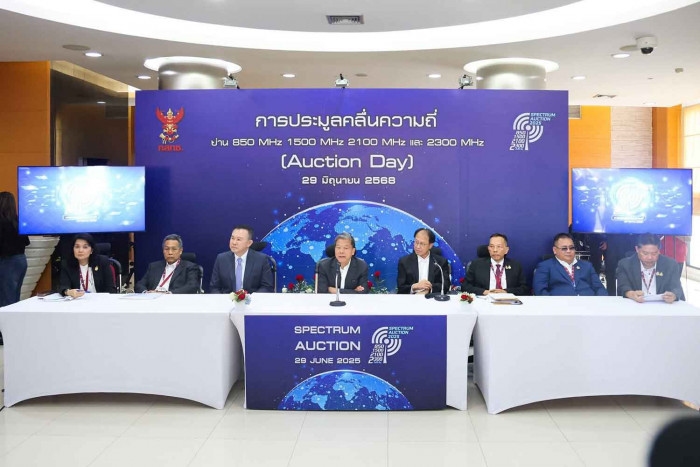
The auction of four mobile spectrum bands on Sunday generated more than 41 billion baht from the sales of the 1500MHz, 2100MHz, and 2300MHz bands to two major telecom operators, Advanced Info Service (AIS) and True Corporation. There were no bids for the 850MHz band. AIS subsidiary Advanced Wireless Network (AWN) and True subsidiary True Move H Universal Communication (TUC) were the only two qualified bidders in the auction, hosted by the National Broadcasting and Telecommunications Commission (NBTC). Dr Sarana Boonbaichaiyapruck, chairman of the NBTC board, said AWN proposed a total of around 14 billion baht to grab all three available sets of the 2100MHz band. It clinched the band by proposing a price of 4.9 billion per set, compared to the reserve price of 4.5 billion baht per set. The 2100MHz band was available in three sets of 10MHz of bandwidth, each at a price of 4.5 billion baht. The AWN total winning price on the 2100MHz is around 10% higher than the combined three sets of the band's reserve price. TUC proposed a total of 26.4 billion baht to grab the 2300MHz and 1500MHz bands: 21.7 billion baht for all seven available sets of the 2300MHz band, and a further 4.65 billion baht for four out of the total 11 sets of the 1500MHz available for the auction. The 2300MHz band was available in seven sets, each with 10MHz of bandwidth and a price of 2.59 billion baht each. TUC's winning price for the 2300MHz band is estimated to be 19.7% higher than the total reserve price of the combined seven sets of the 2300MHz. Eleven sets of the 1500MHz band were available, each with 5MHz of bandwidth at a price of 1 billion baht each. TUC's winning price for four sets of the 1500MHZ is around 10% higher than the combined four sets of the 1500 MHz's reserve price. The auction began at 9.30am and took only one hour to finish. The NBTC board held a meeting to acknowledge the auction result in the afternoon. Two sets of the 850MHz band were on sale, each containing 10MHz of bandwidth at a reserve price of 7.7 billion baht each. The NBTC board is slated to hold a meeting on Wednesday to consider all dimensions of the auction results.
