


Latest news with #NUSUSI


BBC News
 5 days ago
- Health
- BBC News
Student housing: Mould, damp and rats among 'normalised' issues
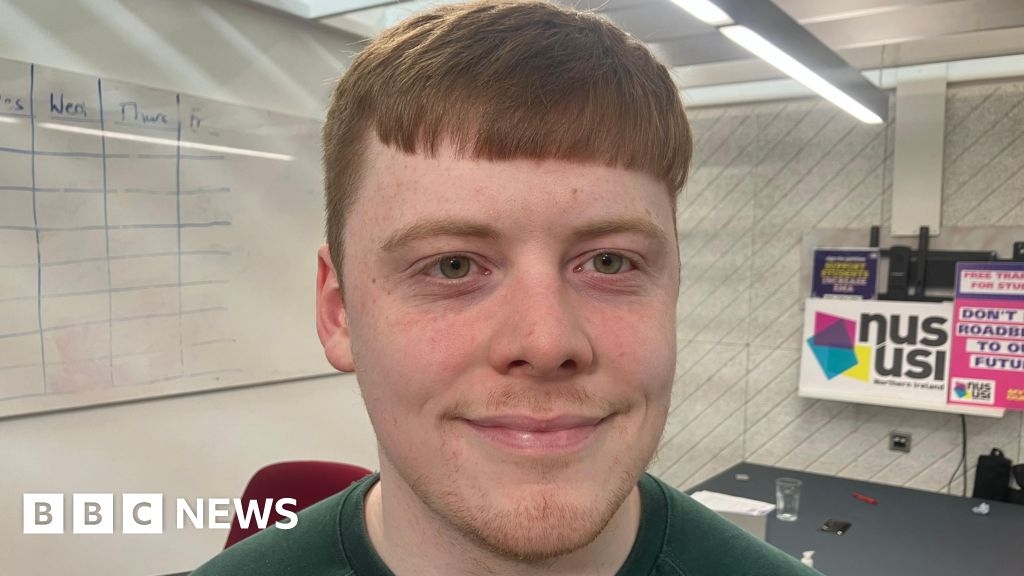
Mould, damp and pests in student housing have become "sadly normalised", according to the body that represents students in Northern comes as two students told BBC News NI about issues in their previous homes, including the discovery of dead rats, maggots and residents feeling the effects of breathing in Friel, president of the NUS-USI, said that despite housing being the single biggest expense for students, the houses available are often "not safe" and "may impact students' health long term". He added many students do not know how to find help and that "there is a real lack of education around housing rights". BBC News NI has approached the Landlords Association of Northern Ireland (LANI) for comment. Dara Cunningham, 19, who is due to start his second year of studying financial risk management at Queen's University Belfast, told BBC News NI that mould at his previous student rental was so serious it affected his housemate, who suffers from asthma. He said it spread across the house "on the ceiling, beside the bathroom, in the bathroom and in some of the bedrooms". "It's quite difficult to breathe and then it's kind of just that constant icky feeling. You don't really feel comfortable," he also said that when he moved into the property his housemate cleared the yard, only to find dead rats and got worse when rats found their way into the floorboards between the ground and first they died, maggots developed leading to them "falling from the light fittings into the kitchen", an incident Dara described as "absolutely disgusting".The issue was "thankfully" resolved by the landlord, he added. What are the health risks of mould? Mould was the main issue for Shannon, 22, a graduate from Queen's - she told BBC News NI that the extent of the problem at her rental home caused her embarrassment and paranoia. "I was scared of it spreading under my bed and onto my bed," she said, adding that she could really "feel it" in her Public Health Agency said that mould in housing "can pose serious health risks" particularly for individuals with respiratory conditions like is a microscopic fungus that grows in damp places and people living with it are more likely to suffer from respiratory illnesses, infections and can also trigger asthma attacks and cause coughing, wheezing and breathlessness. A survey of 633 students in Northern Ireland completed by the NUS-USI in November 2024 found that 92% of students had experienced issues with their student rentals, with 59% reporting pest infestations and 19% reporting having of social housing in England will be forced to investigate and fix damp and mould within strict timescales from October, with the government hoping to extend those rules to private landlords as those rules do not extend to Northern Ireland, where housing policy is devolved. Ben Friel, president of the NUS-USI for Northern Ireland, said that there is "a lot to be done" to resolve the issues being faced by students. Initially calling for the "stronger enforcement" of HMO legislation, he added "longer term though we need to consider how we think about student housing".He suggested alternative models such as student housing cooperatives and more affordable purpose-built student accommodation, so that students aren't "forced to live" in such "poor conditions".Tony Carmichael, Ulster University's Student Union advice manager, said students often don't know where to find help for housing said he had found local councils were often "the one effective bargaining chip students seem to have" and that, once contacted, most issues are "resolved within a matter of weeks".The Public Health Agency (PHA) advises students experiencing rental issues to raise the issue with landlords in the first health departments at councils can also assess properties in their area and offer City Council said it would can carry out a property inspection for issues like pest control or mould, and provide guidance depending on the inspection results."We would always advise tenants to report any issues with the property to their landlord or agent directly, in the first instance."A mediation service is available to those living or providing accommodation in a private rental, managed by Housing Rights."
BBC News
08-05-2025
- Business
- BBC News
University fees: Students would 'bear the brunt' of proposed rises
Students in Northern Ireland would "bear the brunt" of a rise in tuition fees of over £1,000, called for by university is according to Ben Friel, the president of the National Union of Students and Union of Students in Ireland (NUS-USI).Leaders of Northern Ireland's five universities and university colleges have called for student tuition fees to rise by more than £1,000 a have written to the leaders of the five main political parties asking for tuition fees to rise to £5,831 a year from the current £4,750. The joint letter is signed by the heads of Queen's University Belfast (QUB), Ulster University (UU) and the Open University in Ireland (OU).It has been supported by a separate letter from the principals of St Mary's University College and Stranmillis University College. Why do the universities want a rise in tuition fees? The leaders' letter said that about a third of young people leave Northern Ireland to study elsewhere "due to the continued Northern Ireland Executive policy on funding".The letter said there has been a "real-terms loss caused by a legacy of sub-inflationary uplifts" in funding for higher education."Applying an inflation increase from a 2021 baseline alone, which part-recovers the hitherto unallocated inflationary uplifts to the current Northern Ireland fee, would see an inflation-corrected fee of £5,831," the letter added that the pressure was "compounded by the reduction in international student numbers and associated income"."Without urgent intervention, the region's skills pipeline, research capacity, and innovation-led growth are at serious risk-undermining productivity and long-term economic recovery," the letter an accompanying statement to BBC News NI, the leaders urged the Executive "to acknowledge that tuition fees have not kept pace with inflation, and to rectify this position." What do students pay in tuition fees elsewhere in the UK and Ireland? The letter also pointed out that fees in Northern Ireland are lower than those in England and Wales, where students currently pay £9,250. This will go up to £9,535 in the next academic students in the Republic of Ireland pay a maximum of €2,000 (£1,695) a year in fees, while Scottish students who remain in Scotland to study do not pay tuition Northern Ireland tuition fees have risen from £3,685 a decade ago to £4,750 in 2024/ vast majority of students take out a loan to cover their annual tuition fees and living costs, which they then pay back when they begin working after graduation. What do students leaders think? Mr Friel, of the NUS-USI, said the rise in fees called for by the universities meant "asking students to bear the brunt of a broken system"."It's the fundamental principle of how we fund education and treat it as a country," he told BBC News NI."Education is seen as a burden to the budget at the moment, but it needs to be seen as an investment for our future and our young people."Mr Friel said that students were already facing financial pressures, and skipping meals."Nearly one in five students are using a foodbank," he said."We can't be putting more burden on students at a time like this." He said he empathised with some of the universities' concerns about funding."They want and need to raise revenues and the only way they have to do that at the minute is off the back of students," he said."We can't keep throwing money at a broken system, we're wasting students money, we're wasting public money."Mr Friel said that any rise in tuition fees could deter students from lower-income backgrounds, especially, from going to said that while the end of fees should be a "long-term" goal, he was a "realist"."I know it's not going to happen in the next two, three, four years," he said."Long-term I think we should always be aiming for that." What happens now? The university letter has gone to the leaders of Sinn Féin, the DUP, UUP, SDLP and Alliance Party.A tuition fee rise of the amount wanted by the universities would have to be approved by the Stormont education is the responsibility of Economy Minister Caoimhe university letter has received support from a number of business leaders, who said "a tipping point" had been reached."We believe that it is time for the funding model to be refreshed, so that it continues to reflect Northern Ireland's distinctive needs, protects access for local students, and enhances the region's economic attractiveness to both domestic and global investment," their statement said.
