


Latest news with #NorthwestInstituteofPlateauBiology

Borneo Post
 3 days ago
- Science
- Borneo Post
Robotic guardian joins Tibetan antelope herd
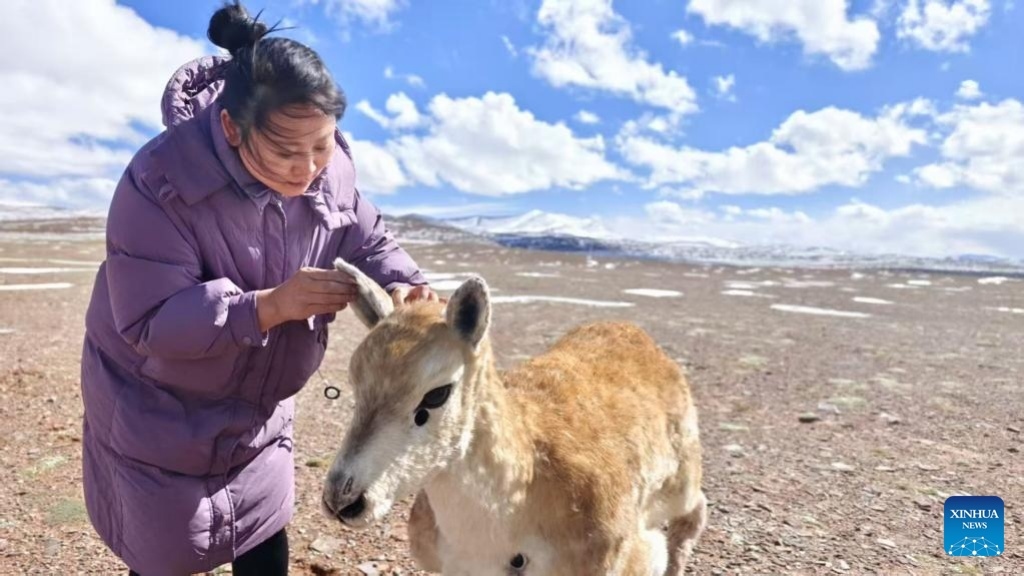
A specialist in fur simulation and animal specimen creation repairs a robotic Tibetan antelope in the Hoh Xil National Nature Reserve, northwest China's Qinghai Province in July 2025. – Xinhua photo XINING (Aug 17): As the afternoon sets in, the sun begins to warm the Qinghai-Tibet Plateau, making it the peak time for Tibetan antelopes to search for food. After a night without eating, these creatures dot the hillsides near Zonag Lake in the Hoh Xil National Nature Reserve. A slightly larger animal stands out on the grass. Unlike the others, which have lowered their heads to graze, this 'antelope' holds its head high, moving carefully toward the herd. It is a robotic antelope, which, from a distance, looks just like the real antelopes nearby, sharing the same fur color and body shape. But up close, a small, hidden camera can be seen beneath its eyes. At first, the real antelopes seem curious about the newcomer, pausing to look at the mechanical stranger. However, the robot does not scare them away. Gradually, the unique robotic antelope is accepted into the herd to roam alongside thousands of animals in the wilderness. The robot undertook trial operations in late July in Hoh Xil, which has an average altitude of more than 4,600 meters. The environment is cold and oxygen-poor, making it almost impossible to sustain human life there. At the same time, it is also widely recognized as a 'kingdom of animals' due to its rich and diverse wildlife. Its rare species, including Tibetan antelopes, serve as important ecological indicators of the Qinghai-Tibet Plateau. Every summer, thousands of female Tibetan antelopes gather at Zonag Lake to give birth and care for their young. Scientists say that the robotic Tibetan antelope has overcome the established limitations on the distance from which humans can observe wildlife. It will provide more accurate, reliable images and data for the study of Tibetan antelope behavior in China. A technician tests a robotic Tibetan antelope in Golmud City, northwest China's Qinghai Province on May 22, 2025. – Xinhua photo Lian Xinming, a researcher at the Chinese Academy of Sciences' Northwest Institute of Plateau Biology who participated in the recent trial, said that Tibetan antelopes are very sensitive, and that it is difficult for people to get close to them. 'They will run away as soon as they see someone from a distance – even 500 to 800 meters away,' Lian told Xinhua on Monday. 'A close encounter can induce stress, and can even cause miscarriage in pregnant females.' Previously, scientists relied on telescopes, cameras or other indirect methods like studying feces or carcasses to monitor the antelopes. Drones, though useful, can also startle the animals. Lian said that robots could be a promising solution to study animals more closely without causing disruption. The idea to create a robotic Tibetan antelope was first proposed in February this year. A group of humanoid robots performing a dance on the televised 'Spring Festival Gala' inspired the zoologists to incorporate robot technology into their research. As a result, Lian's team partnered with DEEP Robotics, a Hangzhou-based company known for its innovation in robotics, to develop the project. According to Qian Xiaoyu, a senior brand marketing manager at DEEP Robotics, the robotic antelope is powered by the X30 quadruped robotic dog. 'This technology is designed to perform in hazardous, complex environments, including extremely harsh terrains,' Qian said. 'The robot aims to assist or even replace humans in patrol and rescue tasks.' To make the robot appear as lifelike as possible, the team collaborated with specialists in fur simulation and animal specimen creation. Based on the antelope's skeletal structure and real fur samples provided by scientists, they dressed the robot to resemble its living counterparts closely. During its trial, the robotic antelope successfully navigated a distance of 2 kilometers across open areas in the nature reserve, overcoming various obstacles such as slopes, potholes and muddy wetlands. It integrated into a herd, carrying out close-range observation and non-intrusive filming tasks. Lian said that he had hoped the robot would capture dramatic moments such as antelopes giving birth. A robotic Tibetan antelope moves toward a herd of antelopes in the Hoh Xil National Nature Reserve, northwest China's Qinghai Province in July 2025. – Xinhua photo However, during the three-day experiment, the footage recorded by the robot was quite simple – it only showed the antelopes grazing peacefully. But the scientist has not lost heart. 'Even when the exploration does not yield the expected results, it provides invaluable experience,' Lian said. He believes that robotics technology holds immense promise for future wildlife studies and conservation efforts, offering a glimpse into how innovation can support the protection of endangered species in remote and challenging environments. 'The ultimate goal is to ensure the safe migration of Tibetan antelopes, with minimal human interference,' he said. – Xinhua China robot Tibetan antelopes Xinhua
Borneo Post
10-08-2025
- Science
- Borneo Post
Professional wildlife atlas decodes biodiversity of China's Qilian Mountains
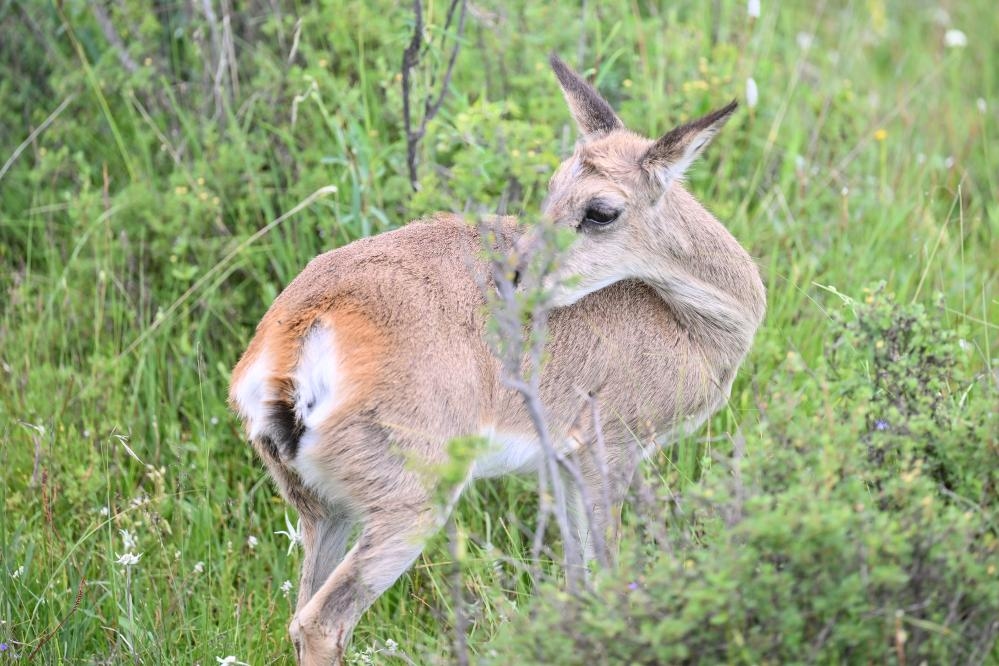
A rescued Tibetan gazelle is seen at the Wildlife Rehabilitation and Breeding Station in Qilian Mountain National Park in northwest China's Qinghai Province, July 23, 2025. (Xinhua/Sun Ruibo) XINING (Aug 11): A professional atlas documenting the wildlife of the Qilian Mountains, one of China's key ecological security barriers, has been published, according to the Northwest Institute of Plateau Biology (NWIPB) of the Chinese Academy of Sciences. This atlas is the first in China to systematically present the wildlife resources of the Qilian Mountains with both scientific rigor and stunning visual presentation, said Zhang Tongzuo, editor of the atlas and a researcher at the NWIPB. It is based on the solid scientific foundation of China's second research survey of the Qinghai-Tibet Plateau, offering the public a window into the wildlife of the Qilian Mountains. The atlas systematically catalogs 396 representative wildlife species from the Qilian Mountains, including 349 bird species from 59 families across 21 orders, and 47 mammal species from 17 families across 5 orders. Each species is illustrated with one to three high-definition color photos, allowing readers to clearly identify the animals through their distinct morphological features. A drone photo taken on Jan. 15, 2025 shows the snow scenery of Qilian Mountains in Tianzhu County of Wuwei City, northwest China's Gansu Province. (Xinhua/Lang Bingbing) The atlas also provides a comprehensive information system for each species, detailing its scientific name, taxonomic classification, morphological features, ecological habits, county-level distribution within the Qilian Mountains, and conservation status. The Qilian Mountains straddle the border between Gansu and Qinghai and are a major mountain range with an average altitude of over 4,000 meters. This magnificent mountain range spans the junction of major plateaus, including the Qinghai-Tibet Plateau and the Loess Plateau. The mountain range nurtures a complete vertical ecosystem spectrum, from glacier-capped peaks to desert and Gobi terrain, creating a complex mix of meadows, forests and wetlands that provide ideal habitats for many rare wild animals and plants, according to Zhang. In terms of national biodiversity conservation, the Qilian Mountains play an irreplaceable role in maintaining ecological balance in western China and ensuring the country's overall ecological security. Years of careful work have gone into compiling this atlas, which holds both academic value and practical use for scientists, forestry experts, birdwatchers, wildlife photographers and nature educators, Zhang said. He added that the atlas is expected to raise awareness about biodiversity protection in the Qilian Mountains, inspire conservation efforts, help with ecological preservation in western China, and promote harmony between people and nature. – Xinhua biodiversity China wildlife
Borneo Post
29-07-2025
- Science
- Borneo Post
Smart traffic lights safeguard Tibetan antelope migration
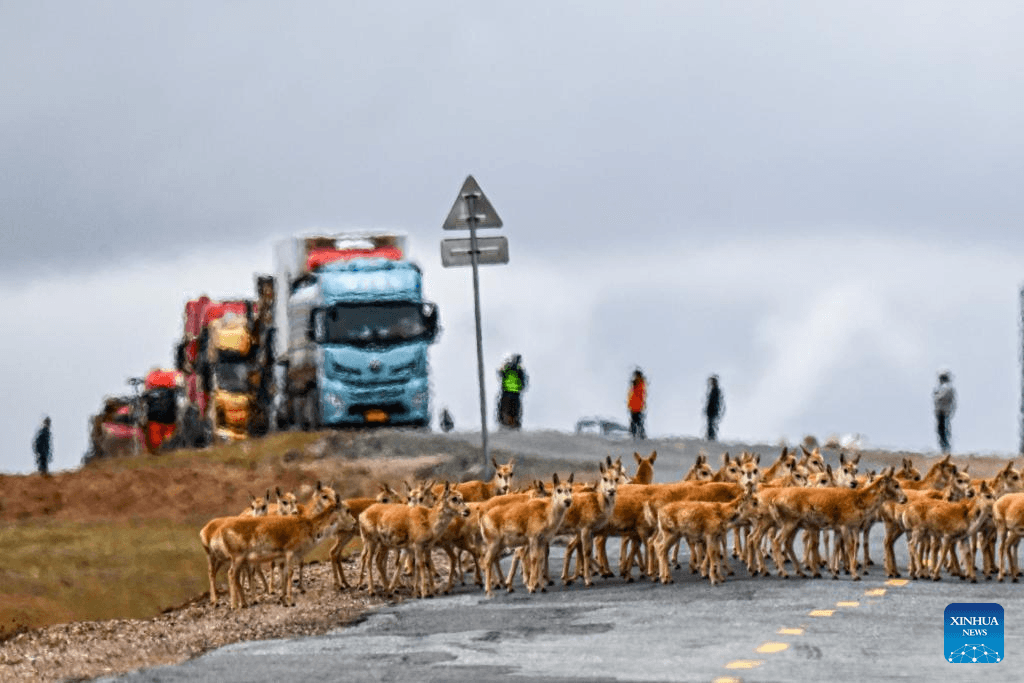
A herd of Tibetan antelopes cross a road while vehicles stop to give way upon staff members' instruction at Hol Xil Nature Reserve, northwest China's Qinghai Province, May 27, 2024. (Xinhua/Zhang Long) XINING (July 29): In the early summer, drivers on a stretch of National Highway 109 in the Yushu Tibetan Autonomous Prefecture of northwest China's Qinghai Province often encounter a unique spectacle: herds of Tibetan antelopes crossing the busy road. In a display of harmony between nature and human activity, vehicles on the highway pull over and wait patiently, creating a temporary pause in traffic flow to allow the animals to pass safely. More recently, a high-tech 'mobile sentry' has joined this harmonious scene. Stationed by the roadside, it is remotely controlled by dedicated staff who adjust its height and angle, zoom in and out, and meticulously record the entire process of the antelopes crossing the road. Every year from May to July, female antelopes from areas such as Sanjiangyuan in Qinghai, Qiangtang in southwest China's Xizang Autonomous Region and the Altun Mountains in northwest China's Xinjiang Uygur Autonomous Region travel hundreds of kilometers to give birth in the heart of the Hoh Xil National Nature Reserve, and many need to cross the iconic National Highway 109. The mobile devices on duty for antelope migration are part of an intelligent management platform for human-wildlife conflict mitigation, which is the result of a key national research and development project. The platform utilizes traffic signals that drivers can understand at a glance, effectively indicating when to proceed or stop, which can minimize the impact of antelope migration on highway traffic and efficiently avoid the risk of collision, said Lian Xinming, head of the project and a researcher at the Chinese Academy of Sciences' Northwest Institute of Plateau Biology. 'So far, our project has collected data on 28 groups of antelopes crossing the road during their migration from wintering grounds to breeding grounds,' Lian said. Using video recordings from the mobile devices, researchers analyze the scale and speed of each antelope herd to determine the correlation between the two, providing data support for rapid traffic light response. When the platform detects antelopes approaching the road, it sends an early warning to staff at a nearby protection station, alerting them to direct traffic. Meanwhile, electronic billboards on both sides of the passage display messages such as 'Tibetan antelopes are crossing ahead, please slow down.' Once the last antelope has passed, the platform prompts vehicles to proceed. Lian noted that in situations where some antelopes do not cross the road, only cross halfway or turn back after crossing, the platform also relies on data analysis and AI recognition to rapidly judge the animals' crossing intentions, and to prevent accidents between vehicles and herds. The idea to develop traffic lights for antelope migration in the Hoh Xil National Nature Reserve had been brewing in the minds of scientists for two decades. This file photo taken on July 28, 2023 shows a herd of Tibetan antelopes crossing a road en route to their habitat in Sanjiangyuan area, northwest China's Qinghai Province. (Xinhua/Zhang Hongxiang) Back in June 2004, thanks to the call of the Green River non-governmental environmental organization and support from all sectors of society, China's first traffic lights for wildlife were installed on the Qinghai-Xizang Highway. Yang Xin, who initiated the project, remembers that whenever personnel at the observation point heard a command on their walkie-talkie, they would turn on the traffic lights on both sides of the highway where the antelopes were about to cross. The traffic police would then signal cars to pull over using standard road traffic gestures. Today, with China's advancements in intelligent machinery and other technological fields, those manual traffic lights have been upgraded to a more intelligent system. The management platform is expected to be put into use in 2027. By then, with the help of the smart traffic lights, this lifeline for antelopes migrating to breed and deliver their young will operate more safely and smoothly, Lian said. Under first-class state protection in China, the once-endangered Tibetan antelope is mostly found in Xizang, Qinghai and Xinjiang. The species' population has increased over the past three decades thanks to a ban on illegal hunting and measures implemented to improve habitats. – Xinhua antelopes China fauna traffic lights
