


Latest news with #Petropiar

IOL News
 04-08-2025
- Business
- IOL News
Oil and Gas in the Global South
Petropiar: Company in Venezuela, Latin America. Image: Sputnik In 2024, BRICS expanded its membership to include Iran, the United Arab Emirates (UAE), Egypt, Ethiopia, and others, transforming from an emerging-market coalition into a significant force in global energy. This enlarged group, now known as BRICS+, comprises some of the world's leading oil and gas producers. It now accounts for over 40% of global oil output and more than 30% of gas production. This expansion signifies a pivotal change in global energy dynamics, especially for the Global South. The Major BRICS+ Oil and Gas Producers Numerous BRICS+ nations hold significant influence in the global hydrocarbon sector: Russia Russia, a key player in the global energy market, produced around 10.8 million barrels of oil per day (bpd) in 2024 and ranks among the top three global natural gas producers. Even with Western sanctions, Russia has strengthened energy ties across Eurasia by increasing exports to China and India. Brazil South America's leading oil producer, Brazil, has experienced significant offshore expansion. Its production hit 3.5 million barrels per day in 2024, largely due to pre-salt fields such as Búzios. Brazil's formal entry into OPEC+ in 2023 has further strengthened its position in global supply negotiations. Video Player is loading. Play Video Play Unmute Current Time 0:00 / Duration -:- Loaded : 0% Stream Type LIVE Seek to live, currently behind live LIVE Remaining Time - 0:00 This is a modal window. Beginning of dialog window. Escape will cancel and close the window. Text Color White Black Red Green Blue Yellow Magenta Cyan Transparency Opaque Semi-Transparent Background Color Black White Red Green Blue Yellow Magenta Cyan Transparency Opaque Semi-Transparent Transparent Window Color Black White Red Green Blue Yellow Magenta Cyan Transparency Transparent Semi-Transparent Opaque Font Size 50% 75% 100% 125% 150% 175% 200% 300% 400% Text Edge Style None Raised Depressed Uniform Dropshadow Font Family Proportional Sans-Serif Monospace Sans-Serif Proportional Serif Monospace Serif Casual Script Small Caps Reset restore all settings to the default values Done Close Modal Dialog End of dialog window. Advertisement Video Player is loading. Play Video Play Unmute Current Time 0:00 / Duration -:- Loaded : 0% Stream Type LIVE Seek to live, currently behind live LIVE Remaining Time - 0:00 This is a modal window. Beginning of dialog window. Escape will cancel and close the window. Text Color White Black Red Green Blue Yellow Magenta Cyan Transparency Opaque Semi-Transparent Background Color Black White Red Green Blue Yellow Magenta Cyan Transparency Opaque Semi-Transparent Transparent Window Color Black White Red Green Blue Yellow Magenta Cyan Transparency Transparent Semi-Transparent Opaque Font Size 50% 75% 100% 125% 150% 175% 200% 300% 400% Text Edge Style None Raised Depressed Uniform Dropshadow Font Family Proportional Sans-Serif Monospace Sans-Serif Proportional Serif Monospace Serif Casual Script Small Caps Reset restore all settings to the default values Done Close Modal Dialog End of dialog window. Next Stay Close ✕ Iran As a founding member of OPEC and a BRICS+ country, Iran possesses the world's second-largest natural gas reserves and fourth-largest oil reserves. Despite sanctions, its production of approximately 3 million barrels per day remains robust. Iran's entry into BRICS has further bolstered the bloc's influence in the Gulf region. United Arab Emirates The United Arab Emirates (UAE), led by the Abu Dhabi National Oil Company (ADNOC), currently produces approximately 3.2 million barrels of oil per day (bpd) and aims to increase this to 5 million bpd by 2027. The UAE also boasts substantial natural gas production, particularly from the Shah gas field, solidifying its role as a vital energy contributor within BRICS+. Saudi Arabia (Unofficial Member) Saudi Arabia, the world's largest crude oil exporter with a production exceeding 10 million barrels per day, demonstrates a clear strategic alignment with BRICS, even as its formal accession is still pending. Its cooperation within OPEC+ supports the energy interests of BRICS+, particularly in price stabilisation and counteracting Western financial influence. Why This Matters for the Global South Energy Access and Affordability Energy access continues to hinder development in many Global South nations, especially in Africa and South Asia. However, BRICS+ oil producers, notably Russia and Iran, have offered discounted crude to countries like India, China, and Brazil. This has lowered import costs and helped control inflation, creating new energy alignments that provide alternatives to Western markets where prices are pegged to the dollar. Redefining Global Pricing and Trade The global oil trade is being transformed by BRICS+'s increasing efforts to settle oil transactions in local currencies, including the yuan, rupee, and dirham. India has already acquired Russian oil using rupees, and discussions are underway for a BRICS clearing mechanism that would circumvent the U.S. dollar. This shift offers Global South economies reduced currency risk and greater financial autonomy. South-South Energy Financing The New Development Bank (NDB), the financial arm of BRICS, has started financing infrastructure projects in member states. These projects, including pipelines, refineries, and gas terminals, are aimed at fostering value-added industrial development. This initiative supports energy independence and local job creation, going beyond mere resource extraction. Strategic Implications for BRICS and Global Energy Geopolitical Leverage The multi-polar energy order is now represented by BRICS+, which challenges the petrodollar system and the dominance of Western oil majors. BRICS countries wield influence over OPEC+ and emerging consumer markets, enabling them to stabilise prices, shape production levels, and advocate for more equitable market access globally. Energy Transition Pressure BRICS+ unity faces a significant challenge due to the global push for decarbonisation. Although fossil fuels are still widely used, some BRICS+ members, such as the UAE and Brazil, are making substantial investments in green hydrogen and biofuels, respectively. A key challenge remains how to achieve a just energy transition that fosters growth in the Global South without simply mirroring Western approaches. The BRICS+ Oil Pivot For BRICS+, oil and gas have transcended their status as mere commodities, evolving into strategic instruments. The integration of key hydrocarbon nations such as Iran and the UAE positions the bloc as a pivotal energy provider for the Global South, simultaneously establishing it as a formidable counterbalance to Western-controlled energy organisations. In a fragmented global order, the future of resource control extends beyond mere ownership to the establishment of new global standards in pricing, currency, financing, and sustainable development. This shift, driven by BRICS+ oil and gas diplomacy, signifies an evolving world where the Global South gains increased agency, expanded options, and a stronger voice. Written By: Sesona Mdlokovana Associate at BRICS+ Consulting Group African Specialist
Yahoo
17-03-2025
- Business
- Yahoo
Venezuela's PDVSA to keep producing, exporting oil previously handled by Chevron, document says
(Reuters) -Venezuela's state-run PDVSA has put together three operational scenarios as part of a plan to continue producing and exporting oil at its largest joint venture with Chevron once a license for the U.S. major to operate in the country expires next month, according to a company document seen by Reuters on Monday. The administration of U.S. President Donald Trump this month gave Chevron 30 days through early April to wind down all oil operations and exports from Venezuela that are currently going to the United States under a license granted in 2022. Chevron has a presence in the U.S.-sanctioned South American country through joint ventures where PDVSA is the largest shareholder, with the Petropiar project at the vast Orinoco Belt being the most important partnership. The Venezuelan firm plans to produce between 105,000 and 138,000 barrels per day (bpd) of Hamaca heavy crude at Petropiar once the Chevron license expires, in line with production levels in recent months, the document says. A portion of the crude output that varies depending on the scenario will be sent to domestic refineries along with some byproducts like vacuum gasoil, while another portion will be exported to markets other than the U.S. The vacuum gasoil allows PDVSA to produce low-octane gasoline for domestic distribution. PDVSA's main goal with the changes is to maintain Petropiar's output levels and avoid the need to halt the upgrader or shut any of the joint ventures' oilfields, a source close to the company's operations said. PDVSA and Chevron did not immediately reply to requests for comment. In order to deal with possible shortages of diluents needed to sustain Petropiar's operations, PDVSA will recycle a larger portion of imported naphtha while supplying other diluents from its largest refining complex, Paraguana, to the project. A dynamic movement of tankers that is currently allowing Chevron to move Venezuelan crude between domestic ports before exporting would be minimized, according to the document. Some units of Petropiar's crude upgrader are expected to be taken out of service to produce feedstocks other than crude oil in an arrangement similar to the one PDVSA put in place in 2020 when the Chevron license was restricted by Trump's first administration.

Bloomberg
14-02-2025
- Business
- Bloomberg
Chevron Cranks Up Venezuelan Oil Exports Amid Trump-Maduro Reset
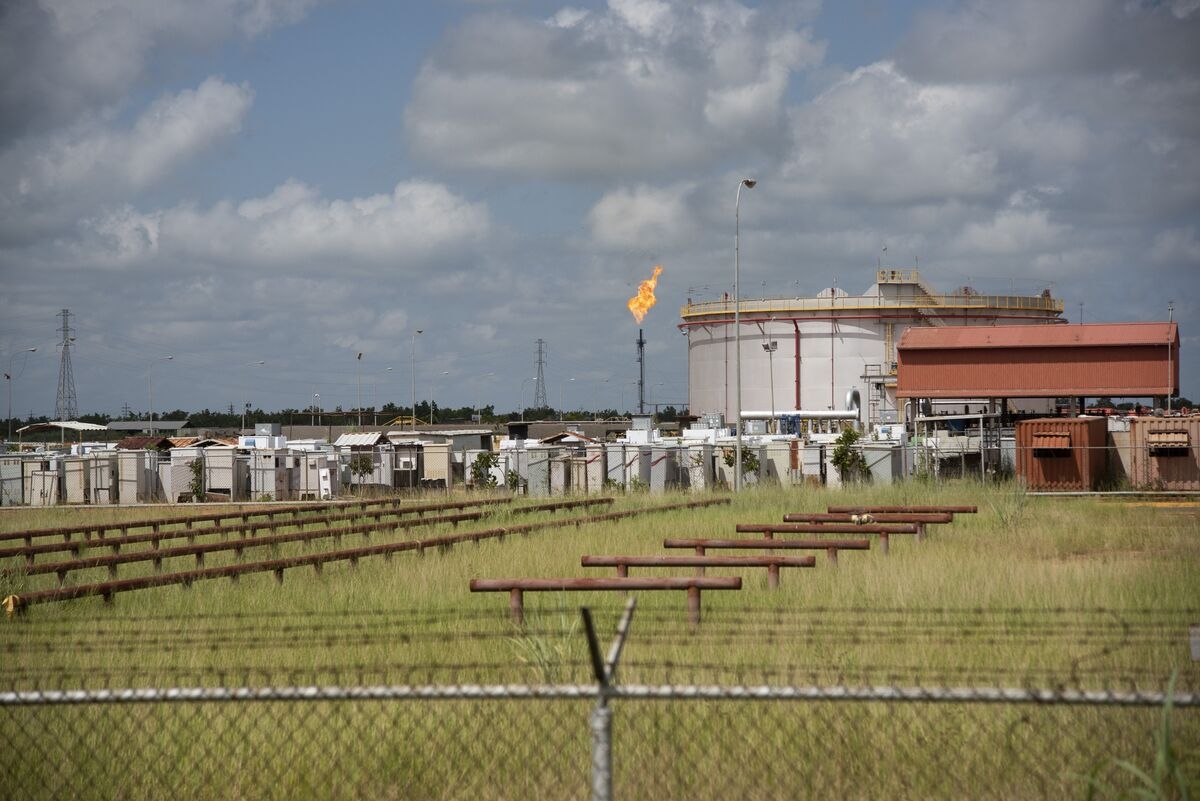
Chevron Corp. plans to ratchet up oil exports from Venezuela to a seven-year high as a reset of the country's relationship with the US eases concerns that trade restrictions will increase. Exports of synthetic oil from Chevron's Petropiar project are expected to rise about 50% to about 143,000 barrels a day this month, the highest since March 2018, according to preliminary port schedules compiled by Bloomberg. Petropiar's output has grown 37% in the past year to 110,000 barrels a day in January, said a person with knowledge of the operations, who asked not to be named because they aren't authorized to speak publicly.
