


Latest news with #Stalingrad


Arab News
 7 hours ago
- Health
- Arab News
Israeli government has lost all trace of its humanity
I grew up with stories of starvation at home. Both my parents somehow survived, only just, this horrible fate during the Second World War. My mother was in Stalingrad and my father in a concentration camp in Poland, suffering from that slow and agonizing process of wasting away. Their stories, and those of others who did not survive, exposed me from a young age to this type of cruelty, which one group of human beings is capable of inflicting on another at times of war and conflict. Tragically for humanity, we have completely failed to eradicate it. Starvation, if it doesn't kill you, will induce severe long-term mental and other health vulnerabilities and adversely affect one's life expectancy. Having lived my formative years among those who had suffered from extreme hunger and its consequences, I feel sickened and distressed by the images of starved people in Gaza. It feels personal. Some might argue it evokes a secondary trauma and the inability to reconcile with the fact that no empathy or compassion are being shown by today's Israeli government, not to the very young or old or anyone else there. I can already hear the chorus of criticism for comparing what is taking place in Gaza with the Holocaust. I won't do this, because this is not what matters now and is not my intention. A starved person, especially when their condition is human-made and avoidable, is the victim of a brutality that has no place in a civilized society. And those who are in a position to stop it but do not do so must be held accountable. For a nation that includes so many of its people who suffered the fate of starvation and either perished as a result or somehow survived, there must be an obligation and an expectation to be particularly sensitive to its recent history and to refuse to be complicit, in any way, shape or form, in causing the starvation of other people. Alas, this is not the case. The World Health Organization reports that malnutrition in Gaza is on a dangerous trajectory, marked by a spike in deaths in July. 'Of 74 malnutrition-related deaths in 2025, 63 occurred in July — including 24 children under five, a child over five, and 38 adults … (and) their bodies showing clear signs of severe wasting.' In the first two weeks of last month alone, more than 5,000 children under five were admitted for outpatient treatment of malnutrition, nearly a fifth of them with severe acute malnutrition. According to the Integrated Food Security Phase Classification platform, two out of three famine thresholds have been reached in Gaza: plummeting food consumption and acute malnutrition. There is mounting evidence that 'widespread starvation, malnutrition and disease' are driving a rise in hunger-related deaths, which is the third famine indicator, but not yet on levels where famine can be formally declared. A starved person, especially when their condition is avoidable, is the victim of a brutality that has no place in a civilized society. Yossi Mekelberg The Israeli government, and first and foremost Prime Minister Benjamin Netanyahu, are denying the fact of starvation or hunger in Gaza, something that has even angered the PM's close backer, US President Donald Trump. Netanyahu does not sound convincing by first denying that there is a severe shortage of food despite mounting evidence to the contrary and then accusing Hamas of causing these shortages that he denies exist. In reality, Israel could have prevented this acute shortage of food by flooding, so to speak, the place with food to circumvent anyone who tries to control the food market, for either racketeering or political gain, and by that deprive them of having any leverage over the Gazan population. To meet the basic needs of the 2.1 million people who live in Gaza, there is a need for 62,000 tonnes of food staples monthly. In a decision that represents both extreme callousness and a complete lack of judgment, in the months of March and April, Israel did not allow any food to enter Gaza. Then, under international pressure, a trickle of food was allowed in, but only about a quarter of what was required. This slowed the trajectory of Gaza's descent into starvation, but it did not stop it. Moreover, the Israeli decision to declare war on UNRWA and other UN agencies that were best equipped to provide humanitarian aid to Palestinians in Gaza — thanks to their experience and the trust they enjoy with the local population — has backfired. The failed attempt to replace these organizations with the American-backed Gaza Humanitarian Fund resulted in not enough food entering Gaza. And, to make things worse, according to the UN, at least 1,373 Palestinians have been killed while seeking food — 859 in the vicinity of this group's sites and 514 along the food delivery routes. Supplying humanitarian aid by airdrops was mainly a PR exercise and it has delivered only a fraction of the quantities needed, and at times led to the deaths of those desperate to get food. Those are the facts and, without an urgent, immediate and substantial increase in the supply of food and medicine, we are likely to see an exponential rise in the number of those dying from hunger — meanwhile, there is heartless political wrangling over who is to blame. As there is mounting evidence of many and various war crimes committed in Gaza, mass starvation is the one that has led the international community, at last, to voice its grave concerns and apply some pressure on Israel, albeit with limited results, to end this inhumane policy and start allowing food in. It is simply beyond comprehension how this Israeli government could have lost all trace of its humanity and morality, not to mention its basic common sense, and sunk to a new low of withdrawing the most basic needs for subsistence from people who have already suffered immeasurable loss and pain. Nothing has united the world in its criticism of Israel, not before the war and not during it, more than its inflicting of such degrees of hunger and distress in Gaza. If future historians should look at one single aspect of the Israeli-Palestinian conflict that gave the impetus for leading Western countries such as the UK, France and Canada, among others, to recognize the Palestinian state — or for Germany of all countries to impose a partial military embargo — it would most probably be this current Israeli government's decision that starving the people of Gaza is permissible and might serve Israeli interests. No one else shares this view. Alexander Solzhenitsyn, the Soviet and Russian author and dissident who was incarcerated in Stalin's gulag prison system, wrote on this experience in his book 'One Day in the Life of Ivan Denisovich': 'That bowl of soup — it was dearer than freedom, dearer than life itself, past, present and future.' Those who deliberately deprive people of food do so because they want their total submission, which is Israel's intention in Gaza. • Yossi Mekelberg is professor of international relations and an associate fellow of the MENA Program at Chatham House. X: @YMekelberg

The Citizen
07-07-2025
- Politics
- The Citizen
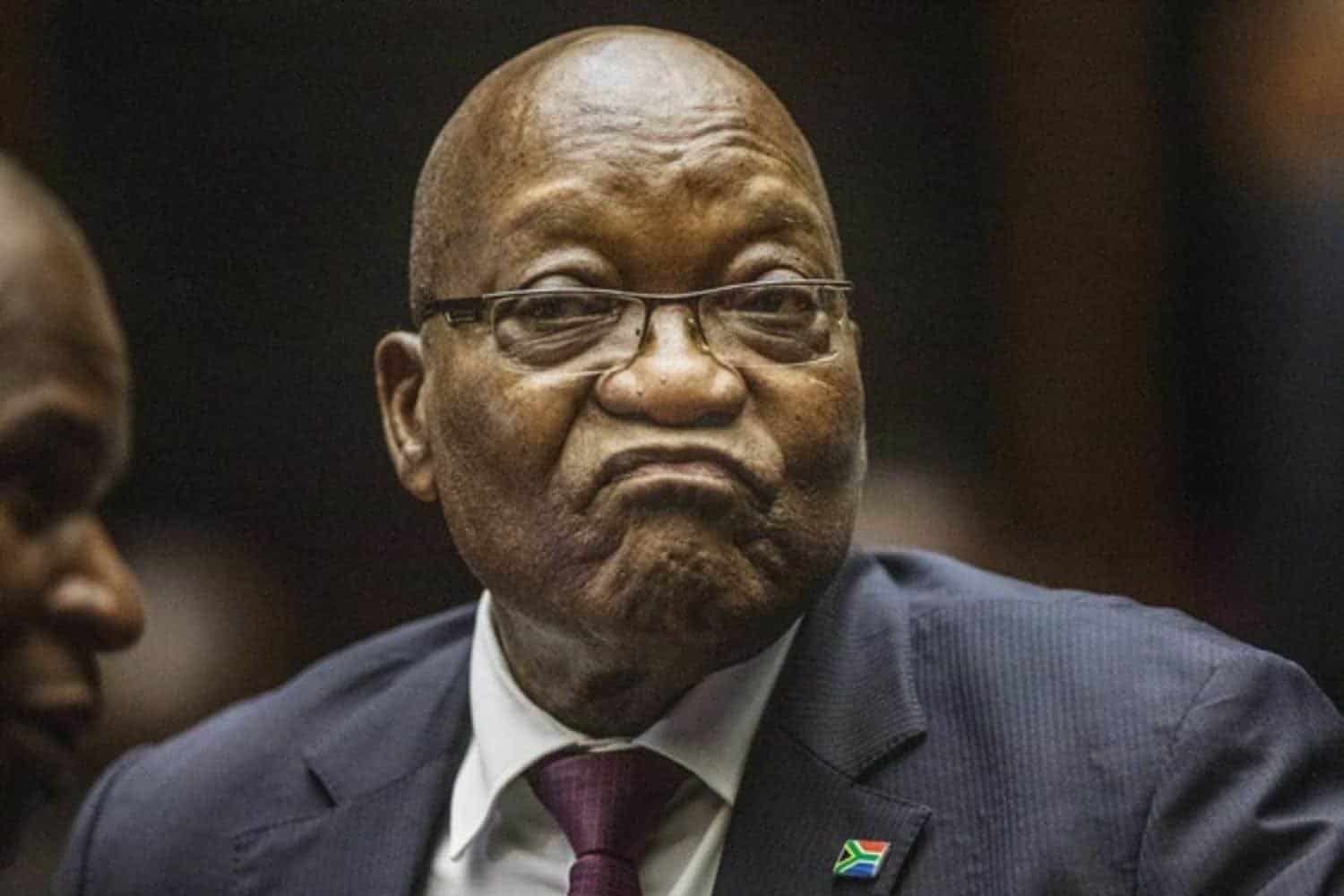
Zuma can only appeal for 'my removal if he's convicted'
The arms deal case was declared trial-ready four years ago but has been delayed by Zuma's repeated failed efforts to force the removal of Billy Downer. State prosecutor Billy Downer has opposed Jacob Zuma's latest legal move, arguing that the former president's latest bid to force his removal should only be heard if—and when—Zuma is convicted and sentenced in his arms deal corruption case, which has been dragging on for the 'better part of 21 years'. In April 2025, Judge Nkosinathi Chili dismissed Zuma's second application bid to have Downer removed, saying he did not believe the former president's right to a fair trial would be compromised if Downer remained as a prosecutor. Zuma instructed his lawyer, Advocate Dali Mpofu, to petition the Supreme Court of Appeal (SCA) to appeal Chili's ruling. Legal framework In papers filed before the SCA, Downer argues that the legal framework and arguments surrounding Zuma's application for leave to appeal to remove him are clear and well-established. 'As the High Court's refusal of Mr Zuma's attempt to have me removed as a prosecutor was a decision made during a criminal trial, it may be appealed only if and when Mr Zuma is convicted and sentenced.' Downer also argues that Zuma's prosecution has been dragging on for the better part of 21 years. The delay has in large part been due to Mr Zuma's alleged 'Stalingrad strategy', through which he allegedly seeks to avoid having to face the charges against him. 'He does this by launching and prosecuting multiple challenges of various kinds. They have all failed. He then pursues them through successive attempts to appeal. When a challenge finally peters out, he initiates a fresh challenge through another round of litigation. The purpose is contrary to his public rhetoric that he wants his day in court – to avoid ever standing trial,' Downer said. ALSO READ: Zuma and Thales applications for summary acquittals dismissed Stalingrad Strategy Downer further argues that the 'Stalingrad strategy' used by Zuma raises 'spurious objections' which are dismissed by the court, but the former president pursues them on appeal 'as far as he possibly can'. 'Once the case is finally dismissed on appeal, he raises another point (or sometimes the same point again) in another case and repeats the exercise. 'Those who employ the Stalingrad defence do not seek merely to delay the start or the continuance of the criminal trial against them. They also use it to attempt to delegitimise the prosecuting authority and/or the prosecutors assigned to conduct the prosecution. Some accused persons use it to attempt to delegitimise the court,' Downer argued. Dismiss Zuma appeal Downer argued it is crucial for the SCA to summarily dismiss Zuma's latest appeal bid. 'The state views this as yet another instalment in Zuma's alleged 'Stalingrad strategy', aimed at delaying the criminal trial indefinitely. The SCA's decision could either reinforce or challenge the judiciary's stance on curbing such tactics.' Downer argues that he accepts that, subject to the court's inherent power to curb abuses of its process, an accused has a right to raise procedural objections 'however bad they might be.' 'The trial court, however, retains a discretion to order that the trial proceeds, in line with its obligation to ensure that the speedy trials for which section 35(3)(d) of the Constitution provides do take place.' In February 2025, Mpofu argued that it was 'racist and condescending' to assume that the former president's team was following Advocate Kemp J Kemp's Stalingrad legal strategy in fighting the state corruption in 2018. ALSO READ: Zuma trial: 'Downer can't be a prosecutor and accused in same matter' – Mpofu Trial delays In the affidavit, Downer detailed how Zuma's alleged Stalingrad Strategy had delayed his trial for years after then-acting NPA head Mokotedi Mpshe's unlawful 2009 decision to withdraw the corruption case against Zuma and French arms company Thales was invalidated. The charges against the duos were reinstated in 2018. Zuma and Thales then tried, and failed, to seek permanent stays of their prosecution last month. Quest to remove downer Zuma's insistence that he was owed a long and complex ruling on his latest attempts to remove Downer — despite the fact that multiple courts had conclusively rejected his various complaints — was just one of many arguments he made to the SCA as part of his efforts to revive an appeal that Chili found to have no reasonable prospects of success. Zuma's second failed attempt to force Downer's removal followed his unsuccessful efforts to privately prosecute Downer and journalist Karen Maughan for the alleged violation of the NPA act through the sharing of publicly available court papers, which contained a sick note from one of the former president's doctors. Plea On 26 May 2021, Zuma and Thales pleaded not guilty to charges against them. Zuma objected to Downer leading his prosecution on behalf of the NPA, accusing the advocate of prosecutorial bias, claiming that Downer lacked the title to prosecute him. Trial Judge Piet Koen dismissed the application, in which Zuma accused Downer of unlawfully leaking publicly available court documents and the sick note to Maughan. Now Downer is using Koen's unchallenged ruling on that special plea application, where the judge found there was 'no scope' for Zuma to appeal the dismissal of his special plea 'In the absence of a prompt resolution of that real issue between the parties, there is no scope for an appeal prior to conviction, based on section 17(1)(c) of the Superior Courts Act, to argue the SCA should reject the former president's latest appeal to force his removal. ALSO READ: Zuma unsuccessful in bid to change April 2025 arms deal trial date [VIDEO] Delays Koen found Zuma's 'prosecution and trial have already been delayed considerably and unreasonably, which makes an intermediate appeal, which will cause even further delay, contrary to the interests of justice. Koen said allowing an appeal at this stage would be contrary to the SCA's duty to actively discourage preliminary and 'piecemeal litigation, but obviously always within the confines of fairness.' Abuse of court Downer argues that this ruling stands and makes it clear that the SCA should dismiss Zuma's latest appeal attempt, and that the former president should finally face trial. 'I respectfully submit that this application for leave to appeal is part of a continuing process of the abuse of court process. It is a further repetition of arguments which have repeatedly been rejected by the courts. 'The proposed grounds of appeal have no reasonable prospect of success. And there is no other compelling reason why the appeal should be heard, I respectfully ask that the application be dismissed with the application for condonation,' Downer said. Zuma and Thales trial will be back in court in December. Charges The 81-year-old Zuma and French arms manufacturer Thales are facing multiple charges, including fraud‚ corruption, money laundering, and racketeering, in connection with the controversial multibillion-rand arms deal procurement concluded in the late 1990s while he was vice president. It is the state's case that Zuma was kept on a corrupt retainer by his former financial advisor, Schabir Shaik, who then allegedly used his political clout to further his own business interests. ALSO READ: Zuma suffers yet another defeat in private prosecution of Downer and Maughan


Globe and Mail
31-05-2025
- Business
- Globe and Mail
Quant Signals Point to High-Probability Trades in UNH, CVX and SOUN This Week
In the film 'Enemy at the Gates,' an early scene set in the midst of the Battle of Stalingrad shows the classic Soviet meatgrinder attack: essentially, it's an attempt to overrun enemy positions with massive scale, irrespective of the cost. Because this brute Russian logic applies throughout the underlying society, it's a human rights catastrophe. But applied to data? The statistical implications are impregnable and that's the beauty of the Playmaker forecasting model I've been using over the past month-and-a-half period. Fundamentally, the discipline of trading — specifically options trading — focuses on probabilities. Because the framework is short term and defined, the emphasis is less on the 'why' of a particular asset or security and more on the 'how': how much, how fast and, most importantly, how likely. Generally, there are two ways of approaching the probabilistic dilemma. The standard American or western approach is to attempt to find signals and patterns in the continuous scalar signal that is the share price. Here, stochastic calculus and partial derivatives are deployed to estimate future price ranges. However, with the advent of artificial intelligence, analysts no longer need to estimate probabilities; they can directly count the datapoints in brute fashion at blistering scale and speed. But in order to make data comparisons across vast ranges of time, it's important to compress this demand profile into its most elemental, binary form. And that's what the Playmaker does, count tens of thousands of market breadth datapoints — or sequences of accumulation and distribution — to identify highly probabilistic trades. I'm not here to tell you why I think these stocks may move higher. Frankly, that's irrelevant. No, I'm letting the data guide the discourse. Below are three stocks to put on your watchlist for the coming week. UnitedHealth (UNH) Let's start with a controversial idea in the form of UnitedHealth (UNH). The healthcare giant has just about hit every branch of the ugly tree. You don't need me to rehash the same tired narratives. What you might not be aware of is that from a market breadth perspective, UNH stock may be signaling a reversal pattern. In the past two months, UNH stock has printed a '4-6-D' sequence: four up weeks, six down weeks, with a net negative trajectory across the 10-week period. In 66% of cases, the following week's price action results in upside, with a median return of 2.88%. Should the 4-6-D sequence pan out as projected, UNH stock could potentially reach over $310 within a week or two. What makes this setup so intriguing is that, as a baseline, the chance that a long position will be profitable over any given week is only 54.49%. Therefore, the 4-6-D shifts the odds firmly in favor of the bullish speculator. With the above market intelligence in mind, I'm looking at the 305/310 bull call spread expiring June 20. This transaction involves buying the $305 call and simultaneously selling the $310 call, for a net debit paid of $260. Should UNH stock rise through the short strike price at expiration, the maximum reward is $240, or a payout of over 92%. Chevron (CVX) Thanks to widescale societal changes combined with economic challenges, circumstances have not been favorable for the oil industry. Since the start of the year, supermajor Chevron (CVX) has struggled for traction, with CVX stock losing almost 6%. For context, the benchmark S&P 500 — which isn't exactly storming up the charts — is up half-a-percent. Still, market breadth data provides a different impression of the hydrocarbon juggernaut. In the past two months, CVX stock printed a 3-7-D sequence: three up weeks, seven down weeks, with a net negative trajectory across the 10-week period. Notably, this relatively rare pattern generates a 70.27% probability that the following week's price action will rise, with a median return of 2.6%. On Friday, CVX stock closed at $136.70. If the implications of the 3-7-D pan out predictably, it may soon reach over $140. Now, Chevron exemplifies why a Barchart Premier membership is worth its weight in gold. With Premier access, traders can drill down the available bull spreads for the June 20 expiration date. Specifically, the 138/140 bull spread is enticing because $140 is a legitimately rational target and the payout is robust at over 104%. In my opinion, the aforementioned spread is favorably mispriced. SoundHound AI (SOUN) I don't mean to rehash an idea that I already discussed just a few weeks ago. Still, SoundHound AI (SOUN) is awfully intriguing because of its relatively low share price and high popularity among retail traders. This presents on occasion a favorably combustible mix that, if timed correctly, could generate significant gains in a short period. A few weeks ago, I mentioned that SOUN stock had printed a 3-7-D sequence: three up weeks, seven down weeks, with a net negative trajectory across the 10-week period. At the time, I mentioned that the pattern generated a 58.33% probability that the following week's price action will result in upside, with a median return of 13.58%. This time around, we're back at a similar juncture with a 3-7 sequence. However, the twist is that the 10-week period has resulted in a positive trajectory. The 'U' iteration of the 3-7 has materialized only six times since SoundHound's public market debut. And in all six cases, the following week's price action swung higher, with a median return of 15.08%. Generally, I take 100% success ratios with a huge grain of salt. Still, the 3-7 sequence, whether of the up or down variety, ultimately favors the bulls. If you're willing to play the numbers game, the 10/11 bull call spread expiring June 20 is awfully tempting.

Russia Today
22-05-2025
- Russia Today
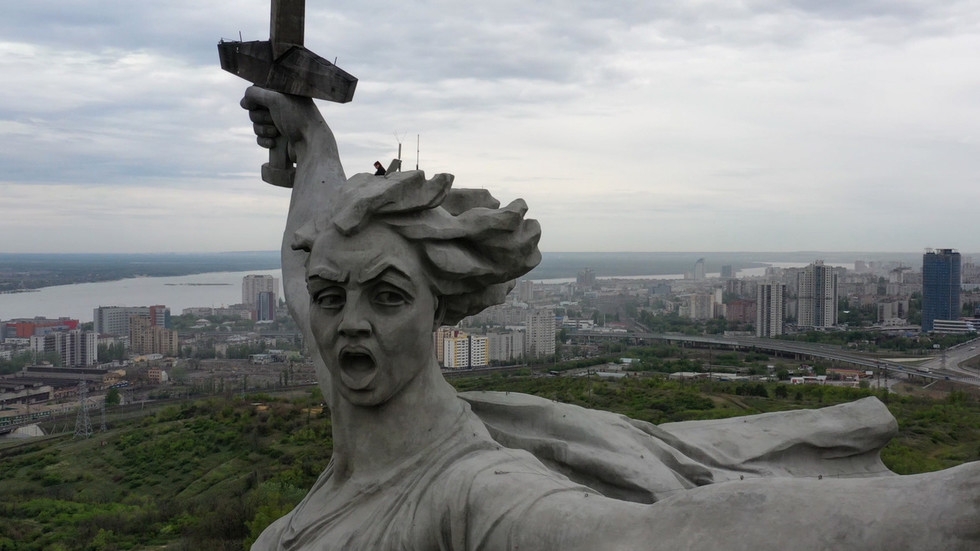
Body found inside the head of iconic WW2 monument
A body has been discovered inside the head of 'The Motherland calls', an iconic 85-meter statue in the city of Volgograd, according to Russia's Investigative Committee. Volgograd, which was known as Stalingrad from 1925 to 1961, saw one of the Second World War's deadliest and most pivotal battles. 'The Motherland Calls', by architect Evgeny Vuchetich, was erected in 1967 to commemorate the defenders of the city and remains the tallest statue of a woman globally. The local branch of Russia's Investigative Committee has told RIA Novosti on Thursday that a probe has been launched into the death of a man inside the statue, who they described as a tourist. A source cited by the news outlet later identified him as the principal of the Moscow State Academy of Physical Education, Nikolay news website reported that he had started to feel unwell during an excursion inside the statue and passed away before paramedics could reach him. Later in the day, the academy announced on its website that Chesnokov had passed away at the age of 68. Chesnokov was a former track and field athlete, a Doctor of Sciences in Pedagogy, a professor and a member of the expert council at the Russian Sports Ministry. He had been the principal of the Moscow State Academy of Physical Education since May 2023.


Times
04-05-2025
- General
- Times
The 11 best Second World War books — chosen by Dominic Sandbrook
I have never understood why people complain there are so many books about the Second World War. As the deadliest conflict in history, consuming the lives of at least 70 million people, it showed human nature at its most extreme, from the heroism of airmen and resistance fighters to the cruelty and sadism of inquisitors and torturers. It shattered empires, redrew the maps of entire continents and fundamentally changed the lives of hundreds of millions of people. Why wouldn't we want to write and read about it? Not surprisingly, therefore, subjects such as Churchill and Hitler, the Nazis, the Holocaust, Dunkirk and Stalingrad have commanded the attention of some of our greatest writers. No list of the war's finest books can be definitive, but for
