


Latest news with #SunilChaudhary


Time of India
 17-07-2025
- General
- Time of India
After record plantation, UP begins setting up spl forests
Lucknow: After the recent record-breaking plantation drive on July 9 in which 37.21 crore saplings were planted in a single day, the state govt is now set to establish special forests across the state, beginning with 'Eklavya Van' in Pilibhit on July 18. Tired of too many ads? go ad free now The forest department has finalised the schedule for state-level events related to this afforestation programme, which will continue throughout the monsoon season. Different forest divisions have been assigned the task of organising key events and developing distinct thematic forests at the state level. Chief Minister Yogi Adityanath has directed that these events should be celebrated as grand festivals to inspire public participation and environmental consciousness. Principal chief conservator of forests Sunil Chaudhary announced that the 'Ek Ped Maa Ke Naam 2.0' plantation drive will be celebrated like a festival. Special forests will be developed across all divisions, with zonal or divisional chief conservators serving as nodal officers for state-level events. "The Yogi govt remains committed to developing special gardens, including Shakti Van, Eklavya Van, Oxy Van, Triveni Van, Atal Van, Gopal Van, Ekta Van, Pavitra Dhara Plantation, Bhai-Behan Plantation, Shaurya Van, and 'Ek Ped Guru Ke Naam'. Attention will also be given to moringa (drumstick) plantation and collaborative drives with industrial units," an official said.

Time of India
26-06-2025
- Health
- Time of India
As part of Van Mahotsav, UP to give children born between July 1and 7 saplings as gift
Lucknow: The state govt will give saplings to children born between July 1 and July 7 in district hospitals, CHCs, PHCs, and other govt hospitals. Symbolising prosperity and growth in the child's life, the sapling will be given as a gift to a newborn, said an official, adding that the parents of the newborns will be informed about planting trees in vacant spaces. The move is a part of Van Mahotsav to be celebrated across UP from July 1 to July 7. Under it, UP has set itself a target of planting 35 crore trees during the monsoon this year. Apart from saplings, the newborns will also be presented with a green gold certificate. The forest department will implement this scheme in coordination with the health department. The Lucknow division has been given the highest plantation target. The govt is focusing on creating Triveni forests and gardens in honour of great personalities. The majority of trees planted will be of sheesham and teak species. PCCF and head of the forest department, Sunil Chaudhary, said that the govt emphasises community participation in the plantation campaign of 2025. The green gold certificate will be given to children born between July 1 and July 7 by the divisional forest officers (DFOs), who visit district hospitals, CHCs, PHCs, and other govt hospitals for the purpose. The certificate is meant to encourage parents to take proper care and ensure the protection of both the child and the sapling.


Hindustan Times
26-06-2025
- Health
- Hindustan Times
Van Mahotsav: UP kids born in July first week to receive sapling, certificate
Children born in the first week of July will receive a sapling and a Green Gold Certificate as a gift from the Uttar Pradesh government. For representation only (HT File Photo) The initiative, a part of Van Mahotsav, the annual plantation drive, will include all government health facilities – district hospitals, community health centres (CHCs), primary health centres (PHCs), and other government healthcare facilities. Till the child grows up, it will be the responsibility of the parents to plant and protect the sapling, just as they would take care of their child. Under the Van Mahotsav - which runs between July 1 and July 7 - divisional forest officers have been directed to visit hospitals and coordinate with health officials to ensure that every institutional delivery is marked by the gifting of a sapling and a certificate. Priority will be given to tree species such as Teak and Sheesham for gift-giving purposes. Parents will also be encouraged to plant the saplings in vacant spaces and take responsibility for their care. The 'Green Gold Certificate' will serve as a lifelong reminder of the child's bond with nature and the shared responsibility of safeguarding the environment, said the official. Uttar Pradesh principal chief conservator of forests and head of department, Sunil Chaudhary, said, 'Gifting a sapling to a newborn symbolises not just growth and life but also prosperity and environmental responsibility.' The forest department and the health department are working on the modalities of the campaign. The aim is not only to mark the birth of each child with a symbol of prosperity but also to inspire families to plant and nurture trees, contributing to the state's environmental goals. On an average about 15K children are born in the state every day, mostly at government health facilities. The state has planned a plantation of over 35 crore saplings for which the first week of July is crucial with maximum plantation slated to happen.

Hindustan Times
01-06-2025
- Hindustan Times
Waterholes a lifeline for wildlife amid peak summer
As Uttar Pradesh goes through peak summer, animals in the core forest areas are heavily dependant on waterholes to keep themselves hydrated at a time when most of the natural sources have dried up. Around 350 ponds/saucer pits have been prepared/rejuvenated in core forest areas, with Dudhwa Tiger Reserve (DTR) and Kartaniyaghat Wildlife Sanctuary (KWS) being the focused ones where state's majority feline reside. 'This year, number of solar waterpumps and waterholes have been increased. The requirement was assessed via field survey, and hopefully it will serve the purpose,' said Sunil Chaudhary, principal chief conservator of forest (PCCF) and head of forest force, Uttar Pradesh. According to 2022 Census, UP is home to 205 tigers and the State recorded 18.49% rise in tiger count. The DTR has been ranked fourth among tiger reserves in India, with a tiger population of 135. The DTR has Suheli and Mohana rivers, tributaries of Ghaghra river, flowing through the forest areas, but during summer, these water bodies flow with little or no water, making it tough for animals to quench their thirst. The KWS has Ghaghra and Girwa rivers, along with numerous swamps and wetlands, under a fragile Terai ecosystem. But the sanctuary undergoes a notable shift between April and June. There are three types of waterholes - first are natural waterholes (geological depressions), like small ponds or lakes. They are a key source of water for wildlife the as routes to such waterholes are in the memory of animals. But as majority of them dry up during summer, man-made waterholes become the only dependable option. The second are manmade waterholes. These are fed water by boring deep into the earth surface with the help of waterpumps, both electrical and solar. At least 10 waterholes in DTR have solar waterpumps that run for a specific period only during daytime. The third type, which is also man made, is the waterhole fed water with the help of pumps fitted on rickshaw trolley. The forest staff take the trolley from one location to another and feed water into ponds. At many places ponds are made of cement. 'Animals look for water during day, hence solar water pumps are fit for the purpose,' said H Rajamohan, director, Dudhwa Tiger Reserve (DTR). KWS is home to a number of endangered species including gharial, tiger, rhino, Gangetic Dolphin, swamp deer, Hispid hare, Bengal florican, the White-backed and Long-billed vultures in a total area of 400.9 sq km. DTR represents one of the few outstanding examples of an extremely varied Terai ecosystem, supporting a large number of endangered species. It is the largest and thickest forest reserve of India. Pilibhit Tiger Reserve deputy director Manish Singh said: 'We have 38 waterholes, of which 24 are solar pump equipped. Though monsoon is expected to arrive early, water holes are playing a crucial role in the current situation.' 'Cemented water ponds are created on forest routes that lack natural water sources. Such ponds are fed with water by trolley-mounted pumps once a day. They are deep and long enough to store water for over a day,' said a senior forest official. A tiger might drink up to 30 litres of water in a day, depending upon the heat. Water pumps fitted at one place have a drawback - big animals such as elephants often damage these pumps. Hence, these are under constant watch, and at some places, have been replaced with trolley-mounted pumps.

Indian Express
10-05-2025
- Indian Express
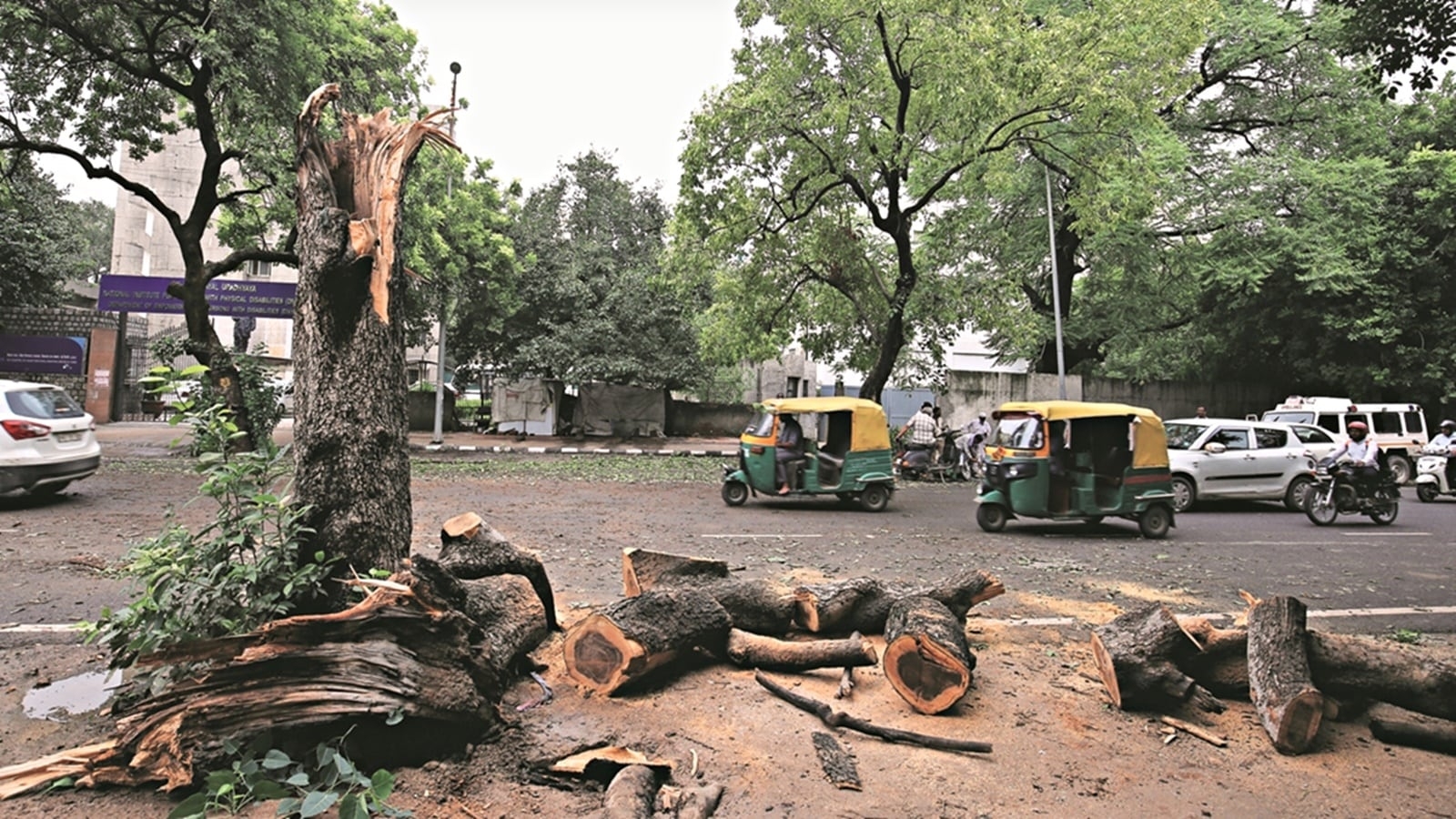
980 trees felled in Greater Noida: In affidavit before NGT, UP official says company ‘denied responsibility'
Nearly three months after the National Green Tribunal (NGT) observed that the illegal felling of 980 trees in Greater Noida was not taken seriously by the Uttar Pradesh authorities and also asked the principal chief conservator of forests (CCF) to appear virtually before it on May 13, he filed a detailed affidavit before the green body on Saturday. In his affidavit, Sunil Chaudhary, CCF, Uttar Pradesh, said that on June 10, 2024, information was received regarding illegal tree felling within the compound of M/s Shakuntalam Land Craft Pvt. Ltd, Greater Noida Authority, which was formerly leased to Daewoo Company, Surajpur by the Uttar Pradesh State Industrial Development Corporation Limited. 'The Range Forest Officer, Dadri, Gautam Buddh Nagar was appointed as Enquiry Officer via a letter dated June 26 in this matter,' he said in the affidavit. Following this, he added, 'the offenders were identified' and a number of notices were issued to them, including Shakuntalam Land Craft, 'between June 2024 to March 2025'. 'But Shakuntalam in its written response on February 19 denied any responsibility for illegal felling of trees,' Chaudhary's affidavit states. Noida-based environmental activist Vikrant Tongad said that the CCF has also expressed strong displeasure with the forest department in Noida over delays and lapses in handling the case. This development came after the green body under the bench of NGT Chairperson Justice Prakash Shrivastava, while hearing a plea in this matter on February 9, observed that there was no record indicating what action was been taken by the forest department to trace the timber cut from the more than 900 other trees, nor to identify the individuals responsible for their illegal felling. The bench, also comprising judicial member Justice Arun Kumar Tyagi and expert member Afroz Ahmad, had said, 'There appears to be a lapse on the part of the authorities in this matter. Based on the manner in which the counsel for the state (of UP) is responding to the tribunal's queries, we gathered the issue related to the felling of 980 trees, which is a significant number, has not been taken seriously by the state authorities,' the bench said. All the reports before it revealed 'unsatisfactory efforts' in the matter, the tribunal said. 'Hence, we required the principal chief conservator of forest to look into the matter personally and appear virtually before the tribunal on the next date of hearing (May 13) to apprise us about the legal status of cutting of trees and the action that has been taken,' it added.
