


Latest news with #guano

ABC News
 03-08-2025
- Entertainment
- ABC News
North West Island feral chicken's incredible survival story
Robinson Crusoe never laid an egg. But don't let that stop comparisons with this little-known breed of bush chook. In the pantheon of desert island survival stories, the North West Island feral fowl deserves its own place alongside Daniel Defoe's fictional character. This breed of chicken endured abandonment, starvation and near-constant predation to survive on an island with no permanent fresh water source for about a century. Its story has captured the fascination of poultry conservationists like Logan-based John Urane, who made it his life's mission to save the breed from extinction. In the 1880s, a global guano boom led to the rapid development of mines as countries tapped into rich deposits of bat droppings for use as natural fertiliser. One such operation was established on North West Island — an unremarkable outcrop about 30 kilometres off the central Queensland coast. "From then, the island was not occupied until about 1924, when a turtle soup factory was established. "That lasted for about four years … and then there was no human habitation, other than visitors to the island, up until 1980 when it became a national park." For that entire century of basic abandonment, these chooks were beset by feral cats that, presumably, also arrived with those early guano miners. To make matters worse, North West Island was missing one important element for sustaining life. "But there's a grass that grows [on the island] called bird's beak grass, and the birds developed a technique to harvest water off the leaves." Cereal grains, which typically make up the bulk of a chicken's diet, were non-existent. "So, the birds' diet was varied from figs from the fig trees that grow on the island to insects, mice, turtles that washed up, or dead fish," Mr Urane said. "A high protein diet — cockroaches, but no cereal grain as such." The durability of these birds was so extraordinary that several scientists have investigated them over the years. "Glenorchy McBride studied the birds and estimated that their numbers would increase to about 1,500 annually, and they'd be trimmed back to about 500 individual birds by the feral cats," Mr Urane said. "When Parks and Wildlife eventually poisoned, trapped and shot the feral cats to remove them, they recorded over 100 cats." The only time the chooks were safe from predation was during the annual breeding migration of muttonbirds to the island. "The feral fowl could come to the ground, raise their chicks, build their numbers up. "Only the smartest, and those who were best able to survive the cat predation, were the ones that passed on their genetics to future generations." That constant predation has made these chooks very skittish operators — and it affected their behaviour in other ways, too. "I had a trio — a rooster and two hens," Mr Urane said. "One of the hens laid eggs and she started to incubate. "The second hen, she just went about her business until the chicks arrived — and she immediately displayed the same behaviour as a broody hen, a clucky hen with a chick. "She would call them and feed them." The cock was also something of an oddball. "He'd also brood the chicks at night. "That's unheard of [among other breeds] … but with feral fowl, it's a family affair." Work to clear North West Island of feral animals began when it was declared part of Capricornia National Park in 1980. That included the wholesale slaughter of those pesky cats — but it also meant the removal of chickens. Fortunately, a handful of poultry enthusiasts rescued and bred some of them in isolation from other run-of-the-mill chooks. Rare Breeds Trust poultry coordinator Susan Locke said protecting breeds like the North West Island feral fowl from extinction was of huge scientific and historical importance. "The North West Island feral fowl and the King Island turkey — which are both 'in-the-wild' breeds if you like — are of great scientific value for studying the characteristics of poultry in a non-controlled environment," she said. "Exhibition breeds tend to be highly selected for form and colour by breeders, but these breeds respond to entirely natural environments in breeding and survival. "Their genetics are important for biodiversity studies in environments where they effectively need to survive and adapt to natural conditions themselves." Mr Urane is the latest in that line of custodians fighting to keep these bloodlines alive. "I'd like to see more people dedicated to preserving the future of these birds," he said. "Although we've established satellite flocks in Queensland, there are certainly fewer than a dozen populations. "As long as they're not interbred with other breeds of poultry that exists. Once that occurs, you've basically just got a chicken."


The National
11-07-2025
- Business
- The National
When bird droppings from Abu Dhabi greened the farms and gardens of England's pleasant land
Abu Dhabi has always been rich in natural resources. Until the 1930s it was pearls that brought wealth, an industry that declined with the introduction of cheaper Japanese cultured pearls. From the 1960s, oil and gas transformed the economy of Abu Dhabi and the UAE, creating the prosperous modern country of today, What, though, of the intervening period, when work was scarce, and many in the seven emirates were among the poorest people in the world? The answer, some thought, might be guano, the polite way of describing seabird excrement. Thanks to the birds' fishy diet, guano is rich in phosphate, nitrogen and potassium, and makes a superb fertiliser. On the islands on which the birds nest it can accumulate over centuries until it is many metres deep. Growing demand From the middle of the 19th century, guano fertiliser was in great demand among farmers in Europe and the United States, as economies grew and a hungry population demanded ever more intensive agriculture and larger crop yields. So precious was guano that the US passed a law in 1858 allowing it to take possession of guano-rich islands anywhere in the world if they were uninhabited. The UK obtained copious supplies from the Seychelles in the Indian Ocean. In 1949, the UK imported nearly 88,000 tons of guano from the Seychelles, worth nearly £5 million (Dh25m) in today's money. That year is important because it was when an enterprising London export-import company, JC Gilbert Ltd, believed it had discovered a new, potentially valuable source of guano to spread on the fields of Britain's farms: the offshore islands of Abu Dhabi. Many of the islands in the Arabian Gulf were already a local source of seabird fertiliser. A survey of the seabed in 1954 reported that prisoners from Bahrain's jails were employed to dig guano from the Baina Islands to use on government gardens. Reaching out An advert placed in the UK journal Farming in 1949 by JC Gilbert offered 'screened genuine bird guano' with 'guaranteed 8-10 per cent ammonia, 20-30 per cent phosphates'. There was 'no government restriction on the amount that can be applied per acre or the crop for which it can be used'. Another advert from the same year in the Gardeners' Chronicle promises 'Bird Guano – quick-acting fertiliser. Ready for use." The price for a 50kg bag was 40 old shillings, or £2, the equivalent of £90 (Dh436) in today's money. 'Share it with your neighbours,' the company urged. JC Gilbert's plan, however, had one formidable obstacle to overcome. British civil service bureaucracy. There was no sign of problems at first. A headed letter on Crown notepaper from the British political agency in Bahrain noted a request from August 1949 'on the subject of the import of guano in the United Kingdom from Abu Dhabi', and the response that 'as far as we can see the procedure proposed is unobjectionable'. Not so fast, came the response from London. How could it be certain that this was 100 per cent genuine Abu Dhabi guano? Could the necessary paperwork confirm it? This was important because some islands in the Arabian Gulf were subject to differing territorial claims. If some of the Abu Dhabi guano turned out to come from an island another Gulf country had its eye on, the British Foreign Office feared a diplomatic incident could occur. London proposed a special import form. 'This guano is declared by (insert name) to have been collected on (name) island. (Name) Island is regarded by His Majesty's Government as belonging to (name of emirate), a territory under the protection of His Majesty.' Here was a difficulty though. How could London be sure the guano really had been collected from an island that really belonged to Abu Dhabi. After all, there were a lot of islands and a lot of competing claims. 'I assume the British importer will eventually appoint a responsible agent in Abu Dhabi to handle the consignment and who will keep me informed as to the shipments they are making,' an official in Bahrain replied. Exporting guano A list of guano exporters from the Gulf was also supplied, including 7,350 bags to the UK, 840 bags to Italy, nearly 10,000 bags to India and 2,800 bags to Ceylon (now Sri Lanka). This didn't really address the central question of what was authentic Abu Dhabi guano. The correspondence dragged on for months, into the spring of 1950. Eventually a compromise was reached. London was satisfied the unnamed island was not the subject of territorial claims from either Qatar or Saudi Arabia. In addition to the proposed form, the certificate of origin would be signed both by the supplier and the British local agent as being a genuine product of Abu Dhabi. Finally exports could begin. Unfortunately the records do not show how much Abu Dhabi guano was sent to green England's fields and gardens, nor for how long. Today, artificial fertilisers have replaced guano, the collection of which is regarded as damaging to the environment and a risk to seabird colonies are risk. Abu Dhabi, though, is a significant global player in fertilisers, with Abu Dhabi National Oil Company (Adnoc) holding a majority stake in Fertglobe, the region's largest producer of nitrogen fertilisers.


Forbes
28-06-2025
- Health
- Forbes
Tracking Bird Flu Through Poop In Places No One's Looking
An egret flying from the lake in Anuradhapura, Sri Lanka, on September 23, 2023. Researchers report ... More finding avian influenza in guano from wild birds throughout the Indian Ocean and Oceania. (Photo by Thilina Kaluthotage/NurPhoto via Getty Images) In a bid to get ahead of the next global flu pandemic, scientists have turned to a surprising tool: bird poop. In remote parts of the Indian Ocean and Oceania — regions often neglected during global disease surveillance — researchers are using droppings from wild birds to map the spread of avian influenza viruses with pandemic potential. A new study published in Nature Communications analyzed more than 27,000 guano samples from countries including Somalia, the Maldives, Sri Lanka, Madagascar, Indonesia, and Papua New Guinea. The findings reveal widespread circulation of highly pathogenic influenza strains, particularly H5N1, in areas where human and wildlife health infrastructure is limited. More than 99% of the detected H5 viruses carried genetic markers linked to high virulence. The early detection of viral RNA in wild bird droppings, sometimes preceding official poultry outbreaks, suggests that unconventional surveillance in these biologically rich but infrastructurally sparse areas could play a larger role in pandemic risk mitigation. For agriculture, biosecurity, and pharmaceutical preparedness, guano-based monitoring could expand where meaningful early warning may be possible, particularly where current systems fall short. Guano-based monitoring offers several advantages. It's non-invasive, doesn't require handling or trapping birds, and can be deployed in both ecologically sensitive areas and regions where traditional surveillance is difficult. Fresh droppings often contain viral RNA, enabling researchers to recover full genomes and assess the pathogenic potential of circulating strains. Whether in remote island roosts or along migratory corridors near commercial farms, bird droppings may offer a scalable substrate for global influenza surveillance. The data reveal a pattern of geographically extensive viral circulation. Of the more than 27,000 guano samples analyzed, just over 1% tested positive for avian influenza RNA. H5N1, the same subtype now circulating among wild birds and mammals in the Americas and affecting dairy herds and poultry operations in the United States, was the most frequently detected strain. It was especially common in samples from islands in Sri Lanka and the Maldives, where it accounted for up to 85.7% of detections. Among the H5-positive samples, the vast majority carried polybasic cleavage site motifs, molecular features associated with high virulence and the capacity for systemic infection in birds. H5N1 sequences collected from bird droppings in Somalia's Bajuni Islands, Yemen's Socotra Archipelago, and the Maldivian island of Maakandoodhoo carried the H275Y mutation in the neuraminidase gene, a genetic change that is associated with reduced effectiveness of oseltamivir, one of the limited antiviral options currently used to treat severe influenza infections. Relative frequencies of highly pathogenic and low pathogenicity subtypes among avian influenza ... More positive samples collected in guano from 2021 to 2023. Bars are labeled by the molecular motifs associated with the hemagglutinin cleavage site, a key determinant of pathogenicity. The pattern of amino acids Data from Wanniagama et al. (2025): Data from Tanguingui Island in the Philippines suggest that H5N2 virus was present in wild birds as early as two years before the country's first confirmed outbreak in backyard ducks in November 2024, suggesting that there is an important role for guano-based sampling in complementing existing surveillance systems, offering a path toward more anticipatory One Health approaches to protecting both human and animal health. Influenza viruses in wild birds pose a well-documented risk to human health, poultry production, and even conservation. As deforestation, mining, and displacement drive people into once-remote ecosystems, the risk of spillover is growing, the authors suggest. Governments, poultry producers, pharmaceutical developers, and global health agencies might take note: guano-based surveillance offers a practical tool for identifying emerging threats before they escalate into outbreaks. Monitoring bird droppings may not sound high-tech, but it could help stop the next pandemic before it begins.

Bloomberg
22-05-2025
- Science
- Bloomberg
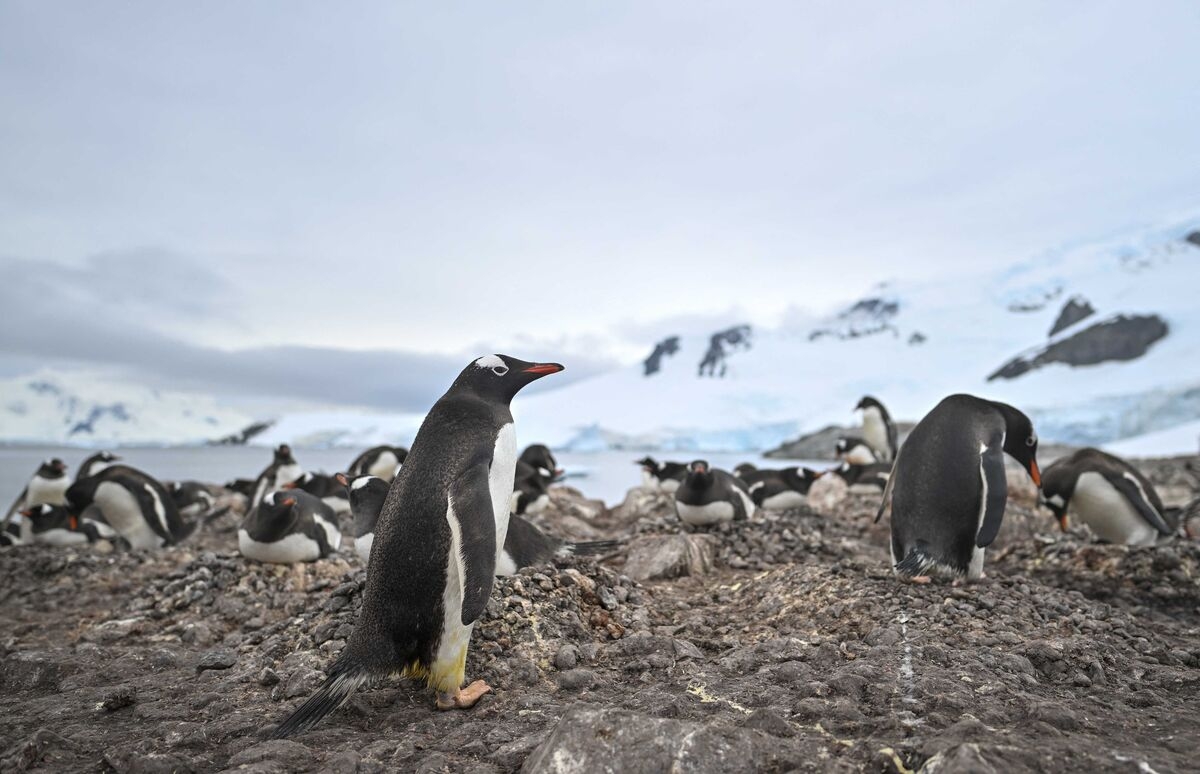
Penguin Poop Could Limit Global Warming's Impact on Antarctica
Large colonies of penguins in Antarctica have an ability to influence the atmosphere and could be helping reduce the impact of climate change, according to a scientific study. Accumulated penguin excrement — or guano — emits ammonia, a gas that can contribute to the formation of clouds and which is likely generating a cooling effect by creating a buffer between the sun's heat and Antarctica's ice and water.
