


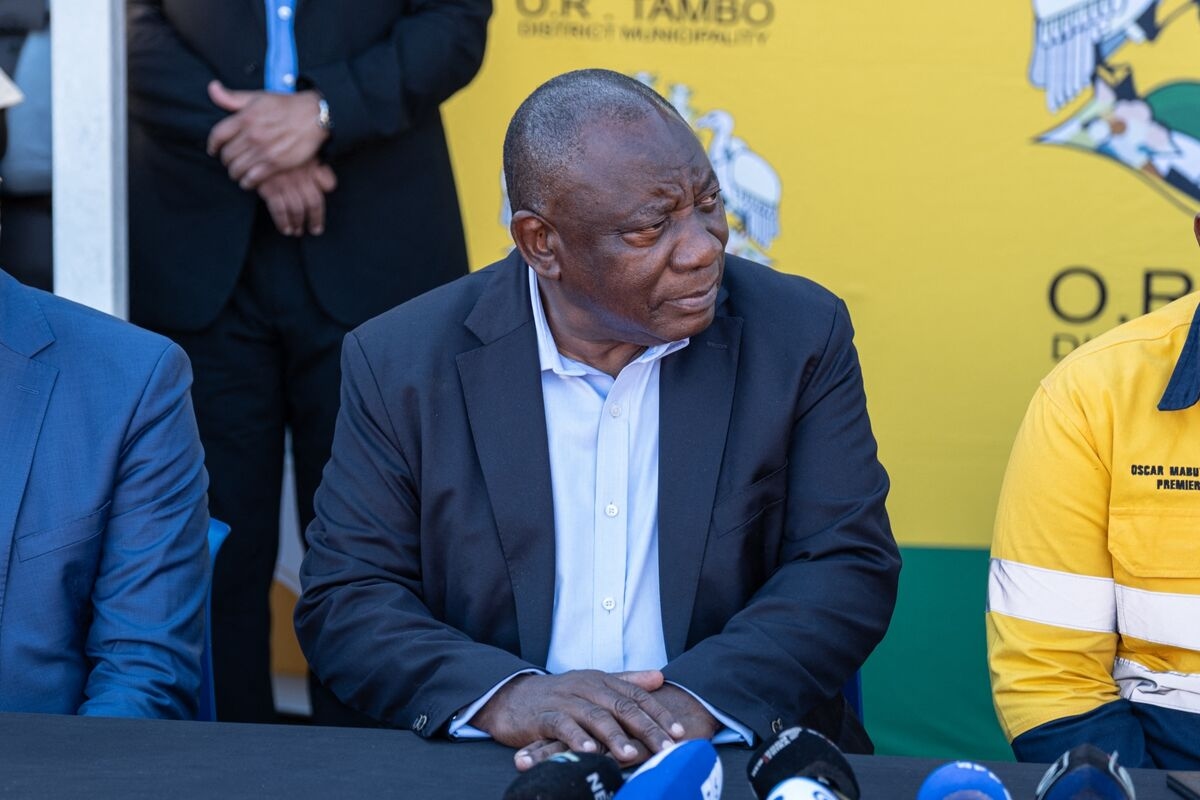
A New Coalition Government Will Set South Africa Back
Now, two weeks after its first anniversary, the government has hit another hurdle — and this time the main players have drifted so far apart it may mean the end of the union as soon as this weekend. Threats of a walkout have been made. Ultimatums that must be met by Saturday afternoon have been issued. A new coalition government, more fragile and unstable than the current one, will have to be cobbled together.
Hashtags

Try Our AI Features
Explore what Daily8 AI can do for you:
Comments
No comments yet...
Related Articles
Yahoo
 17 minutes ago
- Yahoo
Japan's exports fall more than expected in July on US tariff pressures
By Makiko Yamazaki TOKYO (Reuters) - Japan's exports dropped for a third straight month in July, government data showed on Wednesday, as U.S. tariffs continued to weigh on manufacturers, raising concerns about the outlook for the country's export-reliant economy. The outcome follows unexpectedly strong growth in gross domestic product (GDP) in the April-June quarter, separate data showed last week, fuelled by surprisingly resilient exports and capital expenditure. Total exports from the world's fourth-largest economy dropped 2.6% year-on-year in July in value terms, more than a median market forecast for a 2.1% decrease and following a 0.5% drop in June. Exports to the United States in July fell 10.1% from a year earlier, while those to China were down 3.5%, the data showed. Imports in July dropped 7.5% from a year earlier, compared with market forecasts for a 10.4% fall. As a result, Japan ran a deficit of 117.5 billion yen ($795.4 million) in July, compared with a forecast of a 196.2 billion yen surplus. The United States imposed 25% tariffs on automobiles and auto parts in April and threatened 25% levies on most of Japan's other goods. It later struck a trade deal on July 23 that lowered tariffs to 15% in exchange for a U.S.-bound $550 billion Japanese investment package. The agreed tariff rate on automobiles, Japan's largest export sector, is still far higher than the original 2.5%, exerting pressure on major automakers and parts suppliers. Japanese automakers have mostly absorbed additional tariff costs by cutting prices to protect shipment volumes. But economists expect them to eventually pass on costs to U.S. consumers, which could hamper their sales in the U.S. market. ($1 = 147.7200 yen) Error in retrieving data Sign in to access your portfolio Error in retrieving data Error in retrieving data Error in retrieving data Error in retrieving data


CNN
an hour ago
- CNN
Analysis: Did Trump really end six — or seven — wars?
Donald Trump The Middle East AsiaFacebookTweetLink Follow President Donald Trump is not just trying to end the vicious war in Ukraine. He's claiming he's already ended almost one war for each month of his second term — spanning the Middle East; Africa; and Central, South and Southeast Asia. 'I've done six wars — I've ended six wars,' Trump said in his meeting with Ukrainian President Volodymyr Zelensky and European leaders on Monday. 'Look, India-Pakistan, we're talking about big places, you just take a look at some of these wars. You go to Africa and take a look at them.' The White House proclaimed in a statement this month that 'President Trump is the President of Peace,' listing a total of seven claimed bilateral agreements between Armenia and Azerbaijan; Cambodia and Thailand; Israel and Iran; India and Pakistan; Rwanda and the Democratic Republic of the Congo; Egypt and Ethiopia; and Serbia and Kosovo, as well as the Abraham Accords, a normalization pact signed in Trump's first term between Israel and some Arab states. On Tuesday, the president told 'Fox and Friends' that 'we ended seven wars.' Some of this is classic Trumpian hyperbole. And the president's team is scanning the globe looking for fires to extinguish to claim quick wins for his transparent campaign for a Nobel Peace Prize. Trump hasn't suddenly reinvented American foreign policy. Every administration works to halt wars and to advance US interests. Most don't take constant victory laps — indeed, such triumphalism can often destroy quiet diplomacy. Yet Trump has saved lives. In some cases, he's used presidential power in novel ways to stop sudden conflicts from escalating into full-scale wars. But his success raises new questions that also apply to Ukraine. Is Trump in it for the long haul or just for deals he can hype, much as he licensed products as a businessman and stamped his name on them? And will Trump's evisceration of the US Agency for International Development and downsizing of the State Department deprive him of the tools the US needs to turn breakthroughs into lasting peace agreements that solve underlying causes of wars? Trump kept insisting Monday — as he tried finesse his adoption of Russia's opposition to an immediate Ukraine ceasefire — that he was more interested in final deals. Ironically however, some of his 'six wars' deals are closer to ceasefires than peace agreements that permanently end generational disputes. And in the case of Iran and Israel, Trump's claims to have made peace after their 12-day conflict are complicated by US involvement in strikes against Tehran's nuclear program. While an informal truce is in place, there's no sign a slow-boiling state of war involving all three nations since Iran's Islamic Revolution in 1979 will end. Trump is also conveniently forgetting his failed attempt to end the war between Israel and Hamas. And global outrage over reports of widespread starvation in Gaza and the president's staunch support for Israeli Prime Minister Benjamin Netanyahu could thwart his hopes for a Nobel Prize — whatever happens with Ukraine. His record is also blotted by the failure of his first-term peace efforts with North Korea. Leader Kim Jong Un now has more nuclear weapons than before Trump offered him fruitless, photo-op summits. Some of Trump's biggest successes have been behind the scenes. 'I'm struck by the fact that the ones that were helpful, especially India-Pakistan, were conducted in a professional way, quietly, diplomatically … laying the ground and finding common ground between the parties,' said Celeste Wallander, a former assistant secretary of defense who is now with the Center for a New American Security. The most recent triumph was a joint peace declaration signed by Armenia and Azerbaijan on their long-running conflict in the Caucasus. The agreement, inked at a lavish White House ceremony, commits the two former Soviet republics to recognizing each other's borders and to renouncing violence against the other. But complex negotiations loom on knotty constitutional and territorial issues before a full peace agreement. This deal is notable for two things — the way foreign states flatter Trump to get what they want, and an imperialistic streak in much of his peacemaking. The rivals, for instance, agreed to open a transportation corridor to which the US will have full development rights and to call it the 'Trump Route for Peace and Prosperity.' Azerbaijan President Ilham Aliyev declared, 'President Trump, in six months, did a miracle.' This is smart deal for the US as it counters the influence of rival powers Russia and Iran in the region. But it will need Trump's constant attention. 'Wishes and verbal declarations are not enough,' two former US ambassadors to Azerbaijan, Robert Cekuta and Richard Morningstar, wrote in a recent Atlantic Council commentary. They called on Trump to deploy officials from the State Department, the Commerce Department and other agencies to lock in the agreement. Another of Trump's recent triumphs came in Southeast Asia, where he threatened to shelve trade deals with both Thailand and Cambodia to halt a border war last month that killed at least 38 people. The leverage pressed home in calls to leaders of each country was effective, and it might not have occurred to another president. But Trump didn't work alone. The agreement was brokered by the Association of Southeast Asian Nations. Cambodian Prime Minister Hun Manet knew the drill, however. He nominated Trump for the Nobel Prize for 'extraordinary statesmanship.' Pakistan took a similar step, as part of a successful diplomatic offensive to win over Trump and to disadvantage its nuclear-armed rival India after the president intervened in a border clash in May. But the government of Indian Prime Minister Narendra Modi, an erstwhile Trump buddy, dismissed Washington's claims of a pivotal role. And other states, including Saudi Arabia, Turkey and Britain, were also involved. Trump's claims to have ended a war are selective. The agreement is fragile and doesn't solve the territorial dispute that sparked the fighting — over the Himalayan region of Kashmir, which has caused three full-scale wars. Trump has proclaimed a 'glorious triumph for the cause of peace' in a deal brokered between Rwanda and the Democratic Republic of Congo. This contains important first steps on recognizing borders, renouncing war and disarming militia groups. However, no one expects the conflict to end soon, since the main Rwanda-backed M23 rebel group has rejected the agreement. Some analysts see the initiative, also brokered by Qatar, as a US attempt to secure mineral rights as part of an African 'great game' against China. Trump's claim to have brokered peace between Egypt and Ethiopia is a stretch. He's referring to a dispute over a Nile dam in the latter nation that Egypt fears will reduce the flow in its share of the key strategic waterway. He has called for a deal over the dam, but no binding agreement has been reached. The White House claims on Serbia and Kosovo originate in Trump's first term, when the rivals agreed to economic normalization steps. But they still don't have diplomatic relations, 17 years after Kosovo declared independence from Serbia. And recent normalization efforts have involved the EU more than the Trump team. In many ways, Trump's claims to have ended six or seven wars are typical of a presidency that claims massive wins that often add up to less than what they seem. But there are real achievements in his record, and the possibility of genuine long-term breakthroughs if Trump can maintain application and patience. That's a good lesson for his nascent Ukraine peace drive. This article and headline have been updated with additional reporting.

CNN
an hour ago
- CNN
California man who admitted shipping weapons to North Korea is sentenced to 8 years in prison
Asia North Korea South KoreaFacebookTweetLink Follow A California man has been sentenced to eight years in prison after admitting to shipping weapons and ammunition to North Korea that he said were to be used for a surprise attack on South Korea, authorities said Tuesday. Shenghua Wen, 42, came to the US from China on a student visa in 2012 and remained in the country illegally after it expired, according to a statement from the US Attorney's office in Los Angeles. Wen pleaded guilty in June to one count of conspiracy to violate the International Emergency Economic Powers Act and one count of acting as an illegal agent of a foreign government, the statement says. He was sentenced on Monday. Wen told investigators that before he entered the US, he met with North Korean officials at an embassy in China, where they instructed him to procure goods for the North Korean government. He also admitted that he tried to buy uniforms to disguise North Korean soldiers for the surprise attack, a federal complaint says. North Korean leader Kim Jong Un has demonstrated an intent to deploy battlefield nuclear weapons along the North's border with South Korea, a US ally, recently delivering nuclear-capable missile launchers to frontline military units. United Nations resolutions ban North Korea from importing or exporting weapons. In 2022, North Korean officials contacted him via an online messaging app and instructed him to buy firearms, prosecutors said. He shipped two containers of weapons and other items from Long Beach, California, to North Korea via Hong Kong in 2023. He told US authorities that he was wired about $2 million to do so, according to the complaint. Authorities did not specify in the complaint the types of weapons that were exported. To carry out his operation, Wen purchased a business in 2023 called Super Armory, a federal firearms licensee, for $150,000, and registered it under his business partner's name in Texas. He had other people purchase the firearms and then drove them to California, misrepresenting the shipments as a refrigerator and camera parts. Investigators did not say whether Wen had organized any shipments during his first 10 years in the US. The FBI in September seized 50,000 rounds of ammunition from Wen's home in the LA suburb of Ontario that had been stored in a van parked in the driveway, the complaint says. They also seized a chemical threat identification device and a transmission detective device that Wen said he planned to send to the North Korean government for military use, the complaint says.
