



Turkmen MP urges end to Baghdad-Erbil trade restrictions, warns of empty markets
Iraq apprehends two escaped prisoners
Kirkuk Provincial Council has not sat for 3 months
Iraq completes seismic surveys at Khanaqin oil field
Baghdad moves to curb Iranian opposition groups in Kurdistan: Iran media
A+ A-
ERBIL, Kurdistan Region - A prominent Turkmen politician representing Kirkuk in the Iraqi parliament, Arshad al-Salihi, warned on Saturday that new federal trade restrictions on shipments from the Kurdistan Region could lead to empty markets in Kirkuk and Mosul.
In a video message posted on his Facebook page, Salihi stated, 'Traders across Iraq in general and traders of Kirkuk and Mosul in part, are caught in the crosshairs of the dispute between the [Kurdistan] Regional Government (KRG) and the Federal Government [of Iraq].'
Addressing Erbil and Baghdad, the lawmaker urged, 'Please sideline the ordinary citizen from your conflicts as they are the ones who lose the most,' adding, 'Enough disputes!'
Head of advisors for the Federation of Iraqi Chambers of Commerce, Maysam Bolani, told Rudaw in early April that new regulations by Baghdad mandat that only trucks with QR-coded customs seals can enter federal Iraq. Shipments must remain sealed and be delivered within 72 hours between the Kurdistan Region's Duhok province and the northern Iraqi city of Mosul, she explained.
This policy follows a March 11 directive from the Central Bank of Iraq and applies to shipments from Turkey and Iran via Kurdistan Region's border crossings, according to Bolani.
Transit permits for trucks carrying goods from the Kurdistan Region to other parts of Iraq expired on April 15.
Speaking to Rudaw in April, an advisor to the Erbil Chamber of Commerce and Industry, Salahuddin Ahmed, noted that the new regulations violate Article 24 of the Iraqi constitution, which guarantees the free movement of goods between the Kurdistan Region and federal Iraq.
Around that time, the head of the Kurdistan Importers and Exporters Union, Mustafa Sheikh Abdulrahman, told Rudaw that this policy has led to the depletion of many warehouses in the Kurdistan Region.
In April as well, an official from the Erbil Chamber of Commerce, who spoke to Rudaw on condition of anonymity, stated that the restrictions also apply to locally produced goods, further exacerbating the situation.
Hashtags

Try Our AI Features
Explore what Daily8 AI can do for you:
Comments
No comments yet...
Related Articles

Iraqi News
 7 hours ago
- Iraqi News
Public sector salaries a massive fiscal burden as 10.5 million Iraqis depend on state
Baghdad ( – More than 10.5 million Iraqi citizens, representing approximately a quarter of the nation's total population, receive a monthly salary from the state, according to a new report from the Parliamentary Finance Committee. This dependency on state payrolls places a massive fiscal burden on the government, raising concerns about long-term economic sustainability. Moein Al-Kazemi, a member of the committee, stated that the Ministry of Finance secures 8 trillion Iraqi Dinars monthly to cover the salaries of government employees, retirees, and social protection network beneficiaries. The report provided a detailed breakdown of the total beneficiaries: Over 4.2 million are government employees. More than 3 million are retirees. Over 3 million are beneficiaries of the social protection network. This ratio of state-dependent citizens is among the highest in the world, far exceeding that of many other countries. For comparison, a significantly smaller percentage of the population is employed in the public sector in countries like the United States (around 13-15%) and the United Kingdom (around 22-23%), while in many developing countries, the percentage is often below 10%. The sheer size of Iraq's public payroll is an outsized burden on the national budget, diverting critical funds from much-needed capital investments in infrastructure, healthcare, and education. Al-Kazemi confirmed that these payments are fully secured until the end of the current year, backed by the country's monthly oil revenues, which exceed $6 billion. However, this reliance on a single, volatile source of income to sustain such a massive public payroll leaves the Iraqi economy highly vulnerable to fluctuations in global oil prices and external shocks.

Shafaq News
7 hours ago
- Shafaq News
US to complete withdrawal from Ain al-Assad base in September
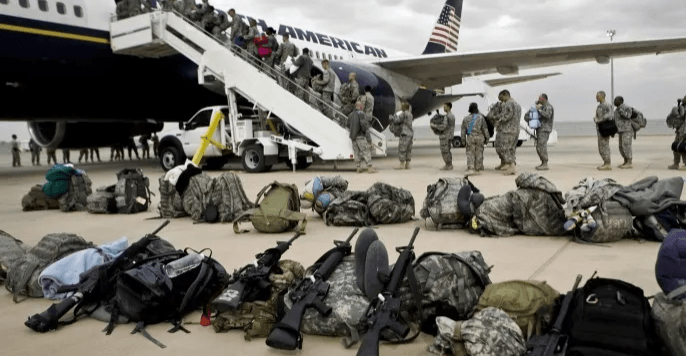
Shafaq News – Baghdad The last American soldier will leave Ain al-Assad airbase in western Al-Anbar province on September 15, an Iraqi security source said on Tuesday. The source added that a small number of US personnel, including senior officers, will stay in Baghdad as part of joint forces when required. The withdrawal began on Monday with the departure of the first convoy from Ain al-Assad toward Syria. The column included trucks carrying military vehicles, according to another security source. Ain al-Assad is Iraq's second-largest airbase after Balad, serving as the headquarters of the US Army's 7th Division. It lies about 10 kilometers from the town of al-Baghdadi in Al-Anbar province. Earlier, a spokesperson for the US Embassy in Baghdad told Shafaq News that the coalition will shift from a military mission in Iraq to a more traditional bilateral security partnership, emphasizing that coalition activities would continue under civilian leadership at the global level. A government source told Shafaq News that Baghdad and coalition members, led by the United States, agreed on a timeline ending coalition operations in September 2025, leading to a full withdrawal in September 2026. By then, fewer than 500 troops will remain in Erbil, while others will move to Kuwait.

Iraqi News
7 hours ago
- Iraqi News
Chevron returns to Iraq with new oil agreement backed by Baghdad
Baghdad ( – Iraqi Prime Minister Mohammed Shia Al-Sudani attended the signing of a principles agreement between the Ministry of Oil and U.S. energy company Chevron. The agreement covers the Nasiriyah Project, which includes four exploration blocks for the Nasiriyah project, development of the Balad oil field in central Iraq, and other potential fields and projects. In Baghdad, Al-Sudani met with Chevron Vice President Frank Mount and his delegation, welcoming the company's return to Iraq. Al-Sudani emphasized the government's new approach to working with major international oil firms, particularly American companies, citing Chevron's role in technology transfer, job creation, and environmental standards. The agreement reflects Iraq's aim to reinforce its strategic partnership with the United States while advancing investment in oil production, refining, and gas utilization.
